
Last updated: September 20, 2026
Quick Answer: Trending Christian responses to true crime obsession acknowledge that the genre’s pull is real and not always sinful, but they warn that binge-consumption of graphic crime content can dull spiritual sensitivity, feed anxiety, and treat real victims as entertainment. Clean psychological thrillers offer a genuine alternative: the same tension and moral stakes, without the voyeurism or the spiritual cost.
Key Takeaways
- Christian ethicists and commentators broadly agree that some true crime engagement is understandable, but obsession crosses into spiritually harmful territory
- The genre’s appeal is rooted in real psychological needs, justice, pattern recognition, safety, not moral failure
- Graphic true crime content has been linked to increased anxiety, disrupted sleep, and what researchers call “moral disengagement”
- The Bible does not forbid engaging with dark themes, but Philippians 4:8 provides a practical filter for what we consume habitually
- Clean psychological thrillers address the same human questions, who did this, why, and what does it cost, without graphic violence, profanity, or voyeuristic detail
- Faith-rooted suspense fiction like The Gathering Light series handles moral complexity honestly while keeping the content contract intact
- Christian leaders in 2026 are increasingly distinguishing between discernment and avoidance, the goal is not to stop thinking about evil, but to engage it without being shaped by it
- Breaking a true crime habit is less about willpower and more about replacing the underlying need with something that meets it better
Why Are Christians Drawn to True Crime Podcasts and Shows?
Christians are drawn to true crime for the same reasons everyone else is, and a few reasons that are specifically faith-shaped. The genre speaks directly to the human need for justice, the desire to understand evil, and the instinct to protect people we love.
From a faith perspective, true crime also touches something deeply theological: the reality that evil exists, that it has a face, and that it demands a response. Christianity has never been a tradition that looks away from darkness. The psalms name suffering plainly. The prophets catalogued injustice in detail. The cross is not a sanitized image.
What makes true crime compelling for Christian audiences in particular:
- The justice instinct. Believers who hold that God is a God of justice feel that pull acutely when they hear about crimes that went unpunished or victims who were ignored.
- The pattern-recognition drive. True crime rewards the same analytical attention that Bible study rewards, close reading of evidence, motive, and consequence.
- Community and conversation. Podcasts like the growing wave of Christian-adjacent true crime formats (several launched in late 2025 and into 2026) have built communities where people process grief, outrage, and hope together.
- The “it could happen to me” awareness. Particularly for women, true crime functions as a kind of safety education, however imperfect.
Christian commentators note that none of these motivations are inherently sinful [4]. The question is what happens when the engagement becomes habitual, graphic, and consuming.
Is Watching True Crime Bad for Your Spiritual Health?
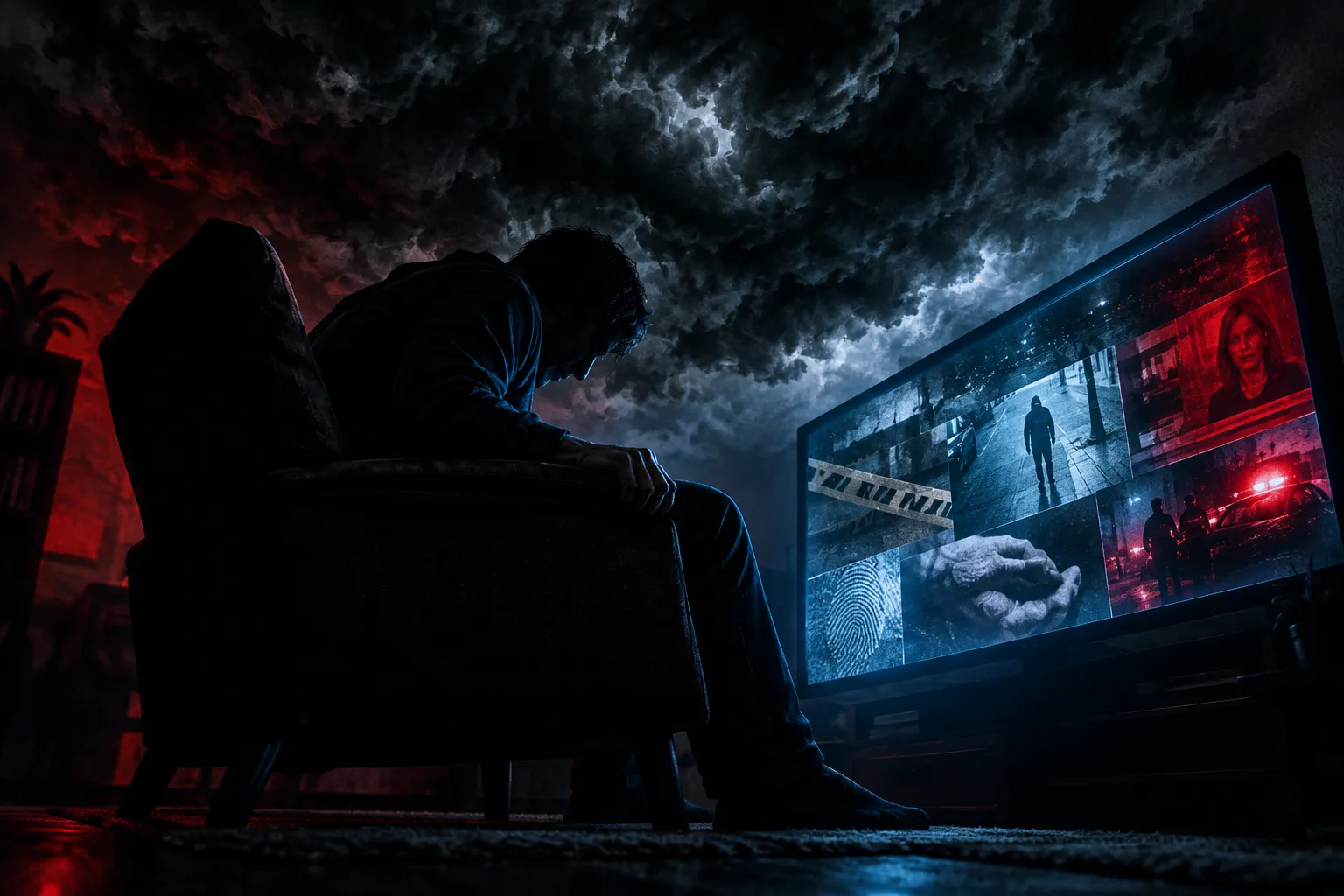
It depends on what you’re watching, how much, and what it’s doing to you. Occasional engagement with thoughtful true crime content is different from nightly binge-watching graphic re-enactments of Ted Bundy’s crimes or spending hours inside the forensic details of John Wayne Gacy’s case.
Christian ethicists have raised several specific concerns [3]:
- Spiritual numbness. Regular exposure to graphic violence, even presented as journalism, can gradually reduce a person’s capacity for moral outrage. What once disturbed begins to entertain.
- Voyeurism. When the victim’s suffering becomes the product being consumed, something has shifted from justice-seeking to spectacle. Christianity.com describes this as the line where engagement becomes exploitation [3].
- Obsession as idolatry. Christianity.com specifically names the risk of true crime obsession becoming a form of idolatry, when a habit consumes time, attention, and emotional energy that crowds out prayer, Scripture, and genuine community [4].
- Fear without faith. Conservative Christian commentators have noted that heavy true crime consumption can produce a distorted worldview, one where danger is everywhere and trust is impossible, which is the opposite of the “peace that passes understanding” Paul describes [10].
The honest answer: true crime is not automatically bad for your spiritual health. But the version most people are actually consuming, graphic, detailed, victim-focused, and designed for binge-watching, carries real spiritual risk.
What Does the Bible Say About Consuming Violent Media?
The Bible doesn’t name podcasts or streaming services, but it does speak directly to what we allow to shape our minds. The most cited passage in this conversation is Philippians 4:8: “Whatever is true, whatever is honorable, whatever is just, whatever is pure, whatever is lovely, whatever is commendable, if there is any excellence, if there is anything worthy of praise, think about these things.”
This is not a command to avoid all darkness. It’s a command about what we dwell on. The distinction matters.
What the biblical framework suggests:
- Engaging with evil in order to understand it, grieve it, or seek justice for it is different from consuming it for entertainment
- Romans 12:21 (“Do not be overcome by evil, but overcome evil with good”) implies active engagement, not passive avoidance
- Proverbs 4:23 (“Guard your heart, for everything you do flows from it”) speaks to the cumulative effect of what we repeatedly take in
The Catholic perspective, articulated by Our Sunday Visitor, frames it well: the goal is to “approach the evil” in true crime content “with Christ’s heart”, which means with grief, with justice-seeking, and without voyeuristic pleasure [7]. That’s a useful filter for any Christian trying to discern whether their true crime habit is spiritually sound.
How Much True Crime Is Too Much for Mental Health?
Mental health researchers (independent of faith frameworks) have documented consistent patterns in heavy true crime consumers: elevated anxiety, disrupted sleep, and what psychologists call “mean world syndrome”, an overestimation of danger in everyday life.
For Christians, the mental health question and the spiritual health question are the same question. A habit that produces chronic fear, disturbed sleep, and a distorted view of the world is not a neutral habit.
Practical warning signs that consumption has become harmful:
- You feel anxious or unsafe in ordinary situations after watching/listening
- You’re losing sleep because of content you consumed before bed
- You feel compelled to keep listening even when you don’t enjoy it
- The suffering of victims has started to feel abstract or entertaining rather than grievous
- Your prayer life or Scripture time has been displaced by podcast hours
Axis, a youth discipleship organization, frames the discernment question for teens and parents this way: ask not just “is this content bad?” but “what is this content doing to me?” [5] That question applies equally to adults.
Can You Be a Christian and Enjoy True Crime Content?
Yes, with discernment. The Christian conversation in 2026 has largely moved past the binary of “true crime is fine” versus “true crime is sinful.” The more useful question is whether a specific piece of content treats victims with dignity, serves a legitimate purpose (justice, awareness, grief), and leaves the viewer more compassionate rather than more numb [2].
Relevant Magazine has argued that true crime content can actually matter to Christians precisely because it forces engagement with injustice, but that the genre’s worst impulses (graphic detail, perpetrator glorification, victim-as-spectacle framing) undermine that potential [1].
Choose to engage if:
- The content centers victim dignity and community impact
- It serves awareness, advocacy, or grief rather than entertainment
- You can stop watching without compulsion
Step back if:
- The content is graphic for its own sake
- You’re consuming it out of habit rather than intention
- It’s producing fear, numbness, or spiritual disconnection
What Christian Leaders Say About True Crime Media Consumption
Christian leaders in 2026 are not uniformly opposed to true crime, but they are increasingly specific about what makes engagement spiritually responsible. Several key voices:
- Christianity.com distinguishes between consuming true crime with a justice-seeking heart versus consuming it as entertainment that treats evil as spectacle [3][4]
- Axis (youth discipleship) recommends a discernment framework: ask what the content is for, who benefits from its production, and what it’s producing in the viewer [5]
- Our Sunday Visitor (Catholic perspective) suggests approaching true crime content “with Christ’s heart”, meaning with active moral engagement, not passive consumption [7]
- Relevant Magazine has published multiple pieces arguing that the true crime genre’s popularity is a cultural signal Christians should pay attention to, not dismiss, but that the response should be discernment, not binge-watching [1][2][6]
- The Denison Forum has explored the “Investigating Christianity” angle, the idea that the same analytical instincts true crime rewards can be redirected toward faith questions [9]
The emerging consensus: true crime is a cultural moment worth engaging, but the way most people engage it is spiritually costly.
The Difference Between True Crime and Psychological Thriller Fiction
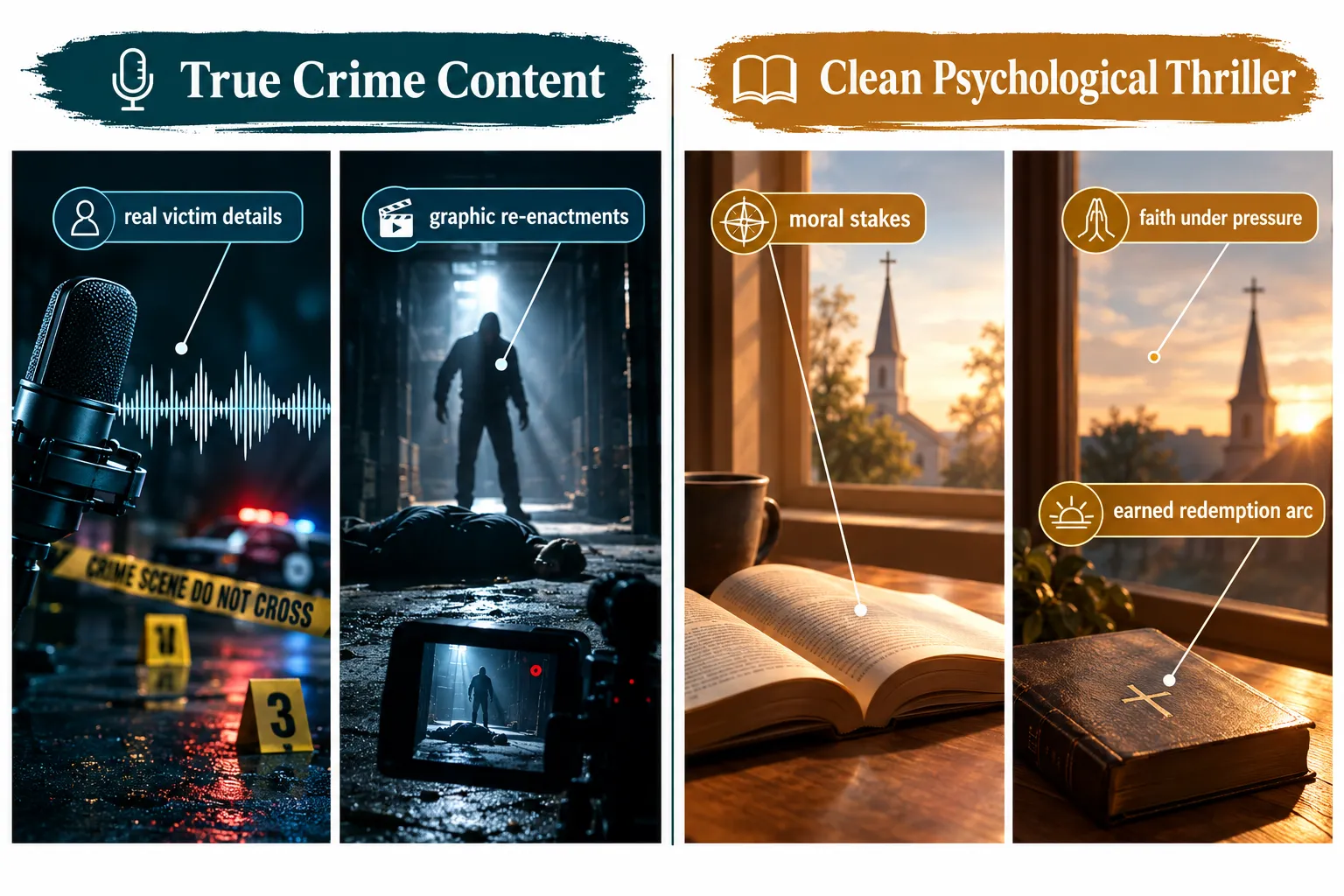
True crime and psychological thrillers both involve crime, moral stakes, and the question of who did what and why. The difference is structural, not superficial.
| True Crime | Clean Psychological Thriller | |
|---|---|---|
| Subject | Real victims, real perpetrators | Fictional characters |
| Purpose | Documentation, entertainment | Story, moral exploration |
| Content | Often graphic, forensic detail | Controlled by author’s choices |
| Victim treatment | Variable, often voyeuristic | Dignified within the narrative |
| Resolution | Often absent or unsatisfying | Shaped by authorial intent |
| Faith dimension | Rarely present | Can be load-bearing |
The key distinction for Christian readers: in a psychological thriller, the author controls what you see and why. Graphic content is a choice, not a requirement. A skilled author can create genuine tension, moral complexity, and real stakes without re-enacting suffering for its own sake.
That’s exactly what clean Christian psychological thrillers are built to do, and why they’re a structurally better fit for readers who want the engagement without the spiritual cost.
Why Do People Get Addicted to True Crime Stories?
The addiction pattern in true crime is well-documented and has nothing to do with moral weakness. It’s rooted in how the brain processes unresolved narratives.
The psychological mechanics:
- Zeigarnik effect: The brain fixates on unfinished stories. Cold cases and unsolved crimes are neurologically compelling because they never close.
- Dopamine and resolution: Each new detail, each episode, each theory creates a small dopamine loop, the same mechanism behind any binge-worthy content.
- Safety simulation: For many women especially, true crime functions as a kind of mental rehearsal for danger, a way of feeling prepared.
- Moral processing: Humans are wired to work through questions of justice and evil. True crime gives that processing a concrete object.
None of these drives are sinful. But they can be met by content that doesn’t carry the spiritual and psychological costs of graphic true crime. A well-crafted psychological thriller activates every one of these mechanisms, the unresolved tension, the moral stakes, the pattern-recognition reward, without the forensic detail or the real victims.
Does Consuming True Crime Affect Anxiety and Sleep?
Yes, and the effect is well-established enough that it’s worth taking seriously. Heavy true crime consumption, particularly before bed, is consistently associated with elevated anxiety, nightmares, and hypervigilance in everyday settings.
The mechanism is straightforward: the brain doesn’t fully distinguish between threat information encountered in a documentary and threat information encountered in real life. Repeated exposure to graphic crime content trains the threat-detection system to stay active.
For Christians, this matters because chronic anxiety is not a neutral spiritual state. It crowds out the kind of quiet attentiveness that prayer and Scripture require. A habit that reliably disrupts sleep and elevates fear is worth examining honestly, not with guilt, but with the same practical wisdom you’d apply to anything else that was affecting your health.
How to Break a True Crime Obsession Habit
Breaking a true crime habit works better as a replacement strategy than a deprivation strategy. The underlying needs, tension, moral engagement, pattern resolution, community, are legitimate. The goal is to meet them with content that doesn’t carry the same costs.
Practical steps:
- Name what you’re actually getting from it. Justice? Anxiety relief? Community? Identifying the real need makes replacement easier.
- Replace the format, not just the content. If you listen to true crime podcasts while driving, find a faith-rooted fiction podcast or audiobook for that slot.
- Start with cozy mystery before moving to thriller. The Mercy House Mysteries series, set in Juniper Gap, Tennessee, gives you the puzzle-solving satisfaction and small-town moral stakes without graphic content. Christian cozy mystery vs. true crime is a useful comparison for readers making this transition.
- Move toward psychological thriller when you want more tension. The Gathering Light series, starting with When Hannah Sleeps, handles institutional manipulation, identity, and moral pressure with real stakes and no graphic content.
- Don’t white-knuckle it. If you slip back into a true crime binge, the goal isn’t perfect abstinence, it’s gradual reorientation of what you reach for first.
Best Clean Psychological Thrillers for Christian Families
Clean psychological thrillers for Christian readers are not a compromise, they’re a distinct genre with its own strengths. The best ones carry genuine tension, morally complex characters, and faith that shows up in choices rather than speeches.
Starting points for Christian readers new to the genre:
- The Gathering Light series (Silas Bellhaven), Three standalone psychological thrillers set at a Christian retreat center where testimony records are being weaponized. Each book follows a different woman navigating institutional manipulation and the question of who controls someone’s truth. No graphic violence, no profanity. Starts with When Hannah Sleeps.
- The Mercy House Mysteries (Silas Bellhaven), Cozy mystery set in Juniper Gap, Tennessee. Lower tension than full psychological thriller, but genuine stakes and a protagonist who finds bodies where she expected to find donations.
- For readers who want to understand what makes faith the engine of suspense rather than decoration, this piece on psychological thrillers with purpose is worth reading before choosing a series.
For readers coming from secular psychological thrillers and wondering how the clean version holds up, Christian psychological thrillers that don’t rely on graphic violence makes the case directly.
Christian Alternatives to True Crime Entertainment
The goal isn’t to find something that feels like a lesser version of true crime. It’s to find content that meets the same genuine needs, moral engagement, tension, justice, resolution, with a different set of costs and a different kind of payoff.
By format:
- Podcast: Look for faith-rooted storytelling podcasts, church history series, or apologetics content that rewards the same analytical attention true crime does. The Denison Forum’s “Investigating Christianity” series [9] is one example of content that channels the investigative instinct toward faith questions.
- Fiction (cozy mystery): Lower stakes, community-centered, puzzle-focused. The Mercy House Mysteries series is a natural entry point.
- Fiction (psychological thriller): Higher tension, moral complexity, identity under pressure. The Gathering Light series handles this without graphic content.
- Fiction (western suspense): The Mercy Line series operates on moral stakes and frontier justice, a different register than psychological thriller, but the same commitment to earned grace over cheap resolution.
For a broader reading list across genres, clean Christian fiction recommendations for 2026 covers mystery, thriller, fantasy, and western in one place.
Conclusion: Hope in the Dark, Without the Damage
The trending Christian response to true crime obsession in 2026 is not “stop watching.” It’s something harder and more honest: pay attention to what it’s doing to you.
The pull toward true crime is not a character flaw. It’s a response to real human needs, for justice, for understanding, for the sense that evil has a shape and a consequence. Those needs are worth honoring. The question is whether the content you’re consuming to meet them is leaving you more compassionate or more numb, more grounded in faith or more driven by fear.
Clean psychological thrillers, the kind rooted in faith, built on earned grace, and written with genuine stakes, can meet those needs without the spiritual and psychological cost. They can hold hope in the dark without pretending the dark isn’t real. They can ask hard questions about evil, identity, and justice without treating victims as spectacle.
That’s not a compromise. That’s a better story.
Actionable next steps:
- Take one week off from your usual true crime content and replace it with a cozy mystery or psychological thriller, start with A Donation to Die For (cozy) or When Hannah Sleeps (psychological thriller)
- Use the Philippians 4:8 filter on your current media diet, not as a guilt exercise, but as a practical audit
- If you’re a Kindle Unlimited subscriber, explore the full Silas Bellhaven catalog, psychological thriller, cozy mystery, western, and fantasy, all under one faith-rooted identity
- Read how to find clean Christian fiction across every genre for a practical guide to building a reading list that holds real stakes without graphic content
Frequently Asked Questions
Is it a sin for a Christian to watch true crime? No, engaging with true crime is not automatically sinful. The concern is habitual consumption of graphic content that produces spiritual numbness, fear, or voyeurism rather than justice-seeking or compassion.
What does Philippians 4:8 say about true crime? Philippians 4:8 instructs believers to dwell on what is true, honorable, just, pure, and commendable. It’s not a ban on engaging with darkness, it’s a filter for what we habitually think about. Graphic true crime consumed for entertainment is harder to square with that standard than content consumed with a justice-seeking heart.
Why do women especially love true crime? Research consistently shows women are the primary true crime audience. The most cited reasons: safety awareness (mental rehearsal for danger), justice instinct, and community. None of these motivations are problematic, the question is whether the specific content being consumed serves them well.
What is a clean psychological thriller? A clean psychological thriller is a suspense novel or story that creates genuine tension and moral complexity without graphic violence, profanity, or explicit content. The stakes are real; the content contract is intact.
How is The Gathering Light series different from true crime? The Gathering Light series (starting with When Hannah Sleeps) is fiction, the characters, crimes, and institutions are invented. The author controls what the reader sees and why. The tension comes from psychological pressure, institutional manipulation, and identity under fire, not from forensic detail or real victims.
Can psychological thrillers have real faith content without being preachy? Yes. The best faith-rooted thrillers let faith show up in character choices and consequences rather than narration or dialogue. The question “what will you do with the truth once you’re holding it?” is a theological question, it doesn’t need to be labeled as one to do its work.
What’s the difference between a cozy mystery and a psychological thriller? Cozy mysteries are lower-tension, community-centered, and puzzle-focused, the violence typically happens off-page. Psychological thrillers carry higher stakes, deeper moral complexity, and more sustained tension. Both can be clean; they serve different reader moods.
How do I know if my true crime habit has become spiritually harmful? If it’s disrupting your sleep, producing chronic anxiety, crowding out prayer or Scripture time, or making you feel compelled to keep consuming even when you don’t enjoy it, those are practical signs worth taking seriously.
Are there Christian true crime podcasts? Several have launched in 2025-2026 that approach crime from a faith perspective, including formats focused on church scandal and abuse. These tend to be more victim-centered and less graphic than mainstream true crime. The Denison Forum’s “Investigating Christianity” series channels investigative instincts toward faith questions rather than crime.
What’s the best first book for a true crime fan trying clean Christian fiction? Start with A Donation to Die For (Mercy House Mysteries, Book 1) if you want a lighter entry point, or When Hannah Sleeps (The Gathering Light, Book 1) if you want the full psychological thriller experience, both are available on Kindle Unlimited.
References
[1] Why True Crime Shows Should Matter Christians – https://relevantmagazine.com/culture/why-true-crime-shows-should-matter-christians/
[2] Why True Crime Culture Has Christians Asking The Wrong Questions – https://relevantmagazine.com/culture/why-true-crime-culture-has-christians-asking-the-wrong-questions/
[3] Is It Ok For Christians To Watch Violent True Crime Documentaries – https://www.christianity.com/wiki/current-events/is-it-ok-for-christians-to-watch-violent-true-crime-documentaries.html
[4] Can Christians Like True Crime – https://www.christianity.com/wiki/christian-life/can-christians-like-true-crime.html
[5] The Truth Of True Crime – https://axis.org/blog/the-truth-of-true-crime/
[6] The Case For Not Watching True Crime Documentaries – https://relevantmagazine.com/culture/the-case-for-not-watching-true-crime-documentaries/
[7] How To Approach The Evil In True Crime Podcasts – https://www.oursundayvisitor.com/how-to-approach-the-evil-in-true-crime-podcasts/
[9] Investigating Christianity – https://www.denisonforum.org/podcasts/faith-and-clarity/investigating-christianity/
[10] Why Our Obsession With True Crime Isnt As Dark As You Think – https://www.theblaze.com/shows/relatable/why-our-obsession-with-true-crime-isnt-as-dark-as-you-think