Last updated: October 4, 2026
Quick Answer
The best Christian epic fantasy alternatives to Game of Thrones deliver the same engine, contested thrones, scheming courts, ensemble casts, generational family wreckage, without explicit sexual content or lingering cruelty. For the closest court maneuvering, read Megan Whalen Turner’s The Queen’s Thief. For church-and-crown politics with a Christian worldview, read Patrick W. Carr’s The Staff and the Sword. For the widest epic scale, Brandon Sanderson’s The Stormlight Archive. For prophecy woven into war, Katherine Briggs’s The Eternity Gate. None are interchangeable, and that’s the point.
Key Takeaways
- Political intrigue doesn’t require graphic content. Betrayal, succession law, and forged records generate tension on their own [10].
- Start with Carr’s A Cast of Stones if you want a succession crisis plus institutional religion handled from inside a Christian worldview.
- Choose The Queen’s Thief for tight court strategy and unreliable narration; content reviewers rate the series mild, with violence but no sex or profanity.
- Choose The Stormlight Archive for Westeros-sized scope, oaths, guilt, and leadership under pressure, mainstream, not Christian, so check content guides.
- Christian fiction and “fantasy with Christian values” are different products. One names God; the other echoes Him.
- Avoid the usual GoT read-alike lists if content matters, Abercrombie, Hobb, and Druon are recommended for political cynicism, not clean reading [1][5].
- Preachiness is a craft failure, not a genre feature. The fix is consequence, not sermon.
- Specialist presses like Enclave are where adult Christian epic fantasy actually lives.
What makes a fantasy series Christian and epic at the same time
A fantasy series is both Christian and epic when its moral framework assumes a real moral order, covenant, mercy, judgment, consequence, and its plot operates at the scale of nations, dynasties, and long time. The faith is structural, not decorative.
Epic fantasy needs four things: scope, stakes beyond one life, a world with its own history, and multiple viewpoint characters whose choices collide. Christian epic fantasy adds a fifth: the story behaves as though sin costs something and grace is expensive. Mercy that arrives free, early, and without wreckage reads false in any genre.
Decision rule: if a book’s faith content could be deleted without changing a single plot outcome, it isn’t Christian epic fantasy. It’s epic fantasy with a devotional foreword.
Common mistake: assuming “Christian” means the author must invent a church. Some of the strongest work builds its theology into how magic, prophecy, or prayer actually functions in the world, an approach explored in depth in this guide to faith-integrated magic systems in Christian epic fantasy.
Best Christian epic fantasy alternatives to Game of Thrones: clean political intrigue compared
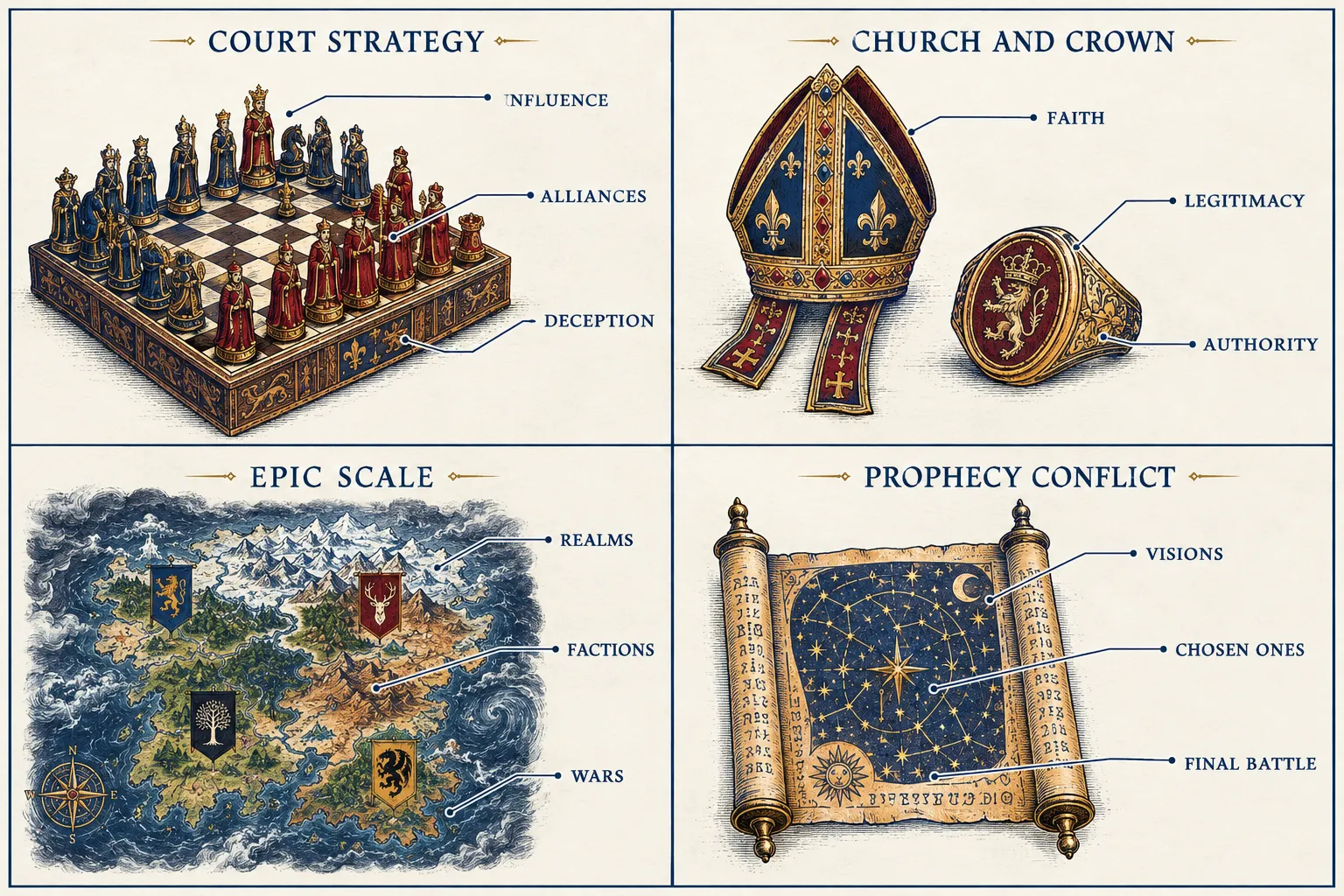
Here’s the honest comparison. Four books, four different jobs.
| Series | Closest GoT element | Worldview | Best for |
|---|---|---|---|
| The Staff and the Sword (Patrick W. Carr) | Succession crisis + church politics | Explicitly Christian | Readers wanting crown and clergy in conflict |
| The Queen’s Thief (Megan Whalen Turner) | Court strategy, reversals, unreliable narrators | Values-compatible, not explicit | Readers who love being outsmarted |
| The Stormlight Archive (Brandon Sanderson) | Vast scale, ensemble POVs, warring houses | Mainstream, ethically serious | Readers who want 1,000-page immersion |
| The Eternity Gate (Katherine Briggs) | Continent-wide war, prophecy, betrayal | Explicitly Christian, allegorical | Readers who want theology in the plot engine |
Carr’s A Cast of Stones drops an untrained protagonist into a kingdom facing a kingless throne, a church with its own agenda, and reform factions circling. That’s the Westeros structure with the theology left in.
Turner’s series is the leanest. Greek-inspired, compact, and devastating in its misdirection. A content review rates the series mild, violence present, no sex, no profanity.
Sanderson earns his place on scale alone: more than 10 million copies sold across the Stormlight books, per his publisher. He asks whether broken people can be trusted with power, which is a more interesting question than who wins.
The Game of Thrones ache isn’t bloodshed. It’s watching a family inherit a decision no one alive agreed to.
Best fantasy books with political intrigue without graphic content
Yes, political-intrigue fantasy exists without explicit material, and some of it is sharper precisely because the threat stays verbal. Genre roundups consistently place court-maneuvering fantasy as its own subcategory, separate from grimdark [10].
What to look for:
- Conflict carried by documents, wills, charters, surveys, claims. Paper is terrifying when it’s lawful and wrong.
- Information asymmetry rather than body count. Who knows what, and when.
- Institutional antagonists. A council is scarier than a villain because it can’t be killed.
- Consequence memory. Book three should still be paying for book one.
Edge case: “clean” is not a certified standard. A book with no sexual content can still carry battlefield horror or disturbing imagery. Readers who care about this should check individual content guides and learn to filter clean reads inside Kindle Unlimited rather than trusting a category label.
Christian fantasy series with complex characters and moral dilemmas
Complex characters come from competing goods, not from shock. A steward who must choose between an unjust lawful order and an unlawful act of mercy is more interesting than any antihero with a body count.
Three dilemma structures that work in faith-rooted fantasy:
- Mercy versus justice. Forgive the man who burned the village, and the widows pay for it.
- Truth versus loyalty. Testify against your own house, or let a record stand that damns someone innocent.
- Obedience versus conscience. Follow the seal, or answer to something higher than the seal.
The Sarel Chronicles runs on the third. In Sarel, silver roads mark the prayers the Maker-Who-Hears has answered, all certified, all kept by the House of Witness. The Map of Unanswered Prayers begins when a black road appears on a disgraced map-scribe’s skin, belonging to a boy the House refused to record. That’s an institution deciding whose suffering counts.
The Kethara Chronicles poses the same problem through empire and audit: The Stone That Remembered opens with a buried witness-stone surfacing under a ritual court, bearing a mark no empire can explain.
How does The Silmarillion compare to Game of Thrones for Christian readers
The Silmarillion is the better theological read and the harder entry point. Tolkien gives you creation, rebellion, oath-binding, and dynastic ruin across thousands of years, but delivered as mythic chronicle, not scene-by-scene drama.
Choose The Silmarillion if you want kinslaying, curses, and the long cost of a vow, and you don’t need close third-person POV or dialogue-driven scenes.
Skip it if what you loved about Game of Thrones was the room, two people talking, one of them lying. Tolkien rarely puts you in the room.
What it does better than almost anything: it treats pride as a dynastic inheritance. The Oath of Fëanor poisons three generations. That’s succession horror with a moral spine, which is exactly what readers seeking deep faith themes without heavy-handed allegory are usually after.
Fantasy books about dynasties and power struggles for faith-based audiences
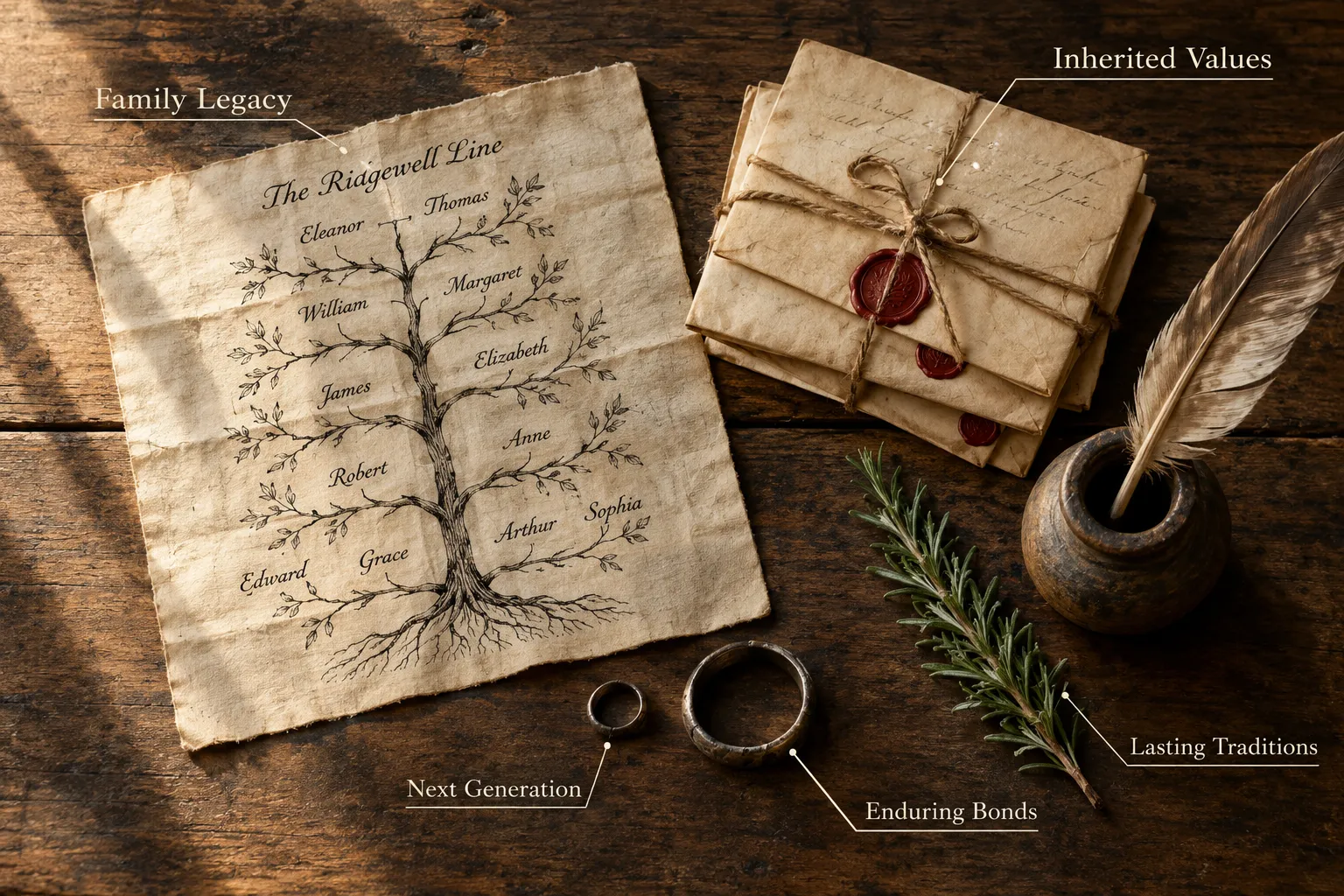
Dynastic fantasy works for faith-based readers when inheritance is treated as a moral burden rather than a prize. The question shifts from “who takes the throne” to “what did the throne already cost, and who’s still paying.”
Strong picks by priority:
- Church and crown entangled: The Staff and the Sword
- Succession by deception: The Queen’s Thief
- Highland covenant versus imperial audit: The Kethara Chronicles, where two women carry a covenant word the auditors can’t own
- Prophecy as political weapon: The Eternity Gate
- Family saga for all ages: The Wingfeather Saga, now an animated series distributed by Angel Studios with more than a million copies sold
Which fantasy series have strong family dynamics and succession themes? Wingfeather is the clearest answer for household reading, three siblings, a hidden lineage, a mother and grandfather who refuse to lie about what it will cost. For adults, Carr and Turner both build plots where a family’s claim is the whole conflict.
Is The Wheel of Time appropriate for Christian readers
The Wheel of Time is generally manageable for adult Christian readers, with caveats. Robert Jordan’s content stays mostly non-explicit, but the series includes sensuality, implied sexual content, torture sequences, and a cosmology built on cyclical reincarnation rather than linear redemption.
Use this test:
- Comfortable with Eastern-flavored metaphysics as worldbuilding? The series reads fine as fiction.
- Need a story whose moral universe matches your own? The wheel-turning framework will grate, because nothing is finally resolved, it only comes around again.
- Sensitive to sensuality or long scenes of cruelty? Several mid-series books will be a problem.
It belongs in the honest-alternatives column, not the faith-aligned column. Same goes for most of the standard GoT read-alike lists: Joe Abercrombie, Robin Hobb, and Maurice Druon get recommended for dynastic scheming and political cynicism [1][5], and they deliver, but their appeal runs on compromised protagonists and a world where mercy is naïveté.
Christian fantasy alternatives that aren’t preachy or heavy-handed
Preachiness isn’t caused by faith content. It’s caused by an author resolving a moral question for the reader instead of letting the plot cost someone something. Andrew Peterson described writing Wingfeather as telling the best story he could without shoe-horning a lesson in, which is why his publisher could market it beyond the Christian shelf.
Warning signs you’re holding a sermon with a sword on the cover:
- A character explains the theme out loud in the last chapter
- Conversion arrives dramatically and fixes the plot problem
- Scripture appears as argument-ending proof rather than as something a person reaches for in the dark
- The faithful characters are never wrong
Warning signs you’re holding good fiction:
- Someone prays and nothing visible changes, and they keep going
- The right choice makes everything worse before it makes anything better
- Doubt gets real lines, not straw-man lines
What’s the difference between Christian fiction and fantasy with Christian values? Christian fiction names God inside the story’s own terms, covenant, providence, grace as a real force. Fantasy with Christian values keeps the moral architecture (sacrifice matters, pride destroys, mercy is costly) without naming its source. Lewis wrote both. Readers who want the first should look to specialist presses like Enclave; readers happy with the second have the whole mainstream shelf.
Best epic fantasy for readers who want moral clarity and redemption arcs
For moral clarity plus earned redemption, Sanderson and Carr are the two safest bets, and the Measured Debt books are built on the same principle in a different register.
Moral clarity doesn’t mean simplicity. It means the story knows the difference between mercy and excuse. The Cost of Being Chosen runs that idea through a record system: Eamon Kersey keeps walking out of collapses that kill other men, and the position series eventually asks why. Progression there is moral as well as mechanical, the structure is unpacked further in this piece on progression fantasy with real stakes.
Fantasy series with intricate plots and multiple perspectives like Game of Thrones: Stormlight for breadth, Queen’s Thief for precision, Staff and the Sword for faith-forward POV rotation. If multi-POV sprawl is the draw, start with Sanderson and accept the page count.
Can you recommend fantasy with political intrigue that’s not dark or violent
Yes, but expect less violent rather than non-violent. Thrones are contested by force in nearly every secondary world worth reading.
Lowest-intensity options, roughly ascending:
- The Wingfeather Saga, peril, humor, family, no grimness
- The Queen’s Thief, violence present, brief, consequential; no sex or profanity
- The Staff and the Sword, battle and danger, redemptive frame
- The Eternity Gate, war and betrayal at continental scale
- The Stormlight Archive, sustained warfare, trauma, heavy themes
Clean doesn’t mean soft. Christian fiction readers borrow these books in volume precisely because the restraint makes the stakes land, a pattern examined in why clean Christian fiction outsells graphic alternatives. Readers also keep an eye on seasonal release trackers, Christian fantasy continues to publish steadily, with multiple 2026 titles listed through specialist trackers [7] and new-release roundups [3].
FAQ
What is the single best Christian alternative to Game of Thrones? Patrick W. Carr’s A Cast of Stones, book one of The Staff and the Sword. It’s the closest match for succession crisis plus church politics inside a Christian worldview.
Is there a Christian epic fantasy TV series like Game of Thrones? No adult equivalent exists. The Wingfeather Saga is the most prominent Christian fantasy adaptation, and it’s animated family content, not prestige adult drama.
Does clean epic fantasy mean no violence? No. Clean generally means no explicit sexual content, no profanity, and no graphic or lingering cruelty. Battle, danger, and death still appear.
Is Brandon Sanderson Christian fiction? No. Sanderson writes mainstream epic fantasy with serious ethical weight, oaths, guilt, sacrifice, leadership, which makes it compatible for many readers, not faith-based.
Where do adult Christian epic fantasy books get published? Largely through specialist presses such as Enclave Publishing and independent authors, rather than major trade imprints.
Are the standard “books like Game of Thrones” lists safe for Christian readers? Usually not. Those lists lean on Abercrombie, Hobb, and Druon for political cynicism [1][5], which is the opposite of a redemptive frame.
What should I read if I want court intrigue but hate long series? The Queen’s Thief. Compact books, Greek-inspired setting, and the sharpest strategic deception in clean fantasy.
Can Christian fantasy have morally gray characters? Yes, and the strongest work does. Gray characters are the point, the difference is that the story treats their choices as having real weight rather than treating morality as arbitrary.
Conclusion
Start with one book, not a stack. If court strategy is the itch, read The Queen’s Thief. If you want crown versus clergy with theology intact, read A Cast of Stones. If you want to disappear into a continent for a month, open The Way of Kings. And if what you actually missed from Westeros was the sensation of a record deciding someone’s fate, the Sarel and Kethara books were built on that exact nerve, a certified map, a buried stone, an empire that wants every act of mercy counted.
Three next steps: pick your priority (intrigue, scale, or worldview), check one content guide before you commit, and note which element made you keep reading. That’s your real preference, and it’ll steer every recommendation after this one.
Grace in these stories never arrives cheap. It shows up late, after cost, which is the only way it means anything.
References
[1] Books Like Game Of Thrones – https://www.wetherid.com/en/books-like-game-of-thrones.html [3] Christian Fiction New Releases January 2026 – https://www.narelleatkins.com/christian-fiction-new-releases-january-2026/ [5] Books Like Game Of Thrones – https://www.panmacmillan.com/blogs/fiction/books-like-game-of-thrones [7] Christian Fantasy – https://www.risingshadow.net/new-book-releases/christian-fantasy [10] Best Fantasy Books With Political Intrigue – https://fantasybookcompass.com/articles/best-fantasy-books-with-political-intrigue/