Last updated: October 26, 2026
Quick Answer
The best Christian historical romance books about grief, loss, and second chances treat bereavement as an ongoing condition, not a tidy backstory, and they let love arrive after cost, not instead of it. Start with Tracie Peterson and Kimberley Woodhouse’s A Constant Love (Bethany House, March 2025) for guilt and survivor’s grief handled honestly, then Peterson’s Faithful of Heart, set in 1870 Minneapolis, for a slow-burn widow’s story. For stronger period research and award-recognized craft, read Tamera Alexander. Most titles in this category run 300-400 pages and are available on Kindle Unlimited.
Key Takeaways
- Grief-centered Christian historical romance differs from general inspirational romance by making loss the actual engine of the plot, not a sad detail in chapter one.
- A Constant Love by Tracie Peterson and Kimberley Woodhouse is the clearest benchmark title: disaster, guilt, withdrawal, then slow healing.
- Tracie Peterson has written more than 110 books, most of them historical, making her the safest entry point for new readers.
- Tamera Alexander holds four Christy Awards, three Carol Awards, and two RITA Awards, a reliable quality marker for period accuracy.
- Widow and widower romances are a distinct subcategory; look for “second chance,” “mending,” and “beloved” in titles [1].
- Nearly all books in this genre end hopefully, though a few close on bittersweet reconciliation rather than a wedding.
- Non-religious readers generally enjoy these books fine when faith is shown through choice rather than sermon.
- Most are available through Kindle Unlimited, Amazon, Christianbook, and library apps like Libby.
What’s the difference between Christian historical romance and regular historical romance?
Christian historical romance keeps the courtship clean and makes faith load-bearing in the characters’ decisions; general historical romance usually includes explicit content and treats religion as period set dressing.
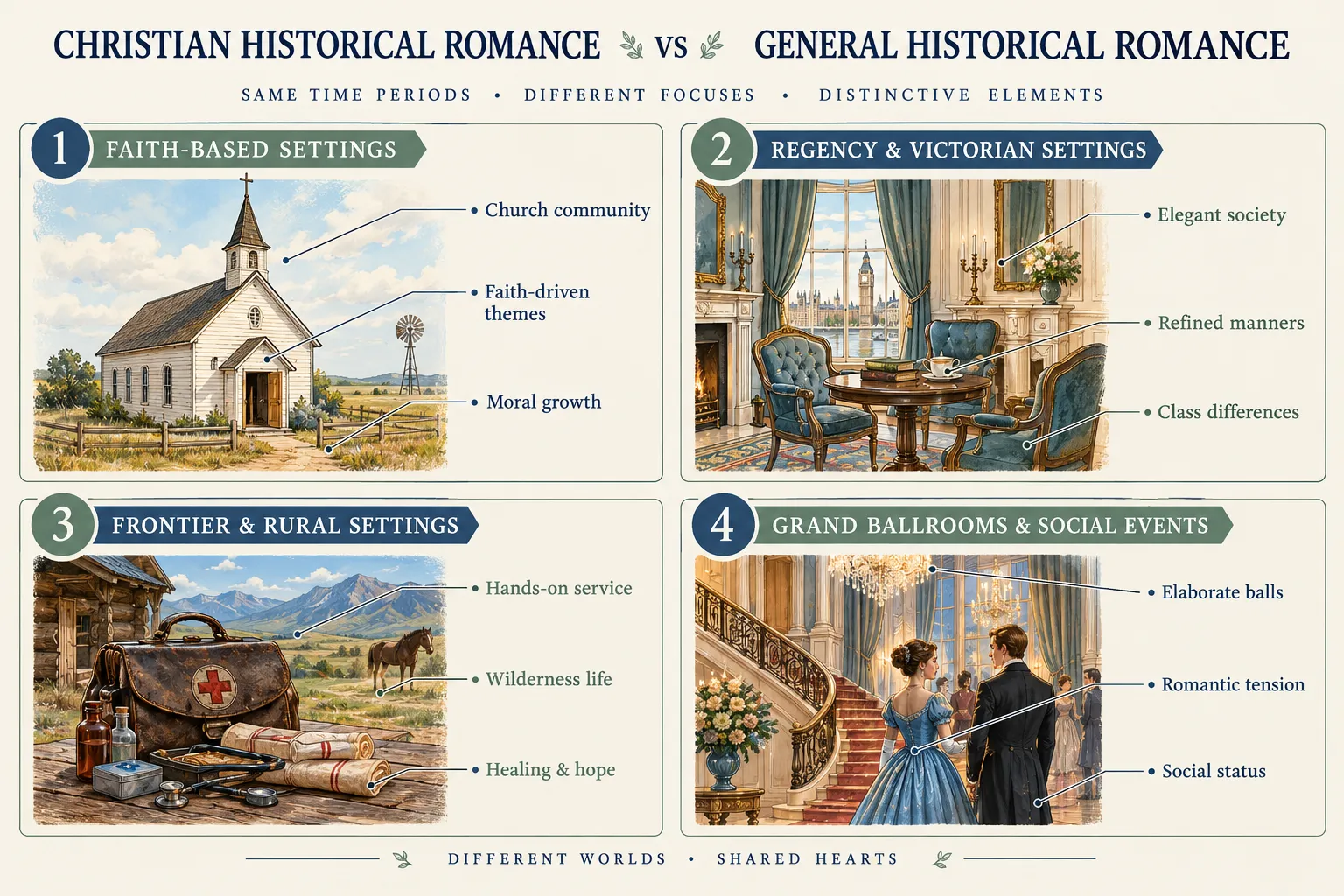
The practical differences readers notice first:
| Element | Christian historical romance | General historical romance |
|---|---|---|
| Physical intimacy | Closed door or absent | Often explicit |
| Faith | Shapes choices and consequences | Background detail |
| Grief resolution | Worked through, often with prayer and community | Resolved by the relationship alone |
| Language | No profanity | Varies |
| Ending | Hopeful, usually marriage or betrothal | Varies by subgenre |
Decision rule: if you want the period detail and the longing but not the bedroom scenes, the Christian shelf is where you belong. Readers who also want tension woven in can look at Christian historical romance with suspense across eras.
Common mistake: assuming “clean” means “low stakes.” The strongest books in this category are brutal about what loss costs, they just refuse to be graphic about it.
Christian historical romance vs. inspirational romance, what’s the difference?
“Inspirational romance” is the retail category label; “Christian historical romance” is the subgenre inside it. Inspirational covers contemporary, suspense, Amish, and historical. Christian historical romance is specifically period-set, frontier, Regency, Civil War, Victorian.
In practice, publishers and bookstores use the terms almost interchangeably, and Amazon files both under Historical Christian Romance [1]. The difference matters mostly when you’re searching: “inspirational” pulls contemporary results you may not want.
Best Christian historical romance authors who write about grief and loss
Four names carry the most weight for grief-centered period romance, and each handles bereavement differently.
- Tracie Peterson, ECPA, CBA, and USA Today bestselling author of more than 110 books, mostly historical. Her strength is sustained emotional patience rather than dramatic reversal.
- Kimberley Woodhouse, frequent Peterson co-author; brings disaster-history settings and survivor psychology.
- Tamera Alexander, four Christy Awards, three Carol Awards, two RITA Awards, and a 2020 Christy Award Hall of Fame induction. Deepest historical research of the group.
- Kathleen Rouser, smaller catalog, but Wounds and Rescues (October 6, 2026) pairs a nurse with a wounded heart and a former lawman haunted by loss [2].
Choose Peterson if you want warmth and slow-burn comfort. Choose Alexander if you want moral complication and verifiable period texture.
Best Christian historical romance that doesn’t shy away from real grief
A Constant Love by Tracie Peterson and Kimberley Woodhouse (Bethany House, March 4, 2025) is the standout. Micah Hamilton and Charlotte Aldrich lose loved ones in a disaster and carry it differently, he withdraws from society, she carries guilt, and the book treats grief as an ongoing condition rather than a plot device.
Other titles that refuse to rush the sorrow:
- Sparks of Hope by Avrie Swan (September 1, 2026), a woman rebuilding after the Peshtigo Fire meets a grieving father searching for hope. The historical disaster gives the loss-and-reconstruction arc unusual clarity [2].
- Faithful of Heart by Tracie Peterson, 1870 Minneapolis. Judith Stanford has lost her husband and her entire family. She serves widows and orphans; Dr. Roman Turner enters slowly. Forgiveness, repentance, and second-chance love move at a realistic pace [3].
- The Ballerina’s Bargain by Lorri Dudley (September 8, 2026), London, 1815. Emmeline Laurent survives her parents’ execution and learns to live unnoticed. More concealed trauma than bereavement, but emotionally honest [4].
Grace that arrives before the cost has been paid isn’t grace. It’s a shortcut. The books worth your evening know the difference.
Christian historical romance books for widows or widowers finding love again
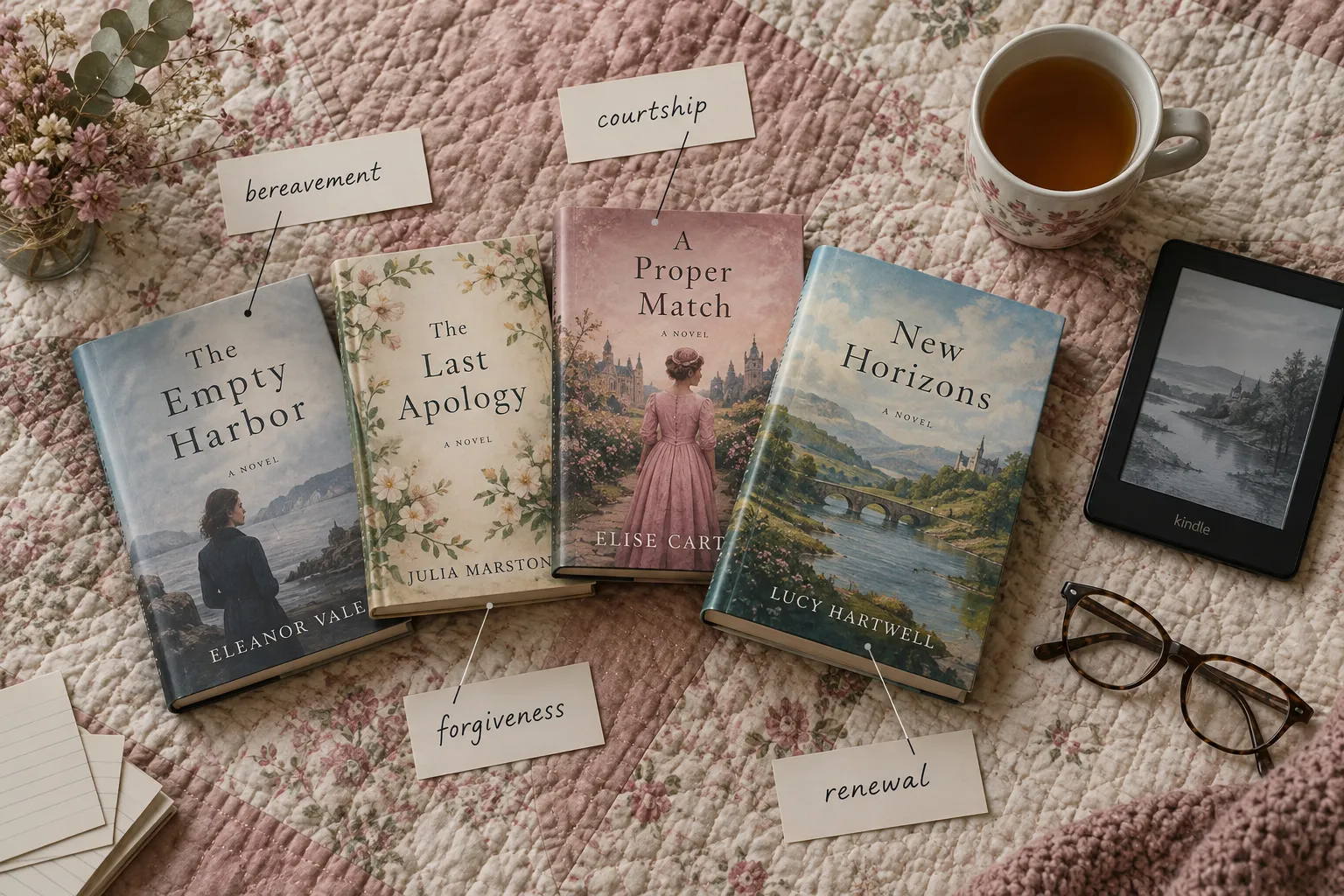
Widow and widower stories are the core of this category, because period settings made early death ordinary, childbirth, war, fire, fever. Faithful of Heart and A Constant Love are the two strongest starting points.
Retailer listings show steady demand for the theme: Amazon’s late-2026 historical Christian romance charts included Lauralyn Keller’s The Teacher’s Mending Heart and The Reverend’s Second Chance, both branded directly around renewal and restored love [1][5].
Edge case: some “second chance” titles mean reunited first love, not love after bereavement. Read the blurb for a death or a departure before you commit.
How do I find Christian romance with authentic second-chance love stories?
Read the first two pages and the last chapter heading. Authentic second-chance stories name the specific loss early and don’t resolve it with a single conversation.
A quick screening checklist:
- Does the blurb name the loss? Vague “painful past” phrasing often means the grief is decorative.
- Is there a cost in the middle? Look for reviews mentioning a hard decision, not just misunderstandings.
- Does faith appear as a struggle? Characters who doubt and then choose read truer than characters who recite.
- Check review language. Readers who write “I cried but it earned it” are telling you something useful.
- Sample the prose. Overwrought description in chapter one usually means thin emotion in chapter twenty.
Are Christian historical romance books preachy or actually entertaining?
The good ones are genuinely entertaining; the weak ones stall for a sermon. The dividing line is whether faith shows up in a character’s choice or in a character’s speech.
Watch for these signals before buying:
- Preachy: a secondary character explains the theme out loud; a conversion solves the conflict; scripture arrives as a bandage.
- Entertaining: faith costs someone something; prayer goes unanswered for a while; the hardest choice is between two goods.
Authors and readers both wrestle with this balance, more on it in how Christian authors keep story first while exploring spiritual themes.
Christian historical romance, if I’m new to the genre, where do I start?
Start with a single standalone from an established author before committing to a long series. A three-book on-ramp:
- A Constant Love (Peterson & Woodhouse, 2025), frontier-era, grief-forward, strong craft.
- Faithful of Heart (Peterson), 1870 Minneapolis widow’s story, slow-burn, gentle [3].
- In These Hills (Tamera Alexander, 2026), Lynchburg, Tennessee; a woman fleeing a deadly secret and a man bound by family loyalty. Choose this if you prefer moral conflict over pure bereavement.
If you discover you like the period atmosphere more than the romance itself, the books like Louis L’Amour for Christian fiction readers guide points toward frontier stories with the courtship dialed down.
Where can I buy or download Christian historical romance ebooks?
Amazon Kindle carries the deepest selection, and most new releases in this category enroll in Kindle Unlimited, which means borrowing is free with a subscription [1][5]. Other reliable sources: Christianbook, Barnes & Noble, Kobo, Apple Books, and your library through Libby or Hoopla.
Budget tip: publishers like Bethany House and Barbour run frequent $1.99,$3.99 ebook sales on backlist grief-and-renewal titles. If you borrow heavily, see what Kindle Unlimited borrow trends reveal about faith-friendly reading habits, or browse the Kindle Unlimited Christian books collection.
Do all Christian historical romances have happy endings?
Nearly all of them do. The genre convention is a hopeful close, usually an engagement, wedding, or committed reunion, and most publishers treat it as a requirement, not a preference.
The variation is in how hopeful. Some grief-centered titles end on reconciliation and renewed purpose rather than a proposal, and a few let a secondary character’s loss stay unresolved. That’s usually a sign of a stronger book, not a weaker one.
Can I enjoy Christian historical romance if I’m not religious?
Yes, provided the author shows faith instead of explaining it. Readers who enjoy period drama, closed-door romance, and family saga often read this shelf happily without sharing the beliefs.
Choose carefully if you dislike prayer scenes or church settings entirely, those are structural here, not optional. You’ll likely be fine if you enjoy Jane Austen’s moral seriousness or BBC period adaptations.
How long is a typical Christian historical romance novel?
Most full-length titles run 300-400 pages, roughly 80,000-100,000 words, about six to nine hours of reading. Novellas, common around Christmas, run 100-150 pages; Michelle Griep’s Belle’s Christmas Carol (September 2026), which recasts Scrooge’s former fiancée Belle Beaumont as the inheritor of a struggling London orphanage, is a good example of the shorter form [6].
Series installments usually sit at the shorter end so readers can finish one per week.
What else should I read if I love Christian historical romance?
Stay with the emotional register and change the furniture:
- Christian historical fiction without romance, Tamera Alexander’s less romance-forward titles.
- Time-slip period drama, see Christian historical romance for fans of Outlander.
- Small-town Christian mystery, the same community warmth, with a puzzle. Try small-town Christian mystery series set in the South.
- Frontier westerns about conscience, Silas Bellhaven’s The Mercy Line runs romance-absent, built on ledgers, false warrants, and what a man answers to when law runs out.
- Clean psychological suspense, for grief handled with tension rather than courtship, Christian psychological thrillers about doubt and redemption.
FAQ
What is the single best Christian historical romance about grief? A Constant Love by Tracie Peterson and Kimberley Woodhouse (Bethany House, 2025), because it treats grief as a lasting condition rather than a plot obstacle.
Are these books suitable for teens? Generally yes. Content is clean, though grief, death, and occasional period violence appear. Most suit ages 14 and up.
Do I need to read series in order? Usually no for standalone romances, but linked series share secondary characters and are more satisfying read in sequence.
What’s the most common historical setting? American frontier and post-Civil War settings dominate, followed by Regency and Victorian England.
Is Christian historical romance the same as Amish romance? No. Amish romance is typically contemporary and set in present-day Pennsylvania or Ohio communities.
How explicit is the romance? Closed door at most. Kissing is common; anything beyond happens off the page or after marriage.
Which author should I try first for period accuracy? Tamera Alexander, whose research credentials and four Christy Awards make her the dependable benchmark.
Are new releases still coming out in this category? Yes. Fall 2026 alone brought Rhonda Dragomir’s The Heir’s Beloved (September 30), Kathleen Rouser’s Wounds and Rescues (October 6), and Avrie Swan’s Sparks of Hope (September 1) [2][6].
Conclusion
Grief doesn’t negotiate, and the books worth reading in this category don’t pretend otherwise. They let a widow serve soup to other widows for three hundred pages before anyone mentions a second wedding. That’s the whole appeal, hope in the dark, arriving on foot and late, which is how it usually comes.
Next steps:
- Borrow or buy A Constant Love and read the first three chapters this week.
- If the pacing suits you, add Faithful of Heart for a slower, gentler grief arc.
- Try one Tamera Alexander title to calibrate your taste for historical density.
- Browse current Historical Christian Romance new releases and screen blurbs with the five-point checklist above.
- Keep a short list of what made you cry honestly versus what made you roll your eyes. That list becomes your filter.
Read the ones that cost their characters something. The comfort lands harder when it’s been paid for.
References
- Digital Text. us.amazon.com.
- hollysbookcorner.home.blog.
- Best Christian Historical Fiction Books of 2026. gracefulreads.com.
- Lorri Dudley. ihopeyoudanceinlife.com.
- Amazon New Releases. us.amazon.com.
- babblingbeckyl.com.