
Last updated: November 4, 2026
Quick Answer
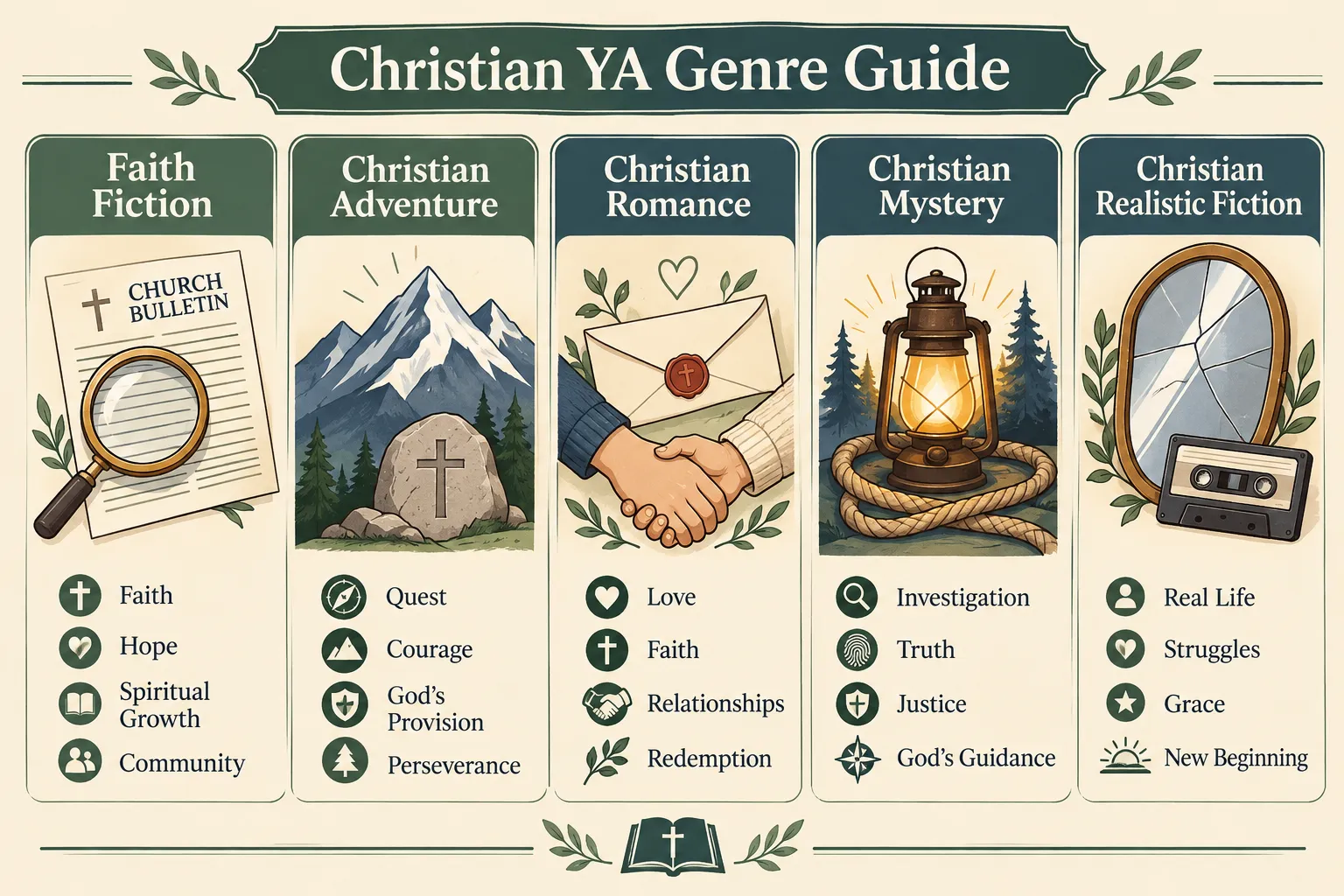
Young Adult Literature for Christian Readers: A Genre Map of Clean Mystery, Fantasy, Romance, and Adventure is best understood as five overlapping lanes, mystery, fantasy, romance, adventure, and psychological suspense, sorted by two things: emotional intensity and content boundaries. “Christian” describes worldview; “clean” only describes content, and the two labels don’t always travel together [1]. The fastest way to match a reader to a book is to decide how much dread, romance, and moral ambiguity that reader can carry well, then pick the lane that fits.
Key Takeaways
- Christian YA means faith shapes the plot and the characters’ choices; clean YA only means certain content is absent. A book can be one without being the other.
- “Clean” has no fixed definition. Some readers mean closed-door romance, others mean no romance at all, and clean labels say nothing about violence levels [1].
- Christian YA right now leans heavily toward fantasy and speculative fiction, the 2026 Christy Award Young Adult finalists included Illuminary by Chawna Schroeder and The Outsider by Katy Morgan, with the field skewing toward quests, political intrigue, and high-stakes danger.
- Faith works best in YA when it shows up through sacrifice, forgiveness, and consequence, not through a sermon or a tidy conversion scene.
- The broader YA market is struggling: Publishers Weekly reported YA fiction print sales down sharply in 2026, which pushes more Christian YA discovery onto indie authors, small presses, and reader-built lists.
- Independent and small-press authors supply much of the clean teen mystery lane [2].
- Kindle Unlimited, library apps, and Amazon’s teen Christian fiction bestseller lists are the three most reliable free or low-cost entry points [3].
- Christian YA is not only for religious households, crossover readers often pick it for the content ceiling and the hopeful ending, not the theology.
What Makes a YA Book Considered Christian?
A YA book is Christian when belief is load-bearing, when a character’s faith, doubt, or moral obligation actually changes what happens in the plot. Removing the faith element should break the story. If you can delete it and nothing shifts, the book is probably clean YA with Christian packaging.
Markers that signal genuine Christian YA:
- Choice with cost. A character does the right thing and loses something for it.
- Doubt treated seriously. The protagonist questions God and isn’t punished by the narrative for it.
- Grace that arrives after consequence, not instead of it, earned grace, not a reset button.
- Community as a real force, often a church, a family, or a covenant group that both helps and fails.
What doesn’t qualify on its own: a Bible verse epigraph, a pastor side character, or a prayer in chapter three.
A record can be true and still be used to hide something. That’s the question most faith-rooted fiction is really asking, whether the teen reading it notices or not.
How Is Clean YA Different From Regular Young Adult Novels?
Clean YA removes or softens explicit sexual content, profanity, and graphic description; regular YA makes no such promise. That’s the whole difference in content terms, it is not a promise about worldview, theme, or intensity.
Reader-facing standards vary widely. One widely used set of clean-YA criteria weighs profanity, lustful description, violence, and compatibility with Christian beliefs separately, rather than treating “no explicit sex” as sufficient [1]. Current clean-romantasy guides warn the same thing: some readers mean no sex at all, others accept closed-door, and clean labels do not guarantee low violence or gentle themes.
Decision rule: if the household’s real concern is violence or occult content rather than romance, “clean” is the wrong filter. Ask about intensity instead.
What’s the Difference Between Christian and Secular Young Adult?
Secular YA most often resolves toward self-determination: the protagonist finds their own truth. Christian YA resolves toward something outside the self, a covenant, a calling, an owed debt, a person who deserves the truth. Both can be beautifully written. The difference is where authority sits at the end.
| Element | Secular YA | Christian YA |
|---|---|---|
| Source of meaning | Self-discovery | Something the character answers to |
| Moral resolution | Ambiguity often rewarded | Consequence usually honored |
| Romance ceiling | Varies, often explicit | Usually closed-door or absent |
| Dark material | Frequently unresolved | Allowed, but met with hope |
| Ending tone | Open or bleak permitted | Hope in the dark |
Does Christian YA Have to Be Preachy?
No, and the best of it isn’t. Preachiness happens when the author explains the theme instead of trusting the image. The fix is structural: put the faith question inside the plot engine so the reader experiences it rather than receives it.
Signs a book walks with the reader instead of talking at them:
- The faith conflict is unresolved for most of the book.
- No character delivers a speech that summarizes the moral.
- The antagonist has a coherent reason, not a cardboard one.
- The ending costs the protagonist something concrete.
Common mistake: parents screening for “strong Christian content” sometimes choose the most sermon-heavy book on the shelf, then wonder why the teen abandons it at chapter four. Teens detect instruction instantly. For readers who want this handled well in adult crossover fantasy, see what makes a Christian fantasy book different from regular fantasy.
Best Christian YA Mystery Books and the Clean Whodunit Lane
The clean teen mystery lane is supplied mostly by small presses and independent authors rather than major houses. In October 2026, author Betty Johansen announced Lilli’s Song, a teen-centered disappearance mystery set in a UFO-focused Texas community, alongside an adult-aimed murder mystery, a useful illustration that “Christian mystery” gets used broadly, and not every title marketed that way is genuinely YA [2].
How to read the mystery lane by intensity:
- Lowest intensity, cozy whodunit. Small town, no on-page violence, puzzle-forward. Good for younger teens and for adults who want the same comfort.
- Mid intensity, amateur sleuth with real danger. Threat is present but not gory.
- Highest intensity, psychological suspense. Dread, unreliable narration, institutional pressure. Best for older teens and adult crossover readers.
Crossover readers who like this lane often move into adult cozies; the clean Christian mystery series with no profanity or graphic content guide maps that step. The Mercy House Mysteries, set in Juniper Gap, Tennessee, sit at the low-intensity end, church socials, donation boxes, and secrets that outlive the people who kept them, starting with A Donation to Die For.
Christian YA Fantasy That Isn’t Dark or Demonic
Yes, it exists in volume, and it’s currently the strongest lane in the category. Christian publishers increasingly use the broader label “speculative fiction” to cover fantasy, science fiction, dystopia, and supernatural conflict without framing every book as direct allegory.
The 2026 Christy Award Young Adult finalists, including Illuminary, Sons of Day and Night, and The Star-Blessed, are described through assassinations, political succession, competitions, and identity rather than devotional premises. One October 2026 review of Winter’s Dawn described a book blending clean romance, mystery, poverty and loneliness themes, and a warrior-woman lead [4]. Bryan Davis remains a reliable teen-shelf name, with Dragons in Our Midst and Oracles of Fire still carried alongside newer titles like Refining Fires.
How to screen magic systems: ask whether power has a source and a cost. Systems built on covenant, gift, or inherited obligation read very differently from systems built on summoning. Readers working through this distinction will find clean magic systems and best Christian fantasy series with Percy Jackson-style quests and clean magic useful next steps.
YA Romance for Christian Teens That’s Actually Engaging
Clean romance works when the obstacle is real. Tension in YA comes from stakes, not from heat level, a girl who must choose between a boy and her own integrity generates more pull than any bedroom scene.
What makes clean YA romance land:
- External pressure (family, class, duty, danger) rather than manufactured miscommunication.
- Slow build with visible restraint, restraint reads as respect, and teens notice.
- A cost to the pairing. Someone gives something up.
- An ending that isn’t automatic.
Also worth noting: some faith-rooted series deliberately run romance-absent, which suits readers who want adventure without a love plot at all. Adult crossover readers who want the romance dialed up but still closed-door can look at Christian suspense romance with high emotional stakes and no graphic content, correction, see Christian suspense romance for readers who love high emotional stakes but avoid graphic content.
Adventure Books for Teens With Christian Values
Adventure is the most portable lane, survival, frontier, quest, and exploration stories carry moral weight without needing explicit faith language. The genre’s engine is what will you do when no one is watching, which is already a faith question.
Look for: a clear physical goal, a moral complication layered underneath it, and an ending where the protagonist’s choice matters more than their skill. Frontier and western settings do this especially well; see western fiction for readers who love moral complexity without the preaching.
How Do I Find YA Books With No Inappropriate Content?
Use a layered check instead of trusting a single label. Content labels are reader-created and inconsistent, so verify rather than assume.
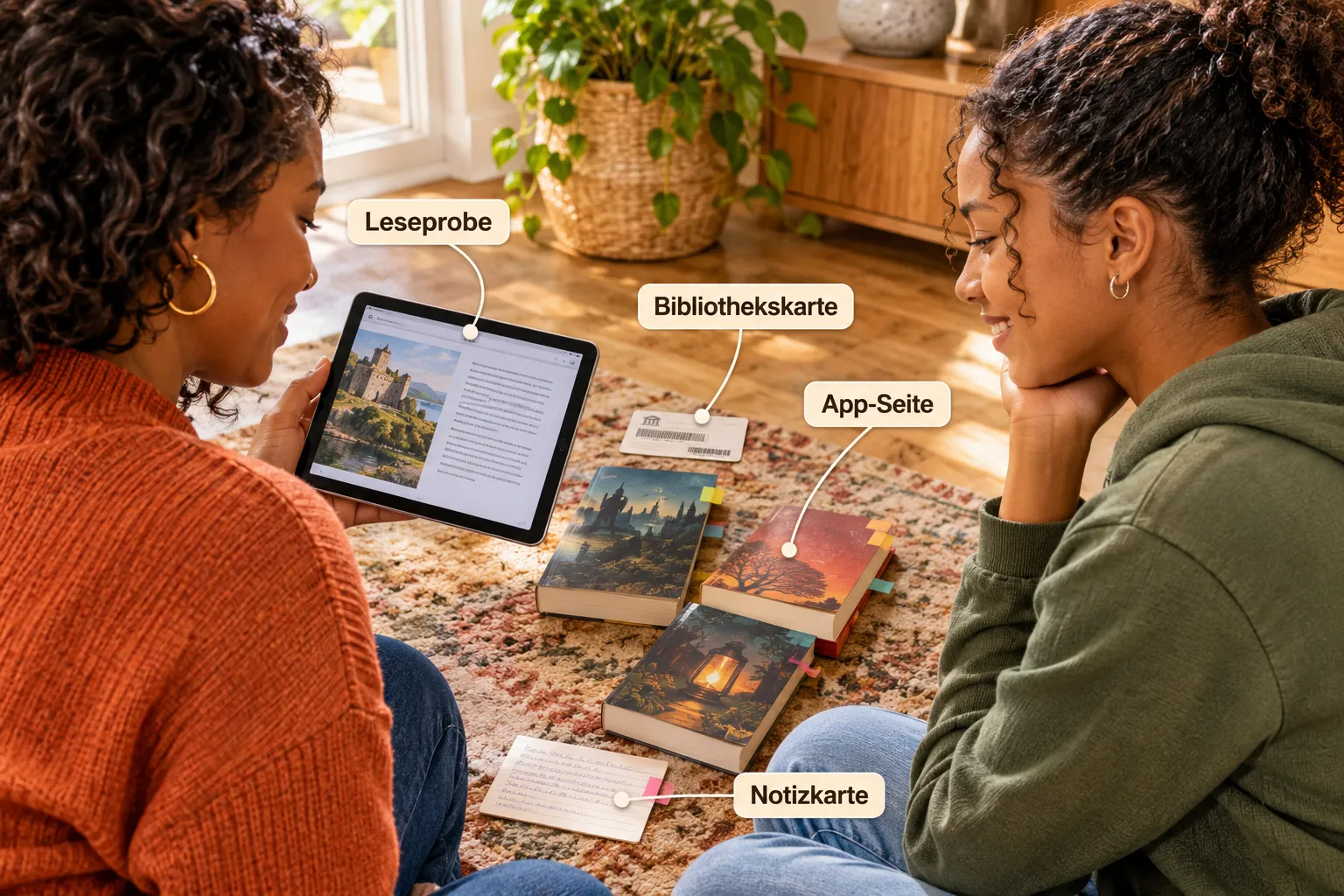
A practical five-step checklist:
- Read the sample. The first 10% reveals voice, profanity, and intensity faster than any review.
- Search reviews for the words language, steamy, dark, and trigger. Unhappy reviewers are specific.
- Check reader-built lists. Goodreads maintains curated clean young/new adult suspense and mystery lists [5].
- Check the publisher. Faith-focused presses hold a narrower content range than general-market imprints.
- Ask the teen. Teens who feel screened rather than consulted route around the screen.
Edge case: a book can be entirely profanity-free and still be emotionally heavy, grief, abuse aftermath, or institutional betrayal. That’s not a flaw. It just belongs on a different intensity shelf.
Where Can I Read Christian YA Books for Free?
Three dependable routes, in order of catalog depth:
- Public library apps (Libby, Hoopla), free with a card, strongest for traditionally published titles.
- Kindle Unlimited, a subscription, but it functions as free reading once active, and it’s where most indie Christian YA and crossover series live.
- Amazon’s teen and young adult Christian fiction bestseller list, free to browse and the fastest way to see what’s currently moving [3]. Many titles there offer free samples or first-in-series promotions.
For building a multi-genre plan rather than one-off picks, see how to build a cross-genre clean Christian fiction reading plan for Kindle Unlimited.
Best Christian YA Authors Right Now
The current field is award-visible and fantasy-weighted. Chawna Schroeder (Illuminary) and Katy Morgan (The Outsider) both appeared among 2026 Christy Award Young Adult finalists, announced September 11, 2026, with winners set for November 6 in Nashville. Bryan Davis remains the long-standing teen fantasy anchor. Author Miriam Thor has spoken publicly about the craft distinction between middle grade and YA, older protagonists, coming-of-age pressure, deeper character work, and the challenge of writing culturally current stories without surrendering values [6].
Beyond awards, much of the category’s growth is indie. Religion category sales have held up better than general trade in recent reporting [7], while YA fiction broadly declined in 2026, which means reader-built lists and subscription catalogs matter more than bookstore shelves now.
Is Christian YA Only for Religious Families, or for Everyone?
It’s for anyone who wants a content ceiling and an earned hopeful ending. Plenty of readers pick up faith-rooted YA for the guarantee, no explicit content, no nihilistic finish, without sharing the theology. Librarians and teachers use the same logic when building shelves for mixed audiences.
Some books in this space appeal to Christian readers without being marketed as religious at all: clean survival stories, puzzle mysteries, and quest fantasy with a strong moral spine. Those titles sit in the overlap, and they’re often the easiest place to start with a reluctant teen reader. Readers tracking the overlap can browse clean Christian fiction.
FAQ
Is “clean” the same as “Christian”? No. Clean describes what’s absent from the content. Christian describes a worldview shaping the plot. A clean book may have no faith element at all [1].
What age is Christian YA written for? Typically 13-18, with protagonists 15-18. Middle grade runs younger with lower intensity and simpler character arcs [6].
Can clean YA romance still be engaging? Yes. Tension comes from obstacle and cost, not heat level. Restraint plus real external stakes usually outperforms explicit content for emotional pull.
Does Christian YA fantasy use magic? Often. Many Christian speculative titles include magic-like systems, dragons, and supernatural conflict. Screen by whether power has a cost and a source, not by whether magic exists.
Why is YA fiction selling poorly if Christian YA is growing? Publishers Weekly reporting shows overall YA print sales fell hard through 2026 while religion-category sales held firmer [7][8]. Christian YA competes inside a shrinking broader market, which shifts discovery to indies and lists.
Are adult Christian fiction series appropriate for teens? Frequently yes, when the series holds a clean content contract. Cozy mystery and covenant fantasy cross over most easily; psychological thrillers are better suited to older teens.
How do I check a book’s intensity, not just its content? Read reviews mentioning pacing and dread, and read the last page of the sample. Intensity shows in the prose rhythm before it shows in events.
Where do Christian YA mysteries usually come from? Mostly small presses and independent authors rather than major imprints [2].
Conclusion
The practical move is to stop sorting by label and start sorting by two questions: how much dread can this reader carry, and what has to be true about the ending. Everything else, mystery, fantasy, romance, adventure, suspense, is just where those two answers land on the map.
Next steps:
- Pick one lane based on intensity, not genre preference.
- Read a 10% sample before committing.
- Build one curated list in a library app or Kindle Unlimited, five titles deep.
- Start a teen with the low-intensity end of a lane, then step up.
- Let the conversation about the book do the work the sermon would have done badly.
Grace in these stories doesn’t arrive because the plot got tired. It arrives after something is paid for. That’s the shelf worth building.
References
- Clean Books for Girls. sydneyschmiedbooks.com.
- Clean Christian Mystery Novels for Young Adults. news.marketersmedia.com.
- Best Sellers in Teen & Young Adult Christian Family Fiction. us.amazon.com.
- Christian Fantasy Featuring Magic, Mystery and Romance. wng.org.
- Clean Young and New Adult Suspense, Thriller, Mystery. goodreads.com.
- Mitchell S. Karnes Podcast, Miriam Thor Interview. podimo.com.
- Trade Sales Were Mixed in 2025; Religion Sales Up. publishersweekly.com.
- WI2026: Passion Purchases, Analog Living Trend Up. publishersweekly.com.