
Last updated: September 2, 2026
Quick Answer: Christian cozy fantasy is a subgenre that combines the warmth, community focus, and low-stakes comfort of cozy fiction with secondary-world or light fantastical elements grounded in Christian faith. What sets it apart from mainstream fantasy is how magic works: rather than being a force characters accumulate, control, or weaponize, grace-based magic systems tie supernatural ability to mercy, covenant, sacrifice, and spiritual posture. The result is fiction that feels wondrous without feeling threatening, and spiritually resonant without preaching.
Key Takeaways
- Christian cozy fantasy sits at the intersection of cozy fiction’s warmth and Christian faith’s theology of grace, mercy, and earned redemption.
- Grace-based magic systems function differently from power-based ones: ability flows from relationship, sacrifice, or covenant, not from skill trees, raw talent, or domination.
- Cozy fantasy is now a formally tracked ebook submarket, with K-lytics releasing a dedicated report in January 2026 [4], signaling real commercial momentum for authors writing in this space.
- Searches for “cozy fantasy” have grown 2-10x since 2022, according to Google Trends data cited by ChristShare in May 2026, making this one of the fastest-growing clean fiction segments [3].
- Magic in Christian fiction does not have to be demonic or allegorical. The key is intentionality: what the magic costs, what it serves, and who it belongs to within the story’s theology.
- Christian cozy fantasy differs from paranormal romance in tone, content contract, and spiritual framing, not just in the absence of explicit content.
- Common writer mistakes include making grace-based magic too easy, too tidy, or too obviously symbolic, all of which undercut the earned quality that makes it work.
- The genre is primarily read by women 35-65 who want clean Christian fiction with real stakes and genuine faith, not formula.
What Is Christian Cozy Fantasy and How Is It Different From Regular Fantasy?
Christian cozy fantasy is fantasy fiction that prioritizes warmth, community, and spiritual meaning over combat, conquest, or world-ending stakes. Regular fantasy often centers power, who has it, who wants it, how to get more of it. Christian cozy fantasy asks a different question: what does faithfulness look like in an ordinary life that turns out to be extraordinary?
The differences are structural, not just tonal:
| Feature | Regular Fantasy | Christian Cozy Fantasy |
|---|---|---|
| Central conflict | External threat, war, power struggle | Relational, moral, or spiritual tension |
| Magic source | Talent, training, bloodline, or raw power | Grace, covenant, mercy, sacrifice |
| Stakes | World-ending or kingdom-level | Community, family, conscience |
| Faith role | Absent or decorative | Load-bearing, shapes plot and character |
| Content | Variable (often graphic) | Clean: no explicit content, minimal graphic violence |
| Resolution | Victory through strength | Restoration through honesty and grace |
The cozy element is not just aesthetic, it is structural. Cozy fiction, whether mystery or fantasy, depends on a community that matters, a protagonist rooted in relationship, and a resolution that restores rather than destroys. Christian cozy fantasy adds the conviction that grace is real, that mercy costs something, and that the ordinary Tuesday can carry more weight than anyone expected.
What Makes Cozy Fantasy Actually Cozy?
Cozy fantasy earns its name through specific structural choices, not just a soft color palette or a cup of tea on the cover.
The genre is genuinely cozy when:
- The setting feels inhabited. A village, a valley, a small city district, somewhere with regular people who have names, histories, and routines.
- The protagonist is embedded in community. She isn’t a lone chosen one. She has neighbors, a healer she trusts, a market she visits on Thursdays.
- Danger is real but not graphic. Stakes matter, but the story doesn’t rely on shock or horror to create tension.
- Resolution restores something. The ending doesn’t just stop the threat, it heals a relationship, rights a wrong, or returns something lost.
- Wonder is small-scale. A glowing herb. A stone that remembers a name. A door that only opens when someone tells the truth. Magic that fits inside a life rather than overturning one.
K-lytics’ January 2026 Cozy Fantasy Book Market report [4] confirmed that the subgenre is now distinct enough to warrant its own market analysis, a signal that readers are actively seeking this specific combination of comfort and wonder.
How Do Grace-Based Magic Systems Work in Fiction
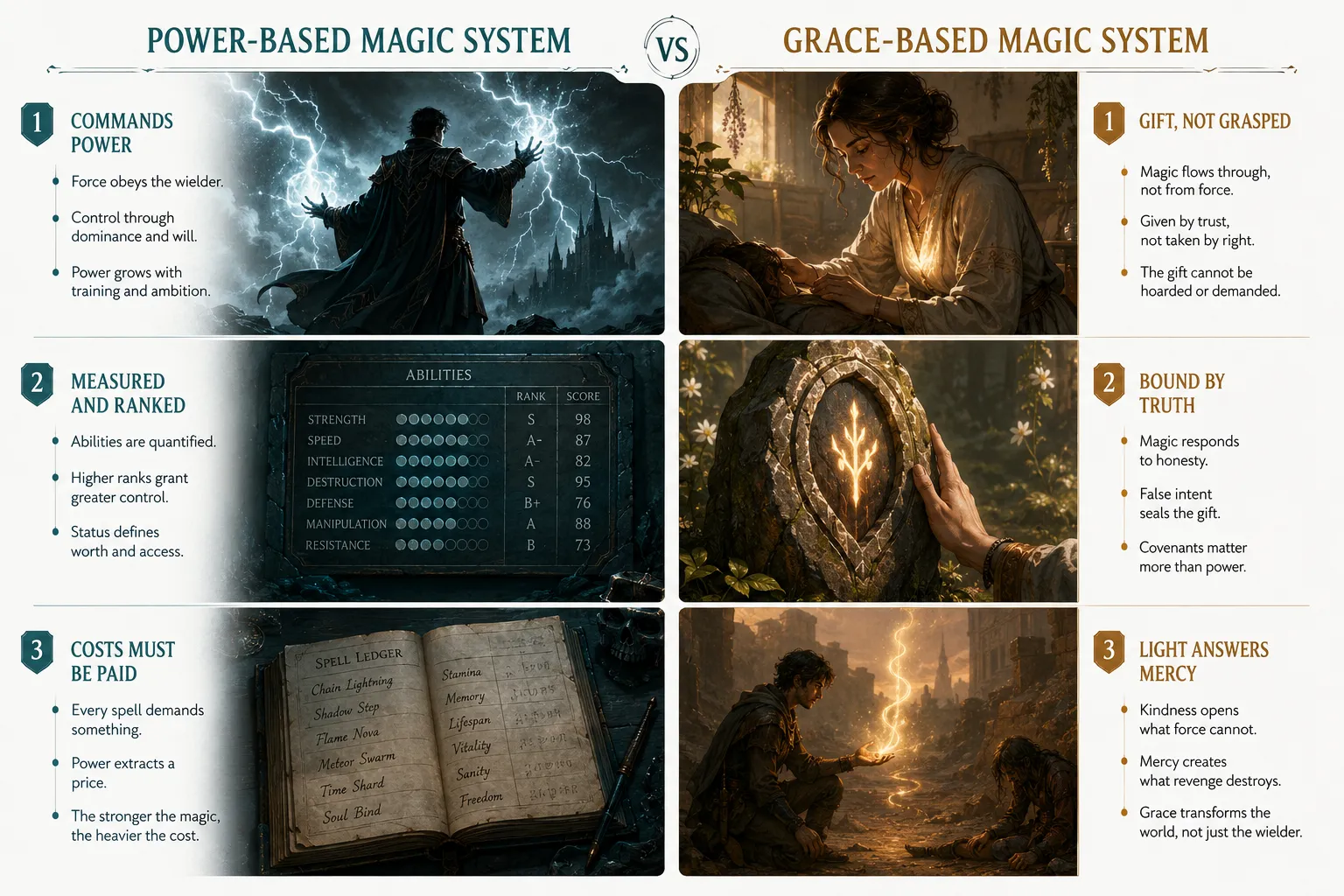
A grace-based magic system ties supernatural ability to spiritual posture rather than personal power. It doesn’t reward the strongest, the most trained, or the most ambitious, it responds to humility, mercy, covenant-keeping, and sacrifice.
The core mechanics of a grace-based system:
- Cost without transaction. Grace isn’t earned by accumulating the right actions. But it isn’t free either. A character who receives a gift of healing may find it comes with exhaustion, vulnerability, or the requirement to stay honest about her own wounds first.
- Relational, not mechanical. The magic doesn’t work the same way for everyone. It responds to the relationship between the character and the source, whether that source is named as God, a Maker, a covenant, or something analogous.
- Accountability built in. A grace-based system tends to fail or go quiet when the character acts in pride, self-protection, or cruelty. It doesn’t punish, it withdraws. That distinction matters theologically and narratively.
- Communal rather than individual. The gift often serves others, not the one who holds it. A healer heals. A truth-speaker speaks truth even when it costs her. The ability is shaped by its purpose.
This is the opposite of a power fantasy. It’s closer to a stewardship story, and that framing is what makes it feel genuinely Christian rather than just spiritually adjacent.
For readers interested in how this earned-progression model works across other Christian fantasy subgenres, Progression Fantasy for Christian Readers Who Want Earned Grace, Not Cheap Grace covers the mechanics in depth.
Can You Have Magic in Christian Fiction Without It Being Demonic?
Yes, and the answer isn’t complicated, though the conversation around it sometimes is. Magic in Christian fiction becomes problematic when it operates as an autonomous force that bypasses God, invites occult practice, or glorifies spiritual rebellion. Magic that functions as a narrative expression of grace, covenant, or divine gift is a different category entirely.
The debate has been ongoing in Christian reading communities for decades, and it remains active into 2026 [9]. The key questions writers and readers should ask:
- What is the source? Magic rooted in a Maker, a covenant, or divine gift reads differently than magic drawn from forbidden knowledge or self-deification.
- What does it cost? A system where power is simply taken or accumulated raises different questions than one where ability requires surrender, service, or sacrifice.
- What does it serve? Magic that exists to protect the vulnerable, restore the broken, or speak truth carries a different moral weight than magic used to dominate.
C.S. Lewis navigated this in Narnia. Tolkien navigated it in Middle-earth. The question is not whether magic can appear in Christian fiction, it’s whether the system has been thought through with theological care. A grace-based system, by definition, has been.
Christian Cozy Fantasy vs. Paranormal Romance: What’s the Difference?
These two categories are frequently confused in search results, but they serve different readers and make different promises.
Christian cozy fantasy is built around community, wonder, and spiritual meaning. Romantic elements may appear, but they are not the engine of the story. The central tension is moral or spiritual, a covenant broken, a truth hidden, a mercy withheld. The content contract is clean: no explicit content, no graphic violence.
Paranormal romance centers a romantic relationship, often between a human and a supernatural being. The supernatural element exists primarily to create romantic tension and obstacle. Content ranges widely, from clean to explicit, and the spiritual framing, when present, is usually decorative rather than structural.
The practical difference for readers:
- If you want faith handled as lived experience rather than backdrop, Christian cozy fantasy is the right shelf.
- If you want the romantic arc to carry the story, paranormal romance is the right shelf, but vetting for content and spiritual framing will be necessary.
For readers navigating multiple clean fiction genres, How to Find Clean Christian Fiction Across Every Genre is a useful starting point.
Is Cozy Fantasy the Same as Christian Fantasy?
No, cozy fantasy and Christian fantasy overlap but are not the same category.
Cozy fantasy is a tone and structure descriptor. It means low combat, high community, wonder-forward, and emotionally warm. A cozy fantasy novel can be entirely secular.
Christian fantasy is a worldview descriptor. It means faith is load-bearing in the story, not decorative, not allegorical shorthand, but genuinely present in how characters think, choose, and fail.
Christian cozy fantasy is the intersection: the structural warmth of cozy fiction with the theological intentionality of Christian fiction. It’s a smaller shelf, but it’s a real one, and it’s growing. The ChristShare report from May 2026 noted that clean fiction and cozy categories are seeing significant search growth together [3], which suggests readers are actively looking for exactly this combination.
The Kethara Chronicles and The Sarel Chronicles from Silas Bellhaven both operate in this space, secondary-world fantasy where the supernatural is tied to covenant and mercy, the stakes are relational as much as physical, and the resolution costs something real. Browse the full Christian Epic Fantasy catalog for more examples.
How to Write a Magic System Based on Faith and Grace

A grace-based magic system requires the same design rigor as any other magic system, but the design questions come from theology, not game mechanics.
Step-by-step framework:
- Name the source. Who or what grants the ability? A named deity, a covenant relationship, a living tradition? The source determines the system’s moral logic.
- Define the cost. What does using the gift require of the character? Exhaustion, vulnerability, honesty, surrender? The cost should reflect the spiritual posture the system rewards.
- Build in failure conditions. When does the gift go quiet or fail? Pride, cruelty, self-deception? This is where the theology shows up in plot, not in dialogue, but in consequence.
- Make it communal. Who does the gift serve? A grace-based system that only benefits the holder isn’t grace, it’s still a power fantasy with spiritual vocabulary.
- Keep the wonder small. The most resonant grace-based magic tends to be quiet: a stone that remembers, a name that returns, a road that only appears when someone chooses mercy. Scale matters. Big spectacle pulls the story toward power; small wonder keeps it rooted in grace.
- Let it cost something before it helps. Earned grace shows up after cost, not instead of it. If the magic rescues the character before she’s had to choose anything hard, the system isn’t doing theological work, it’s just decoration.
Common mistakes writers make with Christian magic systems:
- Making grace too automatic (it fires every time the character prays, removing all tension)
- Making it too obviously allegorical (every element maps to a Bible verse, turning story into sermon)
- Giving it to only the “good” characters (which removes moral complexity and makes the system a reward system, not a grace system)
- Resolving conflict with magic instead of character choice (the gift saves the day so the character doesn’t have to)
For a broader look at how faith themes balance across genres, Faith in Fiction Across Genres: How Much Is Too Much? addresses this directly.
Examples of Grace-Based Magic in Published Christian Fantasy Books
Several published series demonstrate how grace-based systems work in practice:
The Kethara Chronicles (Silas Bellhaven) In the highlands of Marat-Sol, the covenant word carried by Amara and Sela isn’t a weapon or a skill. It’s a witness, something the empire’s auditors cannot own or quantify. The supernatural element functions as testimony, not power. The Stone That Remembered (Amazon) opens with a buried witness-stone that breaks through dust bearing a mark no empire can explain, small, quiet, and completely load-bearing to the story’s theology.
The Sarel Chronicles (Silas Bellhaven) The silver roads in Sarel mark prayers the Maker-Who-Hears has answered. The magic is cartographic and covenantal, it records, it witnesses, it holds. When a black road appears on Elya’s skin in The Map of Unanswered Prayers (Amazon), it belongs to a boy the House of Witness refused to record. The gift doesn’t give her power over anyone. It gives her a responsibility she didn’t ask for.
The Measured Debt (Silas Bellhaven) The Christian LitRPG series takes a different structural approach, progression mechanics where what a character gains is always measured against what it costs, and where the record itself becomes a theological object. Grace shows up not as a cheat code but as a debt that eventually comes due.
These examples share a common logic: the supernatural element serves the story’s moral and spiritual questions rather than resolving them cheaply.
What Age Group Is Christian Cozy Fantasy For?
Christian cozy fantasy is primarily written for adult readers, with the core audience being women 35-65 who read on Kindle Unlimited and want clean, faith-rooted fiction with real emotional stakes.
That said, the genre’s content contract (no graphic violence, no explicit content, no profanity) makes it accessible to older teens as well. The distinction is not content rating but thematic depth, the best Christian cozy fantasy deals with grief, doubt, betrayal, and hard mercy in ways that reward mature readers.
Who it’s for:
- Readers who loved Narnia as children and want something that holds that same reverence now
- Women who read cozy mystery and want the same warmth in a fantasy setting
- Christian readers who are tired of faith appearing as either a sermon or a decoration
- Kindle Unlimited subscribers looking for clean fantasy books with genuine spiritual weight
Who it may not suit:
- Readers who want high-action combat fantasy or grimdark
- Readers who prefer faith to stay in the background
- Those who want romance as the primary story engine
Christian Cozy Fantasy Recommendations for Beginners
For readers new to the genre, the best entry points are books where the grace-based element is clear but not heavy-handed, the world feels warm and inhabited, and the faith is present as lived experience rather than lesson.
Start here:
- The Stone That Remembered (Kethara Chronicles, Book 1), covenant fantasy with a quiet supernatural element, strong community, and a protagonist whose faith is tested by an empire that wants to own every act of mercy. View on Amazon
- The Map of Unanswered Prayers (Sarel Chronicles, Book 1), a disgraced map-scribe carries a mark that belongs to someone the official record refused to acknowledge. The magic is small, the stakes are real, and the theology is earned. View on Amazon
For readers who want to start with cozy mystery before moving into fantasy, the Mercy House Mysteries (series page) set in Juniper Gap, Tennessee, builds the same faith-forward, community-rooted warmth without the secondary-world element, a good on-ramp to the sensibility.
Additional discovery options are available through the Kindle Unlimited Christian Reads: Hidden Gems and Underrated Series roundup.
How to Balance Magic and Theology in Cozy Fantasy Without Preaching
The balance breaks down in one of two directions: the magic becomes so symbolic it reads as allegory, or the theology becomes so explicit it reads as sermon. Both kill the story.
The working principle: let faith show up through character choice and consequence, not through narration or dialogue that explains what the magic means.
If a character’s healing gift goes quiet after she lies to protect herself, the reader understands the theological logic without being told it. If a covenant stone only responds when the character stops performing and starts being honest, the story is doing theology through plot, which is the only way it works in fiction.
Practical markers that the balance is holding:
- The magic creates problems as often as it solves them
- Characters doubt their gifts, misuse them, or lose them temporarily
- The resolution requires a human choice, not just a supernatural intervention
- A reader who doesn’t share the faith can still feel the emotional and moral logic of the system
Markers that the balance has broken:
- Every use of the gift is accompanied by a reflective monologue about God’s provision
- The magic only works for characters who have “correct” theology
- The story stops to explain what the supernatural element represents
Walking with readers, not talking at them, that’s the standard. The magic should feel like part of the world, not a Sunday school illustration wearing a fantasy costume.
FAQ
What is Christian cozy fantasy in one sentence? It’s fantasy fiction where the world feels warm and inhabited, the magic is rooted in grace rather than power, and faith is present as lived experience, not allegory, not sermon, just honest story.
Do grace-based magic systems have to reference God directly? No. Many effective systems use analogous figures, a Maker, a covenant source, a living tradition, that carry theological weight without requiring a direct name. What matters is that the source is personal, relational, and morally coherent, not that it uses specific religious vocabulary.
Is Christian cozy fantasy the same as Christian allegory? No. Allegory maps story elements directly onto theological concepts (Aslan = Christ, etc.). Christian cozy fantasy lets faith be present as worldview and consequence without requiring a one-to-one symbolic correspondence.
Can men enjoy Christian cozy fantasy? Yes, though the primary market is women 35-65. The genre’s appeal, wonder, community, earned grace, real stakes, isn’t gender-specific. The content contract (clean, no graphic content) is also not gender-specific.
What’s the difference between a grace-based magic system and a “soft” magic system? A soft magic system (Brandon Sanderson’s term) simply means the rules aren’t fully explained to the reader. A grace-based system has clear internal logic, it just draws that logic from theology rather than physics. It can be quite specific about how and why it works.
Is Christian cozy fantasy available on Kindle Unlimited? Yes. Much of the Christian fantasy catalog, including the Kethara Chronicles and Sarel Chronicles, is available through KU. The Christian Fantasy Kindle Unlimited tag is a useful discovery point.
How is this different from Christian epic fantasy? Scale and tone. Christian epic fantasy tends toward high stakes, large casts, and world-level conflict. Christian cozy fantasy keeps the stakes relational and the world small enough to feel inhabited. Both can use grace-based magic systems, the difference is what those systems are asked to carry.
What makes a magic system feel “earned” rather than cheap? The gift costs something before it helps. The character has to choose something hard, honesty, surrender, mercy at personal cost, before the supernatural responds. If the magic fires automatically or rescues the character without requiring a genuine choice, the grace feels cheap.
Can Christian cozy fantasy have real danger? Yes, and it should. Comfort earned through honesty about hard things is different from comfort that avoids them. The genre’s warmth comes from how it handles difficulty, not from pretending difficulty doesn’t exist.
Where should a new reader start? The Stone That Remembered (Kethara Chronicles, Book 1) or The Map of Unanswered Prayers (Sarel Chronicles, Book 1) are both strong entry points for readers new to Christian cozy fantasy with grace-based systems.
Conclusion
Christian cozy fantasy, magic systems rooted in grace, not power, fills a gap that neither mainstream fantasy nor traditional Christian allegory has ever quite reached. It offers wonder without spectacle, faith without formula, and community without sentimentality.
The grace-based magic system is the structural heart of what makes this genre distinct. When magic responds to mercy rather than mastery, when it costs something before it helps, when it serves others rather than elevating the one who holds it, the story stops being a power fantasy and starts being something closer to a testimony.
The market is moving in this direction. K-lytics formally tracked cozy fantasy as its own submarket in January 2026 [4]. Search interest in cozy reading has grown significantly since 2022 [3]. Readers are looking for exactly this combination: warmth, wonder, and faith handled with honesty.
Actionable next steps:
- Readers: Start with The Stone That Remembered or The Map of Unanswered Prayers, both available on Amazon and Kindle Unlimited.
- Writers: Apply the six-step grace-based system framework above. Design the cost before you design the ability. Let the failure conditions do the theological work.
- Curious browsers: Browse the Blending Genres in Christian Fiction article for a wider view of how faith-rooted fiction works across genre lines.
The best Christian cozy fantasy doesn’t explain grace. It shows what grace looks like when it shows up in a world that needed it, quietly, at cost, and right on time.
References
[1] Writes of Grace – https://www.writesofgrace.com/ [3] Marketersmedia 2025 10 23 Cozy Christian Mystery Novel For Adults Early Christmas Gift Option Available – https://markets.financialcontent.com/wral/article/marketersmedia-2025-10-23-cozy-christian-mystery-novel-for-adults-early-christmas-gift-option-available [4] K Lytics Cozy Fantasy Genre Report – https://k-lytics.com/product/k-lytics-cozy-fantasy-genre-report/ [9] womenofgrace – https://www.womenofgrace.com/blog/75854