Last updated: September 4, 2026
Quick Answer
Christian historical romance is a subgenre of Christian fiction that places faith-driven characters in historical settings, most often the American frontier, Regency England, Victorian Britain, or the Civil War era, and centers their romantic arc on moral growth, spiritual conviction, and courtship governed by genuine belief. Unlike mainstream historical romance, the faith element is load-bearing: it shapes how characters pursue love, handle conflict, and find resolution. The result is a reading experience where the happy ending feels earned, not handed over.
Key Takeaways
- Christian historical romance combines period-accurate settings with faith-rooted courtship, where belief shapes every major character decision, not just the wedding scene.
- The genre’s defining feature is emotional restraint used as romantic tension, not a limitation. Readers feel the pull of connection precisely because the characters hold back.
- As of September 2026, the Christian historical romance market lists approximately 2,471 competing titles on Amazon, with 61% enrolled in Kindle Unlimited and a typical Kindle price of $6.99.
- Earned grace, the idea that mercy and love arrive after cost, not instead of it, is what separates the best titles from formulaic ones.
- The genre serves readers who want clean Christian fiction with real stakes: interfaith tension, vocational sacrifice, community conflict, and moral failure that actually matters.
- You do not need to be religious to enjoy Christian historical romance. The period setting, character depth, and slow-burn courtship appeal to secular readers who want wholesome alternatives to explicit content.
- Top authors include Francine Rivers, Liz Curtis Higgs, Tamera Alexander, Lauraine Snelling, and a growing wave of indie voices publishing through Kindle Unlimited.
- Genre hybridization is now standard: the strongest 2026 releases blend historical romance with suspense, dual timelines, or community-conflict plots rather than relying on a single romantic thread.
- Clean Christian romance and Christian historical fiction are closely related but distinct, historical fiction may not center a romance, while Christian historical romance always does.
- The genre rewards binge-reading: most series are designed so each book resolves its central romance while advancing a community or family arc across the series.
What Is Christian Historical Romance and How Is It Different from Regular Historical Romance
Christian historical romance is historical romance in which the characters’ faith is a genuine plot force, not a decorative detail, not a Sunday-morning backdrop, but the actual reason they make the choices they make. The courtship arc is shaped by belief: what a character thinks God requires of them, what they’re willing to sacrifice, and where they find grace when they fail.
The difference from regular historical romance comes down to three things:
| Feature | Christian Historical Romance | Secular Historical Romance |
|---|---|---|
| Faith role | Load-bearing, shapes decisions and conflict | Atmospheric or absent |
| Romantic tension | Built through restraint, moral stakes, and spiritual growth | Often built through physical attraction and social barriers |
| Resolution | Earned through character change and faith tested | Earned through plot obstacles removed |
| Content level | Clean, no explicit scenes, limited to no profanity | Varies widely; often includes explicit content |
| Emotional register | Warm, hopeful, honest about hard things | Broader spectrum, including dark and explicit |
Common mistake: Readers sometimes assume “Christian” means “safe from conflict.” The best titles in this genre don’t avoid hard things, grief, betrayal, spiritual doubt, systemic injustice. They handle those things honestly and let faith show up in the middle of them, not after them. That’s the difference between faith-based fiction that doesn’t feel preachy and a story that uses faith as a shortcut to a tidy ending.
How Important Is the Faith Element in Christian Historical Romance
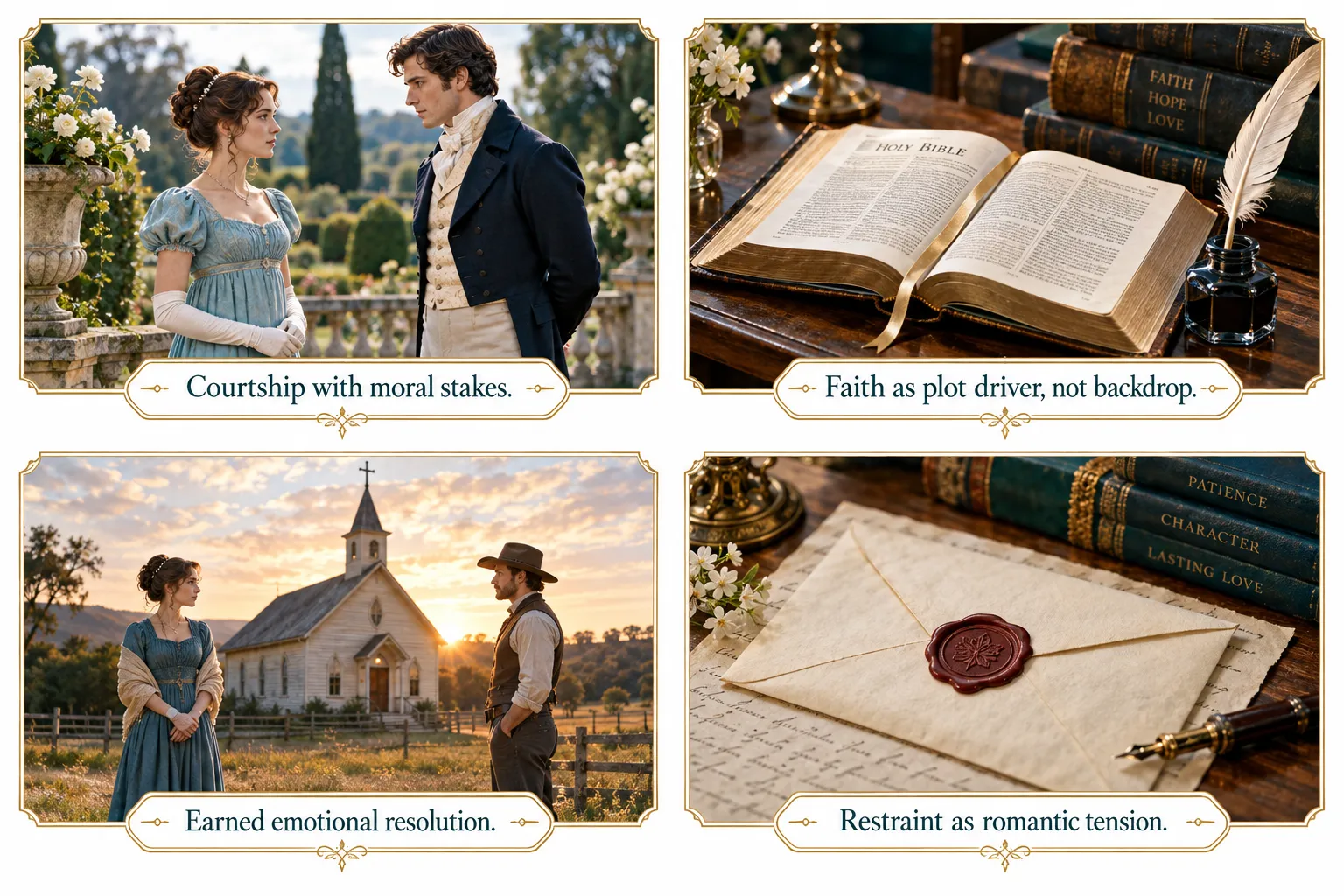
The faith element is the structural spine of the genre, remove it and you have pleasant historical fiction, but not Christian historical romance. Faith drives the central tension in the best titles: a character chooses a harder path because of what they believe, or they fail to choose it and have to reckon with that failure.
What this looks like in practice:
- A heroine refuses a financially advantageous match because she can’t marry someone who doesn’t share her convictions, and then has to live with the cost of that refusal.
- A hero carries guilt from a past moral failure and must work through genuine repentance before he can receive love without flinching.
- A community’s faith is tested by injustice, land theft, racial prejudice, wartime loss, and the characters’ response to that injustice is the real story.
The faith element should never arrive as a sermon. When it’s working, readers feel it through what characters do, not through what the narrator explains. A character who kneels to pray before a hard conversation is showing faith. A character who thinks three paragraphs about the theology of forgiveness is being preached at. Faith in fiction works best when it’s woven into plot through character choice and consequence, not delivered as narration.
Common Tropes in Christian Historical Romance Courtship Stories
Christian historical romance has a recognizable set of courtship tropes, and the best authors know which ones to use straight, which to subvert, and which to retire entirely.
Tropes that work well:
- Forced proximity, a mail-order bride arrangement, a shared homestead, a long stagecoach journey. Physical closeness without physical license creates genuine tension.
- Mismatched social standing, a wealthy landowner and a servant, a frontier farmer and an educated Eastern woman. Class difference forces both characters to examine what they actually value.
- The secret that costs something, one character is hiding a past failure, a family shame, or a previous identity. When it surfaces, the question isn’t whether they’ll be forgiven, but whether they’ll ask.
- Community conflict as romantic pressure, the 2026 market data identifies “community conflict” as the fastest-rising trope in Christian historical romance, and it makes sense. A town divided by land claims, a church split over doctrine, a family feud, these external pressures reveal character faster than any internal monologue.
- Marriage of convenience, two people who agree to marry for practical reasons and then have to decide whether to make it real. The genre’s version of this trope works because the question of what makes a marriage real is inherently theological.
Tropes that go stale fast:
- The instant conversion as romantic resolution. If a character’s faith crisis is solved by falling in love, the faith element wasn’t load-bearing, it was decorative.
- The villain who is simply irreligious. Real moral conflict requires characters who believe wrong things sincerely, not characters who are evil because they don’t go to church.
Christian Historical Romance vs Secular Historical Romance: Which Should You Read
Choose Christian historical romance if you want clean content, a slow-burn courtship where restraint carries emotional weight, and a story where the characters’ faith is genuinely tested rather than performed. Choose secular historical romance if you want a wider range of content levels, more explicit romantic scenes, or a story where faith is absent or incidental.
Choose Christian historical romance if:
- You want a guaranteed clean read with no explicit scenes
- You’re drawn to period settings where moral stakes feel higher because social and spiritual consequences are real
- You want characters who doubt, fail, and find grace, not characters who are simply virtuous
- You’re a Kindle Unlimited subscriber looking for binge-worthy series with consistent content standards
Choose secular historical romance if:
- You want explicit content or a wider emotional range
- You prefer stories where faith plays no role
- You’re looking for darker, grittier period settings without moral resolution
The 2026 Christian fiction market data shows the global Christian fiction market at an estimated $1.37 billion, growing approximately 8.4% year-over-year, with genre hybridization now standard practice. That growth reflects real reader demand, not a niche audience, but a substantial one that knows exactly what it wants.
Christian Historical Romance Set in Different Time Periods
Christian historical romance spans a wide range of historical settings, each with its own emotional texture and spiritual stakes.
Most common settings in 2026 releases:
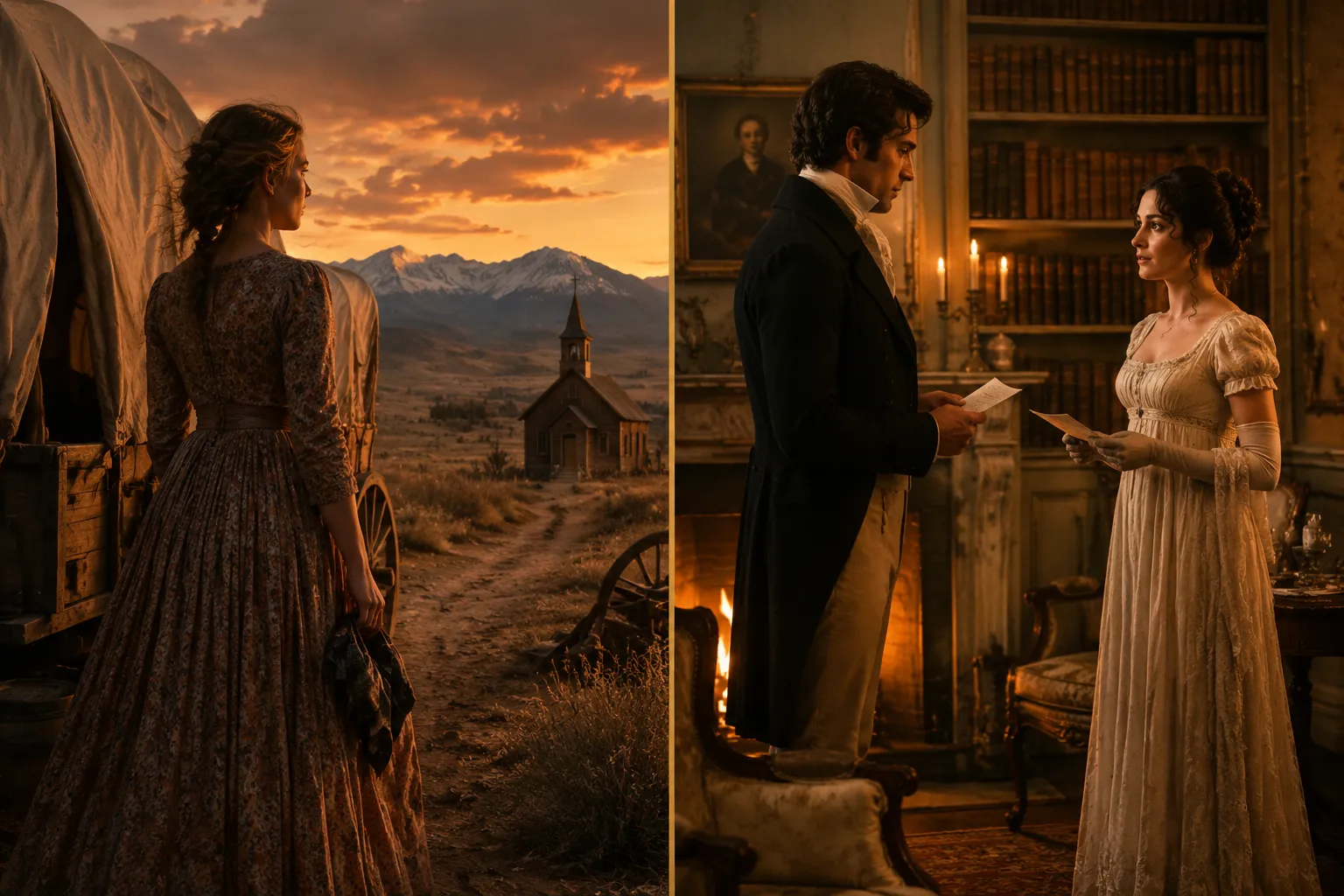
- American frontier / post-Civil War West, the most popular setting in the genre, driven by authors like Mary Connealy (Wildflower Bride, August 2026) and the long tradition of Lauraine Snelling’s Red River of the North series. Faith on the frontier is practical and costly: survival, land, community, and justice all intersect.
- Regency and Victorian England, social constraint becomes romantic tension. Characters navigate class, propriety, and the Church of England’s cultural weight. Recent 2026 releases like A Lady Unveiled (Sandra Ardoin) and Disguised Love (Marie E. Bast) work in this register.
- Civil War and Reconstruction South, Tamera Alexander’s In These Hills (2026) exemplifies this setting, where faith is tested by historical injustice and the question of what it costs to do the right thing in a broken system.
- Biblical and ancient settings, Francine Rivers’ Mark of the Lion trilogy remains the benchmark here. Faith isn’t background; it’s the entire world.
- Dual-timeline / time-slip, a growing 2026 trend where a contemporary character uncovers a historical story. The faith thread runs through both timelines, and the historical romance anchors the spiritual question the present-day character is working through.
For readers who love the frontier setting but want something beyond romance, why Christian readers love frontier westerns covers the broader appeal of the historical West in faith-based fiction.
Best Christian Historical Romance Books and Authors Everyone Should Know
The genre has a clear canon and a fast-moving indie tier. Both matter.
Foundational authors:
- Francine Rivers, Redeeming Love (1991, revised 1997) remains the genre’s most cited title. A retelling of Hosea set in the California Gold Rush, it handles trauma, faith, and earned love with unusual honesty.
- Liz Curtis Higgs, her Lowlands of Scotland trilogy brings Scottish Highlands settings and deep biblical allusion to a wide audience.
- Lauraine Snelling, the Red River of the North series established the Norwegian immigrant frontier as a viable Christian historical romance setting and has influenced dozens of authors since.
- Tamera Alexander, In These Hills (2026) and her Belle Meade Plantation series combine Southern historical settings with strong female leads and layered spiritual conflict.
2026 notable releases:
- Every Given Day, Cathy Gohlke
- Fair Are the Meadows, Lauraine Snelling & Kiersti Giron
- Sarah’s Search, Jodie Wolfe (June 2026)
- Wildflower Bride, Mary Connealy (August 2026)
- A Contrary Betrothal, Denise Farnsworth
- The Darling’s Daughter, Sydney Schmied
Where to find them: Amazon’s Christian Historical Romance category, Kindle Unlimited (61% of titles enrolled as of September 2026), and Christian fiction review sites. For hidden gems beyond the bestseller lists, Kindle Unlimited Christian reads: hidden gems and underrated series is a practical starting point.
Do You Need to Be Religious to Enjoy Christian Historical Romance
No. Many readers who don’t identify as Christian read and enjoy the genre for the slow-burn courtship, clean content, and richly drawn period settings. The faith element adds emotional depth and moral stakes, both of which make for better storytelling regardless of the reader’s personal beliefs.
What non-religious readers typically report appreciating:
- The emotional restraint, tension built through meaningful conversation, small gestures, and withheld declarations rather than physical escalation
- The moral seriousness, characters who actually grapple with right and wrong, not just social convention
- The community texture, church socials, frontier towns, and Victorian drawing rooms rendered with specificity and warmth
- The clean content guarantee, knowing exactly what they’re getting before they open the book
Edge case: Readers who find any religious content alienating may struggle with titles where faith is deeply woven into the plot (Francine Rivers, for example). For those readers, titles where faith is present but lighter, more cultural backdrop than spiritual crisis, will be a better fit.
Christian Historical Romance with Strong Female Characters
The genre has a long tradition of female protagonists who hold genuine convictions, make costly choices, and don’t wait for a man to solve their problems. The best titles give their heroines real agency, not the modern anachronistic kind, but the kind that was actually available to women in their historical moment and that they used with intelligence and courage.
Strong female lead patterns in the genre:
- The woman who chooses principle over security, refusing a match, leaving a comfortable situation, or speaking truth at personal cost
- The woman navigating a man’s world with limited tools, a frontier widow managing a homestead, a Victorian woman pursuing education or suffrage, a Civil War nurse making impossible decisions
- The woman whose faith is tested, not performed, she doubts, she argues with God, she fails and gets back up
Tamera Alexander’s suffragette-on-the-run premise in In These Hills (2026) is a recent example of this pattern done well: historical accuracy, genuine stakes, and a faith that costs the protagonist something real.
For readers who want strong female leads in adjacent genres, blending genres in Christian fiction explores how the genre’s best authors combine romance with mystery, suspense, and frontier justice to give female characters more complex narrative roles.
Christian Historical Romance That Doesn’t Feel Preachy
The best Christian historical romance handles faith the way good fiction handles any theme: through action, consequence, and character, not through explanation. A story feels preachy when the author uses characters as mouthpieces for theological positions rather than letting those positions live in the choices characters make and the costs they bear.
What to look for in a non-preachy title:
- Faith shows up in what characters do when no one is watching, not in what they say about God
- Scripture, when it appears, is carried by a specific character in a specific moment, not dropped in by the narrator as commentary
- The villain or opposing character has a coherent worldview, not just an absence of faith
- Grace arrives after cost, not instead of it, what the Silas Bellhaven brand calls earned grace: mercy that shows up on the far side of something hard
Red flag: Any scene where a character’s romantic or moral problem is resolved by a timely Bible verse or a conversion that costs nothing. That’s not faith under fire, it’s a shortcut.
The earned redemption principle applies here as much as anywhere in Christian fiction: redemption that costs nothing means nothing.
Christian Historical Romance with Diverse Characters and Settings
The genre has historically been dominated by white, Anglo-American settings and characters, but that is shifting, and the shift is producing some of the most interesting work in the space.
Emerging settings and perspectives in 2026:
- African American faith communities in the post-Civil War South, stories where faith is the primary resource against systemic injustice, not a comfort but a weapon
- Indigenous and frontier intersection, stories that grapple honestly with what westward expansion cost, told from perspectives the genre has long ignored
- Immigrant faith communities, Norwegian, Irish, German, and Eastern European settlers whose faith was bound up with cultural identity and survival
- Global historical settings, missionary stories, colonial-era Africa, and Asian historical settings are a small but growing corner of the genre
Honest caveat: Diversity in Christian historical romance is still developing. Readers looking specifically for non-white protagonists in historical settings will find fewer options than in secular historical fiction, but the gap is closing. Indie publishing through Kindle Unlimited has lowered the barriers for authors writing outside the genre’s traditional demographic center.
How Long Does It Take to Read a Typical Christian Historical Romance, and Recommendations for New Readers
Most Christian historical romance novels run between 70,000 and 100,000 words, roughly 4 to 7 hours of reading time for an average reader. Series books tend toward the shorter end; standalone epics (Francine Rivers’ Mark of the Lion trilogy, for example) run longer.
For someone new to the genre, start here:
- If you want the genre’s emotional peak: Redeeming Love by Francine Rivers. It’s the title that defines what earned love looks like in Christian historical romance. It handles hard content honestly without graphic detail.
- If you want a lighter entry point: Mary Connealy’s frontier romances, warm, fast-moving, and set in the American West with genuine faith woven in without weight.
- If you want historical depth with strong female leads: Tamera Alexander’s Belle Meade Plantation series or the 2026 release In These Hills.
- If you want to explore the genre’s indie tier: Browse the Kindle Unlimited Christian Historical Romance category, filter by series, and look for titles with 4+ stars and 100+ reviews. The 2026 market has 7 new chart entrants and 45 climbers in this category, there’s no shortage of fresh material.
For readers who want faith-rooted fiction beyond romance, non-romance Christian epic fantasy for Kindle Unlimited readers covers adjacent options that carry the same spiritual seriousness without the romantic arc.
FAQ
What makes Christian historical romance “Christian”? The faith element is structural, not decorative. Characters make decisions based on genuine belief, face spiritual consequences for those decisions, and find grace that costs something, not a tidy resolution handed over at the end.
Is Christian historical romance always clean? Yes, by genre convention. Clean content, no explicit sexual scenes, no graphic violence, limited or no profanity, is the baseline expectation. Readers who pick up a title labeled Christian historical romance can rely on that standard.
Can secular readers enjoy Christian historical romance? Yes. The slow-burn courtship, period setting, and moral depth appeal to readers regardless of personal faith. Readers who want clean content without religious content should look for “sweet romance” or “inspirational romance” labels instead.
What’s the difference between Christian historical romance and inspirational romance? “Inspirational romance” is a broader, sometimes secular category for clean, values-driven romance. Christian historical romance is specifically faith-rooted, God is present as a real force in the story, not just as a cultural backdrop.
Who are the best Christian historical romance authors for beginners? Francine Rivers, Mary Connealy, Tamera Alexander, and Lauraine Snelling are the most accessible starting points. Each has a substantial backlist and consistent quality.
Are there Christian historical romance series on Kindle Unlimited? Yes, as of September 2026, approximately 61% of Christian historical romance titles on Amazon are enrolled in Kindle Unlimited. It’s one of the most KU-friendly corners of Christian fiction.
What time periods are most common in Christian historical romance? The American frontier (post-Civil War through early 1900s) is the most common setting, followed by Regency and Victorian England, Civil War America, and Biblical/ancient settings.
Does Christian historical romance always have a happy ending? By genre convention, yes, the romantic arc resolves positively. But “happy” in the best titles means earned, not easy. Characters arrive at resolution having paid something real for it.
What is “earned grace” in Christian historical romance? Earned grace means that mercy and redemption arrive on the far side of genuine cost, failure, repentance, sacrifice, rather than as a shortcut that skips the hard part. It’s the difference between a story that takes faith seriously and one that uses faith as a narrative convenience.
How is Christian historical romance different from Christian western fiction? Christian western fiction (like the Mercy Line series) may or may not center a romance. Christian historical romance always does, the romantic arc is the primary plot engine, with faith shaping how that arc develops.
Are there Christian historical romance books with mystery or suspense elements? Yes, and this is a growing trend. The 2026 market shows genre hybridization as standard practice, with historical romance increasingly blended with suspense, dual timelines, and community-conflict plots.
Where is the best place to find new Christian historical romance releases? Amazon’s Christian Historical Romance category, Kindle Unlimited, and Christian fiction review blogs. The September 2026 release wave includes titles from Cathy Gohlke, Lauraine Snelling, Tamera Alexander, and a strong indie tier.
Conclusion
Christian historical romance is not a softer, safer version of historical romance. At its best, it’s a genre that takes love seriously precisely because it takes faith seriously, and faith, in these stories, is not a comfort blanket but a load-bearing wall. The courtship is slow because restraint is meaningful. The resolution is earned because grace costs something. The period setting matters because history is where real human stakes live.
For readers new to the genre, the practical next step is simple: start with Redeeming Love if you want the emotional high-water mark, or browse Kindle Unlimited’s Christian Historical Romance category for a 2026 release that matches your preferred setting. Either way, look for titles where faith shows up in what characters do, not in what they say about God.
For readers already in the genre who want to expand into adjacent territory, Christian historical fiction covers the broader category, and why Christian readers love frontier westerns explores what happens when the historical setting carries the full weight of the story without a romance at its center.
The genre is growing, the 2026 release slate is strong, and the readers who love it know exactly what they’re looking for: hope in the dark, mercy that costs something, and love that had to be earned.
References
[1] Why Does Christian Romance Outsell Christian Fantasy – https://lorehaven.com/speculativefaith/why-does-christian-romance-outsell-christian-fantasy/
[4] Christianity In Romance – https://sites.duke.edu/unsuitable/christianity-in-romance/
[5] Christian Fiction/Nonfiction Genre Study: Fragmented Audience But A Clear Pattern – https://www.thefussylibrarian.com/newswire/for-authors/2026/07/21/christian-fictionnonfiction-genre-study-fragmented-audience-but-a-clear-pattern
[6] Christian Romance – https://sites.duke.edu/unsuitable/christian-romance/
[7] Christian Romance Excerpt – https://www.writersdigest.com/wd-books/christian-romance-excerpt
[8] Baker Publishing Group Launches Imprint For Clean Secular Fiction – https://www.publishersweekly.com/pw/by-topic/industry-news/religion/article/97986-baker-publishing-group-launches-imprint-for-clean-secular-fiction.html
[9] Ask Bethany House: What’s Next In Christian Fiction – https://bethanyfiction.wordpress.com/2017/07/13/ask-bethany-house-whats-next-in-christian-fiction/
[10] All For Love: Five Red Flags To Watch For In YA Christian Romance Fiction – https://redeemedreader.com/all-for-love-five-red-flags-to-watch-for-in-ya-christian-romance-fiction/