
Last updated: September 7, 2026
Quick Answer: Private investigators in Christian cozy mystery work differently from their secular counterparts because faith is not a backdrop, it is a load-bearing element of every choice they make. A faith-shaped PI protagonist brings a moral framework to the investigation that limits certain tactics, deepens community trust, and raises the personal cost of finding the truth. The result is a subgenre where how a case gets solved matters as much as who did it.
Key Takeaways
- ✝️ Faith functions as a constraint and a compass, it limits what a Christian PI will do to get answers, and it shapes what they consider a just outcome.
- 🏘️ Community is both the setting and the stake, in small-town Christian cozy mystery, the church, the neighborhood, and the social fabric are what the investigation is ultimately protecting.
- 📖 Prayer and discernment appear as active plot tools, not decorative piety, a character pausing to pray before a confrontation changes the scene’s tension.
- ⚖️ Mercy and justice sit in genuine tension, the best stories in this subgenre refuse to let either win too easily.
- 🔍 Cases rooted in community sin work best, financial betrayal, hidden family secrets, misused charity, and institutional cover-ups give faith-shaped investigators real moral weight to carry.
- 🚫 The biggest authorial mistake is preaching through the PI, faith shown through choice and consequence reads as authentic; faith stated in narration reads as a sermon.
- 📚 The subgenre is growing in 2026, with major Christian publishers signaling renewed investment in mystery as a standalone lane, not just a romance-suspense hybrid.
- 🤝 Church community functions as both a support network and a suspect pool, which is exactly what makes it dramatically rich.
What Makes a Private Investigator Character Work in Christian Cozy Mystery
A Christian PI protagonist works when faith costs them something specific in the investigation. The character’s belief system must create real friction, moments where the easiest investigative move is the one their conscience won’t allow.
The most effective faith-shaped PI characters share a few qualities:
- A defined moral floor. They won’t use deception, coercion, or manipulation even when those tools would close the case faster. That limitation creates plot pressure.
- Accountability to community, not just law. Their work is answerable to people they sit next to in church, not just to a client or a badge.
- Doubt that is worked through, not resolved cheaply. When a case forces them to question whether justice is even possible, that doubt should show in their choices, not get tidied away with a scripture quote.
- Earned grace. When mercy enters the story, it arrives after cost, not instead of it.
The Mercy House Mysteries series, set in Juniper Gap, Tennessee, illustrates this well. Protagonist Nora Bell Hartley keeps encountering death in places meant for generosity, donation boxes, charity drives, church quilting circles. Her faith is not a superpower. It is a set of commitments that make the investigation harder and the resolution more meaningful. See the full series at the Mercy House Mysteries series page.
How Faith and Religion Influence PI Investigations in Cozy Mysteries
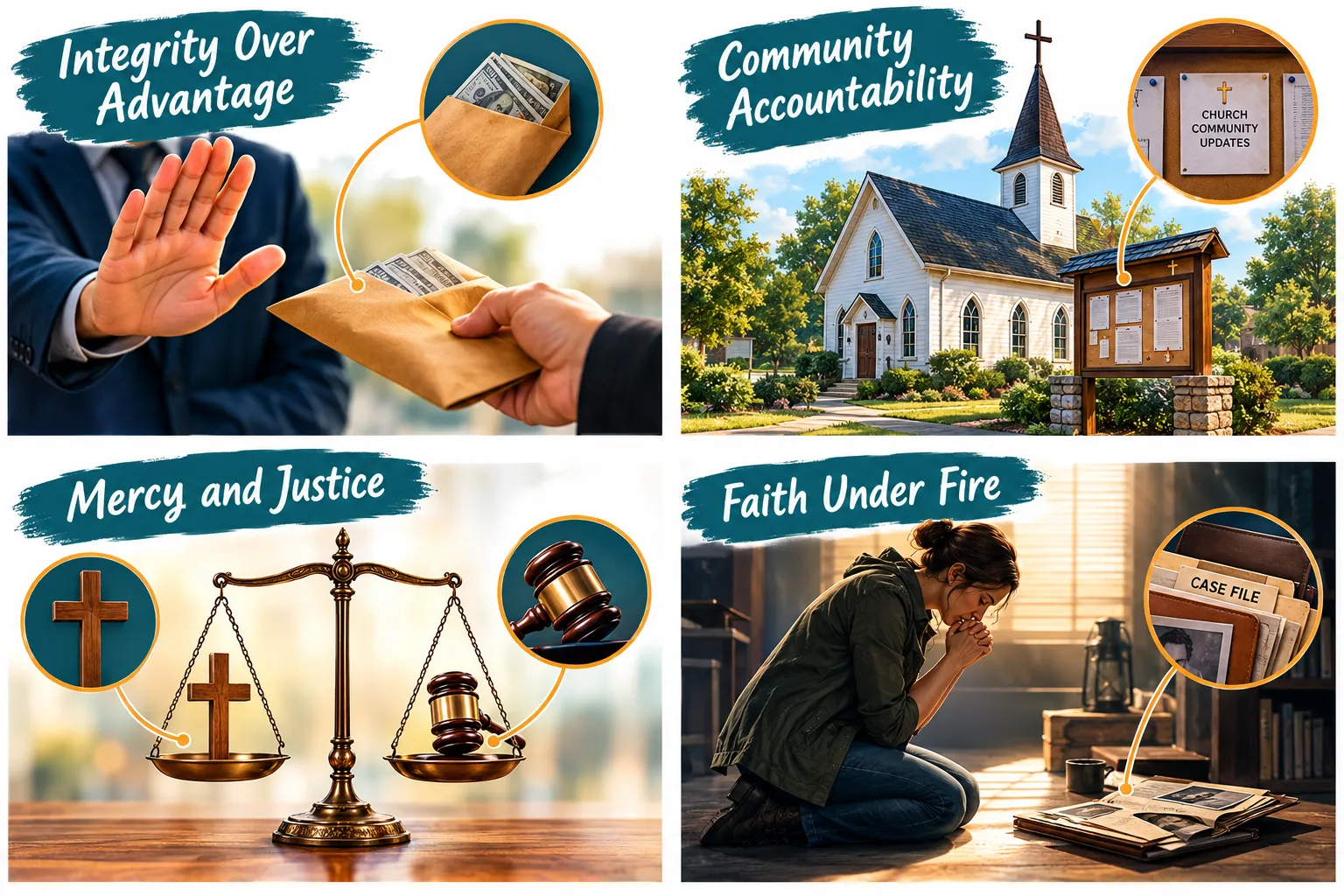
Faith reshapes the investigation at the structural level, not just the character level. A Christian PI operates under a different set of rules than a secular one, and those rules change what evidence they’ll pursue, how they’ll handle informants, and what they consider a satisfying resolution.
Specific ways faith changes the investigation:
| Investigative Element | Secular PI Approach | Faith-Shaped PI Approach |
|---|---|---|
| Gathering information | May use deception or pressure | Relies on trust, relationship, and patience |
| Confronting suspects | Tactical intimidation is on the table | Confrontation is honest, direct, and prayerfully timed |
| Handling confessions | Transactional, information for immunity | Pastoral, truth-telling as a form of release |
| Resolution | Justice served through legal system | Justice and mercy held in tension |
| Personal cost | Professional risk | Moral and relational cost to the investigator |
The faith dimension also changes what counts as a clue. In a Christian cozy, a hymnal with a margin note, a family Bible with a suspicious entry, or a prayer list with a name that shouldn’t be there, these are not just objects. They are records of what people believed and what they hid. That thematic layer is what separates Christian cozy mystery tropes in small communities from their secular counterparts.
What’s the Difference Between Secular and Faith-Based Cozy Mystery PIs
The clearest difference is accountability structure. A secular cozy PI answers to a client, a conscience, and sometimes a love interest. A faith-based PI answers to all of those, plus a community, a God they believe is watching, and a moral tradition that has specific things to say about truth, justice, and mercy.
Three practical differences:
The stakes are communal, not just personal. When a secular PI solves a case, the client gets closure. When a faith-based PI solves a case in a small Christian community, the whole congregation has to figure out how to live with what was true all along.
The investigator’s methods are constrained by ethics, not just law. A secular PI might surveil, deceive, or manipulate within legal limits. A Christian PI has a narrower lane, and that narrower lane is where the interesting story lives.
Redemption is a possible outcome for the perpetrator. Secular mysteries rarely ask whether the guilty party can be restored. Christian cozy mysteries often do, and the answer is never simple.
This distinction matters to readers who want clean Christian fiction that engages with real moral complexity rather than avoiding it.
How Christian Values Create Plot Stakes in Cozy Mystery Investigations
Christian values raise the stakes in cozy mystery by making the investigation personal in a way that goes beyond whodunit. When the PI protagonist believes that truth matters because God is truth, every lie they uncover carries weight beyond the legal.
The highest-stakes scenarios for a Christian PI:
- A trusted church leader is the perpetrator, and the PI must decide whether to expose someone the community depends on.
- The victim was hiding something that, if revealed, would destroy an innocent family member’s reputation.
- The PI’s own past is implicated in the case, and honesty about it costs them standing in the community.
- The perpetrator is genuinely repentant, and the PI must hold both justice and mercy without collapsing one into the other.
These scenarios work because faith doesn’t make the choices easier. It makes them more specific. As faith in fiction across genres explores, the best Christian fiction shows belief as a weight carried through the plot, not a solution dropped into it.
Can a PI Solve Crimes While Staying True to Christian Ethics and Morality
Yes, and the tension between effective investigation and ethical constraint is precisely what makes Christian PI fiction worth reading. The question is not whether faith limits the character (it does), but whether those limits generate better story (they can).
Where the tension produces the best fiction:
- A PI who won’t lie to a suspect has to be smarter, more patient, and more relationally skilled than one who will.
- A PI who believes in forgiveness still has to decide whether to hand evidence to law enforcement, and that decision is never clean.
- A PI operating in a church community can’t burn bridges for information. Every source is also a neighbor.
The key for authors is to let the ethical constraint create the plot problem, not resolve it. Faith under fire means the character’s beliefs get tested by the case, not confirmed by it. That’s the difference between a story that walks with readers and one that lectures them.
What Role Does Church Community Play in Christian Cozy Mystery Stories
The church community in Christian cozy mystery is not just a setting detail, it is the living system that both conceals the crime and makes the investigation possible. This dual role is what gives the subgenre its specific texture.
The community serves multiple functions:
- Information network. Church members know things. They’ve seen things. They’ve been trusted with things they probably shouldn’t have been. The PI protagonist has access to this network because they are part of it.
- Moral pressure. The community’s expectations shape what the PI will and won’t do. Reputation matters in a small church town, and that social weight is a real plot force.
- Suspect pool. The people most likely to have motive are the people closest to the victim, and in a church community, that means deacons, choir members, committee chairs, and longtime friends.
- Restoration site. When the case resolves, the community has to absorb the truth. That process, how a congregation handles betrayal, grief, and the question of forgiveness, is where the faith themes get their full weight.
For a deeper look at how church life shapes the whodunit structure, see Christian cozy mystery tropes in small communities.
Common Mistakes Authors Make Writing Christian PI Characters
The most common mistake is using the PI’s faith as a shortcut rather than a complication. When faith solves the problem instead of shaping the character’s response to it, the story loses its tension and its honesty.
Mistakes to avoid:
- The sermon moment. The PI stops the plot to explain what their faith means. This breaks the spell every time. Show faith through choice, not narration.
- Cheap grace. The perpetrator confesses, cries, and is immediately restored to community standing. Real forgiveness costs something, the story needs to show what.
- The infallible moral compass. The PI always knows the right thing to do because they’re a Christian. Real faith involves doubt, misjudgment, and the need for correction.
- Faith as decoration. A prayer here, a scripture there, but none of it changes a single plot decision. Readers notice when the faith content is cosmetic.
- Avoiding the hard case. Christian PI fiction sometimes flinches from the most morally complex scenarios, the ones where the perpetrator is sympathetic, or the victim was complicit. Those are exactly the cases worth writing.
Expert analysis from the publishing world backs this up: Shana Asaro of Harlequin Love Inspired Trade has noted growing demand for “clean, faith-centered mysteries that capture the spirit of traditional mysteries like Agatha Christie” [10], which suggests readers want the full mystery structure, not a softened version of it.

Who Reads Christian Cozy Mysteries With Private Investigator Leads
The core readership is women aged 35-65 who are active Kindle Unlimited subscribers and want fiction that engages their faith without preaching at them. They read across the cozy mystery subgenre but specifically seek out titles where the protagonist’s belief system is load-bearing, not decorative.
What this reader is looking for:
- A protagonist whose faith is tested, not just stated
- Community stakes that feel real and specific
- Clean content, no graphic violence, no explicit scenes, no profanity, but with genuine tension
- A resolution that holds mercy and justice in honest tension
- A setting (usually small-town, often Southern or rural) where church life is woven into daily existence
This reader is also likely to follow an author across genres if the faith promise holds. That’s the model behind Silas Bellhaven’s catalog, readers who find the Mercy House Mysteries in Juniper Gap can follow that same faith-rooted promise into frontier westerns, covenant fantasy, or psychological thriller. For a broader look at what this audience is reading right now, see 2026 clean and Christian Kindle Unlimited book hauls.
How Prayer and Faith Factor Into Solving Mysteries in These Books
Prayer works best in Christian cozy mystery when it changes the character’s posture before a scene, not when it delivers a miraculous answer. A PI who prays before confronting a suspect enters that scene differently, more patient, more honest, more open to an outcome they didn’t plan for.
Practical ways faith shows up in the investigation:
- Discernment over deduction. The PI senses something is wrong before the evidence confirms it, and that intuition is framed as spiritual attentiveness, not just detective instinct.
- Confession as a plot mechanism. A character who believes in the weight of unconfessed sin may crack under the PI’s patient, non-coercive questioning in ways a secular suspect would not.
- Scripture as a clue. A margin note in a hymnal, a family Bible entry, a benediction tape, these objects carry meaning in a faith community that they wouldn’t carry elsewhere. (See The Hymnal Margin Murder and The Benediction Tape Murder in the Mercy House Mysteries series.)
- Prayer as pacing. A scene where the PI stops to pray before acting slows the narrative tempo in a way that builds tension rather than releasing it, if written with honesty about what the character is actually afraid of.
What Kinds of Cases Work Best for Christian PI Protagonists
Cases rooted in community trust and institutional faith work best because they put the PI’s own world at risk. When the crime happened inside the church, the investigation threatens the PI’s relationships, reputation, and sense of spiritual home.
Case types with the highest dramatic yield:
- Misused charity or ministry funds, financial betrayal inside a faith community hits harder than an outside crime because it implicates people who were trusted precisely because of their faith.
- Hidden family histories, a family Bible with a falsified record, a genealogy that names the wrong father, a will that contradicts a deathbed testimony. These cases carry generational weight.
- Institutional cover-up, a church leadership that buried a truth to protect its reputation. The PI must decide whether to expose the institution they love.
- Crimes of desperation by sympathetic characters, someone who did something terrible for reasons the PI understands. These cases test whether justice and mercy can coexist.
The Mercy House Mysteries series consistently uses this playbook. A Donation to Die For opens with a mislabeled donation box holding a ledger and a deacon who died before he could confess. The Family Bible Secret turns on a record that was about to name the wrong family. Each case is rooted in the specific texture of church community life.
Are There Notable Christian Cozy Mystery Series With PI-Style Main Characters
Several series feature protagonists who function as amateur investigators with PI-like methods, operating from a faith-rooted ethical framework. The market is growing: Publishers Weekly reported in 2026 that Christian publishers are signaling renewed interest in mystery as a standalone category [10], with Harlequin Love Inspired Trade, Bethany House, and independent authors all releasing new titles.
Series and titles worth knowing:
- The Mercy House Mysteries (Silas Bellhaven), Nora Bell Hartley investigates crimes rooted in church community life in Juniper Gap, Tennessee. Ten books in the series, available on Kindle Unlimited. Browse the series.
- Barks & Beans Café Mysteries (Heather Day Gilbert), self-published through Gilbert’s own imprint after finding Christie-style mystery difficult to place in traditional Christian publishing [10]. A clear example of indie publishing serving the faith-mystery reader.
- Bethany House published Naomi Stephens’s Don’t Upstage the Body: A Mystery in June 2026 [10], signaling that major Christian publishers are expanding their mystery offerings beyond romantic suspense.
The wider cozy mystery market is also active: industry observers described 2026 as a strong year for cozy mystery releases overall, with a steady pipeline of new titles across secular and faith-based imprints. For readers who want the inspirational mystery lane specifically, the Mercy House Mysteries series remains one of the most consistent examples of the faith-shaped PI model done well.
How to Balance Detective Work With Religious Convictions in Cozy Mystery
The balance works when the religious conviction is the source of the dramatic tension, not the resolution of it. A PI whose faith tells them exactly what to do in every situation is not interesting. A PI whose faith tells them what they cannot do, and who has to find another way, is.
A practical framework for authors:
- Identify the ethical limit first. What will this character never do, because of their faith? Build the plot so the easiest solution requires crossing that line.
- Let the constraint generate the method. If the PI won’t deceive, they have to earn trust. That process takes longer, costs more, and produces richer scenes.
- Hold mercy and justice as separate weights. Don’t let the PI collapse one into the other. The story lives in the space between them.
- Let faith be doubted mid-case. When the investigation reveals something that makes God feel absent or unjust, the PI’s response to that doubt is where the real character work happens.
For a broader look at how this balance plays out across Christian fiction genres, see how faith themes raise the stakes in Christian psychological thrillers.
Conclusion: Faith That Earns Its Place in the Investigation
Private investigators in Christian cozy mystery work best when faith is not a credential the protagonist carries but a commitment they have to keep, even when keeping it makes the case harder. The subgenre’s real promise is not comfort through simplicity. It is hope earned through honesty about hard things.
The cases that resonate most are the ones where the PI’s faith gets tested by the investigation itself: where the evidence points at someone they love, where mercy and justice refuse to line up neatly, where the community that is supposed to be safe turns out to have been hiding something for years. That is where rooted in faith stops being a tagline and starts being a cost.
Actionable next steps for readers:
- Start the Mercy House Mysteries with A Donation to Die For, the series opens with exactly this kind of case: a deacon, a ledger, and a truth that was almost buried with him.
- Explore the Christian cozy mystery tag for more titles and analysis in this subgenre.
- For authors writing in this space, read faith in fiction across genres to calibrate how much is too much, and what “enough” actually looks like on the page.
The community is waiting. The case is open. The truth is going to cost something to find.
FAQ
What is a Christian cozy mystery PI? A Christian cozy mystery PI is a protagonist, usually an amateur investigator rather than a licensed detective, who solves crimes within a faith community using methods shaped by Christian ethics: honesty, patience, mercy, and accountability to community rather than just law.
Do Christian cozy mystery PIs have to be ordained or clergy? No. Most are laypeople, shop owners, church volunteers, charity workers, whose access to the community and personal faith make them effective investigators. Clergy-led detective fiction is a related tradition, but the Christian cozy PI is typically a neighbor, not a pastor.
How does faith change the way a PI gathers evidence? Faith limits certain tactics (deception, coercion, manipulation) and favors others (relationship-building, patient listening, honest confrontation). This constraint generates plot pressure, the PI has to find a harder, slower, more honest path to the truth.
Is Christian cozy mystery the same as inspirational mystery? They overlap significantly. “Inspirational mystery” is a broader marketing category that includes both cozy and more suspenseful titles. Christian cozy mystery specifically implies a small-town setting, low graphic content, and community-centered stakes rooted in church life.
What makes the community aspect so important in these stories? The community is both the suspect pool and the thing being protected. When the crime happened inside the church, the investigation threatens the PI’s relationships, reputation, and sense of belonging, which raises the personal stakes far beyond a standard whodunit.
Can Christian cozy mystery have real tension without graphic content? Yes. The tension comes from moral and relational stakes, not from graphic violence or explicit scenes. A PI who must choose between protecting a friend and telling the truth generates more genuine suspense than a crime scene described in graphic detail.
How do authors avoid making the PI character preachy? By showing faith through choice and consequence rather than narration. If the PI’s belief system changes what they do in a scene, not what they say about it, the faith reads as authentic rather than instructional.
Is the Christian cozy mystery market growing? Yes. Publishers Weekly reported in 2026 that major Christian publishers including Harlequin Love Inspired Trade and Bethany House are actively expanding their mystery offerings, with editors citing growing reader demand for clean, faith-centered mysteries [10].
What kinds of cases work best for a Christian PI? Cases rooted in community trust: misused charity funds, hidden family records, institutional cover-ups, and crimes committed by sympathetic characters. These scenarios put the PI’s own faith community at risk and force genuine moral reckoning.
How does prayer function in these stories without feeling like a gimmick? Prayer works best when it changes the character’s posture before a scene, making them more patient, more honest, more open to an unexpected outcome, rather than when it delivers a convenient answer. It is a tool for character interiority, not a plot device.
References
[10] Mysteries on the Rise in Christian Fiction – https://www.publishersweekly.com/pw/by-topic/industry-news/religion/article/100974-mysteries-on-the-rise-in-christian-fiction.html