Last updated: September 22, 2026
Quick Answer: Christian historical romance for fans of Outlander offers the same sweep of time periods, high emotional stakes, and slow-burn courtship, without explicit sexuality, graphic violence, or content that breaks a clean-read standard. The best examples use time-slip or dual-timeline structures to create genuine jeopardy, and they place faith at the center of the story as a load-bearing element, not decoration. Gabrielle Meyer’s Timeless series is the most direct substitute in 2026, but a growing catalog of indie and traditional titles now fills this niche.
Key Takeaways
- Christian historical romance keeps all the period detail, romantic tension, and adventure of secular historical romance but relocates intensity into courtship constraints, conflicting duties, and spiritual stakes rather than explicit content.
- Time-slip and time-crossing devices are a recognized innovation in Christian fiction, giving readers the speculative thrill of Outlander within a clean content framework.
- Gabrielle Meyer’s Timeless series (Bethany House) is the leading traditional-published example, with seven books released as of May 2026 and a planned 10-book run. [Publishers Weekly]
- Indie releases are expanding the niche rapidly, August 2026 alone brought new Christian time-travel romance titles from multiple independent authors.
- Faith in these stories is earned, not announced, characters face genuine doubt, sacrifice, and consequence before grace shows up.
- The primary audience is women 35-65 who read on Kindle Unlimited and want emotional depth, period authenticity, and content they can trust.
- Clean does not mean slow or low-stakes, the best titles carry real adventure, moral danger, and romantic tension that earns its resolution.
- Authors like Julie Klassen, Roseanna M. White, Karen Witemeyer, and Lisa T. Bergren round out the reading list for fans who want adjacent titles without literal time travel.
What Is Christian Historical Romance and How Is It Different From Regular Historical Romance?
Christian historical romance is historical fiction with a romantic central arc in which faith functions as a genuine story element, shaping character decisions, raising moral stakes, and influencing how the relationship develops. It is not simply historical romance with a church scene added.
The practical difference comes down to three things:
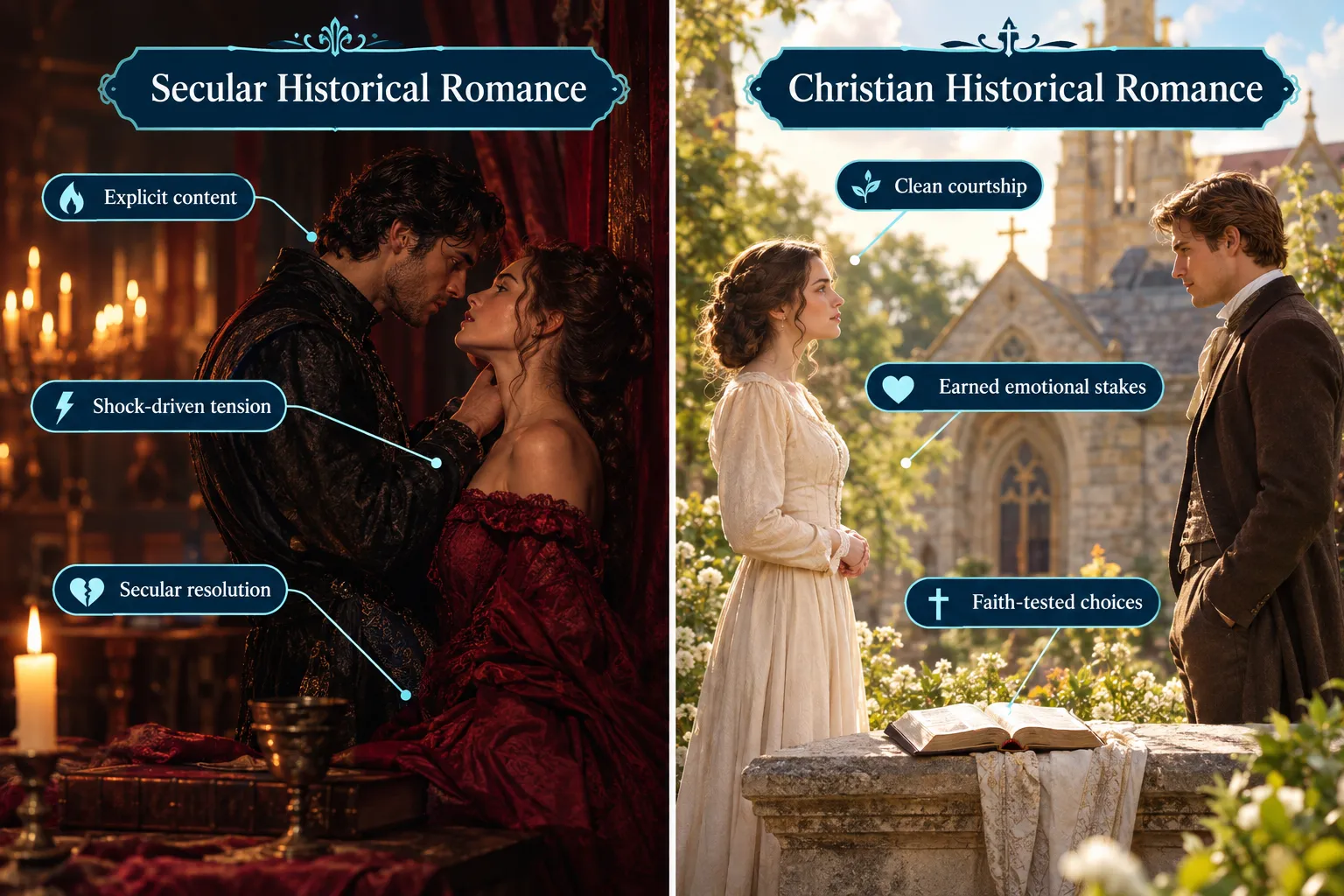
- Content boundaries. Christian historical romance holds to clean content: no explicit sexuality, no graphic violence, no profanity. Romantic tension is expressed through courtship, longing, and restrained physical affection, typically kisses only, with intimacy handled discreetly or off-page. [9]
- The role of faith. In secular historical romance, a character’s religion is usually background detail. In Christian historical romance, faith is tested by the plot. A character’s belief, or doubt, shapes what choices are available and what those choices cost.
- How redemption works. Secular romance often resolves with emotional healing or social vindication. Christian historical romance tends toward what might be called earned grace: mercy that arrives after real cost, not instead of it.
For a deeper look at how these content standards actually work in practice, Clean Christian Fiction vs. Inspirational Romance: Content Standards, Faith Focus, and Reader Expectations breaks down the distinctions readers care most about.
Christian Historical Romance vs. Secular Historical Romance: What’s the Difference in Practice?
The clearest way to see the difference is to look at what carries the dramatic weight. Outlander derives much of its intensity from explicit sexuality, sexual threat, torture, and graphic war violence. [New Zealand Classification Office] Those elements are not available in Christian historical romance, but the emotional intensity has to go somewhere, and where it goes is what defines the genre.
In Christian historical romance, tension lives in:
- The cost of a moral choice under pressure (loyalty vs. truth, duty vs. love)
- Courtship that moves slowly because the characters take commitment seriously
- Persecution, family fracture, or social consequence tied to faith
- Spiritual doubt that the story refuses to resolve cheaply
- Sacrificial decisions where something real is surrendered
This is not a lesser version of the drama. It’s a different architecture for it. The stakes are just as high, they’re simply built from different material.
“Walking with them, not talking at them”, the goal is fiction that feels like a companion in hard places, not a lesson about them.
Best Christian Historical Romance Books Like Outlander
The closest direct substitute for Outlander fans in 2026 is Gabrielle Meyer’s Timeless series, published by Bethany House. The series uses a “time-crosser” device: characters live simultaneously in two historical periods and must ultimately choose one life. That choice, not the mechanism of travel, is where the story lives. [Publishers Weekly, 2026]
The Timeless series (Gabrielle Meyer):
| Book | Eras | Published |
|---|---|---|
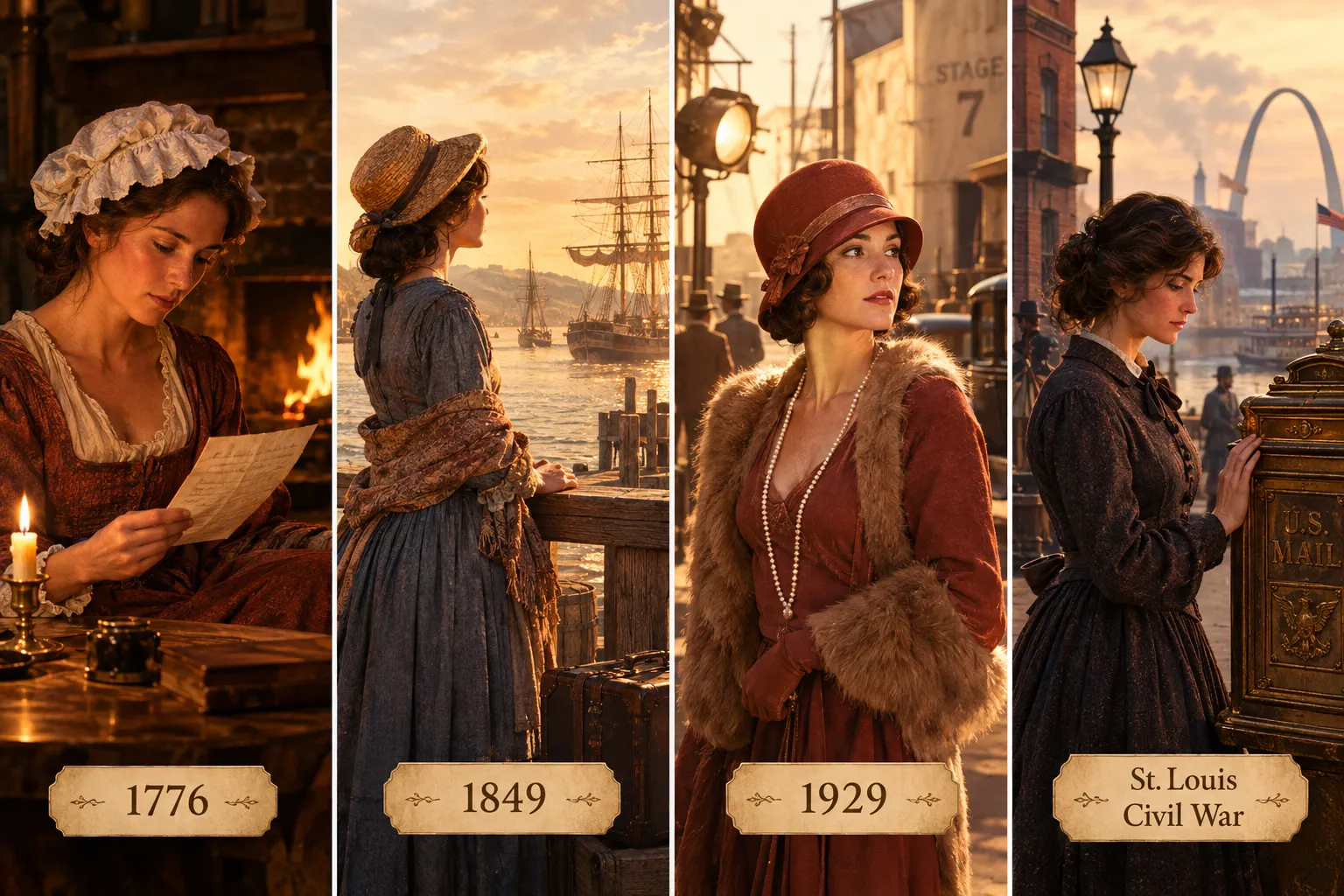
| When the Day Comes (Book 1) | American Revolution / Pre-WWI England | Sept 15, 2026 retail release |
| Into a Golden Era (Book 7) | 1849 San Francisco / 1929 Hollywood | May 5, 2026 |
| Series planned for 10 books total | Various American and European eras | Ongoing |
Reader reviews consistently classify the series as “kisses only” romance with no profanity and discreet handling of intimacy. [Reading Is My SuperPower, 2026]
Other strong options:
- Lisa T. Bergren’s River of Time series, contemporary characters transported to medieval Italy, with adventure, courtship, and Christian themes. Rated PG+ by reader content guides: kissing, no language, moderate action. [Goodreads]
- Julie Klassen, Regency and Victorian settings, strong courtship focus, faith woven into character decision-making. [9]
- Roseanna M. White, espionage, WWI, and Regency settings with dual timelines and deep spiritual stakes. [9]
- Lori Benton, frontier and colonial American settings with rich period detail and faith under fire.
- Kristy Cambron, dual-timeline stories spanning WWII and the present, with strong faith arcs.
For a broader reading list across Christian historical fiction, the Christian Historical Fiction tag is a good place to continue.
Clean Historical Romance With Time Travel and Faith Themes
Clean time-travel romance within Christian fiction is a growing niche, not a rare exception. The device works especially well for faith-rooted stories because the displacement itself becomes a spiritual question: What is a person responsible for, in a time that isn’t theirs? What does faithfulness look like when the world around you has changed completely?
2026 releases in this specific niche include:
- Sarah Hanks’s Braving Red Waters, a woman wakes in Civil War-era St. Louis after touching an antique mailbox. [Iola Goulton, 2026]
- Lynne Basham Tagawa’s Jezebel’s Children, time travel to the trial of Anne Hutchinson, colonial doctrine, politics, and gentle romance. [Iola Goulton, 2026]
- Pamela G. Baker’s Mending Time, a character travels from 1873 to 2020, released May 2026. [Sarah Hamaker, 2026]
- Sarah Hanks’s Braving Fiery Waters, time travel to 1849, released January 2026. [Sarah Hamaker, 2026]
The indie market is producing these titles faster than traditional publishing can track them, which means Kindle Unlimited is often the first place they appear. The 2026 Clean & Christian Kindle Unlimited Book Hauls post covers what faith-focused readers are actually picking up right now.
Who Reads Christian Historical Romance and What Do They Look For?
The core reader is a woman between 35 and 65 who reads primarily on Kindle Unlimited. She wants emotional depth, period authenticity, and a content standard she can trust, not because she’s fragile, but because she’s made a deliberate choice about what she lets into her imagination. [6][8]
What she’s specifically looking for:
- Romantic tension that builds slowly and pays off honestly
- A historical world rendered with enough specificity to feel real
- A faith element that doesn’t preach at her, one that shows up in character choices, not authorial narration
- Stakes that feel genuine: something can actually go wrong, and the resolution isn’t guaranteed
- Clean content she doesn’t have to skim or skip
What she is not looking for is a sanitized version of a secular story with Bible verses inserted. The faith has to be load-bearing. If you removed it, the story would collapse, that’s the standard.
For more on how Christian fiction handles faith without moralizing, Faith in Fiction Without Preaching: How Christian Authors Keep Story First While Still Exploring Spiritual Themes is worth reading alongside this guide.
Can You Have Adventure and Action in Christian Historical Romance, or Is It Just Slow Burn?
Christian historical romance absolutely supports adventure, danger, and high-stakes action, the genre is not defined by quietness. What it avoids is graphic depictions of violence or sexual threat used for shock value. That’s a different thing entirely.
Adventure elements that appear regularly in the genre:
- War and political upheaval as backdrop (Revolutionary War, Civil War, WWI)
- Persecution for faith, real historical threat, not metaphor
- Frontier danger, wilderness survival, and physical peril
- Espionage and hidden identity (especially in Roseanna M. White’s work)
- Time-crossing into eras of genuine historical violence, handled with weight but not graphic detail
The Timeless series places characters in the American Revolution and pre-WWI England, both settings carry real mortal stakes. Lisa T. Bergren’s River of Time series involves sword fights, political imprisonment, and genuine physical danger. The adventure is there. It just doesn’t use gore as a shortcut to tension.
For a look at how Christian Historical Romance with Suspense handles period detail and clean tension together, that post covers the craft side of keeping action compelling without crossing into graphic content.
Christian Romance Books With Strong Courtship and Marriage Focus
Courtship is where Christian historical romance earns its reputation for slow burn, and it’s one of the genre’s genuine strengths. When characters take commitment seriously, the romantic arc carries real weight. Every step forward costs something.
What strong courtship looks like in this genre:
- Restrained physical affection that makes a single touch meaningful
- Competing obligations, duty to family, faith community, or calling, that complicate the relationship
- Moral accountability between the characters, not just attraction
- Marriage as a genuine destination, not a narrative afterthought
- Spiritual compatibility as a real criterion, not a given
Authors like Karen Witemeyer are particularly known for this, her heroes and heroines tend to come from different social positions or vocational callings, and the courtship works through those differences honestly. Tamara Alexander’s work often places courtship inside historical settings where marriage carried legal and social weight that modern readers have largely lost sight of. [9]
How Much Religious Content Should Be in a Christian Romance Novel?
The right amount of faith content is exactly enough to make the story’s moral architecture make sense, no more. The moment faith content becomes a lecture, it stops functioning as story and starts functioning as agenda, and readers feel that shift immediately.
A useful rule: faith should show up in what characters choose, not in what the narrator explains. A character who prays before a difficult decision, then makes the wrong one anyway, then lives with the consequence, that’s faith under fire. A character who stops to reflect on a Bible verse before the plot continues, that’s a speed bump.
Signs the faith content is calibrated well:
- Removing the faith element would change the plot, not just the tone
- Characters doubt, fail, and repent, not just believe and succeed
- Spiritual growth is earned through story events, not announced
- The faith feels like the character’s own, not the author’s
Signs it’s overcalibrated:
- Scenes pause for devotional content unconnected to the plot
- Every conflict resolves through a prayer or scripture
- Secondary characters exist primarily to deliver spiritual wisdom
- The villain’s problem is simply that they don’t believe
For a broader look at this balance across genres, Faith in Fiction Across Genres: How Much Is Too Much addresses the same question from multiple angles.
Time-Slip Romance Books With Faith and Redemption Themes
Time-slip romance, where a character is displaced into another era, often without a clear mechanism, is slightly different from hard time-travel fiction. The displacement is more mysterious, more spiritually suggestive, and often more explicitly tied to a redemptive purpose. The character isn’t just visiting the past; they’re there for a reason.
This structure maps naturally onto Christian themes of calling, providence, and sacrifice. If a character has been placed in another time, the story’s central question becomes: What does faithfulness require of you here, now, in this time that isn’t yours?
Key titles in this specific niche:
- Gabrielle Meyer’s Timeless series, the character lives in both times simultaneously, which raises the stakes further: she must eventually surrender one life entirely. That sacrifice is the spiritual core of the series. [Publishers Weekly, 2026]
- Lynne Basham Tagawa’s Jezebel’s Children, time travel to a colonial doctrinal crisis, where the faith stakes are historical and personal at once. [Iola Goulton, 2026]
- Lisa T. Bergren’s River of Time, contemporary faith tested inside a medieval world that doesn’t share modern assumptions about grace. [Goodreads]
Redemption in these stories tends to cost something specific. It’s not a general spiritual uplift, it’s a particular sacrifice, made by a particular person, in a particular moment. That specificity is what makes it land.
Common Mistakes Authors Make Writing Christian Historical Romance
The most common failure is treating faith as a content filter rather than a story engine. That produces books that feel sanitized rather than clean, the difference being that sanitized removes tension, while clean redirects it.
Mistakes that flatten the genre:
- Cheap grace, the character’s spiritual problem resolves too easily, without real cost. Readers trained on good fiction feel this immediately.
- Anachronistic faith, a 19th-century character who thinks and speaks about God in 21st-century evangelical idiom. Period-accurate faith is more interesting and more honest.
- The sermon scene, a wise mentor character delivers a speech that explains the theme. This is the single most common complaint in Christian fiction reviews.
- Passive heroines, female characters whose faith makes them more compliant rather than more courageous. Historical women of faith were often the opposite.
- Resolved doubt, a character who doubts God early in the book and then simply stops doubting after a plot event. Real doubt is harder than that, and readers know it.
- Ignoring historical darkness, sanitizing the period so thoroughly that the historical setting loses its weight. The faith is more meaningful when the world it operates in is genuinely difficult.
For writers thinking about how Christian Historical Romance with Suspense handles period authenticity alongside clean content, that post addresses the craft problem directly.
What Makes a Good Christian Romance Ending Different From Secular Romance?
In secular romance, the ending typically delivers the “happily ever after”, the couple together, the external obstacles removed, the emotional wound healed. That’s a satisfying structure, and Christian romance often uses it too.
But the best Christian historical romance endings carry something extra: a sense that the happiness is contingent, that it was not guaranteed, that it cost something real to arrive here, and that the characters are changed by what it cost. Grace shows up after cost, not instead of it.
What distinguishes the ending:
- The resolution feels earned because something was genuinely surrendered
- The couple’s faith is stronger for having been tested, not simply affirmed
- The “happily ever after” exists inside an honest acknowledgment that hard things remain, but the characters face them together, and not alone
- There’s often a quiet moment of gratitude that doesn’t need to be explained
This is the difference between a tidy ending and a true one. Readers in this genre have read enough to know the difference, and they remember the books that got it right.
Are There Christian Historical Romance Series Like Outlander With Multiple Books?
Yes, and the catalog is growing. Readers who want the sustained investment of a multi-book series have genuine options in 2026.
Multi-book series worth following:
- Gabrielle Meyer’s Timeless series, seven books released as of May 2026, with a planned 10-book run. Each book features a new time-crossing protagonist, so they can be read independently while sharing the same world and premise. [Publishers Weekly, 2026]
- Lisa T. Bergren’s River of Time series, follows the same characters across multiple books, with escalating stakes and a sustained romantic arc.
- Roseanna M. White’s Shadows Over England series, WWI-era espionage and romance across multiple interconnected novels. [9]
- Kristy Cambron’s Hidden Masterpiece and Lost Castle series, dual-timeline structures that carry across multiple books.
For readers who want clean Christian fiction across multiple genres, not just historical romance, Clean Christian Fiction: How to Build a Cross-Genre Reading Plan for Kindle Unlimited offers a practical framework for building a reading list that holds together.
Where Do Fans of Outlander Find Christian Historical Romance Recommendations?
The best discovery channels in 2026 are a mix of traditional and community-driven:
- Kindle Unlimited browsing, the indie Christian time-travel romance market is particularly active on KU, and the algorithm surfaces similar titles once you’ve read one or two.
- Goodreads lists, searches for “Christian time travel romance” or “clean historical romance” surface curated community lists that are regularly updated.
- Reading Is My SuperPower (readingismysuperpower.org), one of the most thorough content-rating review sites for Christian fiction, with detailed notes on kissing, language, and faith content level for each book reviewed.
- Sarah Hamaker’s monthly new-release roundups (sarahhamakerfiction.com), comprehensive monthly lists of new Christian fiction releases across subgenres, including historical and time-travel titles.
- The Silas Bellhaven blog, covers clean Christian fiction across genres, with posts that help readers find titles by mood, content standard, and faith intensity. The Best Christian Fiction Authors Across Cozy Mystery, Western, Fantasy, Thriller, and LitRPG post is a good starting point for readers whose tastes run wider than romance alone.
FAQ
Q: Is Christian historical romance the same as inspirational romance? A: They overlap significantly but aren’t identical. Inspirational romance (a category used by publishers like Harlequin Love Inspired) may include Christian and non-Christian faith traditions. Christian historical romance specifically centers the Christian faith as a story element. All Christian historical romance is inspirational, but not all inspirational romance is explicitly Christian.
Q: Does Christian historical romance have to be set in America? A: No. The genre covers Regency England, medieval Europe, colonial settings across multiple continents, WWI and WWII Europe, and beyond. The setting is historical; the faith is Christian. Geography is open.
Q: What’s the difference between time-slip and time-travel in Christian romance? A: Time-travel usually involves a mechanism (a device, a portal, a specific object). Time-slip is more mysterious, the character simply finds themselves in another era, often with a providential suggestion that they were meant to be there. Christian fiction tends to favor time-slip because the ambiguity fits naturally with themes of calling and divine purpose.
Q: Are these books available on Kindle Unlimited? A: Many are, particularly indie titles. Traditional-published series like Gabrielle Meyer’s Timeless are available for purchase on Kindle but may not be on KU. Indie time-travel Christian romance titles from 2026 are frequently KU-enrolled at launch.
Q: How explicit is the romance in these books? A: Reader content guides consistently classify the leading titles as “kisses only”, physical affection is present but not explicit. Intimacy between married characters is handled off-page or with discreet reference only.
Q: Can men enjoy Christian historical romance? A: The genre is written primarily for women and marketed accordingly. That said, the adventure elements, historical detail, and moral stakes in titles like Meyer’s Timeless series or Bergren’s River of Time carry genuine appeal for any reader who values those elements regardless of gender.
Q: What if I want Christian historical fiction without the romance? A: The genre exists, it’s simply called Christian historical fiction rather than romance. Authors like Lynn Austin write deeply researched Christian historical fiction in which romance may be present but isn’t the primary arc. For readers whose tastes run toward frontier settings, Christian Frontier Westerns: How Modern Faith-Based Authors Blend Historical Accuracy With Spiritual Themes covers that adjacent territory.
Q: Is Gabrielle Meyer’s Timeless series complete? A: As of September 2026, seven books have been published, with Into a Golden Era (May 2026) being the most recent. Publishers Weekly reported a planned 10-book run, but no title after book seven is currently scheduled. [FictionDB; Publishers Weekly, 2026]
Q: What makes the Timeless series specifically similar to Outlander? A: Both involve a woman displaced across time, a romantic relationship complicated by that displacement, and high historical stakes. The structural difference is that Meyer’s protagonist lives in both eras simultaneously and must choose one, which creates a sustained tension Outlander achieves through different means. The content difference is that Meyer’s series is clean throughout.
Q: How do I know if a Christian historical romance is actually clean? A: Reading Is My SuperPower (readingismysuperpower.org) provides detailed content ratings for most major Christian fiction releases, including specific notes on physical affection, language, and violence. Their reviews are reliable and specific enough to make informed decisions before purchasing.
Conclusion
Christian historical romance for fans of Outlander is not a compromise, it’s a different architecture for the same emotional hunger. The sweep of history, the slow-burn courtship, the sense that something real is at stake: all of that is present. What’s different is where the intensity lives. Instead of explicit content, it lives in the cost of a moral choice. Instead of graphic violence, it lives in persecution, sacrifice, and the weight of a decision that can’t be undone.
The Timeless series is the clearest starting point in 2026, with seven books already published and three more planned. But the indie market is producing new Christian time-travel romance titles every month, and authors like Lisa T. Bergren, Roseanna M. White, Julie Klassen, and Karen Witemeyer have built substantial catalogs for readers who want to go deeper.
Practical next steps:
- Start with Gabrielle Meyer’s When the Day Comes (Book 1 of Timeless), it’s the series entry point and covers the American Revolution and pre-WWI England simultaneously.
- Check Reading Is My SuperPower for content ratings before trying a new author.
- Browse Kindle Unlimited for indie Christian time-travel romance, the niche is active and growing.
- Use the How to Find Clean Christian Fiction Across Every Genre guide to build a reading list that extends beyond historical romance into mystery, frontier fiction, and fantasy, all rooted in the same faith.
Hope in the dark doesn’t require darkness to be graphic. It just requires the dark to be real, and the light, when it comes, to have cost something.
References
[1] Top Selling Christian Fiction – https://www.accio.com/business/top-selling-christian-fiction [6] Best Selling Christian Romance Novels – https://www.accio.com/business/best-selling-christian-romance-novels [8] Best Selling Christian Romance Authors – https://www.accio.com/business/best-selling-christian-romance-authors [9] 25 Christian Historical Romance Novels – https://www.silverpetticoatreview.com/25-christian-historical-romance-novels/