Last updated: September 12, 2026
Quick Answer: Christian frontier westerns are faith-rooted historical novels set in the American West, typically the mid-to-late 1800s, that use period-accurate settings, legal systems, and daily survival as the stage for spiritual questions about justice, mercy, and moral law. They differ from secular westerns in that faith is load-bearing, not decorative, and from preachy inspirational fiction in that the theology shows up through character choice and consequence rather than narration. The best examples in the subgenre treat grace as something that costs something before it arrives.
Key Takeaways
- Christian frontier westerns blend documented history, land claims, territorial law, railroad expansion, with spiritual themes like earned redemption, providence, and conscience.
- Faith is woven into character decisions, not delivered as sermon; the best authors let moral weight accumulate through plot.
- Historical accuracy functions as a “secondary character” in strong frontier fiction, the setting shapes the spiritual stakes rather than just decorating them [1].
- The subgenre is growing: publishers and retailers are actively expanding their frontier/western Christian catalogs as reader demand rises [3][4].
- The primary audience skews toward women 35-65, many reading on Kindle Unlimited, who want real stakes without graphic content.
- Christian westerns handle violence and conflict through consequence and moral cost rather than graphic depiction.
- Common craft mistakes include sanitizing history so thoroughly that the spiritual tension disappears, or front-loading scripture references before trust is earned.
- Series with linked protagonists and conscience-driven plots, like The Mercy Line, are a strong structural model for the subgenre.
What Are Christian Frontier Westerns and How Do They Differ From Regular Westerns
Christian frontier westerns are historical novels set in the American frontier era that place a Christian worldview, not as backdrop, but as the moral engine, at the center of the story. A secular western asks what a man will do when the law runs out. A Christian frontier western asks what he answers to when it does.
The difference is not content warnings or the absence of conflict. It’s the underlying question the story is built around.
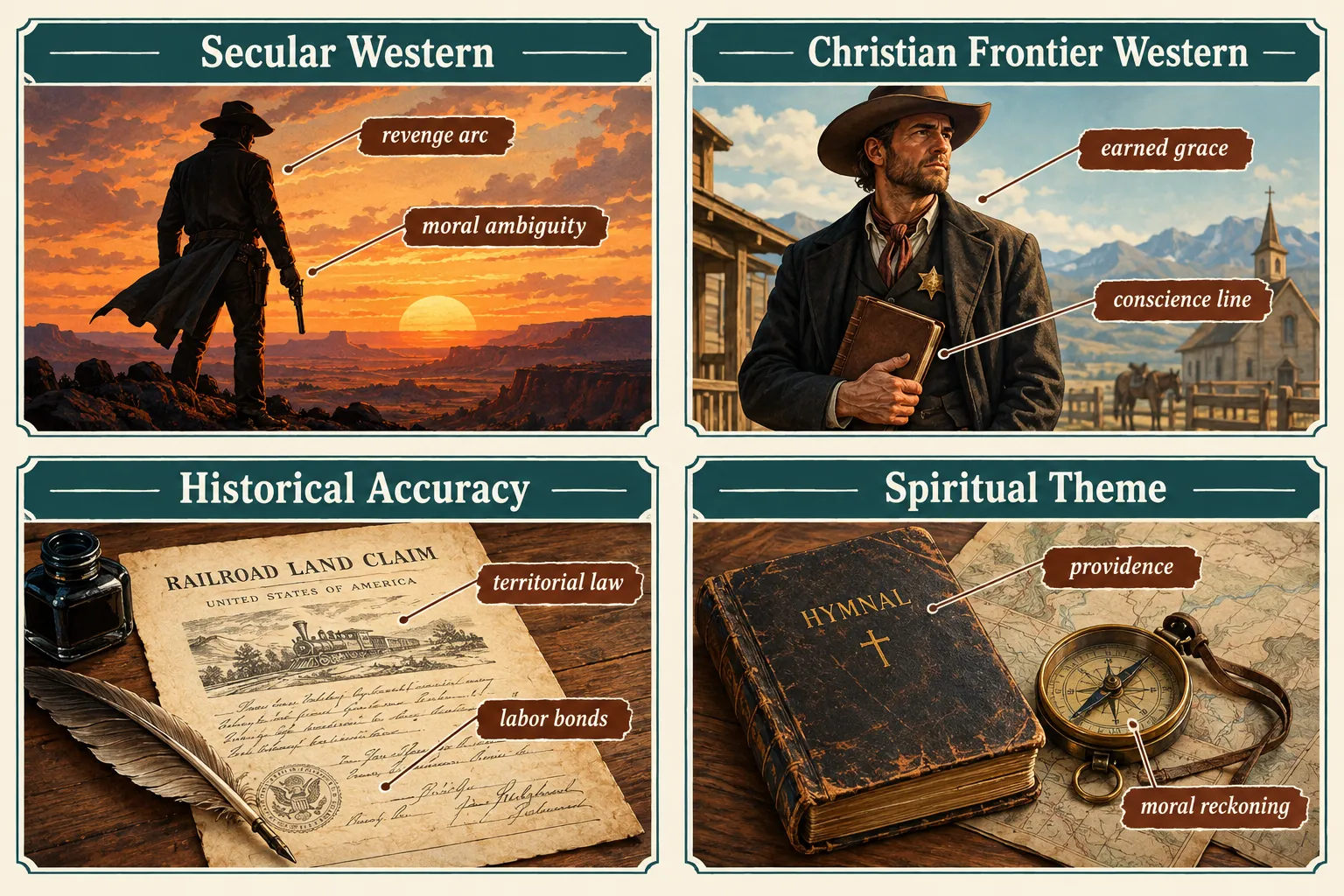
| Feature | Secular Western | Christian Frontier Western |
|---|---|---|
| Central tension | Survival, revenge, or power | Conscience, justice, and moral law |
| Faith role | Absent or incidental | Load-bearing, tested through plot |
| Resolution | Earned by force or cunning | Earned through moral reckoning |
| Violence | Often graphic | Present but consequence-focused |
| Romance | Frequently central | Variable; often secondary or absent |
In a Christian frontier western, the land dispute, the false warrant, or the disputed labor bond isn’t just a plot problem, it’s a test of what the protagonist actually believes about truth, mercy, and accountability. That’s the distinction that matters.
What Spiritual Themes Appear Most in Frontier Western Fiction
The most durable spiritual themes in Christian frontier westerns grow directly from the historical setting rather than being imported into it. Frontier life, with its thin legal infrastructure, physical danger, and isolation from institutional religion, creates natural pressure on exactly the questions faith addresses.
Recurring spiritual themes in the subgenre:
- Mercy and justice in tension, when the law is corrupt or absent, a character must decide which one takes precedence
- Earned grace, redemption that arrives after genuine cost, not as a shortcut around consequence
- Providence under uncertainty, characters acting faithfully without knowing the outcome
- The weight of the record, land claims, ledgers, warrants, and testimony as moral documents, not just legal ones
- Faith under fire, belief tested by isolation, loss, and the absence of easy answers
- Conscience over compliance, the difference between following orders and following what’s right
These themes work in frontier settings because the setting itself demands them. A man holding a false warrant in territorial Arizona in 1882 doesn’t have a pastor to call. He has what he believes and what he’s willing to do about it.
For a broader look at how faith operates across different fiction genres, Faith in Fiction Across Genres: How Much Is Too Much? covers the balance question in depth.
Are Christian Westerns Historically Accurate or Mostly Fiction
Strong Christian frontier westerns prioritize historical accuracy as a craft requirement, not an optional layer. Author Tracie Peterson has described the frontier setting as a “secondary character”, meaning the period details of land law, railroad expansion, labor conditions, and daily survival should shape the story’s stakes, not just dress the scenery [1].
The Historical Novel Society notes that readers of Christian historical fiction hold accuracy expectations that are, in some respects, higher than general historical fiction readers, because inaccuracy breaks both the narrative and the worldview contract [7].
What accuracy looks like in practice:
- Period-correct legal systems (territorial courts, land claims, labor bonds)
- Authentic social structures, including the real hardships faced by settlers, laborers, and marginalized communities
- Honest depiction of frontier violence and injustice, even when graphic detail is avoided
- Real geography, documented settlement patterns, and period-accurate economics
Author Heather Blanton has been direct about this: sanitizing frontier history to make it more comfortable actually undermines the spiritual power of the story, because grace only means something against a backdrop of genuine darkness [2].
The distinction worth holding: historical accuracy and graphic content are not the same thing. A Christian western can be honest about the brutality of frontier injustice without depicting it in graphic detail. The moral weight comes through consequence, not description.
Who Reads Christian Frontier Westerns and Why
The core audience for Christian frontier westerns is women between 35 and 65, many of whom read on Kindle Unlimited and are actively looking for fiction that handles faith honestly without moralizing [1][4]. They want real stakes, not sanitized plots where no one suffers, but they also want content that doesn’t require them to filter out graphic violence, explicit content, or profanity.
That’s not a small ask. It’s actually a precise creative challenge, and the authors who meet it build loyal readers.
Why this audience chooses the frontier western subgenre specifically:
- The historical setting provides natural, earned stakes without requiring manufactured drama
- Frontier isolation makes spiritual questions feel urgent rather than academic
- The absence of modern institutional support forces characters to act from genuine belief
- The genre’s masculine-coded history makes faith-driven male protagonists feel fresh and specific
- Clean Christian fiction in this subgenre is genuinely hard to find, so discovery drives loyalty
For a deeper look at what draws Christian readers to this genre, Why Christian Readers Love Frontier Westerns covers the genre appeal and reader expectations in detail.
Best Christian Western Authors and Books to Read in 2026
Several authors have built strong reputations for blending frontier historical accuracy with spiritual themes in ways that don’t reduce to formula.
Authors worth reading:
- Tracie Peterson, one of the most prolific voices in Christian historical western fiction, known for research-grounded settings and faith arcs that develop through plot [1]
- Heather Blanton, writes gritty frontier realism with an explicit commitment to honest history over comfortable sanitization [2]
- Carly Carlson, a newer voice in Christian historical fiction whose craft approach emphasizes character-driven faith integration [5]
- Heidi Gray McGill, focuses on emotional authenticity and faith as lived experience in frontier-era settings [10]
- Silas Bellhaven, The Mercy Line series is built around a railroad-era frontier town where land claims, labor bonds, and buried records test what characters actually believe about justice and mercy
Starting points for new readers:
- The False Warrant (The Mercy Line, Book 1), a territorial custody dispute that asks what lawful obedience is worth
- The Living Record (The Mercy Line, Book 4), a lawman holding the line between legal paper and a deadly road
- The Orchard Claim (The Mercy Line, Book 5), a widow paying for a debt that was never hers
For a broader reading list across Christian fiction subgenres, Best Christian Fiction Authors Across Cozy Mystery, Western, Fantasy, Thriller, and LitRPG is a good next stop.
How Do Christian Authors Balance Historical Accuracy With Religious Messaging
The balance question is really a craft question: faith should emerge from the historical situation, not be imported over it. When a character’s spiritual conviction shapes how they respond to a land fraud or a false warrant, the faith and the history are doing the same work. When a character stops the plot to deliver a theological explanation, they’ve stopped being a frontier character and become a mouthpiece.
Practical craft principles the best authors follow:
- Root the spiritual stakes in the historical stakes. A disputed survey line isn’t just a plot problem, it’s a question about who gets to define truth.
- Let characters doubt before they act. Faith under fire is more compelling than faith as a given.
- Use period-accurate moral frameworks. Characters in 1880s territorial courts thought about justice, debt, and testimony in specific ways. Use those frameworks rather than importing modern sensibilities.
- Show grace arriving after cost. Redemption that costs nothing reads as cheap; redemption that arrives after genuine loss reads as true.
- Trust the reader. Readers who choose Christian frontier westerns don’t need the theme explained. They need a story that earns it.
Author Carly Carlson has described this as writing fiction that “walks with” the reader rather than “talks at” them, a distinction that applies directly to how faith gets handled in historical settings [5].
Christian Western Books vs. Secular Western Books: Key Differences
The practical differences between Christian and secular frontier westerns show up most clearly in three areas: the moral architecture of the plot, how violence functions, and what resolution looks like.
Moral architecture: Secular westerns often operate on a might-makes-right or survival-of-the-fittest framework. Christian westerns operate on a moral law framework, there is a right answer, even when no one enforces it, and the protagonist’s arc is about whether they’ll act on it.
Violence and conflict: Secular westerns frequently use violence as spectacle. Christian frontier westerns use violence as moral consequence, it costs something, it changes people, and it is never the point of the scene.
Resolution: A secular western often ends with the hero’s power confirmed. A Christian frontier western ends with the hero’s conscience confirmed, sometimes at significant personal cost.
For readers looking specifically for clean western novels with no swearing or graphic content, the Christian frontier subgenre is the most reliable place to find them.
How to Write a Christian Western Novel: Core Craft Principles
Writing a Christian frontier western that works as both historical fiction and faith-rooted story requires holding two things at once: the period must be real enough to create genuine stakes, and the faith must be lived enough to create genuine character.

Step-by-step framework:
- Anchor your setting in documented history. Choose a specific time, place, and legal/economic system, territorial courts, railroad expansion, homestead claims, and research it enough that it shapes your plot, not just your descriptions.
- Build your protagonist’s faith as a liability first. Characters whose faith costs them something early are more compelling than characters whose faith is simply a positive trait.
- Let the historical situation create the spiritual test. A false warrant, a disputed land claim, or a labor bond that traps workers, these are ready-made conscience tests.
- Withhold easy resolution. Grace should arrive late and cost something. Cheap resolution undermines both the history and the faith.
- Use period-accurate moral language. Characters in frontier settings thought about debt, testimony, and obligation in specific ways. Use that vocabulary.
- Keep the faith implicit until the plot earns it explicit. A character can pray, wrestle with God, or act from conviction without narrating their theology.
For writers working on related subgenres, How to Write Christian Cozy Mystery covers parallel craft principles for faith integration in historical settings.
Common Mistakes Christian Authors Make in Western Settings
The most common errors in Christian frontier westerns fall into two categories: historical sanitization and faith front-loading.
Historical sanitization happens when an author removes the genuine darkness of frontier life, the violence, the injustice, the moral complexity, to make the story more comfortable. The problem is that grace only has weight against genuine darkness. A story where nothing is really at stake produces a faith arc where nothing is really proven.
Faith front-loading happens when characters express their faith through dialogue or narration before the plot has given them reason to. A character who announces their trust in God in chapter one and never has that trust tested hasn’t demonstrated faith, they’ve stated it. The story hasn’t earned it yet.
Other common mistakes:
- Using historical settings as costume rather than as moral architecture
- Making faith the solution to every plot problem (easy answers undermine tension)
- Writing male frontier protagonists as emotionally flat, conscience requires interiority
- Avoiding all moral ambiguity to keep the story “safe”, ambiguity is where faith actually operates
- Dropping scripture references as shorthand for character depth rather than earning it through action
For a look at how Christian authors build suspense without relying on darkness as spectacle, How Christian Authors Build Suspense Without Darkness in Psychological Thrillers addresses the same tension from a different genre angle.
Where to Find Christian Frontier Western Novels
Christian frontier westerns are available through several dedicated channels, and the category has grown enough that specialized curation now exists.
- Kindle Unlimited, the primary discovery platform for the subgenre, with multiple series available for borrow [3][4]
- ChristianBooks.today, maintains a dedicated Frontier Western collection with curated titles [3]
- Amazon author pages, series pages for authors like Silas Bellhaven allow readers to follow linked-protagonist series in order
- Goodreads, Christian western shelves and lists, though curation quality varies; see Goodreads for Christian Fiction Fans for guidance on finding reliable lists
- Christian fiction blogs and podcasts, the Christian Book Blurb podcast covers frontier and western titles regularly [9]
For readers specifically looking for series worth binge-reading on Kindle Unlimited, Christian Western Fiction Kindle Unlimited: Which Series Are Worth Binge Reading is a practical starting point.
What Makes a Frontier Western Authentically Christian
A frontier western is authentically Christian when the faith is load-bearing, when removing it would collapse the story’s moral architecture, not just change its tone. That’s the test.
It’s not about the presence of prayer scenes, scripture references, or church settings. It’s about whether the story’s central question is a faith question: What does a person answer to when no institution enforces the right thing? What does mercy cost when justice is also required? What does a man do with a false warrant when obeying it is legal and refusing it is dangerous?
Markers of authentic faith integration in frontier westerns:
- The protagonist’s faith shapes their choices at plot-critical moments, not just in quiet scenes
- Grace arrives after genuine cost, not as a rescue from consequence
- The historical setting creates the spiritual test rather than just providing atmosphere
- Moral questions remain open long enough for the reader to feel their weight
- The story trusts the reader to recognize the faith without having it explained
The conscience line from The Mercy Line series captures this well: “Where law runs out, a man finds what he answers to.” That’s not a tagline about religion. It’s a story question that only has a meaningful answer if faith is real.
FAQ: Christian Frontier Westerns
What time periods do Christian westerns typically cover? Most Christian frontier westerns are set between roughly 1860 and 1900, the post-Civil War settlement era, railroad expansion, and territorial court period. This window provides the richest combination of documented injustice, thin legal infrastructure, and genuine frontier conditions that create natural spiritual stakes.
Are Christian frontier westerns just preaching or actual good stories? The best ones are actual good stories. The difference is craft: faith that emerges from character choice and historical consequence reads as authentic; faith delivered through narration or dialogue before it’s been earned reads as preaching. Readers in this subgenre are experienced enough to know the difference immediately.
Do Christian westerns have to include romance? No. Some do, but the subgenre also has a strong tradition of conscience-driven, romance-absent frontier fiction, particularly in series with masculine leads focused on justice and moral law. The Mercy Line series, for example, maintains a romance-absent content contract across its catalog.
How do Christian frontier westerns handle violence? Violence is present, frontier history demands it, but it functions through consequence rather than spectacle. The moral cost of violence is the point, not the depiction of it. Characters are changed by what they do and witness, and that change drives the faith arc.
Can a Christian western be historically accurate and still be clean fiction? Yes. Historical accuracy and graphic content are not the same thing. A story can honestly depict the injustice of territorial land fraud, the brutality of labor exploitation, or the violence of frontier conflict without graphic description. The moral weight comes through consequence and character response.
What’s the difference between Christian historical fiction and Christian frontier westerns specifically? Christian historical fiction is a broad category that includes biblical fiction, Regency-era stories, Civil War narratives, and more. Christian frontier westerns are a specific subgenre anchored in the American West, typically the post-Civil War territorial period, with frontier justice, land law, and survival as the primary historical context.
Who are the most respected authors in the Christian frontier western subgenre? Tracie Peterson is widely cited as a foundational voice [1]. Heather Blanton is known for gritty realism [2]. Silas Bellhaven’s Mercy Line series is a newer entry with a distinctive conscience-driven structure. Heidi Gray McGill and Carly Carlson represent a growing wave of authors bringing fresh craft approaches to the subgenre [5][10].
Is the Christian frontier western market growing? Yes. Publishers, retailers, and Kindle Unlimited data all point to growing reader demand for frontier and western Christian fiction, particularly in series format [1][3][4]. The subgenre has moved from a niche within Christian historical fiction to a recognized category with dedicated retail curation.
Conclusion
Christian frontier westerns work when they take both halves of the description seriously. The frontier must be real, historically grounded, morally complex, and genuinely dangerous. The faith must be real, tested, costly, and proven through what characters do when no one is watching and no institution enforces the right thing.
The subgenre is growing because readers are looking for exactly that combination: stories rooted in faith that don’t flinch from hard things, and don’t resolve those hard things cheaply. Earned grace, not cheap grace. Hope in the dark, not instead of it.
For readers ready to find that kind of story, the Mercy Line series is a strong starting point. The False Warrant opens the series with a territorial custody dispute that asks a clean, hard question: what is lawful obedience worth when the warrant is false? The answer takes nine books to fully work out, which is exactly how long it should take.
Browse The Mercy Line on Amazon or explore the full Silas Bellhaven catalog at the author page.
References
[1] Christian Fiction Embraces A Classic Genre: The Western – https://www.publishersweekly.com/pw/by-topic/industry-news/religion/article/95660-christian-fiction-embraces-a-classic-genre-the-western.html
[2] An Interview With Heather Blanton: A True Grit Author – https://purplepenworks.com/2025/10/20/an-interview-with-heather-blanton-a-true-grit-author/
[3] Frontier Western Collection – https://christianbooks.today/collections/frontier-western
[4] Best Selling Christian Romance Novels – https://www.accio.com/business/best-selling-christian-romance-novels
[5] Carly Carlson: Journey Of A Christian Fiction Author – https://bookishinak.blog/2025/06/24/carly-carlson-journey-of-a-christian-fiction-author/
[7] Pioneering Efforts In Christian Historicals – https://historicalnovelsociety.org/pioneering-efforts-in-christian-historicals/
[9] Christian Book Blurb Podcast, Episode 84 – https://christianbookblurb.podbean.com/e/ep84/
[10] Author Interview: Heidi Gray McGill, Written On My Heart – https://readingismysuperpower.org/2025/05/01/author-interview-and-a-giveaway-heidi-gray-mcgill-written-on-my-heart/