Last updated: September 24, 2026
Quick Answer
The best Christian epic fantasy series for readers who want Thrones-size stakes without grimdark content are Stephen R. Lawhead’s Pendragon Cycle, Andrew Peterson’s Wingfeather Saga, Ted Dekker’s Circle Trilogy, and Silas Bellhaven’s Kethara Chronicles and Sarel Chronicles. Each delivers rival kingdoms, real death, and political pressure while keeping cruelty purposeful, sacrifice meaningful, and the ending oriented toward restoration rather than despair.
Key Takeaways
- Grimdark is a moral posture, not a body count, the presence of suffering isn’t the problem; suffering without meaning or hope is.
- The Pendragon Cycle offers the closest thing to literal Game of Thrones scale: dynasties, prophecy, civil war, and a Christian worldview underneath.
- The Wingfeather Saga works for readers who want epic exile-and-return stakes in a family-safe package.
- Ted Dekker’s Circle Trilogy brings surreal, high-concept stakes with a clear spiritual spine.
- Kethara Chronicles and Sarel Chronicles (Silas Bellhaven) deliver covenant fantasy built for Kindle Unlimited readers who want political intrigue without romance subplots.
- Christian fantasy avoids grimdark by keeping providence, redemption, and consequence structurally present, not by softening the danger.
- Series length ranges from three-book trilogies to six-book cycles, so time investment varies widely.
- Most current Christian speculative fiction is discovered through independent publishers, Amazon, and niche communities rather than mainstream bookstore shelves.
What Makes a Fantasy Series Christian Without Being Preachy
A Christian fantasy series earns that label through the moral architecture of its world, not through characters quoting scripture at each other. Faith operates the same way gravity does in a well-built world: it’s load-bearing, but nobody stops to explain it.
The difference shows up in three places:
- Consequence with meaning. Bad choices cost something specific, and that cost tracks back to a larger moral order rather than pure chaos.
- Grace that arrives after cost, not instead of it. A character doesn’t get forgiven for free, the story makes them earn the right to be forgiven, the same way earned grace works in any honest redemption arc.
- Doubt treated as real, not decorative. Heroes wrestle with whether providence is even present in their darkest chapter, and the story lets that question sit uncomfortably before answering it.
This is the same standard that governs the Christian Epic Fantasy Series With Covenant Theology tradition: the covenant isn’t a sermon inserted into the plot, it’s the thing the plot is actually about.
How Christian fantasy differs from secular fantasy comes down to where meaning originates. Secular epic fantasy often locates meaning in power, bloodline, or personal will (think Westeros). Christian epic fantasy locates it in a moral order outside any single character, a Maker, a covenant, a witness the empire can’t fully own, so even when kingdoms fall, the fall means something.
Best Christian Epic Fantasy Series for Readers Who Want Thrones-Size Stakes Without Grimdark Content
The short answer: readers get real war, real political betrayal, and real death in these series, they just don’t get torture-as-entertainment, sexual violence, or a universe where cruelty always wins. That’s the entire distinction between epic scope and grimdark tone.
Grimdark, as a category, usually means a story world where power is the only real currency, betrayal is constant and unpunished, and hope reads as naive. You can have epic scope and Thrones-size stakes without any of that, the throne wars, sieges, and dynastic collapse can stay intact while the moral floor holds.
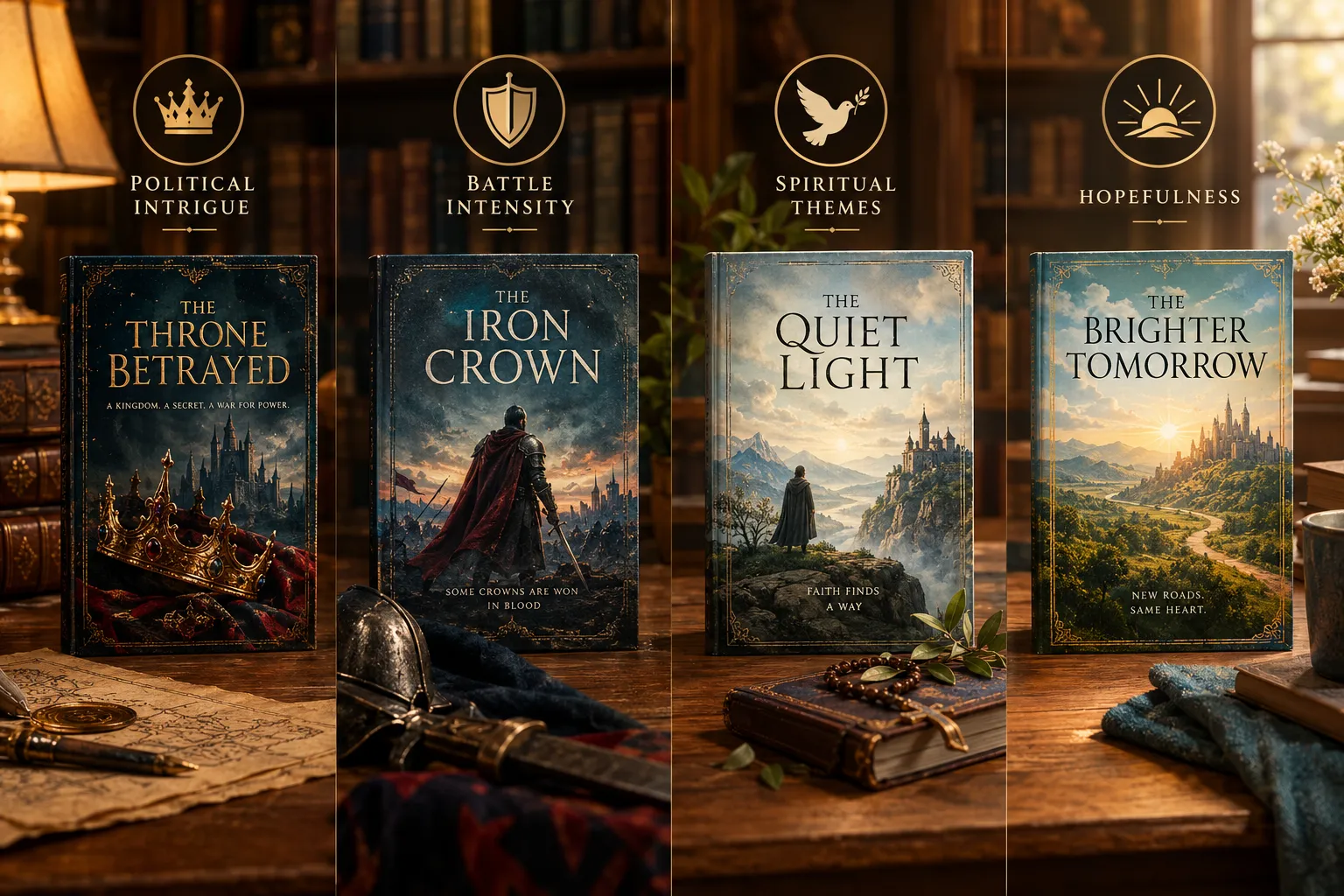
Here’s how six of the strongest options stack up across the dimensions that matter most to readers making a choice:
| Series | World Scale | Political Intrigue | Battle Intensity | Romance Content | Spiritual Themes | Hopefulness |
|---|---|---|---|---|---|---|
| Pendragon Cycle (Lawhead) | Civilization-wide | High, dynastic succession, rival kings | High, real war | Present, restrained | Explicit, woven into myth | Strong |
| Wingfeather Saga (Peterson) | Regional/continental | Moderate | Moderate, family-safe | Minimal | Implicit, faith-adjacent | Very strong |
| Circle Trilogy (Dekker) | Dual-world | High, allegorical empire | High, surreal | Light | Explicit, allegorical | Strong |
| Kethara Chronicles (Bellhaven) | Highland/empire scale | High, covenant vs. audit-state | Moderate-high | Absent | Explicit, covenant-based | Strong |
| Sarel Chronicles (Bellhaven) | Empire-wide | High, bureaucracy as antagonist | Moderate | Absent | Explicit, providence-driven | Strong |
| Chronicles of Narnia (Lewis) | Multiverse | Low-moderate | Moderate | Absent | Explicit, foundational | Very strong |
Choose the Pendragon Cycle if the reader wants literal thrones, prophecy, and civil war on a scale comparable to Westeros. Choose Wingfeather if the household includes younger readers or anyone who wants epic stakes without any edge at all. Choose Kethara Chronicles or Sarel Chronicles if the reader is on Kindle Unlimited and wants political intrigue with zero romance subplot pulling focus from the covenant plot, a distinction covered further in Non-Romance Christian Epic Fantasy for Kindle Unlimited Readers Who Want Adventure and Faith, Not Spicy Subplots.
The Pendragon Cycle has recent momentum worth noting: The Pendragon Cycle: Rise of the Merlin, a seven-episode adaptation, premiered on Prime Video on September 1, 2026, and reached No. 1 among fantasy series in the United Kingdom after first airing on DailyWire+ [1][3]. A second season hadn’t been officially confirmed as of that same month, so the show currently covers Taliesin and Merlin only, the books remain the complete six-volume experience [1].
Christian Fantasy Series With Complex Politics, Multiple POVs, and World-Building
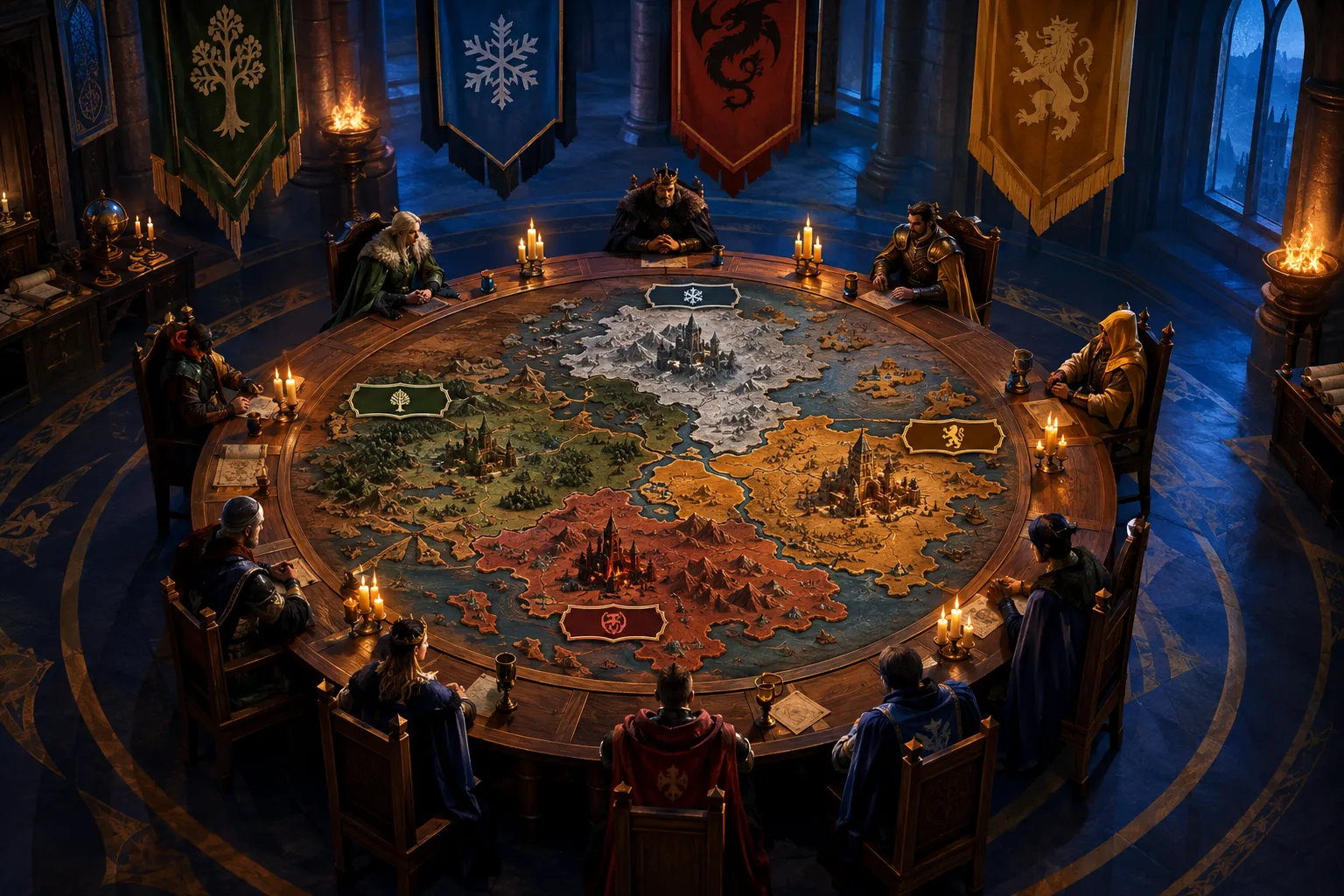
Christian epic fantasy can absolutely support the layered, multi-POV political structure that made Game of Thrones addictive, the difference is what the politics are for. Where secular epic fantasy often treats political maneuvering as morally neutral (whoever wins the game wins), Christian fantasy tends to build a system readers are meant to see through, not just survive.
Look at how this plays out structurally:
- Multiple POV characters like Thrones appear in the Pendragon Cycle (Taliesin, Merlin, Arthur, and rival kings each get real interiority) and in Bellhaven’s Kethara Chronicles, where Amara and Sela carry a covenant word an empire wants to audit and contain, two women, two vantage points, one contested truth.
- Bureaucracy as antagonist replaces the usual dark lord. In the Sarel Chronicles, the House of Witness certifies which prayers “count,” turning faith itself into paperwork, a political structure as layered as any noble house, just built from ledgers instead of swords.
- Magic systems tied to prayer, prophecy, and covenant give these worlds the depth readers want from serious world-building, explored further in Christian Epic Fantasy With Faith-Integrated Magic Systems: How Authors Use Prophecy, Prayer, and Miracles in Worldbuilding and Best Christian Epic Fantasy Worlds On Kindle Unlimited Faith Integrated Magic Systems For Deep Worldbuilding Fans.
Common mistake: assuming political complexity requires moral ambiguity. It doesn’t. A world can have five factions with legitimate, conflicting interests while still having a clear moral floor underneath all five.
Epic Fantasy Series With Strong Moral Themes, Redemption Arcs, and Hope
The strongest Christian epic fantasy series treat redemption as something that costs the character everything, then gives back more than was lost, never a clean, instant conversion moment. Hope in these books survives contact with real loss; it isn’t the absence of loss.
This is the throughline across almost every title on this list:
- Narnia and the Circle Trilogy place evil inside a moral framework where its defeat is never in doubt long-term, even when individual battles are lost.
- Wingfeather Saga builds toward a restoration that only lands emotionally because the Igiby children pay real prices along the way, hidden royalty means nothing if it costs nothing.
- Kethara Chronicles and Sarel Chronicles both structure grace as something earned after failure, not delivered instead of consequence, the same pattern found in Progression Fantasy For Christian Readers Who Want Earned Grace Not Cheap Grace.
Decision rule: choose a series with a heavier redemption arc (Pendragon, Circle Trilogy) if the reader wants theological weight; choose a lighter one (Wingfeather) if the reader wants hope without heaviness at all.
Best Christian Authors Writing Epic Fantasy Today
Stephen R. Lawhead, Andrew Peterson, and Ted Dekker remain the most recognized names in adult and crossover Christian epic fantasy, while independent authors like Silas Bellhaven fill a growing gap for Kindle Unlimited readers who want new, ongoing series rather than decades-old backlist titles.
Christian fantasy sits in an unusual publishing position. Christianity Today reported in early 2025 that some larger evangelical publishers had scaled back fantasy output, describing the category as increasingly niche inside traditional Christian publishing houses. At the same time, specialist presses like Enclave Publishing have kept releasing double-digit fantasy titles per year, and speculative-fiction readers now find most new work through Amazon, independent authors, and genre-specific communities rather than chain bookstores. That shift is exactly why series available on Kindle Unlimited, including Bellhaven’s Kethara Chronicles and Sarel Chronicles, have become a primary discovery path rather than a secondary one.
Fantasy Series That Appeal to Both Religious and Secular Readers
Series with strong craft and universal moral stakes, courage, sacrifice, loyalty, the cost of power, tend to cross over well regardless of a reader’s own faith background. Narnia and the Pendragon Cycle are the clearest examples: both have sold to general fantasy audiences for decades without requiring belief to enjoy the story.
What makes crossover work:
- The plot mechanics stand on their own. A siege, a betrayal, or a prophecy fulfilled works as pure story before it works as allegory.
- Faith is shown, not argued. A secular reader can follow a character’s choice to forgive without feeling lectured, because the choice is dramatized rather than explained.
- Stakes feel earned rather than assigned. Readers of any background respond to consequence that tracks logically from choice.
How Long Are the Best Christian Epic Fantasy Series
Christian epic fantasy series typically run three to six books, with most independently published series (built for serialized Kindle Unlimited reading) landing on the shorter end and legacy traditionally published cycles running longer.
| Series | Book Count | Format |
|---|---|---|
| Pendragon Cycle | 6 books | Traditional publishing |
| Wingfeather Saga | 4 books | Traditional publishing + animated adaptation |
| Circle Trilogy | 3 books (plus companion novels) | Traditional publishing |
| Kethara Chronicles | 3 books | Independent, Kindle Unlimited |
| Sarel Chronicles | 3 books | Independent, Kindle Unlimited |
Edge case: readers who want to finish a complete arc in a weekend should start with a trilogy (Kethara, Sarel, or Circle). Readers who want a multi-month project with dynastic scope should commit to Pendragon.
Frequently Asked Questions
Is Christian epic fantasy the same as clean fantasy? Not exactly. Clean fantasy usually just means no profanity, violence, or sexual content. Christian epic fantasy goes further by building faith, providence, or covenant into the actual structure of the plot, not just filtering out objectionable content.
Can a series have real battle scenes and still avoid grimdark territory? Yes. Battle intensity and grimdark tone are separate variables. A siege can be brutal in stakes while the narrative still treats death as meaningful rather than gratuitous, which is the actual dividing line.
Do these series include romance subplots? It varies. The Pendragon Cycle and Circle Trilogy include restrained romantic elements. Kethara Chronicles and Sarel Chronicles are romance-absent by design, aimed at readers who want the political and covenant plot to carry the whole book.
Which series is best for a reader new to Christian fantasy? Wingfeather Saga is the gentlest entry point. Kethara Chronicles or Sarel Chronicles work well for adult readers who want a shorter, self-contained trilogy with real political stakes.
Are these series available on Kindle Unlimited? Bellhaven’s Kethara Chronicles and Sarel Chronicles are available on Kindle Unlimited. Availability for traditionally published titles like Pendragon and Wingfeather varies by retailer and region.
What counts as grimdark, specifically? Grimdark typically describes a fictional world where cruelty is constant, betrayal goes unpunished, and moral idealism is treated as naive or dangerous. Christian epic fantasy can include cruelty and betrayal but frames them inside a moral order that eventually holds someone accountable.
Do any of these series have ongoing sequels expected? As of September 2026, a second season of the Pendragon Cycle’s screen adaptation had not been officially confirmed, though a first draft reportedly existed. The book cycle itself is complete at six volumes [1][3].
Conclusion
The choice between these series comes down to one honest question: how much darkness is the reader willing to sit with before the story pays it back? Pendragon and the Circle Trilogy sit closer to the heavier end of that scale, with real war and real theological weight. Wingfeather sits closer to the gentle end, built for readers who want epic stakes without any edge. Kethara Chronicles and Sarel Chronicles land in between, political, covenant-driven, and romance-free, built for a weekend or two of focused reading rather than a months-long commitment.
None of these series pretend evil isn’t real. What they refuse to do is let evil have the last word. That’s the difference between grimdark and hope in the dark, and it’s worth choosing on purpose, not by accident. For readers who also want the same faith-under-fire tension in a different format, the Christian LitRPG That Feels Like The Hunger Games Without the Grimdark covers the same ground from a progression-fantasy angle, and the Christian Epic Fantasy for Fans of A Knight of the Seven Kingdoms is worth a look for readers who want chivalric stakes specifically.
References
[1] Christian Epic Pendragon Cycle Sees Unprecedented Climb Streaming Charts – https://www.westernjournal.com/christian-epic-pendragon-cycle-sees-unprecedented-climb-streaming-charts/ [2] Christian Fantasy – https://www.risingshadow.net/new-book-releases/christian-fantasy [3] Jeremy Boreing Christian Arthurian Epic Pendragonno 1 Show – https://www.theblaze.com/shows/rufo-lomez/jeremy-boreing-christian-arthurian-epic-pendragonno-1-show [4] Epic Fantasy – https://www.risingshadow.net/new-book-releases/epic-fantasy [6] Top Selling Christian Fiction – https://www.accio.com/business/top-selling-christian-fiction [7] What Are Publishers Looking For In 2025 2026 – https://www.sarahbullen.com/post/what-are-publishers-looking-for-in-2025-2026 [10] risingshadow – https://www.risingshadow.net/searchlist/epic-fantasy/2026