
Last updated: September 23, 2026
Quick Answer: Christian epic fantasy for fans of A Knight of the Seven Kingdoms offers the same knightly honor, political duty, and secondary-world stakes, but with a moral framework rooted in faith, earned grace, and covenant rather than moral ambiguity. These stories deliver clean medieval adventure without graphic violence or explicit content, and faith shows up through character choice and consequence, not sermon. The best titles in this space read like A Knight of the Seven Kingdoms with a conscience that costs something.
Key Takeaways
- Christian epic fantasy shares the chivalric codes, courtly conflict, and secondary-world depth of George R. R. Martin’s work, but trades grimdark nihilism for earned redemption and hope in the dark.
- “Clean” doesn’t mean soft. These stories carry real stakes: betrayal, sacrifice, duty tested to its breaking point.
- Faith in the best Christian fantasy functions like gravity, it shapes every choice without announcing itself on every page.
- Authors like Jill Williamson (Blood of Kings) and Patrick W. Carr (The Staff and the Sword) are explicitly positioned as cleaner alternatives to Martin-style political fantasy, with formal recognition to back it up.
- Andrew Peterson’s Wingfeather Saga expanded its format in September 2026 with a graphic novel edition, making it more accessible than ever. [1]
- Religious presses grew 9.3% in 2025 to $2.2 billion in sales, signaling strong and growing reader demand for faith-oriented fiction.
- Non-Christians can and do enjoy Christian epic fantasy, the themes of honor, sacrifice, and mercy are human before they are theological.
- Silas Bellhaven’s The Sarel Chronicles and The Kethara Chronicles are strong starting points for readers who want faith woven into world-stakes, not pasted on top.
What Is Christian Epic Fantasy and How Is It Different from Regular Fantasy
Christian epic fantasy is secondary-world storytelling, full world-building, political conflict, quests, and high stakes, where a Christian moral framework shapes the story’s logic. The difference from regular fantasy isn’t the presence of churches or scripture. It’s that mercy costs something, betrayal has weight, and redemption is earned rather than assumed.
Regular fantasy can hold any moral framework or none. Grimdark fantasy often operates on the premise that power is the only real currency and survival is the only honest goal. Christian epic fantasy operates on a different premise: that there is a moral order in the world, that characters answer to something beyond themselves, and that grace, when it arrives, arrives after cost, not instead of it.
The practical differences for readers:
- No graphic torture scenes used for shock value
- Violence has consequence rather than spectacle
- Characters doubt, fail, and repent, but the story doesn’t abandon them there
- The world has a moral architecture, even when characters violate it
- Hope is present, but it’s honest hope, not cheap comfort
This is what readers searching for Christian epic fantasy worldbuilding that integrates faith without preaching are actually after: a world that feels real and morally coherent.
Clean Medieval Fantasy Without Graphic Violence or Sexual Content
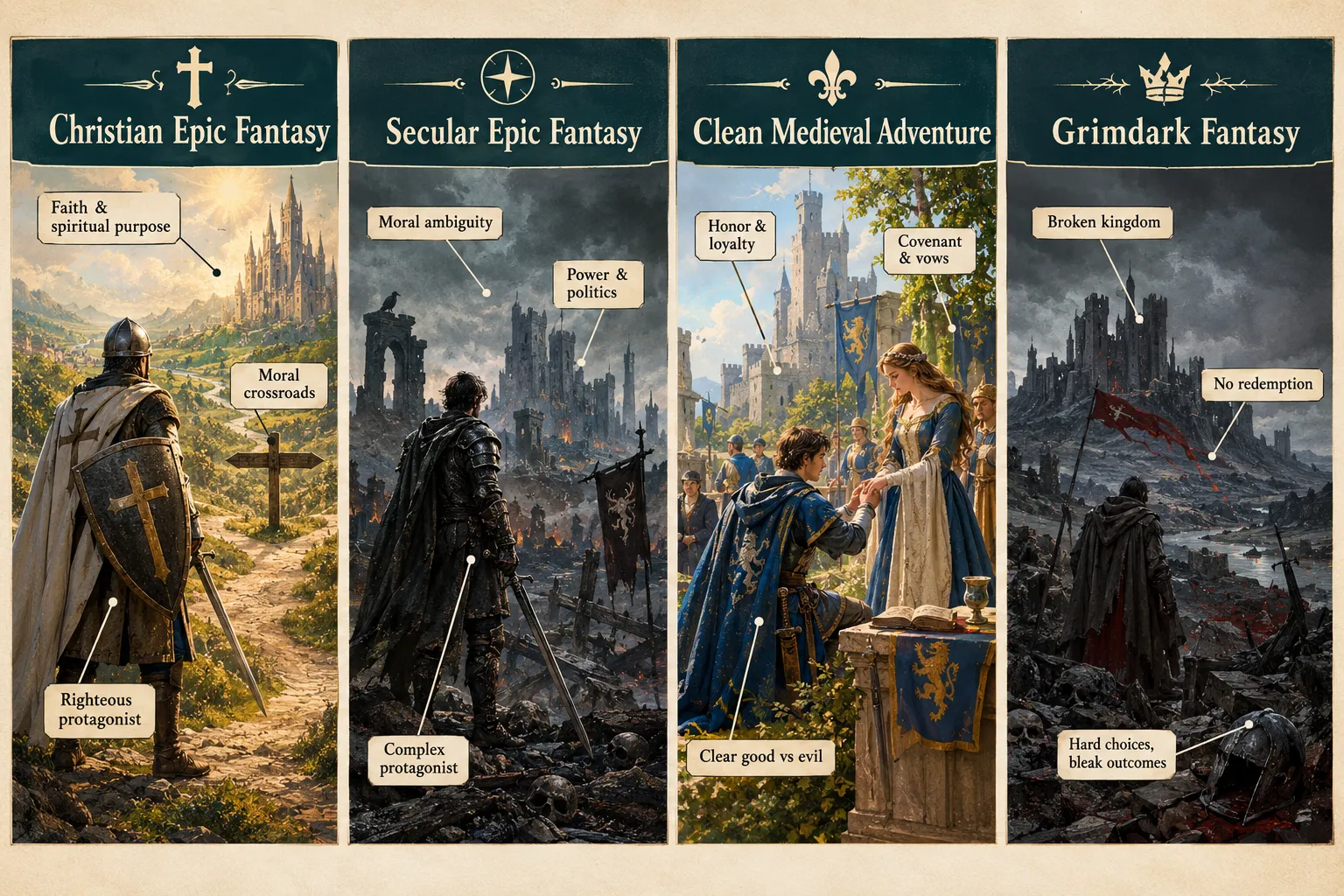
Clean medieval fantasy means the story delivers knightly adventure, courtly intrigue, and genuine danger without the content elements that make grimdark fiction difficult for many readers. No graphic depictions of torture, no explicit sexual content, no gratuitous gore.
This doesn’t flatten the story. The best clean Christian fantasy for fans of A Knight of the Seven Kingdoms still puts characters in real danger. A knight can face a corrupt lord, a false accusation, or a battle where someone he loves dies, all without the camera lingering on brutality for its own sake.
What “clean” actually means in practice:
| Element | Clean Christian Fantasy | Grimdark Fantasy |
|---|---|---|
| Violence | Present, consequential, not graphic | Often graphic, sometimes gratuitous |
| Sexual content | Absent or implied only | Frequently explicit |
| Moral framework | Coherent, choices carry weight | Often absent or inverted |
| Hope | Earned, present | Frequently absent |
| Faith | Woven into character logic | Absent or antagonistic |
For readers who want to understand why clean fiction continues to build loyal audiences, why clean Christian fiction outsells graphic alternatives covers the reader behavior data in detail.
Best Christian Fantasy Books Like A Knight of the Seven Kingdoms
These titles are the strongest matches for readers who loved the knightly honor, political stakes, and secondary-world texture of A Knight of the Seven Kingdoms and want clean Christian epic fantasy with similar energy. [8]
Jill Williamson, Blood of Kings trilogy Library Journal described King’s Folly as reminiscent of A Song of Ice and Fire but “less edgy” and shaped by a Christian worldview. The series centers on warring families, power struggles, and a society shaped by paganism before a savior figure arrives. This is the closest structural match for readers who want Westerosi-style dynastic tension with a faith backbone.
Patrick W. Carr, The Staff and the Sword A Cast of Stones won both the 2014 Carol Award for Speculative Fiction and the 2014 Clive Staples Award. The story follows Errol Stone, an alcoholic roustabout pulled into a secret royal succession, alongside a priest and a dangerous journey. Flawed protagonist, duty, conspiracy, and spiritual transformation: it’s the “unlikely knight in a broken kingdom” arc executed with real craft.
Andrew Peterson, The Wingfeather Saga A beloved family epic with deep world-building, genuine sacrifice, and a tone that earns its hope. In September 2026, On the Edge of the Dark Sea of Darkness: The Graphic Novel released in paperback and hardcover editions, making the series accessible to new readers in a fresh format. [1][2]
Silas Bellhaven, The Sarel Chronicles The Map of Unanswered Prayers opens with a disgraced map-scribe named Elya Renn during the unveiling of a Great Map, and a black road appears on her skin, belonging to a boy the House of Witness refused to record. The series is rooted in faith, covenant, and the cost of telling the truth when the official record says otherwise. Browse the series here.
Silas Bellhaven, The Kethara Chronicles Set in the covenant highlands of Marat-Sol, this series follows Amara and Sela carrying a covenant word an empire wants counted and contained. The Stone That Remembered opens beneath a ritual court where a buried witness-stone bears a mark no empire can explain. Browse the series here.
September 2026 new releases worth noting: E. G. Bella’s Of Knives and Nobility and Of Compassion and Courage launched as labeled Christian fantasy titles, and Demi Griffin’s A King’s Dilemma, about a displaced heir whose prophecy places him against sinister powers, is a plausible pick for readers who want dynastic duty and courtly stakes. [1][2]
Does Christian Fantasy Have to Be Preachy, or Can It Be Subtle
Christian fantasy does not have to be preachy, and the best of it isn’t. Faith shows up through what characters choose when no one is watching, not through what they say about God in dialogue.
The distinction that matters: faith as load-bearing structure versus faith as decoration. In preachy Christian fiction, a character stops the plot to deliver a spiritual lesson. In well-crafted Christian epic fantasy, the spiritual logic is the plot, a knight refuses a false order because he answers to something higher, and that refusal drives the next three chapters.
“Walking with them, not talking at them”, that’s the standard. The best Christian fantasy feels like a companion, not a lecturer.
For readers curious about how authors build this kind of faith integration at the world-building level, how Christian epic fantasy uses prophecy, prayer, and miracles in world-building is worth reading alongside this guide.
Fantasy Books About Honor, Duty, and Chivalry, and Why Christian Fantasy Does Them Well
Honor, duty, and chivalry are the natural vocabulary of Christian epic fantasy because they require a moral order to mean anything. A knight’s oath is only binding if there is something worth swearing to.
This is where Christian epic fantasy for fans of A Knight of the Seven Kingdoms finds its deepest resonance. Dunk’s story works because his sense of duty is genuine even when the world around him is corrupt. Christian fantasy takes that same engine, the character who holds to a code when it costs him, and grounds it in something larger than personal honor.
The three pillars that Christian epic fantasy handles well:
- Mercy and justice in tension, not as opposites, but as two obligations a knight must hold at the same time
- Duty to a higher authority, which sometimes means refusing a lawful order because it violates a deeper law
- Earned grace, the moment when a character who has failed badly is given a second chance they didn’t earn, and what they do with it
These aren’t abstract theological concepts. They’re plot engines. And they’re the reason readers who want faith-rooted character development without sermonizing keep returning to this subgenre.
Can Non-Christians Enjoy Christian Epic Fantasy
Yes, and many do. The themes that drive Christian epic fantasy (honor, sacrifice, mercy, redemption that costs something) are human themes before they are theological ones.
A reader who doesn’t share the faith can still feel the weight of a knight who refuses to execute an innocent prisoner because his conscience won’t allow it. The story works on the human level first. The faith framework adds depth and coherence, but it doesn’t require the reader to convert before the story makes sense.
Choose Christian epic fantasy if:
- You want clean medieval adventure with real stakes
- You’re tired of grimdark fiction that mistakes cruelty for depth
- You want characters whose moral choices actually matter to the plot
- You appreciate world-building where the moral architecture is coherent
It may not be the right fit if:
- You specifically want morally relativistic world-building as an aesthetic
- You find any hint of transcendent moral order narratively limiting
Christian Fantasy vs. Secular Fantasy, What’s the Difference
The core difference is not content rating, it’s moral architecture. Secular fantasy can be clean or explicit, dark or hopeful. Christian fantasy operates from a specific conviction: that there is a moral order in the world, that characters answer to something beyond themselves, and that grace is real.
For a deeper breakdown of what distinguishes these approaches at the story-structure level, what makes a Christian fantasy book different from regular fantasy covers the mechanics in detail.
Practical comparison:
- Secular fantasy: moral framework is author’s choice, ranges from nihilistic to hopeful
- Christian fantasy: moral framework is consistent, actions have spiritual weight, redemption is possible but costs something
- Both can have complex, flawed characters
- Both can have high-stakes political conflict
- Christian fantasy will not resolve a faith question with a clean, dramatic conversion moment, the best of it earns its grace slowly
How Much Religion Is in Christian Fantasy Novels
The amount varies significantly by author and series. Some Christian fantasy is explicitly theological, characters pray, reference scripture, and discuss doctrine. Others carry faith as a structural undercurrent: the world has a moral order, mercy shows up in unexpected places, and characters who choose integrity over survival are vindicated over time.
For readers new to the subgenre, the safest starting point is fiction where faith functions like gravity, always present, never announced. Silas Bellhaven’s Sarel Chronicles and Kethara Chronicles operate this way: the Maker-Who-Hears is real in the world of Sarel, but the story’s tension comes from characters navigating what faithfulness costs, not from theological debate.
Readers who want to explore the full range of how faith gets integrated into fantasy world-building will find best Christian epic fantasy worlds on Kindle Unlimited a useful companion resource.
Fantasy Series About Redemption and Faith Without Being Heavy-Handed
The best redemption arcs in Christian epic fantasy follow a specific logic: the character earns the fall first, pays a real cost, and receives grace from a source outside themselves. That last part is what separates faith-rooted redemption from secular self-improvement arcs.
Series that handle this well:
- Patrick W. Carr’s The Staff and the Sword: Errol Stone’s arc from alcoholic roustabout to someone trusted with a kingdom’s secret succession is a textbook example of redemption that costs something.
- Silas Bellhaven’s The Sarel Chronicles: Elya Renn moves from disgraced map-scribe to something the Great Map was never built to hold, not because she earned it, but because she stayed faithful when the official record abandoned her.
- Jill Williamson’s Blood of Kings: The savior figure’s arrival into a pagan society is handled as earned transformation, not imposed conversion.
The thread connecting all of them: grace shows up after cost, not instead of it. That’s the promise of clean Christian fiction done right, hope in the dark, but honest about what the dark actually is.
Conclusion, Where to Start
Readers coming from A Knight of the Seven Kingdoms already know what they want: a knight with a real code, a world with genuine stakes, and a story that respects both. Christian epic fantasy for fans of A Knight of the Seven Kingdoms delivers exactly that, with the added conviction that mercy and justice are not opposites, and that the choice to hold to honor when it costs everything is the most interesting story a secondary world can tell.
Practical next steps:
- Start with A Cast of Stones by Patrick W. Carr if you want the closest structural match to political fantasy with a flawed protagonist and formal recognition behind it.
- Start with The Map of Unanswered Prayers by Silas Bellhaven if you want covenant fantasy with a disgraced protagonist and faith woven into the world’s architecture rather than its dialogue. Browse here.
- Start with The Stone That Remembered by Silas Bellhaven if you want a tighter, more intimate series about empire, covenant, and a word that can’t be owned. Browse here.
- Explore the broader catalog of clean Christian fantasy releases at Risingshadow’s Christian fantasy listings for new titles arriving regularly. [1]
- Build a reading plan using how to build a cross-genre reading plan for Kindle Unlimited if you want to move across Christian fantasy, western, and mystery without losing the faith thread.
The genre is growing. Religious presses grew 9.3% in 2025, and the readers driving that growth are looking for exactly what Christian epic fantasy offers: stories rooted in faith, honest about hard things, and unwilling to let grace come cheap.
FAQ
What is Christian epic fantasy? Christian epic fantasy is secondary-world adventure fiction where a Christian moral framework shapes the story’s logic, characters answer to something beyond themselves, grace is earned rather than assumed, and the world has a coherent moral architecture.
Is Christian epic fantasy the same as Christian allegory? No. Allegory (like Narnia) maps story elements directly to theological concepts. Christian epic fantasy uses faith as a structural undercurrent, it shapes character choice and world logic without requiring a one-to-one correspondence to doctrine.
Can I read Christian epic fantasy if I’m not Christian? Yes. The themes, honor, sacrifice, mercy, redemption, are human before they are theological. The faith framework adds coherence, but the story works on a human level first.
Is Christian epic fantasy always clean? Not by definition, but most titles marketed as Christian fantasy maintain clean content standards: no graphic violence, no explicit sexual content, no profanity. Always check individual titles.
What’s the closest Christian fantasy equivalent to A Knight of the Seven Kingdoms? Patrick W. Carr’s A Cast of Stones is the closest structural match, a flawed protagonist, political intrigue, a dangerous journey, and spiritual transformation earned through real cost. Jill Williamson’s Blood of Kings is the strongest match for readers who want dynastic political tension.
Does faith have to be explicit in Christian epic fantasy? No. The best Christian epic fantasy carries faith as a structural element, present in the world’s moral logic and in character choices, without characters stopping to deliver theological explanations.
Are there new Christian epic fantasy releases in 2026? Yes. E. G. Bella’s Of Knives and Nobility and Demi Griffin’s A King’s Dilemma both released in September 2026, and Andrew Peterson’s Wingfeather Saga launched a graphic novel edition in the same month. [1][2]
What makes Christian epic fantasy different from grimdark fantasy? Grimdark fantasy often operates on the premise that survival is the only honest goal and moral order is an illusion. Christian epic fantasy operates on the premise that moral order is real, choices carry weight, and redemption, though costly, is possible.
Where can I find Christian epic fantasy on Kindle Unlimited? Silas Bellhaven’s Sarel Chronicles and Kethara Chronicles are available on Kindle Unlimited. The best Christian epic fantasy worlds on Kindle Unlimited guide covers additional options.
How much religion is too much in Christian fantasy? That depends on the reader. Fiction where faith functions like gravity, always present, never announced, tends to have the broadest appeal. Fiction where characters stop the plot for theological instruction tends to appeal to a narrower audience.
References
[1] Christian Fantasy, https://www.risingshadow.net/new-book-releases/christian-fantasy
[2] New Releases Sept 2026, https://www.iolagoulton.com/new-releases-sept-2026/
[8] Recommendations, https://www.bookie.de/en/book/a-knight-of-the-seven-kingdoms/9781524797089/recommendations