
Last updated: September 15, 2026
Quick Answer: Christian LitRPG that feels like The Hunger Games without the grimdark delivers survival-level stakes, competition, and earned character growth inside game-mechanic worlds, all without the graphic violence, despair, or moral nihilism that make secular versions off-limits for many faith readers. These stories keep the tension high and the hope real, because faith is load-bearing in the plot, not decorative. If you loved the urgency of Katniss’s arena but wished the darkness had somewhere to go, this subgenre was built for you.
Key Takeaways
- Christian LitRPG combines game-world mechanics (leveling, stats, progression systems) with faith-rooted storytelling where belief shapes every choice, not just the ending.
- The Hunger Games comparison works because both formats run on high-stakes competition, character pressure, and survival tension, the difference is where the darkness lands.
- Christian LitRPG replaces grimdark despair with earned grace: cost is real, but hope is not naive.
- The LitRPG market is growing rapidly in 2026, with faith-centered subgenres emerging as one of the most discussed hybrid spaces [10].
- New releases like Canthany Rising (June 2026) confirm that Christian LitRPG is a live, publishing category, not a theoretical one [2][3].
- Silas Bellhaven’s The Measured Debt series is a direct example: progression fantasy where the record of what a character has spent, and owes, drives every plot beat.
- Faith readers who want clean content (no profanity, no graphic violence, no explicit material) can find genuine high-stakes tension in this subgenre without compromise.
- The best examples treat faith as motivation and consequence, not as a deus ex machina rescue at the climax.
What Is Christian LitRPG and How Does It Differ from Regular Fantasy?
Christian LitRPG is a subgenre of progression fantasy where game-world mechanics, stat screens, leveling systems, skill trees, and measurable character growth, operate inside a story that treats faith as structurally real. It differs from regular fantasy in two ways: the game-layer is explicit (readers see the numbers move), and the moral architecture is built on Christian conviction rather than secular power ethics.
Regular LitRPG often rewards raw strength, cunning, or grinding repetition. Christian LitRPG asks a harder question: what does it cost to be chosen, and what do you do when the record says you’ve spent more than you earned?
The key structural difference:
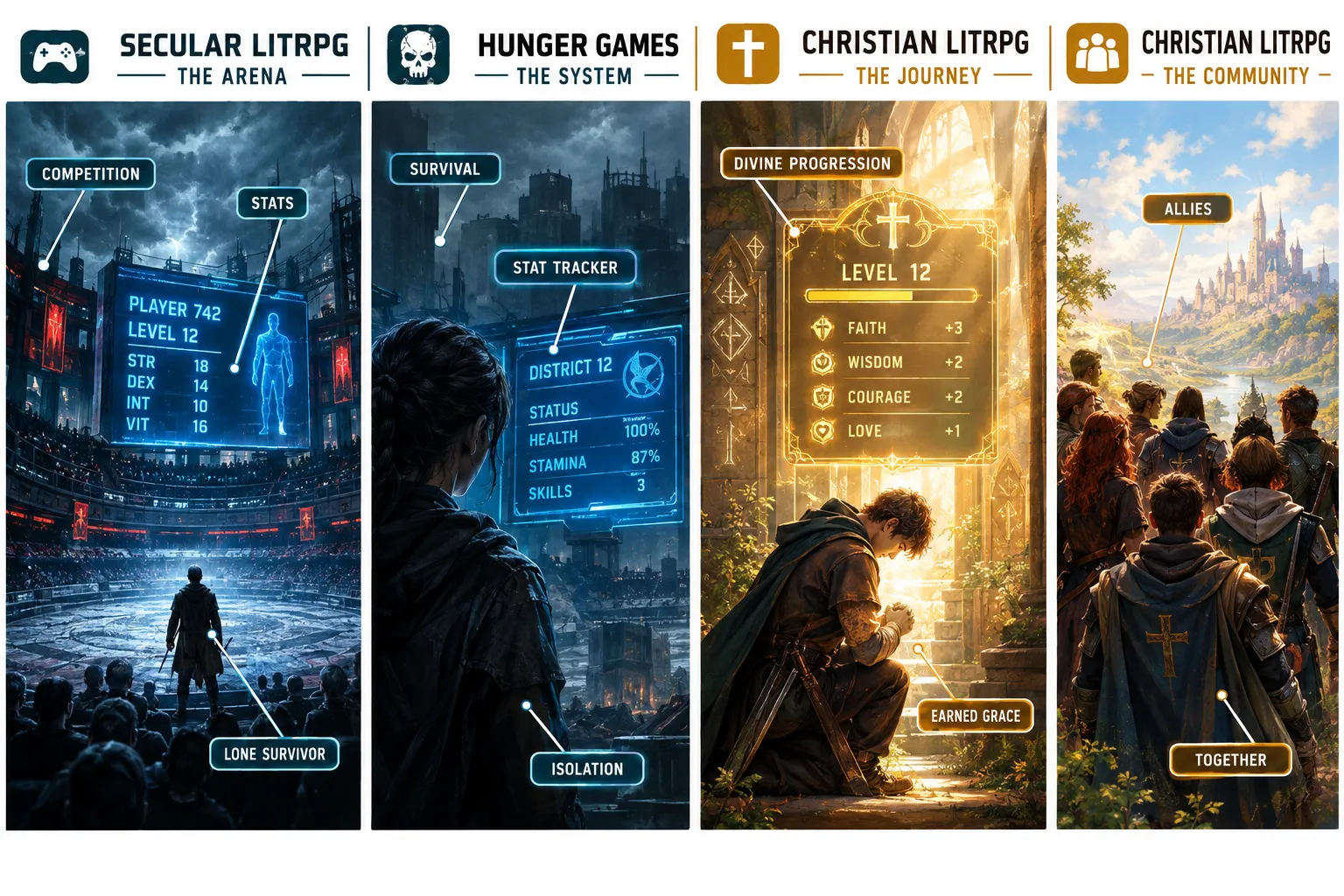
| Element | Secular LitRPG | Christian LitRPG |
|---|---|---|
| Progression driver | Power accumulation | Earned grace, covenant cost |
| Moral framework | Survival of the fittest | Mercy and justice in tension |
| Faith role | Absent or decorative | Load-bearing in plot and choice |
| Darkness handling | Grimdark accepted | Stakes high, hope real |
| Character failure | Setback to overcome | Consequence requiring repentance |
For a deeper look at how the mechanics work spiritually, see Christian LitRPG and Progression Fantasy: Faith, Character Growth, and Game Mechanics Explained.
What Makes a Book Feel Like The Hunger Games but Still Faith-Friendly
The Hunger Games works because it puts a character under maximum pressure and forces moral choices with real costs. That formula is not inherently grimdark, the darkness in Collins’s series comes from specific content choices, not from the competition structure itself.
A faith-friendly book delivers the same pressure through different means:
- Survival stakes without body-count spectacle. The threat is real; the camera doesn’t linger on carnage.
- Competition that reveals character, not just strength. Who a person is under pressure matters more than whether they win.
- Consequences that don’t evaporate. Choices cost something. Grace shows up after the cost, not instead of it.
- Hope that is earned, not assumed. The ending isn’t clean because the author avoided hard things, it’s clean because the hard things were faced honestly.
This is exactly what Christian LitRPG that feels like The Hunger Games without the grimdark is built to do: keep the arena, remove the despair. Faith under fire doesn’t mean faith without fire.
“Walking with them, not talking at them”, that’s the standard. A story that walks a reader through real pressure without abandoning them to it.
Christian LitRPG vs. Secular LitRPG: What’s the Difference for Readers
The difference is not just content filtering, it’s a fundamentally different answer to the question every progression fantasy eventually asks: what is power for?
Secular LitRPG tends to answer: power is for winning, surviving, and proving yourself. The protagonist grinds, levels up, and dominates. The moral stakes are usually personal.
Christian LitRPG answers differently. Power, or the progression system standing in for it, is accountable. What you’ve been given can be measured against what you’ve spent it on. That’s not a limitation; it’s a richer story engine.
In Silas Bellhaven’s The Measured Debt series, protagonist Eamon Kersey operates inside Federated Record, where every action generates a position series, a running ledger of what he’s done and what it cost. The tension isn’t whether he’ll level up. It’s whether the record will prove he was worth what was spent on him. That’s a Hunger Games-level question dressed in LitRPG clothes, and it’s entirely clean.
For more on how faith-based game mechanics work narratively, see Faith in LitRPG and Progression Fantasy: How Christian Game-World Narratives Turn Leveling Up Into Spiritual Growth.
LitRPG Books Without Dark Themes for Christian Readers: What to Look For
LitRPG without grimdark is a real category, and it’s growing. The challenge for Christian readers is that “clean” LitRPG in the secular market usually means less dark, not faith-rooted. Those are different things.
What to look for in a genuinely faith-rooted LitRPG:
- Faith shapes decisions, not just the protagonist’s backstory
- The progression system has moral weight, what you gain, you’re accountable for
- Failure leads to repentance and growth, not just a stat reset
- Community matters; the lone-wolf power fantasy is complicated by covenant obligation
- Hope in the dark is present and earned, not pasted on at the end
Red flags that a “clean” LitRPG isn’t actually faith-rooted:
- Faith mentioned once in chapter one, never again
- Moral choices resolved by power rather than conscience
- Grace appears as a plot device, not a cost
The 2026 release Canthany Rising by Kenneth Bliss is a notable example of the category done right, faith and LitRPG mechanics genuinely integrated, not layered on top of each other [1][2].
How Do Christian Values Work in Progression Fantasy Stories
Christian values work in progression fantasy when they’re structural, not decorative. That means the game-world’s rules reflect a moral order that the protagonist has to reckon with, not just follow as instructions, but genuinely wrestle with under pressure.
Three ways Christian values integrate naturally into progression systems:
- Stewardship over accumulation. Instead of hoarding stats, the character is accountable for what they’ve been given. Every level gained carries a question: what will you spend this on?
- Mercy and justice in tension. The best progression arcs put these two in conflict. The character can win cleanly or win mercifully, rarely both. That tension is where faith does its real work.
- Earned redemption, not cheap grace. A character who fails doesn’t get a clean reset. The record stands. What changes is what they do next, and that costs something.
This is why faith-rooted character development in Christian fiction looks different from secular character arcs. The growth is spiritual and measurable at the same time.
Can You Have Intense Competition in Christian Fiction Without Being Dark
Yes, and the distinction matters. Intensity and darkness are not the same thing. Darkness is a moral category (despair, nihilism, the absence of redemptive possibility). Intensity is a structural category (high stakes, real consequences, genuine threat).
Christian fiction can carry maximum intensity while keeping the moral architecture intact. The Hunger Games comparison is useful here: the arena is intense because the stakes are real and the choices matter. A Christian LitRPG version of that arena keeps every bit of that pressure, but the darkness has somewhere to go. Mercy is possible. Redemption costs something. Hope in the dark is not naive; it’s the hardest thing in the room.
What makes competition feel high-stakes without grimdark:
- The threat is real, but the camera is honest rather than exploitative
- Characters can lose, and that loss means something
- Winning at the cost of conscience is treated as a loss, not a victory
- The reader feels the weight without being buried under it
For readers who want to understand how Christian authors build this kind of tension, how Christian authors build suspense without darkness in psychological thrillers covers the craft mechanics directly.

Best Christian Fantasy Books with High Stakes Like The Hunger Games
These are the titles and series that deliver Hunger Games-level pressure with faith-rooted architecture and clean content:
Christian LitRPG:
- The Cost of Being Chosen, The Measured Debt, Book 1 (Silas Bellhaven): Eamon Kersey’s name keeps clearing every collapse at Federated Record, until the position series starts asking why he’s always the one left standing. View on Amazon
- The Remembered Route, The Measured Debt, Book 2: A corridor route Eamon swears he never walked shows up twice in the record. View on Amazon
- Canthany Rising by Kenneth Bliss (June 2026): A new Christian LitRPG release that integrates faith and game mechanics in an epic adventure setting [2][3][4].
Christian Epic Fantasy with High Stakes:
- The Map of Unanswered Prayers, The Sarel Chronicles, Book 1 (Silas Bellhaven): A map-scribe carries a black road that the House of Witness refused to record. Covenant stakes, real cost. View on Amazon
- The Stone That Remembered, The Kethara Chronicles, Book 1 (Silas Bellhaven): An empire wants every act of mercy counted and contained. View on Amazon
For a broader reading guide, see Christian LitRPG on Kindle Unlimited: Hidden Faith-Forward Game Worlds Readers Are Missing.
Are There Christian Fantasy Series with Tournament Arcs
Tournament arcs, structured competition with elimination stakes, exist in Christian fantasy, though they’re more common in LitRPG and progression fantasy than in traditional Christian epic fantasy. The reason is structural: LitRPG’s game-layer naturally generates competitive frameworks (rankings, trials, advancement gates) that function like tournament arcs without requiring the author to build an explicit arena.
In The Measured Debt, the position series functions as a running tournament: every collapse Eamon enters is evaluated, ranked, and compared against the record of every other operator. He’s always being measured. That’s tournament pressure without a single gladiatorial scene.
For readers specifically looking for tournament-style competition in Christian speculative fiction, the LitRPG subgenre is the most reliable source in 2026. The Christian epic fantasy space, including covenant fantasy like The Kethara Chronicles, tends toward quest arcs with high individual stakes rather than structured competition [6].
Christian LitRPG Recommendations for Young Adults
Christian LitRPG for young adults needs to carry the same faith-rooted architecture as adult versions, but with protagonists facing the specific pressure of identity formation under fire. The Hunger Games resonated with YA readers precisely because Katniss’s choices were about who she was becoming, not just whether she’d survive. Christian LitRPG for that audience needs the same question.
What works for YA Christian LitRPG readers:
- Protagonists who are genuinely uncertain, faith tested, not performed
- Progression systems that reward wisdom and conscience, not just grinding
- Community and mentorship woven into the game-world structure
- Clean content as a baseline, not a disclaimer
The Lightraiders platform (launched July 2026) is worth noting here, it’s a Christian RPG and game-based Bible curriculum that bridges the gap between game mechanics and faith formation for younger audiences [9]. It’s not fiction, but it demonstrates the appetite for exactly this kind of structured, faith-rooted game-world engagement among younger Christian readers.
For YA-adjacent readers who want clean, high-stakes Christian speculative fiction, non-romance Christian epic fantasy for Kindle Unlimited readers is a strong companion resource.
Common Mistakes in Writing Christian Fantasy with Action Elements
The biggest mistake is treating faith as a content filter rather than a story engine. When faith only appears as a reason to remove darkness, the story loses its structural integrity. What’s left is a secular action story with the sharp edges filed off, and readers feel that absence immediately.
The most common errors:
- Grace as rescue, not cost. A character makes a terrible choice, prays, and the consequences disappear. That’s not grace, it’s a plot hole dressed in theology.
- Faith as backstory, not present-tense pressure. The protagonist was raised in the church. Fine. But what does faith demand of them right now, in this corridor, with this choice?
- Avoiding real failure. Christian fiction that protects its protagonist from genuine moral failure has nothing to say about redemption. Earned grace requires something to redeem.
- Preaching through the plot. When a character stops to explain what the story means, the story stops. Faith under fire shows; it doesn’t narrate.
- Mistaking clean for safe. Clean content means no graphic violence or explicit material, it does not mean no real stakes. Safe stories are not the same as clean ones.
How Authors Balance Stakes and Hope in Faith-Based Adventure
The balance point is this: stakes must be real enough that hope costs something to hold onto. Hope that costs nothing is optimism. Hope that survives genuine threat and genuine failure, that’s the thing worth writing toward.
In practice, authors working in Christian LitRPG that feels like The Hunger Games without the grimdark use several specific techniques:
- Let the character lose something they can’t get back. Not everything is recoverable. That’s what makes recovery meaningful.
- Put faith in the room when it’s hardest, not easiest. The character prays when they’re not sure it’s working. That’s more honest, and more compelling, than faith that arrives with the solution.
- Use the progression system to externalize spiritual cost. When the stat screen shows what’s been spent, readers can see the weight of choices in concrete terms.
- End chapters on unresolved tension, not resolution. Hope in the dark doesn’t mean the lights come on at the end of every scene.
This is what separates The Measured Debt from most LitRPG: Eamon’s record doesn’t lie, and neither does the story. What he’s borrowed has to be paid back. That’s mercy and justice doing their actual work.
FAQ
What is Christian LitRPG? Christian LitRPG is a subgenre of progression fantasy that uses game-world mechanics, leveling, stat systems, skill progression, inside stories where Christian faith is structurally real and shapes every major character choice and consequence.
Is Christian LitRPG appropriate for all ages? Most Christian LitRPG is written for adult or older YA readers. The content is clean (no graphic violence, no explicit material, no profanity), but the thematic weight, moral failure, earned redemption, spiritual cost, is often most resonant for readers 16 and up.
Does Christian LitRPG have to be set in a fantasy world? No. The Measured Debt series is set in a corporate/industrial world built around a record-keeping system. The game mechanics are institutional rather than magical. Setting is flexible; the faith architecture is what defines the subgenre.
How is Christian LitRPG different from Christian epic fantasy? Christian epic fantasy uses traditional quest and world-building structures. Christian LitRPG adds an explicit progression layer, the reader sees stats, levels, and measurable growth as part of the story’s mechanics. The faith integration can be equally deep in both; the structural difference is the game-layer.
Are there Christian LitRPG books on Kindle Unlimited? Yes. The Measured Debt series by Silas Bellhaven is available on Kindle Unlimited, and Canthany Rising by Kenneth Bliss (2026) is a new addition to the category [4]. The subgenre is small but actively growing.
What makes a book feel like The Hunger Games without being grimdark? High-stakes competition, real consequences for choices, and a protagonist whose identity is tested under pressure, combined with a moral architecture where hope is possible and earned, not absent or assumed. The arena stays; the despair doesn’t.
Can Christian fiction have characters who fail morally? Yes, and it should. Earned grace requires something to redeem. Characters who fail, face consequences, and find costly redemption are the heart of honest Christian fiction. Protecting characters from real failure produces stories with nothing to say.
Is The Hunger Games appropriate for Christian readers? This is an ongoing discussion in Christian circles. The books contain significant violence and some thematic darkness. Many Christian readers engage with them critically and find genuine moral questions worth discussing. Christian LitRPG offers an alternative for readers who want the same pressure with a different moral architecture.
What is The Measured Debt series about? The Measured Debt by Silas Bellhaven follows Eamon Kersey at Federated Record, where every collapse he survives generates a position series, a ledger of what he’s done and what it cost. The series asks whether his record proves him worthy of what was spent on him. View the series on Amazon.
Where can I find more Christian LitRPG recommendations? The Christian LitRPG tag at Silas Bellhaven’s blog and the faith-based LitRPG tag are good starting points for curated recommendations in 2026.
Conclusion
Christian LitRPG that feels like The Hunger Games without the grimdark is not a compromise category, it’s a more honest one. The stakes are real. The choices cost something. Grace shows up after the cost, not instead of it. And faith is load-bearing in the plot, not decorative trim on a secular story.
The subgenre is small but it’s moving. Canthany Rising launched in June 2026. The Measured Debt series has been building its readership on Kindle Unlimited. The Lightraiders platform is bringing game-mechanics and faith formation together for a new generation of readers. The market data confirms what the fiction already knew: Christian readers want high-stakes stories where faith informs motivation, not just morality [10].
Actionable next steps:
- Start with The Cost of Being Chosen, Book 1 of The Measured Debt, to see what Christian LitRPG feels like when the progression system carries genuine spiritual weight.
- Browse the full Silas Bellhaven author page for cross-genre faith-rooted fiction if LitRPG leads you toward epic fantasy or psychological thriller.
- Check Canthany Rising by Kenneth Bliss for a second voice in the category.
- Use the clean Christian fiction TBR for 2026 to build a reading plan that spans genres without losing the faith foundation.
The arena is real. So is the hope. That’s the whole point.
References
[1] Canthany Rising A Christian Litrpg Adventure By Kenneth Bliss – http://juliearduini.com/2026/07/07/canthany-rising-a-christian-litrpg-adventure-by-kenneth-bliss/
[2] Canthany Rising Brings Christian Faith And Litrpg Adventure Together In An Epic New Fantasy By Kenneth Bliss – https://www.einpresswire.com/article/913878546/canthany-rising-brings-christian-faith-and-litrpg-adventure-together-in-an-epic-new-fantasy-by-kenneth-bliss
[3] Christian Fiction New Releases June 2026 – https://www.narelleatkins.com/christian-fiction-new-releases-june-2026/
[4] Canthany Rising on Amazon – https://www.amazon.com/Canthany-Rising-Christian-LitRPG-Adventure-ebook/dp/B0GZ598XPX
[6] Christian Science Fiction Fantasy Books – https://bakerbookhouse.com/blogs/journal/christian-science-fiction-fantasy-books
[9] Lightraiders – https://lightraiders.com/
[10] LitRPG Toolkit 2026 – https://litrpgtoolkit.com/year/2026