
Last updated: September 24, 2026
Quick Answer
The best Christian psychological thriller alternatives to Dexter keep the investigative pressure and moral tension that made the show compelling, but move the darkness off the page. Instead of a vigilante keeping score with a secret kill room, these stories give readers antiheroes who are hiding a different kind of wound: a lie, a cover-up, a failure of conscience. Titles like Silas Bellhaven’s When Hannah Sleeps, Frank Peretti’s This Present Darkness, and the growing wave of clean Christian suspense from imprints like Love Inspired Trade deliver the same “who can I trust” tension without graphic violence, profanity, or a killer’s body count as entertainment.
Key Takeaways
- Christian psychological thrillers replace body-count suspense with conscience-count suspense, the tension comes from what a character hides, not what they do to a victim.
- Antiheroes still exist in faith-based fiction, but their moral failure is the plot problem to be solved, not a skill to admire.
- Clean does not mean tame. Stakes, deception, and dread can run just as high without profanity or graphic violence.
- Redemption arcs cost something. A character doesn’t get grace for free, they confess, they lose reputation, they make restitution.
- Christian mystery is genuinely expanding in 2026, with new imprints and authors publishing faith-centered suspense beyond romance [1][9].
- You can watch or read Dexter-adjacent stories as a Christian, but the discernment question is what the story asks you to root for.
- Search by author, imprint, or content profile, not genre label alone, Christian suspense marketing is still catching up to demand.
What Makes a Psychological Thriller Christian-Themed?
A psychological thriller becomes Christian-themed when the story’s moral center, not just its setting, is shaped by faith, conscience, and consequence. The suspense still runs on secrets, unreliable narrators, and slow-building dread. What changes is what the story treats as the real danger.
In a secular thriller, the danger is usually exposure, getting caught. In a Christian psychological thriller, the danger is often self-deception: a character convincing themselves that hiding the truth is protecting someone. That’s the engine behind Silas Bellhaven’s The Gathering Light series, where the spine question across all three books is “who controls the record of someone’s truth?” Hannah, Caris, and Taryn each work inside a restoration retreat that’s supposed to hold women’s pain safely, until the system built to protect them starts using their own words against them.
That’s the pattern worth watching for:
- The threat is often institutional or relational, not a masked killer
- Faith shows up as a character’s actual decision-making, not a Bible verse dropped into dialogue
- The story trusts the reader to sit with unresolved tension rather than tying it off in one clean scene
Shows Like Dexter but With Christian Values: What Actually Changes
Shows and books positioned as Christian alternatives to Dexter keep the “is he getting away with it” pressure but strip out the vigilante’s kill kit and the audience’s invitation to root for murder. The antihero’s secret becomes something survivable and forgivable, not something the story asks you to enjoy watching.

Dexter’s appeal was never really the blood. It was the double life, the competence under pressure, and the audience’s uneasy complicity in rooting for someone hiding in plain sight. Christian alternatives keep those three engines running:
| Dexter’s Appeal | Christian Thriller Equivalent |
|---|---|
| Secret identity, double life | Hidden past, buried testimony, or false record |
| Investigative pressure, “will he get caught” | Confession delayed, evidence surfacing at the worst time |
| Vigilante competence | Moral competence, the skill of holding a household or community together under strain |
| Audience rooting for the killer | Audience rooting for the confession, not the cover-up |
Frank Peretti’s This Present Darkness is a useful reference point here. It doesn’t need a serial killer to generate dread, it externalizes evil as spiritual and institutional corruption pressing on an ordinary town, which keeps the suspense high without making violence the reward. The book’s staying power backs this up: it climbed the Christian Booksellers Association’s top 10 for more than 150 consecutive weeks in the late 1980s, and David C Cook is releasing a 40th Anniversary Collector’s Edition on November 3, 2026, with a new introduction, manuscript reproductions, and a companion map, a sign the demand for this kind of story never really went away.
Best Christian Psychological Thriller Alternatives to Dexter With Moral Conflict
The best Christian psychological thriller alternatives to Dexter put a character inside a genuine moral bind, protect a secret or protect a person, and then make them live with whichever choice they make. That’s the moral conflict doing the work Dexter’s kill-room used to do.
Strong picks for readers leaving Dexter behind:
- The Gathering Light series (Silas Bellhaven), a new protagonist and household each book, no ensemble drift, built around the question of who owns someone’s recorded truth. Start with When Hannah Sleeps.
- This Present Darkness (Frank Peretti), spiritual warfare as institutional thriller, currently getting a full anniversary re-release.
- Love Inspired Trade’s expanding mystery line, including titles built around traditional whodunit tension rather than romance-first plotting [1][9].
- Jerusha Agen’s Watched, a psychiatrist facing a malpractice case and a murder threat while unable to fully trust his own memory, a direct match for readers who liked Dexter’s unreliable-narrator undercurrent.
For a broader shelf, this reading guide built for fans of Criminal Minds and Law & Order: SVU covers investigation-heavy alternatives in more depth.
Psychological Thrillers Without Graphic Violence or Profanity: A Vetting Checklist
You can find genuinely tense psychological thrillers with no graphic violence or profanity by checking a handful of specific signals before you buy or press play, not by trusting the genre label alone.
Run through this checklist:
- Read the last five reviews, not the first five. Early reviews are often ARC readers; later ones flag content issues.
- Check the imprint. Love Inspired Trade, David C Cook, and similar publishers maintain clean content standards as a matter of catalog policy.
- Look for “clean” or “faith-based” in the subtitle, not just the category tag, Amazon categories are unreliable.
- Scan for a body-count-as-entertainment structure. If the marketing leads with a kill list, it’s not a clean pick regardless of publisher.
- Confirm the antihero’s arc resolves through consequence, not through getting away with it.
Common mistake: assuming “Christian fiction” and “clean” are always the same thing. Some faith-adjacent thrillers still carry heavy violence; some general-market suspense is cleaner than its cover suggests. Check content, not category.
Antihero Characters in Faith-Based Dramas: Can a Christian Story Have One?
Yes, faith-based dramas can have real antiheroes, but the story has to treat their moral compromise as a problem the plot exists to solve, never as a lifestyle worth admiring. That distinction is the entire difference between glorifying darkness and depicting it honestly.
A Christian antihero usually looks like:
- A record-keeper, counselor, or officer of the court who bends the truth to protect someone, and pays for it later
- A protagonist whose competence (Eamon Kersey’s strength in The Cost of Being Chosen, for instance) becomes suspicious rather than heroic once the record starts asking why he’s always the one left standing
- A character whose sin is concealment, not violence, which keeps the story suspenseful without making cruelty the draw
This deeper look at writing morally complex protagonists without glorifying darkness breaks down exactly where that line sits.
How Do Christian Thrillers Handle Redemption Arcs? The Difference From Secular Thrillers
Christian thrillers handle redemption arcs by making the character pay a real cost before they receive grace, lost reputation, a hard confession, restitution, rather than letting a dramatic reveal erase the consequences. That’s the core difference from secular psychological thrillers, where an antihero often keeps their competence, their freedom, and the audience’s admiration all at once.
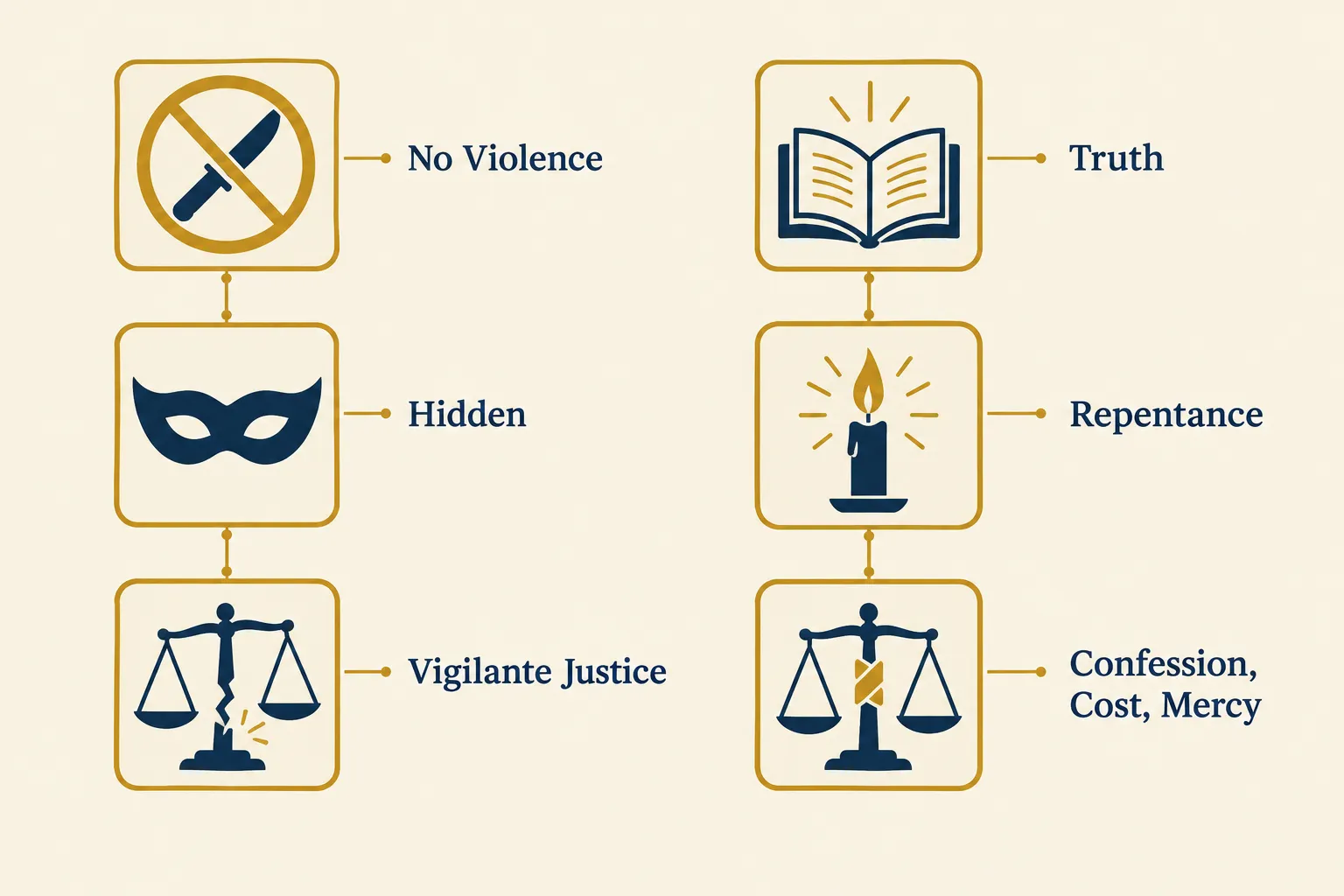
Literary agent Rachelle Gardner has pointed out that Christian suspense developed its redemption logic through romantic suspense first, which is why themes like truth, justice, and forgiveness integrate more naturally into it than a traditional whodunit structure [1]. The result: a Christian thriller’s ending usually asks “what does this person owe, and to whom,” where a secular thriller’s ending asks “did they get away with it.”
Decision rule: choose a Christian thriller if you want the ending to cost the protagonist something real. Choose a secular thriller if you want ambiguity to remain the point. Both can be well-written, they’re just answering different questions. For more on how this plays out structurally, see the role of redemption arcs in Christian thrillers and dark fantasy.
Christian Shows and Books That Explore Moral Boundaries and Ethics
Christian dramas and thrillers explore moral boundaries by putting ordinary institutions, a church, a courthouse, a care facility, under pressure until someone has to choose between loyalty and truth. That’s a quieter kind of moral conflict than Dexter’s, but it’s not a weaker one.
Look for stories built around:
- A ledger, record, or testimony that proves one thing and means another (a recurring structure across Silas Bellhaven’s catalog)
- A community that has to decide whether to protect its reputation or its most vulnerable member
- A protagonist who has legal or procedural power and has to decide how to use it
New Christian suspense releases through mid-2026 show this pattern holding steady, with authors leaning into small-town accountability and courtroom-adjacent tension rather than shock violence [5][9].
Where to Watch and Read Faith-Based Psychological Thrillers
Faith-based psychological thrillers are easiest to find through Kindle Unlimited, dedicated Christian imprints, and author-specific catalogs rather than general streaming or bookstore browsing, since the category still isn’t shelved consistently.
Practical paths:
- Kindle Unlimited, the fastest way to sample multiple Christian thriller series without commitment
- Author pages directly, Silas Bellhaven’s catalog, for example, groups thrillers, cozy mysteries, and westerns under one clean-content promise
- Imprint searches, Love Inspired Trade and David C Cook both maintain consistent content standards across their lists [1]
- Community reading lists, curated Goodreads shelves surface titles faster than algorithmic recommendations, and this guide to building clean Kindle Unlimited lists walks through the process
Can You Watch Dexter Alternatives as a Christian? Common Mistakes to Avoid
Yes, watching or reading Dexter-adjacent stories as a Christian is a personal discernment question, not a blanket rule, the deciding factor is whether the story asks you to admire the harm or simply understand it. Most readers run into trouble not because they picked a dark story, but because they picked one for the wrong reason.
Common mistakes:
- Choosing a title by genre label alone. “Thriller” tells you nothing about content; check the actual synopsis and reviews.
- Assuming clean means low-stakes. Clean fiction can still carry real dread, see these clean-read picks with high tension and no graphic content.
- Skipping the ending pattern. If a story consistently rewards deception, that’s worth noticing regardless of the marketing copy.
- Ignoring your own reaction. If a character’s cruelty starts feeling entertaining rather than uncomfortable, that’s the signal to switch titles, not a flaw in you for noticing.
Who Should Read Christian Psychological Thrillers vs. Regular Thrillers?
Readers who want suspense without graphic content, and who want a story’s tension to resolve into meaning rather than ambiguity, are the best fit for Christian psychological thrillers. Readers who want the story to stay morally unresolved on purpose may prefer secular thrillers instead, and that’s a legitimate preference, not a lesser one.
Christian thrillers carry the same suspense mechanics as secular ones, pacing, misdirection, unreliable narration, they just route the payoff through confession and cost instead of exposure and escape. That makes them a strong fit for readers coming off true-crime fatigue, which this piece on clean psychological thrillers as a better spiritual choice explores directly.
Conclusion
Leaving Dexter behind doesn’t mean giving up suspense, it means changing what the suspense is for. The best Christian psychological thriller alternatives to Dexter keep the double life, the investigative pressure, and the moral conflict, but they aim all of it toward a confession instead of a cover-up. Mercy and justice both get a say by the last page, and the grace a character receives has already cost them something real.
Start with one title that matches your actual reading mood: pick up When Hannah Sleeps for a slow-burn institutional mystery, try Peretti’s This Present Darkness for spiritual-warfare dread, or browse the broader clean psychological thriller shelf for more options rooted in faith, hope in the dark, and earned grace.
FAQ
Is there a Christian version of Dexter? No single title mirrors Dexter exactly, since Christian fiction avoids vigilante killing as a heroic device. The closest matches swap the kill room for a hidden record or a buried testimony, keeping the double-life tension without the body count.
Are Christian psychological thrillers actually suspenseful, or just tame? They can be just as tense as secular thrillers. The suspense comes from moral pressure and slow-building dread rather than graphic violence, so pacing and stakes still matter just as much.
What’s the biggest difference between secular and Christian psychological thrillers? Secular thrillers often let ambiguity stand as the ending. Christian thrillers usually resolve through confession, restitution, or consequence, grace shows up, but only after cost.
Can an antihero be redeemed without a preachy ending? Yes. Well-written Christian antihero arcs show redemption through choice and consequence, a confession, a lost reputation, a restored relationship, rather than a narrated moral or a sermon dropped into the final chapter.
Where can Christian readers find clean thrillers reliably? Kindle Unlimited, imprint-specific searches (Love Inspired Trade, David C Cook), and author catalogs with a stated content policy are more reliable than genre tags alone [1][9].
Is Christian mystery publishing actually growing in 2026? Yes. Publishers have expanded beyond romantic suspense into more traditional mystery structures, though industry voices note this growth is still being tested for long-term staying power [1][5].
Do Christian thrillers avoid moral gray areas? No. The strongest ones lean into gray areas, a character lying to protect someone, a system meant to help people that starts harming them instead, they just resolve the gray area through honesty rather than leaving it open forever.
References
[1] Best Christian Suspense Books Of 2026 – https://gracefulreads.com/best-christian-suspense-books-of-2026/ [5] 23301601 2026 Mystery Suspense Thriller – https://www.goodreads.com/topic/show/23301601-2026—mystery-suspense-thriller [9] Christian Fiction New Releases June 2026 – https://www.narelleatkins.com/christian-fiction-new-releases-june-2026/