
Last updated: September 19, 2026
Quick Answer: Fans of Criminal Minds and Law & Order: SVU who want clean content can find the same psychological tension, moral complexity, and investigative depth in Christian psychological thrillers, without graphic violence, explicit content, or profanity. This Christian psychological thriller reading guide covers the best series, authors, and strategies for finding faith-rooted suspense that keeps the mind games and ditches the graphic cases.
Key Takeaways
- Christian psychological thrillers offer the same moral and psychological stakes as secular procedurals, the difference is in what gets shown, not what gets explored.
- “Clean content” in Christian fiction means no graphic violence, no profanity, and no explicit sexual content, but it does not mean sanitized plots or easy answers.
- The Gathering Light series by Silas Bellhaven is a strong starting point for fans of Criminal Minds-style psychological suspense who want faith-rooted, clean storytelling.
- Kindle Unlimited has a growing library of Christian suspense in 2026, making it one of the most cost-effective ways to binge-read the genre. [1]
- Faith in Christian thrillers functions as a load-bearing story element, not a moral disclaimer, characters doubt, fail, and find grace at real cost.
- Authors like Dee Henderson, Lynette Eason, and DiAnn Mills have built long careers writing law-enforcement and investigative suspense with Christian themes.
- The psychological tension in clean thrillers comes from character interiority, moral dilemmas, and relational stakes, not from what happens to a body.
- Finding clean Christian suspense is easier in 2026 than ever, with dedicated reading guides, Goodreads shelves, and publisher imprints specifically curating the genre. [10]
What Makes a Psychological Thriller Christian vs. Secular?
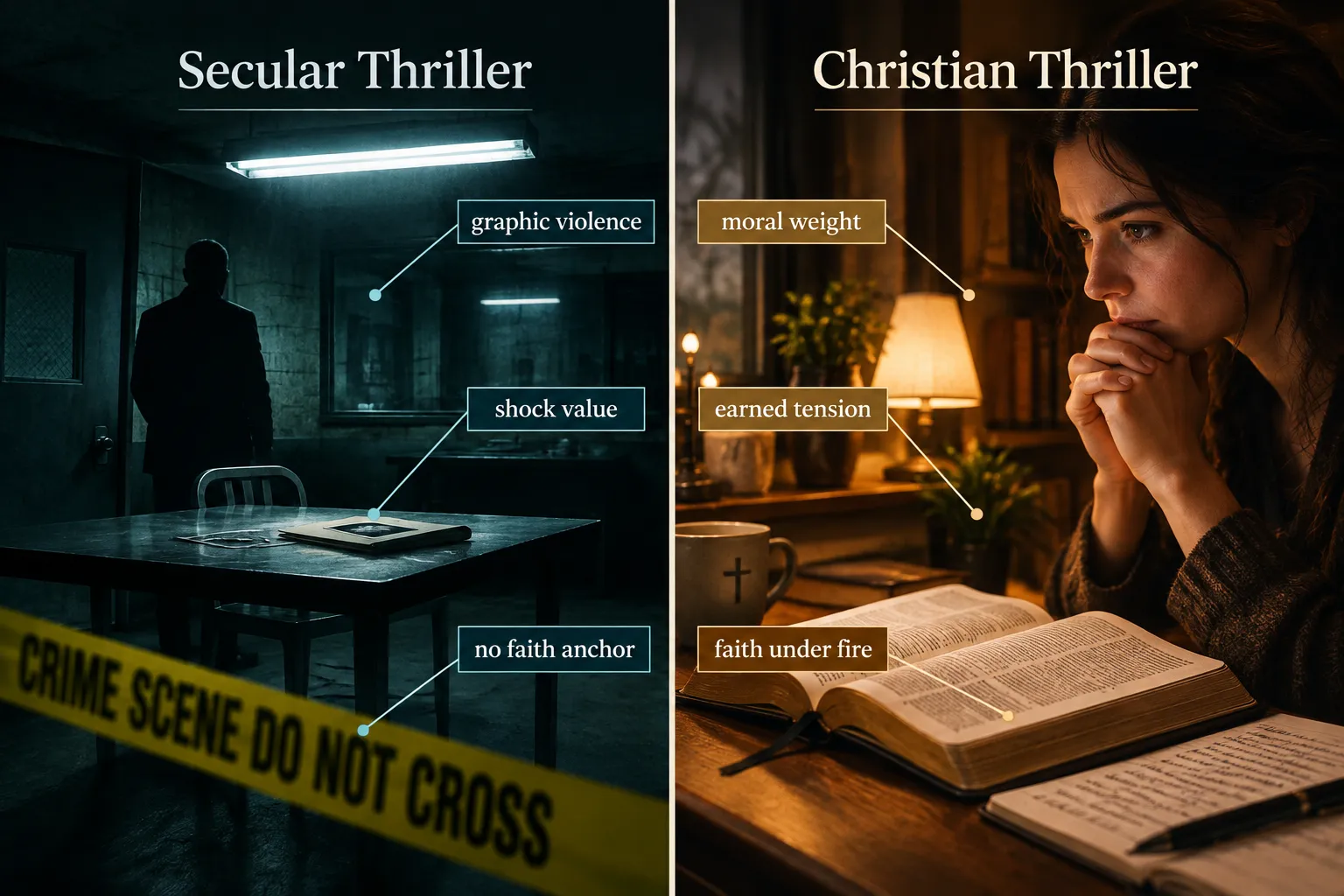
A Christian psychological thriller is defined less by what it excludes and more by what it treats as real. In a secular thriller, the moral universe is open, evil may or may not be punished, and the protagonist’s inner life is shaped by psychology alone. In a Christian thriller, faith is load-bearing: it shapes what a character believes is at stake, how they interpret guilt and mercy, and what they’re willing to do when the law runs out.
The practical differences show up in three places:
- The moral framework. Christian thrillers ask questions about justice, mercy, and truth within a worldview where those concepts have weight beyond personal preference.
- The cost of grace. Redemption in Christian fiction is earned through consequence, not handed out as a tidy resolution. Characters carry real damage.
- The content contract. No graphic violence, no explicit content, no profanity, but the darkness is still present as weight, not spectacle.
For a deeper look at how faith functions structurally inside thriller narratives, see The Psychology of Faith in Thriller Narratives.
“Faith isn’t a backdrop, it’s load-bearing. Every story stands on the conviction that belief and event are woven from the same thread.”, Silas Bellhaven
What Does Clean Content Mean in Christian Fiction?
Clean content in Christian fiction is a specific, practical content contract, not a vague reassurance. For most Christian psychological thrillers, it means:
| Content Category | What “Clean” Means |
|---|---|
| Violence | No graphic descriptions of wounds, autopsies, or torture. Threat and consequence are present; gore is not. |
| Language | No profanity of any kind, including mild substitutes. |
| Sexual Content | No explicit scenes. Romance, if present, stays outside the bedroom. |
| Spiritual Content | Faith is present as lived experience, not preached as lesson. |
Clean does not mean stakes-free. A character can be in genuine danger, a villain can be genuinely menacing, and a plot can explore abuse, manipulation, or psychological coercion, all without crossing into graphic territory. The tension comes from what characters know, fear, and choose, not from what gets described in detail.
For more on how Christian authors sustain real tension without graphic content, see Non-Violent Suspense in Christian Psychological Thrillers: Raising Stakes Without Graphic Content.
Can You Get the Same Tension in Clean Thrillers as Graphic Ones?
Yes, and the mechanism is worth understanding, because it changes what you look for when you browse. Psychological tension in any thriller comes from information asymmetry: the reader knows something the protagonist doesn’t, or the protagonist suspects something they can’t prove. That engine runs entirely on character interiority and plot structure, not on content rating.
What graphic thrillers use shock for, clean thrillers replace with:
- Dread built through detail. A wrong word in a testimony. A name that appears where it shouldn’t. A prayer list with the protagonist’s own name on it.
- Moral cost. When a character must choose between justice and mercy, and both options have real consequences, the reader feels it.
- Relational stakes. The threat to a marriage, a reputation, a community’s trust, these land harder than physical threat for many readers.
A roundtable of Christian suspense authors at CrimeReads confirmed this directly: the genre’s best writers argue that psychological and moral complexity are actually easier to sustain without graphic content, because the reader’s imagination does more work. [4]
Best Christian Psychological Thrillers Like Criminal Minds
For fans of this Christian psychological thriller reading guide who want Criminal Minds-style tension, the profiling, the manipulation, the question of what makes someone capable of harm, these are the strongest starting points in 2026.
The Gathering Light series by Silas Bellhaven is the most direct match for Criminal Minds fans who want clean content. The series is set at a faith-based restoration retreat where testimony records are weaponized against the women who gave them. Each book follows a new protagonist who discovers that the system built to protect her is being used to control her.
- When Hannah Sleeps, Hannah Garrick has transcribed a hundred women’s worst nights, until her own testimony starts appearing in someone else’s file.
- When the Voice Breaks, Caris Weller built her career on careful language, until the retreat’s own system starts speaking for her instead.
- When the Prayer List Opens, Taryn Vickers finds her own name on the retreat’s prayer list, written in the hand of a woman who was supposed to be safe.
Other strong picks in the genre:
- Dee Henderson’s O’Malley series, A family of first responders navigating faith and crisis. Procedural detail, clean content, genuine emotional weight.
- Lynette Eason’s Danger Never Sleeps series, Military and law-enforcement backgrounds, fast pacing, no graphic content.
- DiAnn Mills, Known for FBI and Homeland Security procedurals with Christian themes woven into investigative plots.
Publishers Weekly has tracked mysteries and suspense as one of the fastest-growing segments in Christian fiction, with editors noting rising reader demand for “grittier, more intense” stories that still hold a faith framework. [3]
Are There Christian Versions of Law & Order-Style Books?
Law & Order: SVU fans are drawn to a specific kind of story: institutional systems, victim advocacy, the gap between what the law can prove and what actually happened. Christian suspense addresses all of that, and adds a layer secular procedurals rarely touch: what a person of faith does when the institution fails.
Choose this subgenre if you want:
- Investigative process and legal/institutional tension
- Victim-centered storytelling
- Moral questions about justice that don’t resolve cleanly
Authors to look for:
- Lynette Eason writes law-enforcement procedurals with female investigators and faith-under-pressure themes.
- Terri Blackstock has written extensively about characters navigating criminal investigations with faith as a genuine factor, not a backdrop.
- Patricia Bradley focuses on small-town law enforcement with psychological depth.
The industry has seen a notable pipeline of Christian crime thrillers in 2026 specifically featuring law-enforcement and witness-protection tropes, confirming that this reader appetite is being actively served. [10]
How Do Christian Authors Handle Dark Themes Appropriately?
The short answer: by treating darkness as weight rather than spectacle. Christian authors who write psychological thrillers don’t avoid hard subjects, abuse, manipulation, coercion, grief, moral failure. What they avoid is the gratuitous rendering of those subjects in graphic detail.
The craft approach looks like this:
- Show the aftermath, not the act. A character’s trauma is real and present in how she moves through a room, not in a flashback scene.
- Let the villain be genuinely threatening through psychology, not gore. The most frightening antagonists in Christian thrillers are the ones who use language, authority, and trust as weapons.
- Earn the hope. Redemption shows up after cost, not instead of it. A character who finds faith or grace at the end of a thriller has paid for it in the plot.
For more on how Christian authors build genuine suspense without relying on darkness as a crutch, see How Christian Authors Build Suspense Without Darkness in Psychological Thrillers.
Psychological Thrillers That Explore Faith and Morality
This is the sweet spot for readers who loved Criminal Minds not for the crime scenes but for the moral questions, what makes someone capable of harm, what obligation the living have to the dead, what justice actually requires.
Christian psychological thrillers that explore faith and morality tend to orbit a specific question: what will you do with the truth once you’re holding it? That question appears across Silas Bellhaven’s entire catalog, from the Mercy House Mysteries to The Gathering Light, because it’s the question that makes faith genuinely dramatic rather than decorative.
Themes that appear consistently in this subgenre:
- Institutional power and the abuse of spiritual authority
- The difference between reputation and actual grace
- What forgiveness costs the person offering it, not just the one receiving it
- Conscience under pressure, when doing the right thing has a real price
For a broader look at how faith themes raise the actual stakes in Christian psychological thrillers, see How Faith Themes Raise the Stakes in Christian Psychological Thrillers.
How to Find Christian Books With No Profanity or Sexual Content
Finding clean Christian suspense in 2026 is more straightforward than it was five years ago, because the market has organized around reader demand. [1] Here are the most reliable methods:
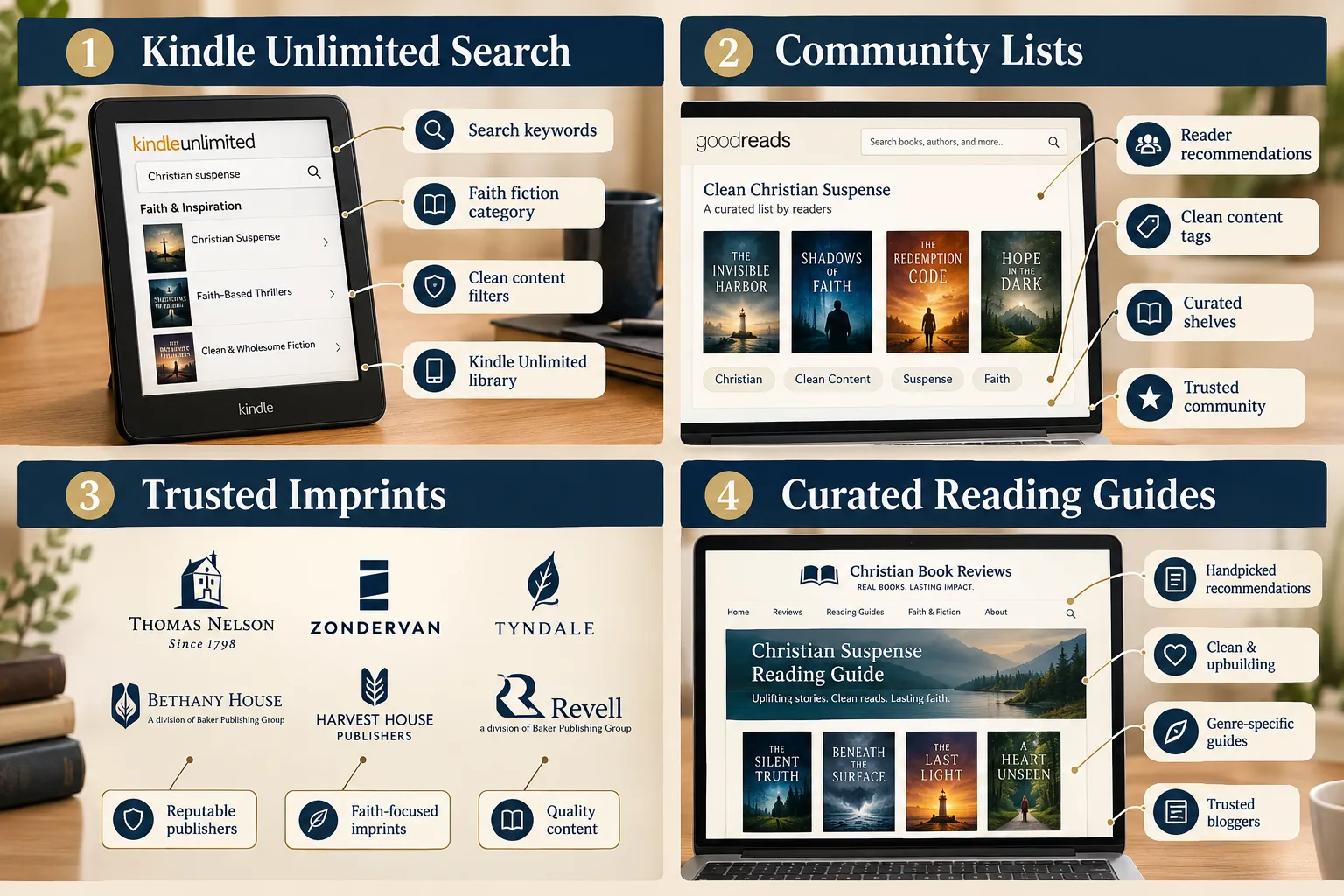
On Amazon/Kindle Unlimited:
- Search within the “Christian Books & Bibles > Fiction” category
- Filter by “Christian Suspense” or “Christian Mystery & Suspense”
- Check the book description for explicit content statements, most clean Christian publishers include them
On Goodreads:
- Search for shelves tagged “clean Christian fiction,” “Christian suspense,” or “no profanity”
- Community-curated lists are often more reliable than algorithm-generated ones
- See Goodreads for Christian Fiction Fans: Finding Clean Cozy Mysteries, Westerns, Fantasy, and LitRPG Lists for a full walkthrough
Trusted publishers for clean Christian suspense:
- Revell (a division of Baker Publishing Group)
- Harvest House Publishers
- Bethany House Publishers
- Love Inspired Suspense (Harlequin’s Christian line)
Dedicated reading guides and blogs:
- The Silas Bellhaven blog maintains curated guides across genres, see Best Christian Fiction Authors Across Cozy Mystery, Western, Fantasy, Thriller, and LitRPG
- Fresh sites devoted specifically to faith-based thrillers and clean suspense recommendations have launched in 2026, reflecting the genre’s growth [10]
Common mistake: Relying on “inspirational fiction” as a category tag alone. Some inspirational fiction is clean; some isn’t. Always check the specific content description rather than assuming the label covers everything.
Best Christian Suspense Series to Binge-Read
For readers who want a long run of books, the Criminal Minds experience of settling into a world and staying there, these series offer the most reading hours in the genre.
For psychological depth and institutional tension:
- The Gathering Light (Silas Bellhaven), 3 books, each a standalone with a new protagonist, all set at the same retreat. Start with When Hannah Sleeps.
For law-enforcement procedural feel:
- Dee Henderson’s O’Malley series, 7 books, ensemble cast of first responders, builds across the series
- Lynette Eason’s Danger Never Sleeps, 4 books, military/security backgrounds, fast pacing
For small-town investigative mystery with psychological layers:
- The Mercy House Mysteries (Silas Bellhaven), 10 books set in Juniper Gap, Tennessee, featuring Nora Bell Hartley. Cozy in setting, genuinely tense in plot. Start with A Donation to Die For.
For readers who want moral complexity without a cozy feel:
- Terri Blackstock’s Intervention series, family crisis, addiction, and faith under pressure
- DiAnn Mills’s FBI series, federal investigations with faith woven into the investigative process
Kindle Unlimited subscribers have particular access here, a significant portion of Christian suspense is available on KU in 2026, making binge-reading the genre genuinely affordable. [1] See Why Clean Christian Fiction Dominates Kindle Unlimited for more on the KU landscape.
FAQ
Q: Is The Gathering Light series appropriate for readers who dislike any mention of spiritual abuse? A: The series deals directly with the abuse of spiritual authority as a plot mechanism. If that subject is a hard stop, it may not be the right fit. If you’re willing to engage with it as a serious subject handled with care, not exploited for shock, the series treats it with honesty and hope in the dark.
Q: Do Christian psychological thrillers always have conversion moments? A: The best ones don’t. Faith in strong Christian fiction is present as lived experience, doubt, practice, failure, and cost, not as a dramatic conversion scene at the end. Readers who dislike heavy-handed faith content often find Christian psychological thrillers more comfortable than they expect.
Q: Can I read The Gathering Light books out of order? A: Yes. Each book follows a new protagonist and household. The retreat setting connects them, but each story is self-contained.
Q: What’s the difference between Christian suspense and Christian cozy mystery? A: Cozy mystery keeps the threat at a distance, the violence happens off-page, the tone stays warm, and the community is part of the comfort. Psychological thriller moves the threat inside the protagonist’s mind and relationships. Both can be clean; they produce different reading experiences.
Q: Are there Christian thrillers that deal with criminal profiling specifically? A: Dee Henderson’s work comes closest to the Criminal Minds profiling model, with characters who analyze criminal behavior professionally. The Gathering Light approaches it from the other direction, the protagonist is the one being profiled and manipulated, which produces a different kind of psychological tension.
Q: Where does Silas Bellhaven’s work fit in the broader Christian suspense genre? A: Silas Bellhaven writes at the literary end of clean Christian fiction, psychological weight, faith as a structural story element, and earned grace rather than formula. Readers who want the mind games and moral questions of Criminal Minds without the graphic content are the primary audience for The Gathering Light series specifically.
Q: Is Christian suspense growing as a genre? A: Yes. Publishers Weekly has reported mysteries on the rise in Christian fiction, and industry observers note a clear shift toward heavier, more psychological subjects within the genre. [3] The 2026 pipeline includes multiple new releases in law-enforcement and psychological suspense with Christian themes. [10]
Q: What if I want something darker than cozy but lighter than full psychological thriller? A: Patricia Bradley’s work sits in that middle space, small-town law enforcement, genuine tension, faith present but not heavy-handed. Lynette Eason’s earlier series also occupies that range.
Conclusion
The gap between Criminal Minds and clean Christian fiction is smaller than it looks from the outside. The psychological tension, the moral weight, the question of what people are capable of and what justice actually requires, none of that belongs exclusively to graphic content. It belongs to good storytelling, and Christian authors have been doing that work for decades.
Actionable next steps:
- Start with The Gathering Light. When Hannah Sleeps is the entry point, a standalone psychological thriller about a woman whose own testimony is turned against her inside a faith-based retreat. It’s the closest thing in clean Christian fiction to the institutional manipulation and psychological dread that Criminal Minds fans respond to.
- Browse the Silas Bellhaven catalog at the Amazon author page for the full range, from psychological thriller to cozy mystery to frontier western, all under the same content promise.
- Use Goodreads community lists to expand beyond a single author, the clean Christian suspense community is active and well-curated.
- Check Kindle Unlimited for binge-reading access, the genre’s KU presence makes it easy to try several series before committing.
Mercy and justice, hope in the dark, faith under fire, these aren’t soft themes. They’re the ones that last. The books in this guide are built on them.
References
[1] The Rise Of Christian Fiction Market Trends Regional Dynamics And Future Predictions For 2026 – https://www.alibaba.com/product-insights/the-rise-of-christian-fiction-market-trends-regional-dynamics-and-future-predictions-for-2026.html
[3] 100974 Mysteries On The Rise In Christian Fiction – https://www.publishersweekly.com/pw/by-topic/industry-news/religion/article/100974-mysteries-on-the-rise-in-christian-fiction.html
[4] Christian Suspense A Roundtable Discussion – https://crimereads.com/christian-suspense-a-roundtable-discussion/
[10] Marketersmedia 2026 4 17 Christshare Releases Report On Christian Reading Trends In 2026 – https://markets.financialcontent.com/bpas/article/marketersmedia-2026-4-17-christshare-releases-report-on-christian-reading-trends-in-2026