

Last updated: November 8, 2026
Quick Answer
A Christian cozy mystery with a traveling sleuth replaces the permanent small town with a rotating series of temporary communities, county fairs, heritage sites, campgrounds, revival weekends, regional festivals, where strangers live shoulder to shoulder for four days and then scatter. The structure works because a festival compresses motive, opportunity, and gossip into a hard deadline. Faith carries the continuity that a fixed town usually supplies: hospitality offered to strangers, local testimony gathered in borrowed kitchens, and a sleuth who keeps her convictions when nobody around her knows her name. Christian publishers are actively expanding into clean, faith-centered mysteries, which makes this an unusually open structural lane [1].
Key Takeaways
- Temporary communities raise stakes naturally. When the suspects leave Sunday night, the clock does the work a small-town setting usually does.
- Faith supplies continuity instead of geography. Church networks, fellowship halls, and volunteer crews give a traveling sleuth a reason to be welcomed anywhere.
- Christian cozy differs from general cozy by making belief load-bearing, tested through choice and cost, not inserted as a lesson.
- Cozy vs. traditional mystery: cozies keep violence off-page, use amateur sleuths, and center community; traditional mysteries allow professionals and darker detail.
- Festival and trip settings are measurable market variables, not novelties, cozy market research tracks occasions like trips, weddings, and parties as category-level data [2].
- The biggest craft risk is rootlessness. Ground the sleuth in habits, a vehicle, a standing phone call home, and one unfinished personal question.
- Discoverability is the real obstacle. Metadata like “Christian cozy mystery,” “festival mystery,” and “amateur sleuth” must do the explaining fast [1].
- No faith background required to read them; the appeal is clean content plus real stakes.
- Most series start with book one and benefit from reading in order when the sleuth’s personal arc carries across locations.
What Makes a Cozy Mystery Christian?
A cozy mystery is Christian when belief changes what the sleuth does, not just what she says. The marker isn’t a scripture quotation or a pastor in the cast. It’s whether mercy costs the protagonist something she’d rather keep.
In practice that looks like:
- A sleuth who has to choose between protecting a friend’s reputation and telling the truth
- Forgiveness that arrives after consequence, not instead of it
- Prayer that doesn’t resolve the plot, only steadies the person praying
- Church community rendered honestly, gossip included, grace included
The distinction matters commercially too. Christian readers can already find thousands of clean cozies outside Christian publishing, so a faith-centered mystery has to offer a genuine spiritual dimension rather than simply the absence of profanity [1]. That’s the difference between content-filtered and rooted in faith.
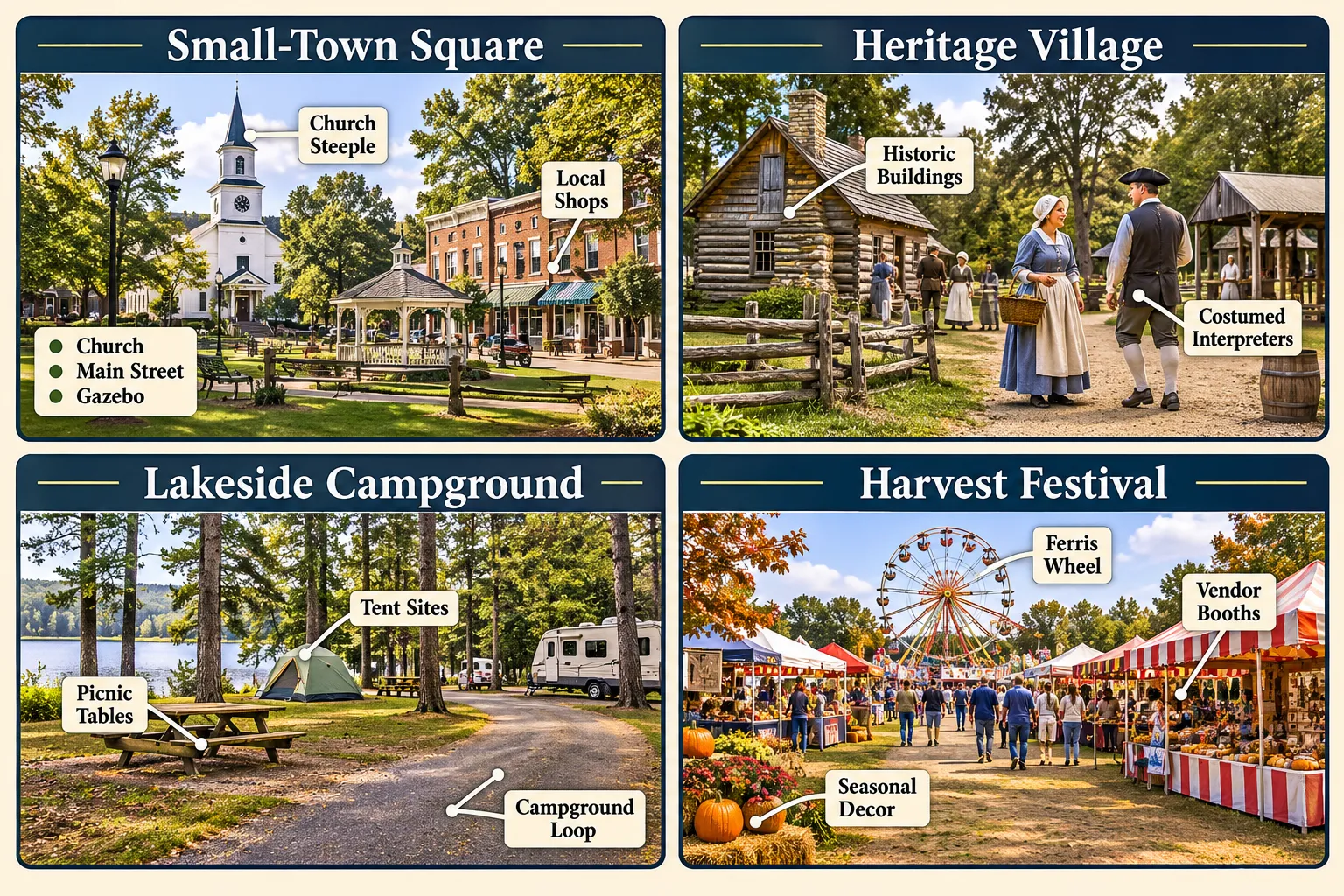
Why Are Festivals and Temporary Communities Good Mystery Settings?
Festivals work because they create forced proximity with an expiration date. Vendors, volunteers, performers, and visitors share tight space, split revenue, and old grudges for a weekend, then disperse. A sleuth has until teardown.
What a temporary community gives a writer that a permanent town can’t:
| Element | Permanent small town | Temporary community |
|---|---|---|
| Suspect pool | Known, slow to change | Fresh every book, instantly plausible |
| Deadline | Soft | Built in (festival ends) |
| Secrets | Buried under decades | Carried in from elsewhere |
| Sleuth’s access | Established standing | Must be earned fast |
| Tone risk | Staleness by book eight | Rootlessness if mishandled |
The 2026 cozy release calendar shows how durable this is: Thanksgiving gatherings, Christmas inns, campgrounds, and tourist destinations all run on the same engine, outsiders and locals colliding under one roof [3]. One announced Christian festival mystery builds a pastor’s death directly into a harvest festival of library booths, dunk tanks, and volunteer crews, treating community itself as a character [4].
Decision rule: choose a festival setting if your central secret traveled in from somewhere else. Choose a fixed town if the secret has been rotting in place for thirty years. For more on that choice, see the collected writing on cozy mystery settings.
What Makes a Temporary Community Interesting for Mystery Plots?
Temporary communities are interesting because everyone present has chosen to be there, which means everyone has a reason. A permanent resident may simply have been born in town. A vendor who hauled a trailer four hundred miles has intent.
Useful tensions to mine:
- Insiders vs. outsiders. Locals resent the money; visitors resent the gatekeeping.
- Shared infrastructure. One generator, one kitchen, one restroom block, everyone touches everything.
- Reputation portability. A craft-circuit vendor’s name travels with her, so slander is a real weapon.
- Hospitality as evidence. Who got offered a bed, who got turned away, and why.
Edge case worth avoiding: a closed-circle plot where nobody can leave starts to feel like a locked-room thriller instead of a cozy. Keep the exits open and let the characters choose to stay.
Cozy Mystery vs. Traditional Mystery: What’s the Difference?
Cozies keep violence off-page, use amateur sleuths, and resolve inside a community. Traditional mysteries allow professional investigators, procedural detail, and a grimmer register.
- Cozy: amateur sleuth, small or temporary community, humor and warmth, no graphic content, puzzle-forward.
- Traditional: police or PI lead, procedural accuracy, moral ambiguity permitted, violence shown.
- Overlap: both prize fair-play clue placement; the Agatha Christie puzzle model sits behind much of the current clean-mystery expansion [1].
If you want the sharper end of the spectrum without the graphic content, the notes on Christian psychological thriller plot structures map that territory.
How to Write a Christian Cozy Mystery With a Traveling Sleuth
Build the series bible around the sleuth’s reason to travel before you build a single case. A quilt-circuit judge, a disaster-relief coordinator, a regional church-camp cook, a heritage-site restorer, the job explains both the mobility and the access.
A working sequence:
- Fix the vocation. It must grant entry to kitchens, booths, and back rooms.
- Fix the deadline. Festival Friday to Sunday teardown is a clean three-act container.
- Seed the local ally. One person per book who vouches for her, usually through a church or volunteer network.
- Place the body where her work takes her. Donation tent, vendor row, fellowship hall.
- Make faith cost something in act three. The truth she tells should damage someone she likes.

Craft notes on pacing and clue placement live in the cozy mystery plot structure archive, and the broader how to write cozy mystery collection covers series-level planning.
How Do Authors Keep Traveling Characters Feeling Grounded?
Grounding comes from repeated small things, not from a home address. Readers attach to habits, objects, and relationships that survive the change of scenery.
Reliable anchors:
- A vehicle with personality and a mechanical flaw
- One standing phone call, a sister, a widowed father, a pastor back home
- A fixed ritual: same morning prayer, same thermos, same hymn hummed under stress
- A recurring correspondent who appears in person once a series
- An unresolved personal question that no single case answers
Common mistake: writing the sleuth as a tourist. If she’s observing the festival rather than working it, she has no standing to ask questions. Give her a shift, a booth, or a clipboard.
How to Develop a Consistent Detective Across Different Locations
Consistency comes from a fixed method, not a fixed address. Decide early how this particular sleuth gets at the truth and keep that method identical in every town.
Pick one dominant investigative instinct and hold it:
- Records. She reads ledgers, sign-in sheets, receipts.
- Hospitality. She feeds people and listens.
- Craft. She notices how things are made and who made them wrong.
- Testimony. She collects what people say about each other and weighs it.
Then vary only the obstacle. A campground manager withholds a registration log; a festival committee withholds minutes. Same instinct, new resistance. Character-side guidance sits in the Christian character development notes.
Common Mistakes When Writing a Mystery With a Road Trip Plot
The most frequent failure is spending chapters on transit. Travel is connective tissue, not plot.
- Driving scenes as filler. Open at arrival; summarize the miles in a line.
- A new cast with no anchor. Always carry one familiar voice into the new town.
- Reset amnesia. Previous cases must leave residue, a reputation, a scar, a debt.
- Convenient authority. A sheriff who hands over case files for no reason breaks the cozy contract.
- Geography as decoration. Give the location one mechanical effect on the crime (flood plain, generator, ferry schedule).
Do You Need to Be Christian to Enjoy Christian Cozy Mysteries? And Are They Appropriate for Teenagers?
No faith background is required. Most readers come for the puzzle, the warmth, and the absence of graphic content, and the faith reads as part of the characters’ lives rather than a demand on the reader’s. Clean fiction interest is rising alongside the cozy surge generally [5].
Teen suitability is generally high. Standard Christian cozies keep violence off-page, avoid profanity, and omit explicit content, which puts them comfortably in reach of readers around 13 and up. Some clean Christian mysteries are marketed explicitly to young adults. Parents should still check individual descriptions, since grief, addiction, or abuse can appear as serious subject matter handled gently.
Where Should I Start With a Christian Cozy Mystery Series?
Start with book one if the sleuth has a personal arc; start anywhere if the series is purely episodic. Traveling-sleuth series usually reward order, because the sleuth’s standing and private question build across stops.
For a Juniper Gap starting point, A Donation to Die For opens the Mercy House Mysteries with a mislabeled donation box, a hidden ledger, and a deacon who died just short of his confession. The full Mercy House Mysteries series page runs through The Benediction Tape Murder. Christian cozy releases also appear steadily on monthly roundups from Christian fiction associations, including seasonal titles built around holiday gatherings [3].
Release pace varies widely. Traditionally published Christian mystery imprints tend toward a few titles a year, while independent Kindle Unlimited authors often publish on a faster schedule; Love Inspired Trade’s continuing mystery program shows the category is being treated as ongoing rather than experimental [1].
Cozy Alternatives if Religious Themes Aren’t for You
If the faith element isn’t the draw, general-market cozies deliver the same structure, amateur sleuth, warm community, no gore, without the spiritual thread. Craft, culinary, bookshop, and pet cozies dominate that space [6].
Readers who want moral weight without overt religion often prefer traditional mysteries or clean suspense. Within this catalog, The Mercy Line westerns carry conscience-driven stakes in a different register, and the genre-blending guide maps the crossover points.
FAQ
What is a traveling sleuth? An amateur detective whose vocation moves her between locations, fairs, festivals, campgrounds, heritage sites, so each book features a new temporary community instead of one recurring town.
Why use festivals instead of a permanent small town? Festivals create a built-in deadline and a fresh, plausible suspect pool every book, which keeps a long series from going stale.
Is Christian cozy mystery a growing category? Christian publishers are expanding into clean, faith-centered mysteries, with at least one major imprint signaling an ongoing rather than trial program [1].
How much faith content is typical? Enough that belief affects decisions. Sermons, conversions on cue, and scripture used as clue-solving shortcuts are generally considered weak craft.
Are these books violent? A death occurs, but it happens off-page and is not described graphically.
Can a traveling sleuth have a romance subplot? Yes, though many Christian cozy series keep romance slow or absent to preserve the puzzle focus.
How long is a typical cozy mystery? Most run between roughly 50,000 and 80,000 words, often shorter in Kindle Unlimited-focused series.
Do I need to read the series in order? Order is recommended when the sleuth carries a personal arc; standalone cases can usually be read out of sequence.
What metadata helps these books get found? Terms like “Christian cozy mystery,” “festival mystery,” “road-trip mystery,” and “amateur sleuth,” since discoverability is the main commercial hurdle for the category [1].
Conclusion
A traveling sleuth trades the comfort of a familiar street for something harder and more interesting: a woman who has to earn trust in four days, in a place where nobody owes her anything, and still tell the truth when it costs her a friend. That’s the structure’s real gift, it keeps faith under fire rather than letting it settle into scenery.
Next steps worth taking:
- Choose a vocation that grants access, then build cases around it.
- Write the sleuth’s three permanent habits before you write her first case.
- Give every location one mechanical effect on the crime.
- Set your metadata before your cover.
- Read a festival-centered cozy and a fixed-town cozy back to back, and mark exactly where the pacing diverges.
The suspects leave Sunday. Whatever truth gets told has to be told before teardown.
References
- Mysteries on the Rise in Christian Fiction. publishersweekly.com.
- Zeitgeist Mystery Thriller Suspense K-Lytics Report. authormedia.com.
- November 2026 New Releases From ACFW Authors. lorainenunley.com.
- Harvest Festival Murder. fantasticfiction.com.
- Christshare Highlights Clean Fiction as Cozy Mysteries Gain Interest. news.marketersmedia.com.
- Cozy Mysteries. kdpeasy.com.