
Last updated: September 16, 2026
Quick Answer: Christian psychological thriller protagonists navigate trauma and fractured memory through faith rather than clinical detachment, and the best of them do it without graphic flashbacks, relying instead on present-tense consequence, unreliable perception, and the slow, costly work of spiritual recovery. These characters work because their faith is tested by the plot, not announced in narration. The result is psychological tension that holds up against secular thrillers while honoring the clean-read expectations of the audience.
Key Takeaways
- Christian psychological thrillers handle trauma through present-tense consequence rather than graphic scene replay
- The strongest protagonists carry unreliable memory as a plot mechanism, what they can’t recall matters as much as what they can
- Faith recovery arcs require cost before grace; cheap resolution breaks reader trust
- The genre differs from secular psychological thrillers primarily in its moral framework and recovery engine, not its tension level
- Techniques like sensory displacement, fragmented documents, and witness testimony replace graphic flashbacks without losing emotional weight
- The audience, primarily women 35-65 on Kindle Unlimited, wants real stakes and honest doubt, not sanitized characters
- Common mistakes include resolving trauma too quickly, using scripture as a shortcut, and writing faith as a personality trait rather than a tested conviction
- Memory as evidence is a recurring structural device: what the protagonist misremembers often points directly at the truth she’s been protecting herself from
- Christian thrillers are appropriate for most adult readers, including those sensitive to graphic content, because tension is built through psychology and moral stakes
- Series like The Gathering Light demonstrate that clean content and genuine psychological suspense are not in conflict
What Makes a Good Christian Psychological Thriller Protagonist
A strong Christian psychological thriller protagonist carries two things simultaneously: a wound she hasn’t fully faced and a faith she hasn’t fully trusted. The tension between those two realities is the engine of the story.

What separates these characters from secular counterparts isn’t that they pray more or sin less. It’s that their moral framework is load-bearing, the choices they make under psychological pressure are shaped by a conscience that answers to something beyond themselves. When Hannah Garrick, the protagonist of When Hannah Sleeps, discovers her own testimony appearing in someone else’s file at Gathering Light Restoration Retreat, the horror isn’t just personal violation. It’s the corruption of something she believed was sacred: the honest record of another person’s pain.
Strong protagonists in this genre tend to share several qualities:
- Competence undermined by blind spots, they’re capable people whose trauma has created a specific gap in perception
- Active faith under pressure, belief that shows up in what they choose, not what they say
- A relationship with truth, they’re usually people whose work or identity involves records, testimony, or witness (a transcriptionist, a counselor, a journalist)
- Earned doubt, they question God not as a character flaw but as a sign that the stakes are real
- Resistance to easy rescue, grace finds them, but not before the cost is paid
The best way to test whether a protagonist works: remove the faith element entirely and see if the story collapses. If it does, faith is structural. If it doesn’t, faith is decoration.
How Christian Thrillers Handle Trauma Without Graphic Content
Christian psychological thrillers manage trauma without graphic flashbacks by shifting the weight from what happened to what it costs the protagonist right now. The past doesn’t need to be shown in full detail to be felt in full force.
This is both a craft choice and a content commitment, and the two reinforce each other. Graphic flashback sequences often function as shorthand, a way to tell the reader how to feel rather than letting the present-tense story earn that response. Removing them forces writers to do harder, better work.
Techniques that replace graphic flashbacks:
- Sensory displacement, a smell, a texture, or a sound in the present scene triggers a physical response the protagonist can’t explain, pulling the reader into the emotional residue without reconstructing the event
- Behavioral tells, the character flinches, goes quiet, or makes a specific wrong choice; the reader understands the shape of the wound through its present-day shadow
- Fragmented documents, letters, transcripts, prayer lists, or case files that are incomplete in telling ways; the gaps are as significant as the text
- Witness testimony, another character’s account of the protagonist’s past, filtered through their own limited knowledge, which creates unreliability without requiring the protagonist to relive the scene
- The locked room structure, a piece of memory the protagonist actively avoids, which the reader recognizes as significant precisely because she won’t go near it
For a deeper look at how these techniques fit into full plot architecture, see Christian Psychological Thriller Plot Structures: Using Trauma, Memory, and Grace Without Graphic Content.
The Difference Between Christian and Secular Psychological Thrillers
The core difference is not content level, it’s the recovery engine. Secular psychological thrillers tend to resolve through revelation (the truth is uncovered) or agency (the protagonist escapes or defeats the threat). Christian psychological thrillers add a third resolution layer: reconciliation, both with the truth and with God.
This doesn’t mean the secular thriller is lesser. It means the Christian version is asking a different question. Where a secular thriller might ask “Can she survive what was done to her?”, a Christian thriller asks “Can she hold her faith while she finds out who she actually is?”
Other meaningful distinctions:
| Element | Secular Psychological Thriller | Christian Psychological Thriller |
|---|---|---|
| Recovery engine | Therapy, agency, revelation | Faith, community, reconciliation |
| Moral framework | Relative, situational | Absolute, conscience-driven |
| Doubt | Often resolved by evidence | Often resolved by trust |
| Antagonist motivation | Power, control, survival | Often includes spiritual corruption |
| Content | Variable, often graphic | Clean, tension through psychology |
| Ending shape | Justice or escape | Justice and grace (earned) |
A 2026 market analysis notes that Christian fiction readers are increasingly seeking stories addressing mental health and faith without explicit content, and that this demand is driving measurable segment growth [3]. The religious publishing market is projected to reach $1.409 billion in 2026, with faith-rooted fiction addressing contemporary issues as a significant driver [9].
What Role Memory Plays in Christian Psychological Thrillers
Memory in Christian psychological thrillers functions as both plot mechanism and spiritual metaphor. What the protagonist can’t remember, or misremembers, is rarely accidental. It’s usually the shape of something she’s been protecting herself from knowing.
This connects directly to the genre’s theological underpinning. The Christian tradition has always held that truth-telling is costly, that bearing witness to one’s own story requires courage, and that confession is not just admission but restoration. When a protagonist’s memory is unreliable, the reader is watching her resist that process in real time.
Memory devices that work well in this genre:
- The prayer list, a record of names and needs that reveals more than it was meant to
- The transcript, a verbatim account that the protagonist helped create, now turned against her
- The testimony, a spoken record that has been edited, selectively preserved, or weaponized
- The journal, entries that contradict the protagonist’s current understanding of events
The spine question running through Silas Bellhaven’s The Gathering Light series is: “Who controls the record of someone’s truth?” Each book, When Hannah Sleeps, When the Voice Breaks, and When the Prayer List Opens, gives that question a new protagonist and a new institutional setting, but the memory-as-evidence structure remains constant.
How to Write a Faith Recovery Arc in a Thriller
A faith recovery arc in a thriller works when faith is the thing being tested by the plot, not the thing that resolves it prematurely. Grace should arrive after cost, not instead of it.
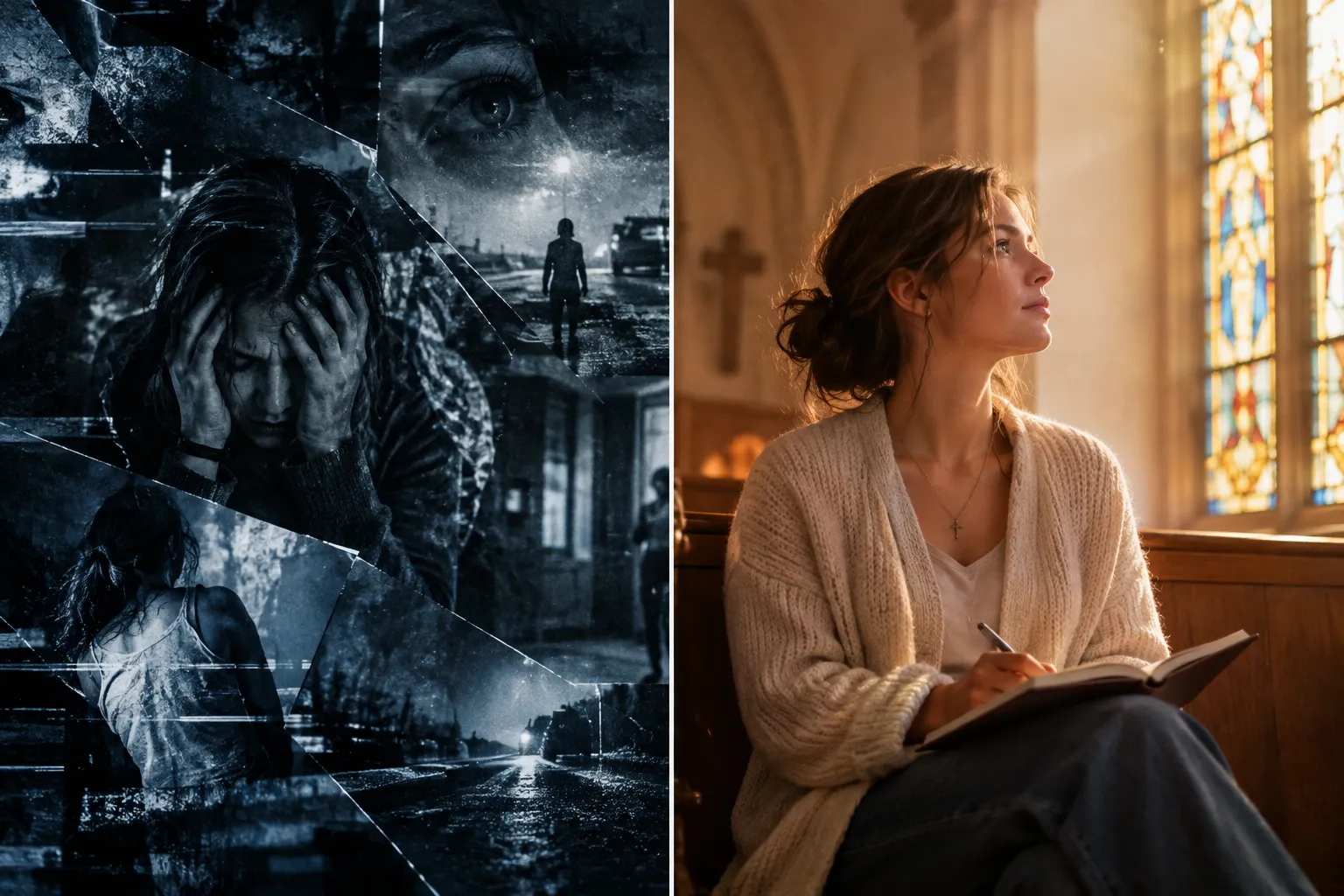
The most common failure is what might be called the “conversion shortcut”, the protagonist has a breakthrough moment of prayer or scripture, and the psychological wound resolves. This breaks reader trust because it treats faith as a mechanism rather than a relationship. Real faith in fiction looks like doubt that doesn’t destroy, choices made without certainty, and mercy that costs the person extending it.
A workable faith recovery arc has five stages:
- Wound established, the trauma is present in its effects, not necessarily its details
- Faith tested, the protagonist’s belief is directly challenged by what she’s discovering
- False resolution, she reaches for an easy answer (a formula prayer, a trusted authority, a doctrinal certainty) and it doesn’t hold
- The real cost, she has to act on faith without confirmation, usually at significant personal risk
- Earned grace, mercy arrives, but it looks different than she expected, and it doesn’t erase the cost
For more on integrating faith into plot without preaching, see Faith in Fiction: How to Weave Believable Spiritual Journeys Into Plot Without Preaching.
How Christian Thrillers Approach PTSD Recovery
Christian psychological thrillers approach PTSD and trauma recovery by treating it as a spiritual and relational process, not just a clinical one. The protagonist isn’t simply healing, she’s being asked to trust again, both people and God, at exactly the moment when trust has been most damaged.
This doesn’t mean the fiction ignores the psychological reality of trauma. The best examples show:
- Hypervigilance as a plot-active trait, the protagonist notices things others miss, but also misreads safety as threat
- Avoidance with consequences, what she won’t face comes back through the plot
- Community as both help and complication, the church or faith community is often both a source of healing and the location of the original wound
- Prayer as honest struggle, not a hotline but a hard conversation
The key distinction from secular treatment: the Christian framework holds that healing is not just psychological restoration but relational reconciliation, with self, with others, and with God. That third dimension gives the recovery arc a shape that secular thrillers don’t have access to.
A 2026 analysis of the CBA Top 25 found that 68% of best-selling Christian titles are genre hybrids, many centering on conscience, suffering, and redemption through character interiority rather than graphic scenes [3]. That’s not a coincidence, it reflects what the audience actually wants.
Common Mistakes in Writing Christian Thriller Characters
The most damaging mistakes in Christian psychological thriller protagonists fall into three categories: cheap grace, performed faith, and sanitized psychology.
Cheap grace means the protagonist’s wound heals too cleanly, too fast, or without real cost. Grace is real in these stories, but it has to be earned by the plot, not handed out as a narrative reward for surviving the climax.
Performed faith means the character talks about belief rather than living it. Scripture-dropping, spontaneous worship moments in the middle of the thriller’s tension, or characters who explain their theology to each other, all of these pull the reader out of the story and into a lesson.
Sanitized psychology means the protagonist’s trauma is present but defanged, she has a hard past, but it never actually distorts her perception or costs her a relationship or leads her to a wrong conclusion. This is the most common mistake in Christian fiction broadly, and it’s fatal in psychological thrillers specifically, because the genre depends on the wound being real enough to mislead the reader.
Other mistakes worth naming:
- Making the antagonist obviously evil from the first scene (psychological thrillers need plausible trust)
- Using faith community as only positive backdrop rather than a complex space where harm can also occur
- Resolving the mystery and the faith arc on the same page, they need separate space
See also: The Role of Redemption Arcs in Christian Thrillers and Dark Fantasy for how redemption arcs function across both genres.
Who Is the Audience for Christian Psychological Thrillers
The primary audience for Christian psychological thrillers is women 35-65 who read on Kindle Unlimited and want psychological tension without graphic content. They’re not looking for sanitized stories, they’re looking for honest stories told within a clean-read framework. The distinction matters.
These readers have often experienced real loss, real doubt, and real institutional disappointment. They want fiction that walks with them, not fiction that talks at them. They’ll accept a protagonist who questions God, who makes wrong choices, who sits in unresolved grief, as long as the story treats those things with the same weight they carry in real life.
The Christian suspense and mystery segment is identified as a key growth persona in 2026 market data, with readers specifically seeking “high-stakes, intrigue, and moral clarity” with faith organically integrated [10]. That phrase, organically integrated, is the whole game. Faith that feels bolted on is as off-putting to this audience as faith that’s absent.
Secondary audiences include:
- Readers recovering from church hurt who want fiction that holds institutional faith accountable
- Readers new to Christian fiction coming from secular psychological thrillers who want cleaner content
- Writers studying how to handle trauma themes within clean-read parameters
For a broader look at the clean-read landscape, see Best Christian Psychological Thrillers for Clean-Read Fans: High Tension, High Morality, No Graphic Content.
How to Balance Faith and Doubt in Thriller Narratives
Faith and doubt in a thriller work best when they’re in active tension throughout the story, not resolved early or saved for the final chapter. A protagonist who doubts and then believes is less interesting than one who doubts and acts anyway, and pays the cost of that choice.
The practical rule: doubt should complicate the plot, not just the character’s inner life. If the protagonist’s crisis of faith only shows up in her thoughts and prayers, it’s not load-bearing. If it causes her to trust the wrong person, withhold a crucial piece of information, or delay an action that costs someone else, then doubt is doing real narrative work.
Faith earns its place in the story the same way: not through declaration but through decision. The moment a character chooses the harder, costlier, more faithful path when the easier one was available, that’s where rooted in faith becomes visible to the reader without ever being stated.
For readers who want to see how this balance plays out across different genres, Faith in Fiction: How Readers Use Christian Stories for Reflection, Healing, and Everyday Spiritual Practice offers a useful companion perspective.
Are Christian Psychological Thrillers Appropriate for All Readers
Christian psychological thrillers are appropriate for most adult readers, including those who are sensitive to graphic content, because the tension is built through psychology, moral stakes, and relational complexity rather than graphic violence or explicit scenes. They are not, however, uniformly light reads, the psychological weight is real, and readers processing active trauma may want to choose timing carefully.
What readers can generally expect from the genre:
- No graphic violence or explicit sexual content
- No profanity
- Psychological tension that may include themes of manipulation, gaslighting, institutional abuse, and fractured trust
- Faith handled as lived experience, including doubt and spiritual crisis
- Resolution that is hopeful but not simplistic
What the genre is not: it is not a cozy mystery with a thriller label. The stakes are genuine, the discomfort is real, and the protagonist’s suffering is treated with weight. Readers who want zero darkness should look at Christian Cozy Mystery vs. Private Investigator Thrillers: Which Subgenre Fits Your Reading Style? to find the right fit.
For readers who want clean content across multiple genres, see Clean Christian Fiction That Isn’t Just Romance: Mysteries, Westerns, Fantasy, Thrillers, and LitRPG for KU Readers.
Conclusion
Christian psychological thriller protagonists work when their trauma is real, their faith is tested, and their recovery costs something. The genre doesn’t need graphic flashbacks to carry psychological weight, in fact, removing them forces the craft to go deeper, building tension through present-tense consequence, unreliable memory, and the slow, honest work of spiritual reckoning.
The audience for these stories is not looking for easy comfort. They’re looking for hope in the dark, the kind that has been through something and still holds. That’s what earned grace looks like in fiction, and it’s what separates a Christian psychological thriller from both a secular thriller and a faith-themed inspirational novel.
Actionable next steps:
- If you’re a reader: Start with When Hannah Sleeps from The Gathering Light series, it’s the clearest example of these principles in practice
- If you’re a writer: Read Christian Psychological Thriller Plot Structures: Using Trauma, Memory, and Grace Without Graphic Content before outlining your protagonist’s wound
- If you’re exploring the genre for the first time: Best Christian Psychological Thrillers for Clean-Read Fans is the right starting list
The record of someone’s truth matters. These stories say so, and they say it without flinching.
FAQ
Q: What is a Christian psychological thriller? A: A Christian psychological thriller is a suspense novel that builds tension through character psychology, unreliable perception, and moral stakes, with faith integrated as a load-bearing element of the protagonist’s identity and recovery, not as decoration or sermon.
Q: Do Christian psychological thrillers have to be clean? A: Most do, by reader expectation and author intent. “Clean” means no graphic violence, no explicit sexual content, and no profanity, but it does not mean no darkness. Psychological weight, moral complexity, and genuine suffering are all present; they’re just handled through implication and consequence rather than graphic depiction.
Q: How do authors write trauma without flashbacks? A: Through present-tense behavioral consequence, sensory displacement, fragmented documents, and witness testimony. The wound is felt through its current effects rather than reconstructed in detail.
Q: Can a Christian thriller protagonist have a crisis of faith? A: Yes, and the best ones do. A faith crisis that complicates the plot and costs the character something real is far more honest and compelling than a protagonist whose belief is never challenged.
Q: What’s the difference between a faith recovery arc and a conversion arc? A: A conversion arc moves a character from unbelief to belief. A faith recovery arc moves a character from damaged, avoidant, or performative faith toward honest, costly, tested belief. Most Christian psychological thrillers use the second structure.
Q: Are these books suitable for readers who’ve experienced church hurt? A: Many readers specifically seek out Christian psychological thrillers because the genre is willing to place institutional faith under scrutiny. The best examples hold the church accountable without abandoning the faith.
Q: How long does a faith recovery arc typically run in a thriller? A: The full arc usually spans the entire novel, with the deepest cost paid in the final act. Partial resolution earlier in the story is fine, but the protagonist should still be carrying something unresolved until near the end.
Q: What makes memory a useful device in Christian thrillers specifically? A: Because the Christian tradition frames truth-telling as spiritually significant, a protagonist’s fractured or suppressed memory carries theological weight, what she can’t face isn’t just a psychological wound, it’s a place where honesty and faith have both broken down.
Q: Is the genre growing? A: Yes. A 2026 market analysis places the Christian fiction segment at $75-85 million within religious publishing, with trauma and healing themes prominent among content drivers [3]. The broader religious publishing market is projected at $1.409 billion for 2026 [9].
Q: Who is Silas Bellhaven? A: Silas Bellhaven is the author of The Gathering Light series and other Christian fiction across multiple genres. The work is rooted in lived belief, not formula, written for readers who want stories that walk with them, not talk at them.
References
[3] Christian Fiction 14.7 Yearly Surge Dramatic Market Expansion Data – https://www.firmenpresse.de/pressrelease734029/christian-fiction-14-7-yearly-surge-dramatic-market-expansion-data.html
[7] Christian Suspense Thrillers – https://christiansuspensenovels.com/christian-suspense-thrillers
[9] Marketersmedia 2026 4 17 Christshare Releases Report On Christian Reading Trends In 2026 – https://www.financialcontent.com/article/marketersmedia-2026-4-17-christshare-releases-report-on-christian-reading-trends-in-2026
[10] Top Selling Christian Novels – https://www.accio.com/business/top-selling-christian-novels