Last updated: October 9, 2026
Quick Answer
Christian Psychological Thrillers and the Science of Suspicion: Why Readers Doubt Memory, Motive, and Testimony comes down to one mechanism: suspense is built from competing explanations, not from gore. A reader doubts a character’s memory because real memory is reconstructive, doubts motive because confirmation bias filters what anyone notices, and doubts testimony because confidence and emotional demeanor are poor guides to truth. Faith-rooted thrillers add a second layer, the moral cost of telling the truth once you’re holding it.
Key Takeaways
- Suspicion is not the same as distrust. Suspicion means a character is still weighing explanations: mistaken, manipulated, self-deceived, or lying.
- Memory distrust is a trait, not just a mood. Research distinguishes short-term memory confidence from a standing tendency to discount your own recollection and defer to someone else’s account.
- Confident doesn’t mean truthful. The confidence, accuracy link is strongest at the first identification and weakens after repeated interviews, feedback, and courtroom preparation [10].
- The “wrong” emotional reaction reads as guilt to observers, even when the person is innocent, a device thrillers use constantly and real investigations get wrong.
- Christian psychological thrillers differ from secular ones mainly in what the ending owes the reader: consequence plus the possibility of earned grace, never a tidy conversion scene.
- Mystery asks who did it. Psychological thriller asks whether you can trust the person telling you.
- The category is still unevenly shelved. Christian mystery and suspense are growing but less institutionally established than romance, so psychological material often gets packaged as gothic, domestic, or romantic suspense [9].
- Clean doesn’t mean low-stakes. Dread comes from uncertainty about what’s real, which costs nothing in graphic content.
What Makes a Psychological Thriller Christian vs. Secular?
A psychological thriller is Christian when the moral framework inside the story is load-bearing, not decorative. Both versions can use unreliable narrators, disputed memory, and conspiracies. The difference shows up in what the resolution costs and whether mercy is treated as real.
Three practical markers:
- Consequence is honored. A character who lied to protect a church doesn’t get absolved by a sympathetic paragraph. There’s restitution, lost standing, a hard conversation.
- Grace arrives after cost, not instead of it. This is the dividing line between faith-rooted suspense and sentimental fiction.
- Faith is lived, not announced. The believing character doubts, prays badly, forgets to pray, and keeps going. Readers who want fiction that walks with them rather than talks at them can feel the difference in the first chapter.
Decision rule: if you could delete every reference to faith and the plot would resolve identically, it’s a secular thriller with Christian decoration. If removing faith removes the protagonist’s reason to do the costly thing, it’s a Christian psychological thriller.
The template for the modern Christian suspense market was largely set by Frank Peretti’s This Present Darkness (1986), which built dread out of hidden conspiracies, competing interpretations of ordinary events, and prayer as actual plot mechanism. David C Cook announced a 40th-anniversary collector’s edition in September 2026, with a new introduction, reproductions of Peretti’s handwritten manuscript, and a map, a signal that publishers see fresh demand for faith-based suspense [4].
Why Do Psychological Thrillers Make Us Doubt Memory and Perception?
Because memory is reconstructive. Every time a character recalls a night, they rebuild it from fragments, and each rebuild can absorb new information, a suggestion from an interviewer, a photograph, a sibling’s version. Thriller writers exploit a real feature of cognition, not a gimmick.
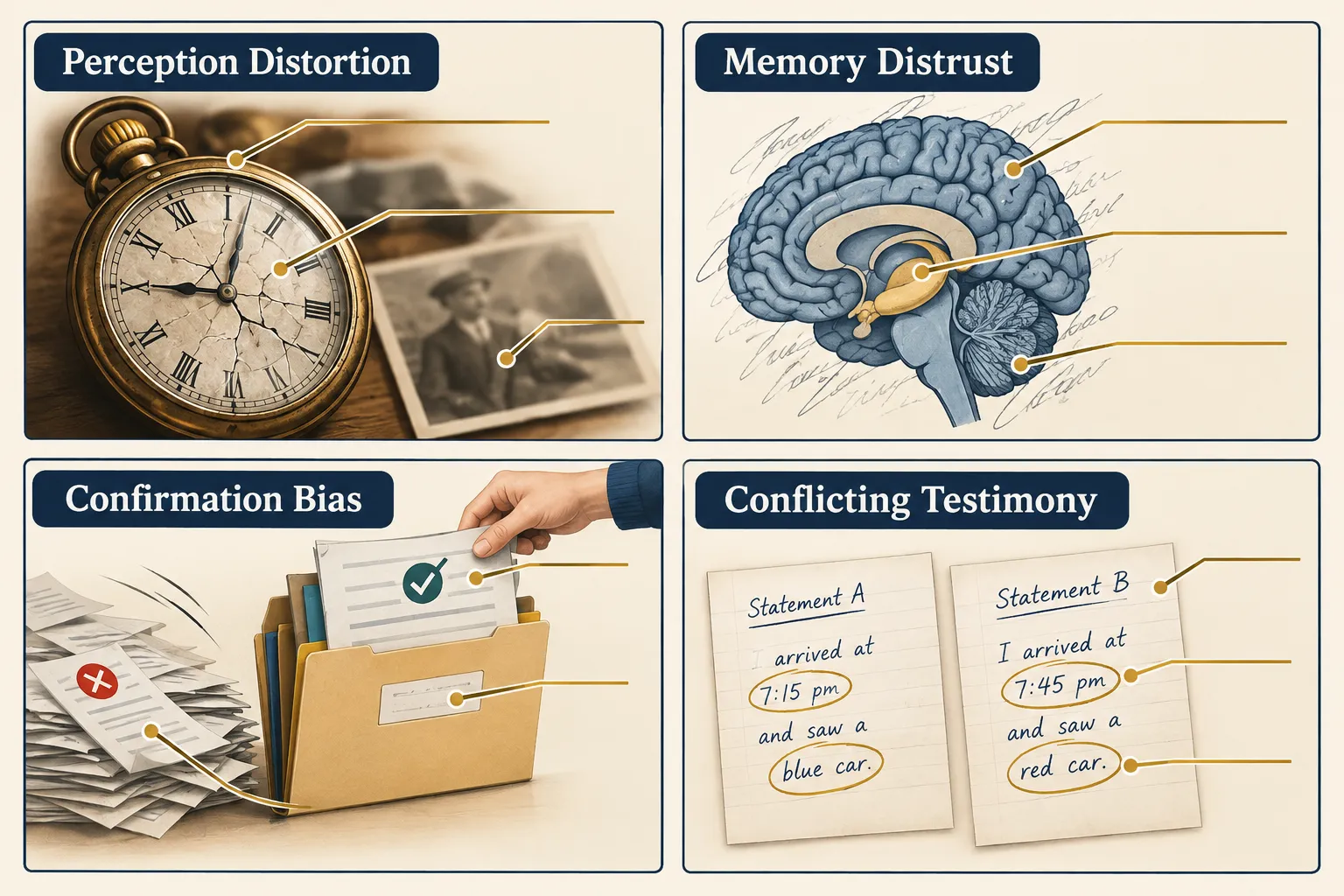
The four mechanisms most often used:
- Perception under stress. Attention narrows. A witness may recall a weapon vividly and a face barely at all.
- Memory distrust. Separate from momentary uncertainty, this is a standing disposition to discount your own recall. Recent research using the Gudjonsson Suggestibility Scale and Memory Distrust Scale with 229 community participants found a significant negative relationship between memory recall and trait memory distrust, with commission errors (remembering things that didn’t happen) more strongly tied to suggestibility than omission errors.
- Confirmation bias. Once a character suspects the deacon, every neutral detail gets filed as proof. Readers do this too, which is why the twist lands.
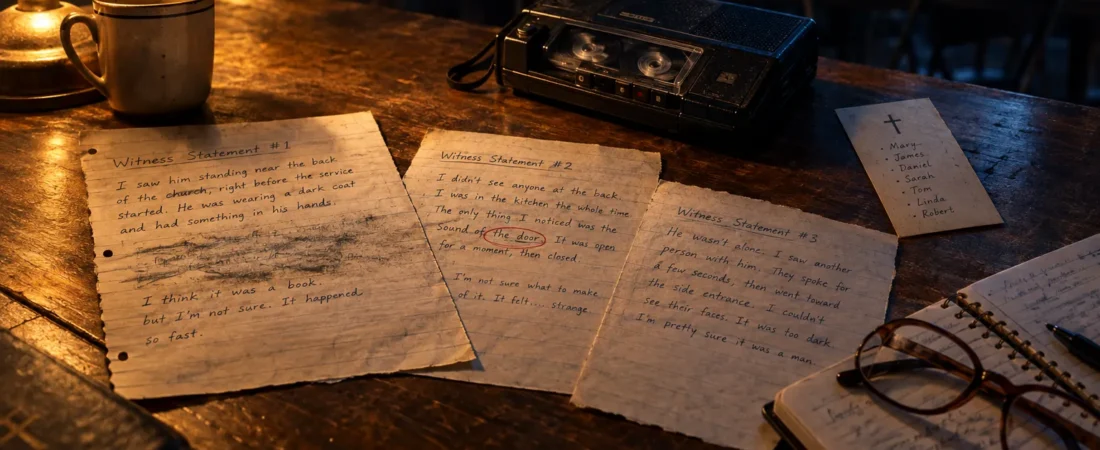
- Conflicting testimony. Two sincere people, two incompatible accounts, no liar required.
The scariest sentence in a clean thriller isn’t a threat. It’s a character saying, “That’s not how I remember it,” and being right about everything except the part that matters.
Why do people doubt their own memory in high-stress situations?
Stress compresses what gets encoded and inflates what gets reconstructed afterward. A person in a crisis may be certain about the sequence and wrong about the timing, or right about the voice and wrong about who was in the room. That gap is where suspicion grows.
Add social pressure and it accelerates. If three people say the meeting happened on Tuesday and you remember Thursday, trait memory distrust makes you yield. Thrillers about institutions, retreats, churches, hospitals, boards, run on this, because an institution’s written record is socially louder than one person’s recall.
How Do Christian Psychological Thrillers Use Unreliable Narrators?
They use unreliable narrators who are honest. Secular thrillers often go with a narrator who’s concealing something from the reader. Faith-rooted suspense more often gives you a narrator who is sincerely trying to tell the truth and can’t fully access it.
Common configurations:
- The compromised witness. Illness, medication, exhaustion, or grief has blurred the account.
- The complicit professional. Someone who helped build the system now being used against them, a transcriptionist, a counselor, an archivist.
- The dual timeline. Two accounts of the same event, decades apart, both defensible. Readers who like this structure will find more in this piece on how dual-timeline Christian thrillers hold two versions of the truth.
- The reliable narrator in an unreliable record. The person is fine. The file is wrong. This is the spine of The Gathering Light series, which keeps asking who controls the record of someone’s truth.
Common mistake: writers make the narrator lie to the reader and call it psychological depth. Sincere confusion is harder to write and far more unsettling, because there’s nobody to blame.
How Does Faith Play Into Suspicion and Doubt in Christian Fiction?
Faith raises the stakes of suspicion rather than resolving it. A character who believes in truth as something real, and in mercy as something owed, can’t treat an accusation casually. Getting it wrong carries weight.
This creates three tensions secular thrillers don’t have access to in the same way:
- Bearing false witness is a sin, not just an error. Suspicion itself becomes morally risky.
- Forgiveness complicates investigation. A character may be required to extend mercy to someone they still have to expose.
- Discernment versus paranoia. The believing protagonist has to distinguish conviction from fear, often without a clear signal.
Faith here isn’t the answer key. It’s the pressure. Readers who want that pressure handled honestly rather than preached can explore Christian psychological thriller books built on memory loss, hidden identities, and moral reckoning.
Christian Psychological Thrillers vs. Mystery Novels: What’s the Difference?
A mystery asks who did it. A psychological thriller asks whether the person telling you can be trusted, including the narrator, the record, and sometimes the reader’s own assumptions.
| Element | Christian Mystery / Cozy | Christian Psychological Thriller |
|---|---|---|
| Central question | Who committed the crime? | What actually happened, and who’s shaping the account? |
| Tension source | Puzzle and community disruption | Doubted perception, motive, and testimony |
| Protagonist | Amateur or professional sleuth outside the harm | Often personally implicated or compromised |
| Pacing | Steady clue accumulation | Escalating uncertainty, late reframing |
| Resolution | Order restored | Truth spoken at cost; order partly restored |
| Faith function | Community, conscience, gentle justice | Discernment under pressure, earned grace |
Readers often enjoy both. If you want the gentler end, the Christian cozy mystery reading guide on small-town clues and gentle justice covers it; for the sharper end, the reading guide for Criminal Minds and SVU fans who want clean content is the better fit.
What Are the Common Tropes in Christian Psychological Thrillers?
The recurring devices cluster around records, memory, and institutional authority. Most of them work because they’re psychologically plausible, not because they’re shocking.

- The contested record, a ledger, transcript, prayer list, or file that says something different than the person it describes.
- The forgotten night, a gap in memory that others are happy to fill in.
- The trusted institution, a retreat, ministry, or congregation whose procedures protect the wrong person.
- The returning name, someone presumed gone reappears and demands an answer.
- The helpful expert, a counselor or physician whose authority quietly overwrites a witness’s account.
- The anonymous package, a concealed past arriving by mail.
- The gothic house, a building holding two timelines at once.
Recent Christian fiction listings lean heavily into memory impairment and disputed expertise. Jerusha Agen’s Watched, among September 2026 releases, follows a psychiatrist experiencing forgetfulness and confusion while under suspicion from an attorney whose client was harmed by his earlier expert testimony, cognitive decline, professional credibility, and the moral weight of testimony in one premise [7].
How Accurate Is the Psychology in Christian Thrillers?
It varies widely. The mechanisms most thrillers use, reconstructive memory, suggestibility, narrowed attention under stress, are well supported. The shortcuts they often take are not.
Where fiction tends to get it wrong:
- “Confident equals truthful.” Confidence recorded immediately at a first identification carries some diagnostic value; confidence expressed after repeated interviews, feedback, and trial prep is far less informative [10].
- “Calm equals guilty.” Research examining 911 callers who reported violent crimes found that callers who didn’t show the expected level of emotion were judged more as moral agents capable of wrongdoing and less as victims deserving protection. Trauma, shock, culture, and personality all shape demeanor.
- “Hesitation equals deception.” A 2026 Stockholm University study found witnesses testifying in a second language recalled roughly the same number of correct and incorrect details as native speakers and were no more susceptible to leading questions, yet felt less confident and were judged less credible. That matters for stories involving multilingual congregations or mission contexts.
- “Observers can spot a false memory.” The University of Exeter’s Evidence-Based Justice Lab reported in February 2026 that people predicted poorly what another person would remember, and that their own experiences biased those judgments.
Edge case worth noticing: legal practice is updating faster than fiction. Massachusetts issued revised model eyewitness-identification jury instructions in February 2026 addressing confidence statements, familiarity, outside information, showups, and in-court identification. A thriller that still treats a confident courtroom pointing finger as decisive is behind the law.
What Readers Should Know About Unreliable Testimony in Thrillers
Unreliable testimony in fiction usually means sincere and wrong, not lying. Reading with that assumption makes twists more satisfying and false suspects easier to spot.
A short checklist for suspicious reading:
- Ask when the detail entered the account. Was it in the first telling, or did it appear after someone else mentioned it?
- Separate the record from the witness. Who wrote it, who edited it, and who benefits from the version that survived?
- Discount demeanor. Flat, over-composed, or oddly cheerful is not evidence.
- Track confirmation bias in the protagonist. Note the moment they stop collecting facts and start collecting proof.
- Watch the second interview. That’s where suggestion gets absorbed.
How Do Christian Authors Handle Moral Ambiguity in Thrillers?
They keep the ambiguity in the situation rather than in the moral law. A character may have no clean option, expose the ministry and harm the vulnerable people it serves, or stay quiet and let harm continue. The dilemma is genuine; the standard against which it’s measured doesn’t move.
That’s a different approach than moral-descent stories, where the framework itself erodes. For the contrast, see this look at moral descent, consequences, and why faith-focused suspense chooses redemption instead, and for compromised protagonists held within boundaries, clean antiheroes, moral boundaries, and redemption.
Decision rule for readers: if the ending rewards the compromise, it’s ambiguity as excuse. If the ending charges for it and still offers mercy, that’s earned grace.
Christian Psychological Thrillers With Twist Endings, Explained
The best twists in faith-rooted suspense don’t reveal a hidden villain. They reveal that the reader was reading the wrong question.
Three structures that work:
- Reframe, not reversal. Every clue stays true; its meaning changes. The confession was real, it was about a different event.
- Reliable person, corrupted record. The narrator was accurate throughout. The document was edited.
- Shared culpability. The answer isn’t one murderer but a chain of small, ordinary compromises.
A twist fails in this genre when it requires the narrator to have withheld something no honest person would withhold, or when it discards the moral weight it spent 300 pages building.
Best Christian Psychological Thriller Books and Authors to Read
Start with the writers who treat suspicion as a moral problem, not a stunt.
Foundational: Frank Peretti, This Present Darkness (1986) established the Christian supernatural-thriller template and gets a 40th-anniversary collector’s edition in late 2026 [4].
Current faith-based suspense worth tracking: Jaime Jo Wright writes dual-timeline gothic suspense; Amanda Cox writes identity-and-concealed-past suspense; Jerusha Agen writes memory-and-credibility premises [7]. Fall 2026 Christian fiction catalogs show the category spreading across gothic, legal, crime, and supernatural suspense rather than consolidating on one shelf [9].
If you want record-centered psychological suspense: The Gathering Light series follows a restoration retreat where every testimony is preserved word for word, and that precision is exactly the danger. When Hannah Sleeps opens with a transcriptionist finding her own testimony inside someone else’s file; When the Voice Breaks turns a communications specialist’s careful language against her; When the Prayer List Opens puts a woman’s name on a prayer list in a hand that shouldn’t exist.
For a wider shortlist, see the best Christian psychological thrillers for readers who want Criminal Minds tension without graphic cases.
FAQ
Can a thriller be genuinely frightening without graphic content? Yes. Dread comes from uncertainty about what’s real and who can be trusted, which requires no violence on the page.
What’s the difference between suspicion and distrust? Distrust is a settled negative judgment. Suspicion is unsettled, the character is still weighing whether a witness is mistaken, manipulated, self-deceived, or lying. Suspicion is what drives plot.
Is memory distrust the same as low confidence? No. Confidence fluctuates with a specific event. Memory distrust is a broader tendency to discount your own recall and defer to outside accounts.
Do confident witnesses tell the truth more often? Not reliably. Confidence at a first identification carries some value; confidence after repeated interviews and preparation is shaped by feedback and delay [10].
Why is a calm witness treated as suspicious in thrillers? Because observers expect a particular emotional display and read its absence as guilt. Research on 911 callers reporting violent crime found exactly that pattern, and demeanor is a poor indicator.
Are Christian psychological thrillers a defined publishing category? Only loosely. Christian mystery and suspense are gaining attention, but they lack romance’s established infrastructure, so psychological material often ships as gothic, domestic, or romantic suspense [9].
Who should skip this genre? Readers who want a settled, comforting read. These books hold uncertainty for a long time before releasing it.
Does a Christian thriller have to end with a conversion? No, and the strongest ones don’t. A clean dramatic conversion usually undercuts the cost the story spent establishing.
Conclusion
Suspicion is honest territory for faith-rooted fiction, because the Bible is full of contested testimony and careful attention to what a record proves versus what it means. A psychological thriller that takes memory seriously, reconstructive, suggestible, socially pressured, doesn’t need shock to unsettle a reader. It needs two sincere people with incompatible accounts and a protagonist who knows that getting it wrong will cost someone.
Next steps:
- Read with the five-point suspicious-reading checklist above and watch for the moment a protagonist switches from gathering facts to gathering proof.
- Pick one record-centered thriller and one dual-timeline thriller to compare how each builds doubt.
- Note which endings charge for the compromise. That’s the test for whether grace was earned or handed out.
- If you’re writing in the genre, replace one concealing narrator with a sincerely confused one and see how much more the scene carries.
The record is rarely the whole truth. What a person does once they’re holding it, that’s the story.
References
[4] David C Cook Announces 40th Anniversary Collector’s Edition of Frank Peretti’s Christian Thriller This Present Darkness – https://www.manilatimes.net/2026/09/22/tmt-newswire/globenewswire/david-c-cook-announces-40th-anniversary-collectors-edition-of-frank-perettis-christian-thriller-this-present-darkness/2429781
[7] September 2026 New Releases In Christian Fiction – https://sarahhamakerfiction.com/2026/09/09/september-2026-new-releases-in-christian-fiction/
[9] New Release Fiction – https://www.christianbook.com/page/fiction/new-release-fiction?event=Fiction%7C1000184
[10] Malleable Mind in the Courtroom: Why Confident Eyewitnesses Often Provide the Least Reliable Evidence – https://www.criminallegalnews.org/news/2025/oct/15/malleable-mind-courtroom-why-confident-eyewitnesses-often-provide-least-reliable-evidence/