

Last updated: September 8, 2026
Quick Answer: Breaking Bad is one of the most acclaimed dramas ever made, and one of the most spiritually troubling. For Christian thriller readers, it offers a masterclass in consequences and moral collapse, but its destination is despair, not redemption. Faith-focused suspense covers the same dark territory, sin, accountability, the cost of choices, but its compass points somewhere different. Understanding that difference explains why Christian psychological thrillers and clean suspense fiction aren’t a lesser version of secular drama. They’re a different argument entirely.
Key Takeaways
- Breaking Bad traces Walter White’s complete moral collapse, a story built on corruption without recovery, making it a powerful but spiritually heavy watch for Christian audiences.
- The show contains graphic violence, strong language, and explicit drug content that many Christian readers will find incompatible with their content standards.
- Christian thrillers cover the same themes, sin, temptation, moral compromise, but route them through conviction, confession, and earned grace rather than escalating corruption.
- The core structural difference: Breaking Bad asks how far can a man fall? Christian suspense asks what does it cost to come back?
- Redemption that costs something is the defining feature of faith-rooted fiction, grace arrives after consequence, not instead of it.
- The Christian suspense market is growing significantly in 2026, with major publishers releasing high-stakes titles that prioritize hope alongside tension. [4]
- Readers who love Breaking Bad’s moral complexity and psychological tension can find that same grip in Christian thrillers, without the content that conflicts with their values.
- Faith-focused antiheroes exist in Christian fiction, but they’re written toward repentance, not toward ruin.
What Makes Breaking Bad Different From Christian Thriller Novels
Breaking Bad and Christian thriller novels both take moral failure seriously, but they treat it as the beginning of opposite stories. Breaking Bad uses Walter White’s descent as its entire dramatic engine, celebrating the fall even as it punishes it. Christian thrillers use moral failure as the pressure that forces a character toward a reckoning with God, self, and others.
The structural gap is this: in Breaking Bad, Walter’s choices compound without genuine accountability until the very end, and even that ending offers closure without restoration. In a Christian thriller, the weight of a character’s choices presses in earlier and harder, because the story is built on the conviction that sin has a specific gravity, it pulls toward confession, not just consequence.
That’s not a softer story. It’s a harder one, because it demands something of the character that Breaking Bad never does: the willingness to be changed.
Is Breaking Bad Appropriate for Christian Audiences?
Breaking Bad is not appropriate for most Christian audiences by standard clean-content measures. The series contains graphic depictions of drug manufacturing and use, sustained strong language, brutal violence including torture and murder, and sexual content. These aren’t incidental, they’re woven into the show’s aesthetic strategy.
Content concerns at a glance:
- Language: Pervasive strong profanity throughout all five seasons
- Violence: Graphic, including scenes of torture, execution, and poisoning
- Drug content: Detailed methamphetamine production is central to the plot
- Sexual content: Present across multiple episodes and storylines
- Spiritual framework: None, the show operates in a morally godless universe where consequences are natural, not divine
For readers who follow a clean Christian fiction standard, Breaking Bad sits well outside those boundaries. That doesn’t make it artistically worthless, but it does mean watching it requires significant content compromise, and many Christian viewers will find the cumulative weight of the show’s darkness genuinely spiritually draining.
Choose to watch it if: you’re studying narrative craft and can engage critically with difficult content. Skip it if: you’re looking for moral complexity and high-stakes tension, because Christian thrillers deliver both without the cost.
What Happens to Walter White’s Moral Compass Throughout the Series
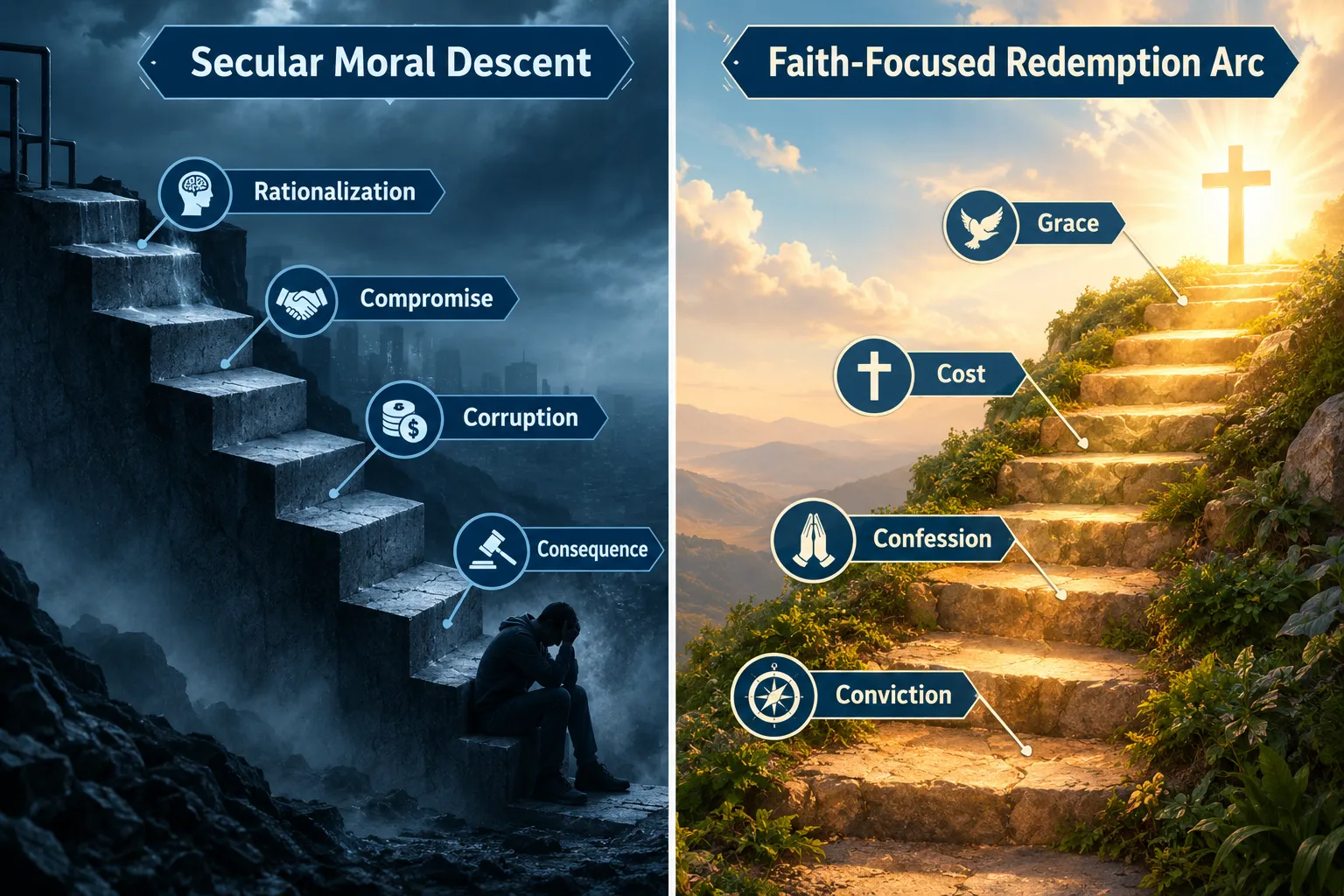
Walter White begins Breaking Bad as a sympathetic figure, a dying chemistry teacher who turns to drug manufacturing to provide for his family. That justification erodes almost immediately. By the end of the series, Walter has committed or ordered multiple murders, manipulated everyone who loved him, and destroyed his family far more thoroughly than cancer ever could have.
The arc in plain terms:
- Season 1-2: Rationalization, “I’m doing this for my family”
- Season 3: Compromise, the line keeps moving
- Season 4: Corruption, Walter becomes the threat he once feared
- Season 5: Consequence, everything collapses, and the admission comes too late
The show’s most honest moment arrives in the final season when Walter tells his wife, “I did it for me. I liked it. I was good at it. And I was really, I was alive.” That’s the confession Breaking Bad was building toward for five seasons. It’s genuine. It’s also the confession of a man with nothing left to save.
For Christian readers, that moment is recognizable, it’s the shape of pride exposed. But the show has no framework for what comes after that honesty. There’s no mercy in the room. The confession lands in a void.
How Does Breaking Bad Compare to Faith-Based Suspense Stories?
Breaking Bad and faith-based suspense share the same raw materials, moral pressure, secrets, escalating stakes, and characters who make choices they can’t take back. The difference is in what those materials are building toward.
"Breaking Bad asks how far a man can fall. Christian suspense asks what it costs to come back. Both questions are serious. Only one of them has hope in the room."
| Element | Breaking Bad | Christian Thriller |
|---|---|---|
| Moral failure | Escalates without check | Creates pressure toward reckoning |
| Consequences | Natural/social only | Natural, relational, and spiritual |
| Accountability | External (DEA, rivals) | Internal, relational, and before God |
| Redemption | Absent or too late | Costly but available |
| Content | Graphic violence, language, drug use | Clean, tension without exploitation |
| Ending register | Tragic closure | Hope earned through honesty |
The comparison between Christian and secular thrillers runs deeper than content standards. Secular thrillers often locate moral authority in society, law, or survival instinct. Christian thrillers locate it in a God who is actually present in the story, not as a deus ex machina, but as the weight that makes every choice matter more, not less.
Why Do Christian Thrillers Focus on Redemption Instead of Corruption?
Christian thrillers focus on redemption because their worldview insists that corruption is never the final word. That’s not wishful thinking, it’s a theological claim that shapes every structural choice in the story.
Faith-rooted fiction doesn’t avoid darkness. Characters in Christian psychological thrillers lie, manipulate, harm others, and carry guilt that doesn’t wash off easily. But the story is built on the conviction that those choices have weight precisely because they matter to Someone, and that the path back, while costly, exists.
Why this produces better tension, not less:
- A character who could be forgiven but hasn’t confessed yet carries more dramatic weight than one with no path home.
- Mercy that arrives after real cost is more moving than mercy that costs nothing, and more honest than a story where mercy is impossible.
- The spiritual stakes raise the narrative stakes. When a character’s soul is genuinely on the line, every choice matters more.
The 2026 Christian suspense market reflects this directly. Titles from publishers like Revell and Bethany House consistently feature protagonists who, as one curated list describes them, “wrestle with sin but seek redemption”, and readers are responding. [4] The category is part of a religious publishing segment projected at $1.409 billion in 2026, growing at a 5.5% CAGR. [4]
How Does Breaking Bad Explore Themes of Sin and Accountability, and Where Does It Fall Short?
Breaking Bad handles sin with more honesty than most secular dramas. Walter’s pride, his self-deception, his willingness to harm innocents, the show names these clearly and shows their cost. In that sense, it’s doing something morally serious.
Where it falls short, from a Christian perspective, is in the framework for accountability. Walter faces legal consequences, relational destruction, and death, but never a moment of genuine repentance. The show’s universe has no mercy structure. Consequences exist, but they’re mechanical, not redemptive. The ledger closes, but nothing is restored.
For readers interested in how faith themes raise the stakes in Christian thrillers, this is the key gap: Breaking Bad is a story about accountability without grace. Christian fiction is a story about accountability that leads somewhere, toward confession, toward cost, toward the possibility of being made new.
That’s not a softer story. It’s a more demanding one.
Does Breaking Bad Show Any Redemptive Arc for Its Characters?
Breaking Bad offers partial redemptive gestures, but not a genuine redemptive arc. Jesse Pinkman comes closest, his suffering throughout the series reads as consequence, and his final escape in El Camino suggests a chance at a different life. But the show never gives him a framework for what that means spiritually.
Walter’s final acts, confessing to Skyler, freeing Jesse, dying to protect his family’s financial future, are gestures toward accountability, not transformation. He dies having told one truth too late, in a room he burned down himself.
The honest assessment: Breaking Bad is a tragedy, not a redemption story. It’s morally serious about sin and consequence, but it has no theology of restoration. For Christian readers, that’s the gap that matters most.
How Do Faith-Focused Stories Handle Antiheroes Differently Than Breaking Bad?
Faith-focused fiction can and does write antiheroes, characters who are morally compromised, self-deceived, or genuinely dangerous. The difference is in what the story does with that character’s conscience.
In Breaking Bad, Walter’s conscience is present early and then systematically dismantled. The show tracks its disappearance as a kind of dark achievement. In Christian fiction, the antihero’s conscience is the dramatic engine, it’s the thing that won’t stay quiet, the voice that keeps pressing toward a reckoning the character is trying to avoid.
Consider the Dexter comparison for Christian readers, another secular antihero story built on moral compartmentalization. Both Dexter and Walter succeed for a long time by silencing their conscience. Christian fiction’s antiheroes tend to fail at that silencing, because the story is built on the premise that conscience is not just psychology, it’s the image of God pressing back.
That makes for a different kind of tension. Not less gripping. More honest.
What Christian Thriller Books Have Similar Tension to Breaking Bad?
Readers drawn to Breaking Bad’s psychological intensity, moral complexity, and high stakes will find real equivalents in Christian suspense, with the content adjusted and the spiritual framework present.
For psychological tension and moral complexity:
The Gathering Light series by Silas Bellhaven, When Hannah Sleeps, When the Voice Breaks, and When the Prayer List Opens follow women whose carefully constructed identities begin to fracture under institutional manipulation. The spine question, who controls the record of someone’s truth?, carries the same paranoid weight as Breaking Bad’s best episodes, without the graphic content.
Colleen Coble’s Sanctuary series, Conspiracy (Thomas Nelson, 2026) delivers the kind of layered suspense that rewards careful readers. [2]
Lynette Eason’s Twilight Tactics (Revell, August 2026), high-stakes suspense grounded in moral clarity. [7]
Elizabeth Goddard’s When the Silence Breaks (Revell, August 2026), psychological tension with redemptive stakes. [7]
For readers who want the frontier moral pressure of Breaking Bad’s “man builds his own destruction” arc, The Mercy Line series offers that same weight in a 19th-century railroad setting, where law runs out and a man finds what he actually answers to.
What Should Christian Viewers Know Before Watching Breaking Bad?
Before watching Breaking Bad, Christian viewers should go in with clear expectations about content and spiritual framework, not as a warning label, but as honest preparation.
What to expect:
- The show is genuinely brilliant at depicting how sin compounds and self-justification works. Those observations are spiritually accurate.
- The content is heavy and sustained, not incidental darkness but structural darkness. It will accumulate.
- The show’s universe has no God, no mercy structure, and no restoration. Consequences exist, but they don’t lead anywhere redemptive.
- Jesse Pinkman’s arc is the most sympathetic and the closest to a conscience-driven story.
Practical guidance:
- If graphic violence, strong language, and drug content conflict with your standards, this show will require significant compromise across all five seasons, not just a few episodes.
- If you’re drawn to the themes more than the specific show, Christian psychological thrillers cover the same territory, moral failure, identity collapse, the cost of secrets, without the content cost.
Are There Christian Alternatives to Breaking Bad With the Same Suspense?
Yes, and in 2026, the options are better than they’ve ever been. The Christian suspense category has matured significantly, producing titles that deliver genuine psychological tension, morally complex characters, and high stakes without graphic content or a spiritually empty framework.
What to look for:
- Stories where the protagonist’s faith is tested, not performed, where doubt is real and grace costs something
- Moral stakes that include spiritual accountability, not just legal or social consequences
- Characters who fail genuinely and face that failure honestly
The role of prayer and discernment in Christian thriller plots is one of the clearest markers of the genre’s difference from secular thrillers. When a character prays in a Christian thriller, it’s not decoration, it’s a plot-relevant act that changes what they’re willing to do next.
For readers who want clean suspense with real stakes across multiple genres, the 2026 clean Christian Kindle Unlimited reading guide is a practical starting point.
Conclusion: The Story Breaking Bad Can’t Tell
Breaking Bad is a great show about a man who destroys himself. It earns its reputation. But it can only tell one kind of story, the kind where the fall is the point, consequences are mechanical, and the final scene is a corpse on a meth lab floor.
Christian thrillers tell a harder story: the one where a person has to keep living after what they’ve done, where the people they’ve harmed are still in the room, and where mercy, if it comes, arrives at a cost that makes it mean something.
That’s not a comfortable story. Earned grace never is. But it’s a story with hope in the dark, and that changes everything about how the tension feels and where it leads.
Next steps for readers:
- Start with When Hannah Sleeps for psychological suspense with genuine moral and spiritual stakes
- Browse the full Gathering Light series for clean Christian thriller with institutional manipulation and identity under pressure
- Explore the Mercy Line western series for frontier moral pressure, where law runs out and conscience is the only authority left
- Check the Silas Bellhaven author page for the full catalog of faith-rooted fiction across genres
The story Breaking Bad can’t tell is the one where the man in the lab gets up off the floor, walks out into the light, and has to figure out what to do next. That story is waiting for you.
FAQ
Is Breaking Bad too dark for Christian viewers? For most Christian viewers who follow clean-content standards, yes. The show contains graphic violence, sustained strong language, explicit drug content, and sexual material across all five seasons. The darkness is structural, not incidental.
What is the main moral lesson of Breaking Bad? The show argues that pride and self-deception compound, that a man who begins justifying small wrongs will eventually justify anything. It’s a serious moral observation, but the show’s universe has no framework for restoration or forgiveness.
Do Christian thrillers have the same tension as Breaking Bad? Yes. Christian thrillers use moral complexity, psychological pressure, and high stakes to generate genuine suspense. The difference is in the destination, Christian thrillers route that tension toward conviction, confession, and earned grace rather than escalating corruption.
What makes a Christian thriller different from a regular thriller? A Christian thriller includes a spiritual accountability layer, characters answer not just to law or society but to God and conscience. Faith is load-bearing in the plot, not decorative. The moral stakes are higher because the framework for what’s at stake is larger.
Does Jesse Pinkman have a redemptive arc in Breaking Bad? Jesse comes closest to a redemptive arc of any character in the series. His suffering reads as consequence, and El Camino suggests a chance at a different life. But the show gives him no spiritual framework for what that means, he escapes, but the story doesn’t know what he’s escaping toward.
Are there Christian alternatives to Breaking Bad? Yes. The Gathering Light series by Silas Bellhaven, along with titles from Lynette Eason, Colleen Coble, and Elizabeth Goddard, deliver psychological tension and moral complexity with redemptive arcs and clean content. [4][7]
Can you enjoy Breaking Bad if you’re a Christian? Some Christian viewers engage with it critically as a study in moral collapse. Others find the cumulative content too heavy to sustain. The honest answer is that it requires significant content compromise and offers no spiritual framework in return, readers who want the same tension in a faith-rooted story have strong alternatives available.
What is “earned grace” in Christian fiction? Earned grace means mercy arrives after real cost, after confession, after consequence, after the character has faced what they’ve done honestly. It’s the opposite of cheap grace, where forgiveness is easy and costs nothing. Christian thrillers built on earned grace are more emotionally honest and more dramatically satisfying.
Is the Christian suspense market growing in 2026? Yes. Christian fiction, including suspense and thriller titles, is part of a religious publishing segment projected at $1.409 billion in 2026, growing at a 5.5% CAGR. Major publishers including Revell, Thomas Nelson, and Bethany House are releasing high-stakes suspense titles throughout 2026. [4]
What is the spine question of The Gathering Light series? The Gathering Light asks: who controls the record of someone’s truth? Each book follows a different woman whose testimony, her own account of her experience, is being shaped, manipulated, or erased by an institution that claims to help her. That question carries the same paranoid intensity as Breaking Bad’s best episodes, without the graphic content.
References
[2] New Christian Fiction Releasing In July 2026 – https://louallenwriter.wordpress.com/2026/06/25/new-christian-fiction-releasing-in-july-2026/
[4] Best Christian Suspense Books Of 2026 – https://gracefulreads.com/best-christian-suspense-books-of-2026/
[7] New Christian Fiction Releasing In August 2026 – https://louallenwriter.wordpress.com/2026/07/23/new-christian-fiction-releasing-in-august-2026/