Last updated: September 22, 2026
Quick Answer: Christian Western fiction for readers who love frontier justice combines the moral weight of the Old West, land disputes, lawmen, outlaws, and survival, with faith that actually costs the protagonist something. These are clean reads built on earned grace rather than easy answers, where conscience is the real law and mercy arrives only after the character has paid a price for it. If you want suspense with real stakes and no gratuitous content, this is the subgenre worth knowing.
Key Takeaways
- Christian Western fiction is distinct from both secular Westerns and generic clean fiction, faith shapes what the protagonist does, not just what the author leaves out.
- The frontier setting is a natural fit for Christian storytelling because survival, sacrifice, and community accountability are already built into the genre’s bones.
- The best Christian frontier justice stories put moral dilemmas, not romance, at the center of the plot.
- Clean Western fiction means no graphic violence, no profanity, and no explicit content, but it does not mean conflict-free or consequence-free.
- Series with linked-protagonist structures (like Silas Bellhaven’s The Mercy Line) let readers stay inside one moral universe across multiple books.
- Authors like Mary Connealy, R.J. Sloane, and Silas Bellhaven represent a range of tones from frontier romance to hard-edged suspense within the same faith-rooted space.
- Kindle Unlimited has become the primary discovery engine for this subgenre in 2026, most active series are KU-available. [1]
- Christian Westerns are not only for religious readers, anyone who wants moral complexity without cynicism will find something here.
- The recurring question in the best books: what will you do with the truth once you’re holding it?
- Redemption in these stories costs something. Grace shows up after the hard choice, not instead of it.
What Is Christian Western Fiction?
Christian Western fiction is historical or frontier-set storytelling where faith is load-bearing, meaning it changes what the protagonist chooses when the pressure is highest, not just what the author leaves on the cutting room floor. It is not simply a Western with the rough edges sanded off. A book can be free of profanity and graphic violence without presenting Christian belief as a meaningful force in the story. The distinction matters: clean fiction avoids certain content, but Christian fiction asks what a person answers to when the law runs out. [8]
The best books in this subgenre treat the frontier as a moral proving ground. Land claims, false warrants, labor bonds, and buried records are not just plot machinery, they are the specific forms that injustice takes when institutions are weak and conscience is the only reliable check. That is exactly the territory where faith under fire becomes visible in a character’s choices.
“Where law runs out, a man finds what he answers to.”, The Mercy Line series conscience line
Why the Frontier Setting Fits Christian Storytelling So Naturally
The American frontier is one of the few historical settings where the absence of stable institutions is the whole point of the story. Courts are corrupt, warrants can be forged, surveyors can be bribed, and the nearest judge may be two weeks’ ride away. That structural vacuum is precisely what makes frontier justice stories such a natural home for Christian moral stakes.
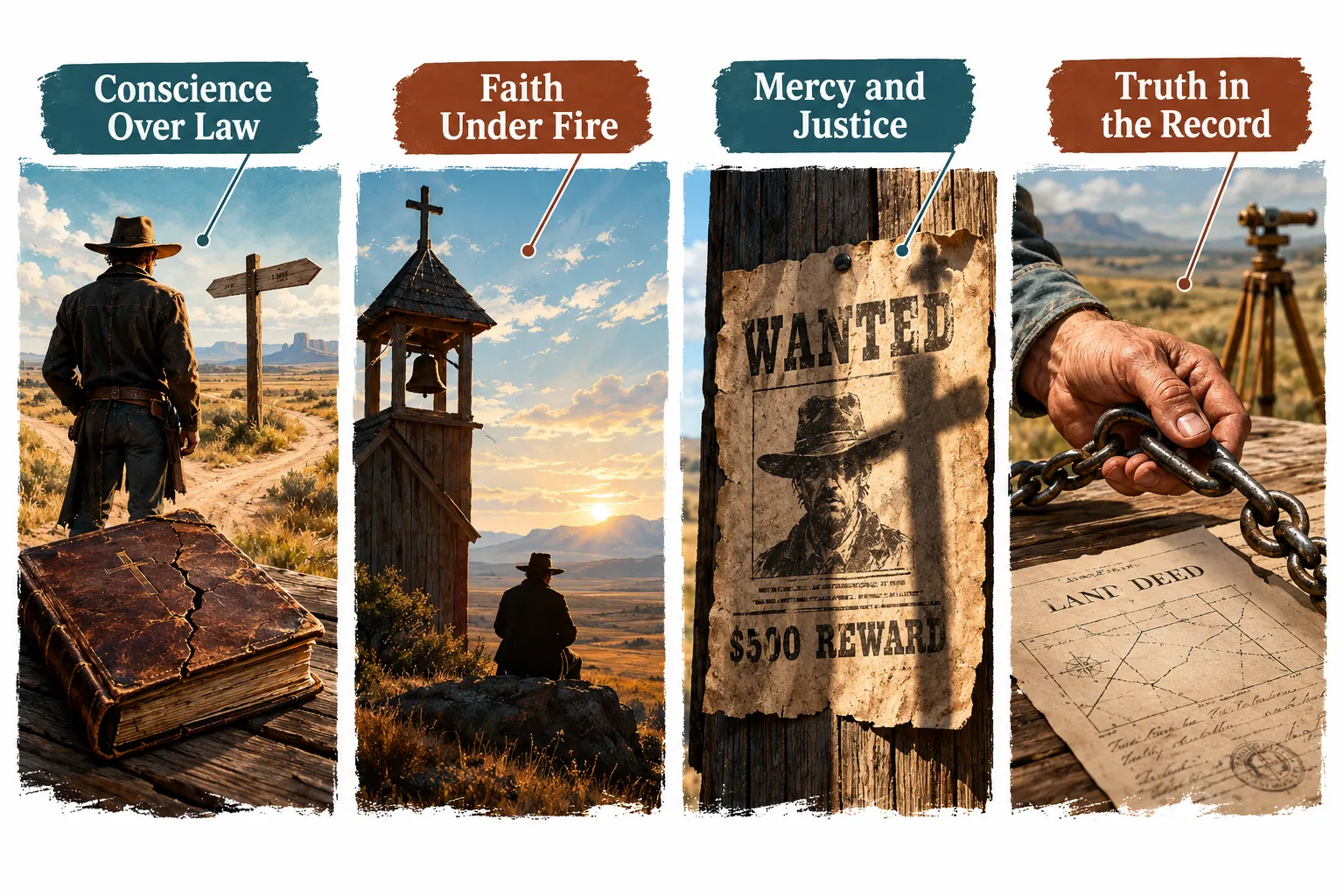
Consider what the frontier forces a protagonist to reckon with:
- Survival vs. mercy, Do you leave a wounded enemy to die on the trail, or does something in you refuse that exit?
- Obedience vs. conscience, A territorial seal doesn’t make a custody lawful. What does obedience cost when the paper is wrong?
- Truth vs. safety, A fire-loss claim that doesn’t add up. Speaking the truth before it hardens into official record.
- Revenge vs. redemption, The man who wronged your family is now at your mercy. What you do next is the whole story.
These are not abstract theological questions. On the frontier, they arrive as plot events, a false warrant, a disputed land claim, a labor-credit ledger hiding an old cage. That concreteness is what makes Christian Western fiction for readers who love frontier justice feel so different from a sermon. The moral stakes are physical, immediate, and personal.
For a broader look at how faith works across multiple genres without tipping into moralizing, see Faith In Fiction Across Genres: How Much Is Too Much.
How Is Christian Western Fiction Different From Regular Westerns?
The difference is not content restrictions, it is what drives the protagonist’s decisions. In a secular Western, justice is typically delivered through force, cunning, or institutional authority. The hero wins because he is faster, smarter, or better connected. In a Christian Western, the protagonist may have all of those advantages and still face a moment where winning by those means would cost him something he cannot afford to lose.
Three practical differences:
| Feature | Secular Western | Christian Western |
|---|---|---|
| Justice mechanism | Force, law, cunning | Conscience, faith, moral cost |
| Protagonist’s inner conflict | Survival, reputation, revenge | Truth-telling, mercy, accountability |
| Resolution | The right person wins | The right choice is made, at a price |
Faith in Christian Western fiction shows up as character choice and consequence, not as narration or scripture-dropping. A protagonist who refuses to forge a record, who rides back for the man he has reason to leave behind, who tells the truth in a land court when lying would save him, that is faith under fire, expressed through action rather than monologue.
For readers curious about how this dynamic plays out in suspense more broadly, Christian Psychological Thrillers vs. Secular Thrillers covers the same tension in a contemporary setting.
What Does Clean Western Fiction Actually Mean?
Clean Western fiction means no graphic violence, no profanity, and no explicit sexual content, but it does not mean stakes-free, conflict-free, or emotionally soft. The best clean frontier fiction is honest about hard things. People die. Injustice lands. Grief is real. The difference is that the author does not use shock value as a substitute for earned tension.
What clean Western fiction includes:
- Genuine physical danger and moral jeopardy
- Villains with real menace and real consequences
- Grief, loss, and moral failure in the protagonist
- Suspense that builds through character pressure, not gore
What it excludes:
- Graphic depictions of violence or torture
- Profanity or crude language
- Explicit romantic or sexual content
This is a meaningful promise for a specific kind of reader, one who wants the full weight of frontier life without content that makes the book impossible to read on a Sunday afternoon or recommend to a friend without a warning attached. For a deeper breakdown of how clean content standards work across the faith-fiction spectrum, see Clean Christian Fiction vs. Inspirational Romance: Content Standards, Faith Focus, and Reader Expectations.
Best Christian Western Novels With Moral Themes: What to Look For in 2026
The 2026 release landscape for Christian Western fiction shows continued investment in series rather than standalones, with packaged collections and linked-protagonist structures giving readers sustained exposure to the same moral universe. [1] A few names and titles worth knowing:

Silas Bellhaven, The Mercy Line Set in the railroad town of Mercy Crossing, this nine-book series uses a linked-protagonist structure, each book follows a different man facing a different record-based injustice, but the moral universe stays consistent. Titles like The False Warrant, The Ash Ledger, and The Oath Ledger put land claims, labor bonds, and buried documents at the center of each story. Grace never comes cheap here. The series conscience line says it plainly: “Where law runs out, a man finds what he answers to.”
- The False Warrant, Book 1
- The Ash Ledger, Book 6
- The Oath Ledger, Book 9
R.J. Sloane, Harper’s Justice Series Sloane’s positioning, “gritty western adventures where justice rides hard across the untamed Southwest”, signals a harder-edged tone than frontier romance. The Maverick Marshal (March 2026) and The Ranger’s Badge (July 2026) are the most recent entries, classified across historical mystery, Western, and Christian fiction. [8]
Mary Connealy A major name in Christian Western fiction, Connealy’s 2026 release Wildflower Bride leans into frontier danger, belonging, and faith alongside romance. Her catalog is a strong entry point for readers new to the subgenre. [5]
Natalie Bright & Denise F. McAllister, Rafter O Ranch CKN Christian Publishing released the complete Rafter O Ranch series in September 2026, reflecting the packaged-series trend that gives readers a complete moral arc in one purchase. [4]
For a broader list of clean faith-based fiction across genres, Clean Christian Fiction That Isn’t Just Romance is a useful starting point.
Common Tropes in Christian Western Fiction, and What Makes Them Work
Christian Western fiction for readers who love frontier justice draws from a recognizable set of tropes, but the faith element changes what those tropes mean in the story.
The False Document, A forged warrant, a fraudulent land deed, a falsified labor record. The protagonist knows the paper is wrong. The question is whether he will say so when saying so costs him.
The Conscience-Bound Lawman, A marshal or deputy who discovers that the law he serves is being used as a weapon. Obedience and integrity have stopped pointing in the same direction.
The Ledger as Evidence, Records, account books, and official documents carry enormous moral weight in frontier fiction because they are the only institutional memory available. When those records lie, someone has to be willing to say so out loud.
Mercy After Pursuit, The protagonist catches the man he has been chasing. What he does next, and why, is where the faith element becomes visible.
The Widow’s Claim, A vulnerable person (often a widow or orphan) is being defrauded by someone with institutional power. The protagonist has to decide whether the law is enough, or whether something else is required of him.
These tropes work because they are not decorative. Each one creates a specific moral pressure that forces the protagonist to choose between self-interest and something harder. That is what earned grace looks like in frontier fiction, not a dramatic conversion, but a costly choice made quietly, with no guarantee of reward.
For more on how frontier justice novels use conscience as the central law, see Frontier Justice Novels Where Conscience Is the Law.
Are Christian Westerns Only for Religious Readers?
No. Christian Western fiction is for anyone who wants moral complexity without nihilism. The faith element is not a theological lecture, it is the reason the protagonist does not take the easy exit. Readers who are not personally religious but who are tired of stories where cynicism is the only honest response to injustice will find something worth reading here.
The practical test is simple: does the protagonist’s faith change what he does under pressure, or is it just background decoration? In the best books in this subgenre, the answer is clear. A man who refuses to forge a record because he answers to something beyond the court, that is a story about conscience, and conscience is not a denominational concept.
Christian Westerns also tend to avoid the two failure modes that drive readers away from faith-based fiction: preachiness (faith delivered as lesson rather than lived experience) and cheap grace (forgiveness that costs nothing and changes no one). The best frontier justice stories are honest about what redemption requires. That honesty is what makes them worth reading regardless of the reader’s own belief. [8]
Western Fiction That Explores Redemption and Forgiveness
Redemption in Christian Western fiction is not a plot device, it is the whole moral architecture. But redemption that costs something is very different from redemption as a narrative shortcut.
What earned redemption looks like in frontier fiction:
- A character who has wronged someone must face that person, not just feel bad about it
- Forgiveness is offered by the injured party at personal cost, not as an automatic story beat
- The protagonist’s changed behavior is demonstrated through subsequent choices, not announced in dialogue
- Grace arrives after the hard thing has been done, not instead of it
This is the distinction between clean Christian fiction and what might be called comfort fiction, stories that use faith as a way to avoid the hard parts rather than walk through them honestly. The frontier setting makes that distinction easy to maintain, because the hard parts arrive as physical plot events. A man cannot spiritually bypass a false warrant. He has to decide what to do about it.
For readers interested in how redemption arcs function across Christian suspense more broadly, The Role of Redemption Arcs in Christian Thrillers and Dark Fantasy covers the same territory in different genre settings.
Where to Find Christian Western Fiction for Readers Who Love Frontier Justice
The most reliable discovery channels in 2026 are Kindle Unlimited, Amazon’s Christian Western category, and curated recommendation blogs. [1]
Where to start:
- Kindle Unlimited, The majority of active Christian Western series are KU-available, making it the most cost-effective way to sample widely
- Amazon’s Christian Historical Fiction category, Filters by faith content rather than just Western setting
- Silas Bellhaven’s Mercy Line series page, Browse the full series for linked-protagonist frontier justice fiction with a romance-absent content contract
- Author pages, R.J. Sloane, Mary Connealy, and Natalie Bright maintain active release schedules in 2026
For building a full faith-based reading list across genres, Kindle Unlimited Christian Reads: How to Build a Clean Faith-Filled TBR walks through the process systematically.
FAQ
What makes a Western “Christian” rather than just clean? A Christian Western presents faith as a force that changes the protagonist’s choices under pressure, not just a content filter. A book can avoid profanity and graphic violence without presenting Christian belief as meaningful. The difference is whether the protagonist’s conscience, shaped by faith, drives the plot’s moral decisions. [8]
Do Christian Western novels have romance? Some do, some don’t. Authors like Mary Connealy blend frontier danger with romance. Silas Bellhaven’s Mercy Line series maintains a romance-absent content contract, the moral stakes are legal, land-based, and conscience-driven rather than romantic.
Are Christian Westerns appropriate for teenagers? Generally yes. Clean content standards (no graphic violence, profanity, or explicit content) make most Christian Western fiction suitable for teen readers, though individual titles vary. Check series descriptions for any content notes.
What is the difference between frontier justice fiction and Christian Western romance? Frontier justice fiction puts moral dilemmas, false warrants, land fraud, labor exploitation, at the center of the plot. Christian Western romance uses the frontier as a setting for courtship stories. Both can be faith-rooted and clean; the distinction is what drives the central conflict.
Which Christian Western series is best for readers who want suspense over romance? Silas Bellhaven’s Mercy Line and R.J. Sloane’s Harper’s Justice series are the clearest current examples of Christian Western fiction where justice and moral jeopardy drive the plot rather than romance. [8]
Can I read Christian Western fiction if I’m not religious? Yes. The best books in this subgenre are honest about what conscience costs, that is a human question, not a denominational one. Readers who want moral complexity without cynicism will find these stories satisfying regardless of personal belief.
How long are most Christian Western series? Series length varies widely. The Mercy Line currently runs nine books with a linked-protagonist structure. Packaged complete-series collections (like the Rafter O Ranch boxed set released in 2026) offer a full arc in one purchase. [4]
Is Christian Western fiction available on Kindle Unlimited? Yes, the majority of active Christian Western series in 2026 are KU-available, making Kindle Unlimited the most practical subscription for readers who want to sample widely. [1]
What is “earned grace” in Christian fiction? Earned grace means forgiveness and redemption arrive after the protagonist has faced a real cost, a hard choice, a genuine loss, an honest reckoning. It is the opposite of cheap grace, where forgiveness functions as a narrative shortcut that requires nothing of the character.
Are there Christian Westerns with male protagonists? Yes. Silas Bellhaven’s Mercy Line uses masculine-only leads across its linked-protagonist structure. R.J. Sloane’s Harper’s Justice series also centers male lawmen and frontiersmen. This makes both series a strong fit for Christian fiction for men who want faith represented honestly in a genre they already love.
Conclusion
The frontier was never a simple place, and the best Christian Western fiction does not pretend otherwise. What it offers instead is a setting where the absence of reliable institutions makes conscience visible, where a man’s faith is not background decoration but the actual reason he does not take the easy exit.
Christian Western fiction for readers who love frontier justice is a subgenre built on earned grace, mercy and justice held in tension, and hope that arrives only after the hard thing has been done. It is clean without being soft, rooted in faith without preaching, and honest about what redemption actually costs.
Actionable next steps:
- Start with a series, not a standalone, linked-protagonist structures like The Mercy Line let you stay inside one moral universe long enough for the themes to accumulate weight.
- Use Kindle Unlimited, most active Christian Western series are KU-available in 2026, making it the lowest-risk way to find your preferred tone (hard-edged justice vs. frontier romance).
- Follow active authors, Mary Connealy, R.J. Sloane, and Silas Bellhaven all have 2026 releases; author pages are the most reliable way to track new entries.
- Browse by moral theme, not just genre label, search terms like “frontier justice,” “clean western suspense,” and “faith-based historical fiction” will surface books that match the content contract you actually want.
The record of what a man does when no one is watching, that is what these books are about. And that question does not get old.
References
[1] Best Christian Suspense Books Of 2026 – https://gracefulreads.com/best-christian-suspense-books-of-2026/ [4] New Releases Sept 2026 – https://www.iolagoulton.com/new-releases-sept-2026/ [5] hollysbookcorner.home.blog – https://hollysbookcorner.home.blog/ [8] Christian Westerns – https://www.cherrypicksreviews.com/christian-westerns