
Last updated: September 30, 2026
Quick Answer
Clean Christian fantasy books for elves, kingdoms, and found-family adventure combine classic high-fantasy elements, magic, royal courts, elvish or elf-adjacent races, sweeping quests, with faith woven into the plot rather than preached at readers. The best titles skip graphic violence, explicit content, and profanity while still delivering real stakes: betrayal, sacrifice, and grace that costs the characters something. Readers can find them through specialty publishers like Enclave, award lists like the Realm Awards, Kindle Unlimited browsing, and series such as The Kethara Chronicles and The Sarel Chronicles.
Key Takeaways
- Clean doesn’t mean shallow. The strongest Christian fantasy handles death, loss, and moral failure honestly, it just doesn’t dwell on gore or explicit content to do it.
- Elves and fantasy races still show up often, usually reframed as covenant peoples, highland clans, or ancient witnesses rather than Tolkien copies.
- Found family is a core structural trope, not a marketing add-on, orphans, exiles, and mismatched companions built into the plot’s spine.
- Kingdoms in this genre are rarely stable. Most stories test a crown, a council, or an empire against a smaller act of mercy.
- The genre skews adult and all-ages at once, many titles work for teens and grown readers because the violence is implied, not staged.
- 2026 has been an active year for the category, with new fairy-tale-adjacent releases and award recognition expanding what counts as Christian fantasy.[1][4]
- Kindle Unlimited and independent publishing have made the genre far easier to find and binge than it was a decade ago.[6][10]
What Makes Clean Christian Fantasy Books for Elves, Kingdoms, and Found-Family Adventure Different From Preachy Fiction
A Christian fantasy novel earns that label through character choice and consequence, not through a character stopping mid-battle to explain a Bible verse. The faith has to be load-bearing, something the plot would actually collapse without, rather than decoration dropped over a generic quest plot.
In practice, that looks like:
- A magic system tied to covenant, prayer, or witness rather than raw power for its own sake
- A villain motivated by control or false mercy, not cartoon evil
- A hero who doubts, fails, or hides before any grace shows up
- Faith that gets tested across the book, not stated once and settled
This is the difference between fiction that walks with a reader and fiction that talks at them. The Kethara Chronicles builds its whole conflict around this idea, an empire that wants every act of mercy “counted and contained,” while two women carry a covenant word no auditor can own. That’s worldbuilding with faith prophecy and covenant baked into the plot mechanics, not stapled onto a sermon scene.
Common mistake: treating “clean Christian fantasy” as a checklist of things to remove (violence, language, romance) instead of a worldview the plot actually runs on. Removing content without adding conviction just produces a thinner book.
Best Clean Fantasy Books With Elf Characters
Elves and elf-adjacent races appear throughout Christian fantasy, usually reworked as ancient witness-peoples, highland clans, or covenant-keepers rather than direct Tolkien imports. Readers looking for the elf archetype, long memory, close ties to land, quiet grief, will find it under different names across the genre.
A few reliable places to look:
- Enclave Publishing’s fantasy catalog, which releases roughly one new hardcover title a month across fantasy, retellings, and alternate-history speculative fiction, much of it featuring fantasy-race worldbuilding.[4]
- The Kethara Chronicles, set in the highlands of Marat-Sol, where memory, witness-stones, and covenant marks function the way elvish lore often does in secular fantasy, ancient, patient, and inconvenient to empires that want everything documented.
- New September 2026 fairy-tale-adjacent Christian fantasy releases, several tagged specifically for no-spice romance and fairy-tale retelling, a pattern worth checking on release-tracking sites when hunting for elf-flavored worldbuilding.[4]
Decision rule: choose books explicitly tagged “covenant fantasy” or “fairy-tale retelling” over generic “Christian fantasy” tags if an elvish, long-memory race is the priority, those tags correlate more often with non-human peoples carrying ancient knowledge.
Christian Fantasy Series With Found-Family Themes
Found family shows up in Christian fantasy as often as biological family does, and it usually carries more weight, a group of mismatched people choosing loyalty when blood ties have failed them. This isn’t incidental to the genre; it’s one of its most reliable structural engines.
Look for it in:
- Series where the protagonist starts isolated (orphaned, exiled, disgraced) and gathers companions across the plot rather than starting with a built-in crew
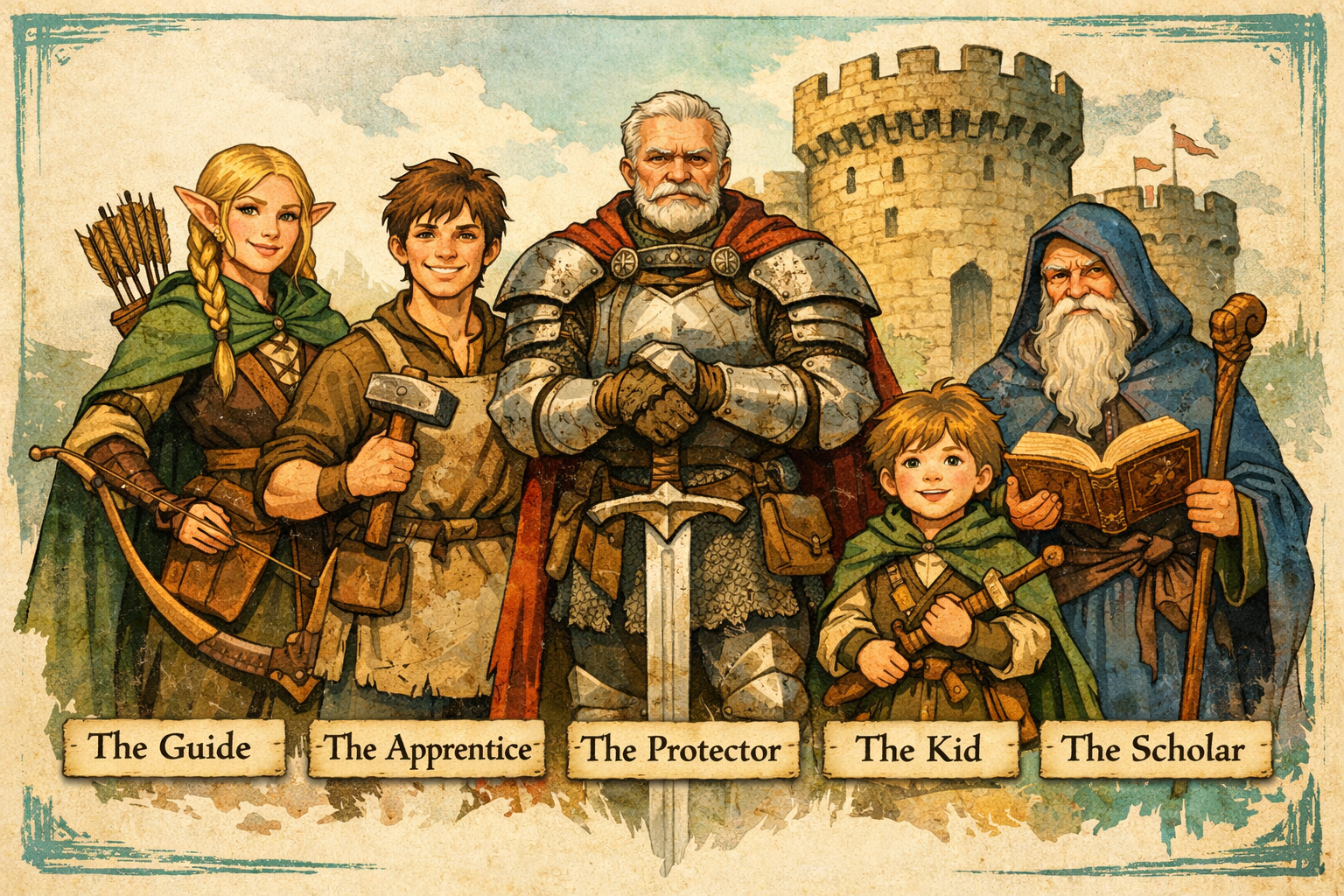
- Groups that cross age, class, or race lines, a disgraced scribe, a soldier, a child, an outsider elder
- Stories where loyalty is tested by cost, not declared once and left alone
The Sarel Chronicles follows this pattern closely. Elya Renn moves from disgraced map-scribe to something closer to a discerner, and the people who stay with her across three books aren’t the ones she started with. Found family, in stories like this, becomes proof of earned grace, companionship that survives someone finding out the worst about a character, not despite it. Readers who want a wider survey of diverse found-family dynamics, different ages, backgrounds, even species, will find good coverage of the trope discussed further in guides on fantasy character arcs.
How to Find Clean Christian Fantasy Books for Elves, Kingdoms, and Found-Family Adventure With No Explicit Content
The fastest way to confirm a book is genuinely clean is to check its retailer tags and back-cover language before opening chapter one, “no-spice,” “fade to black,” or “faith-based” tags are usually reliable, but reading the first review page catches outliers.
Practical steps:
- Check the tags first. Retail listings increasingly label books directly with “no-spice romance,” “clean read,” or “found family,” which cuts guesswork.[4]
- Read the publisher, not just the cover. Enclave and similar Christian speculative-fiction houses maintain consistent content standards across their whole list.[4]
- Skim the first two reviews mentioning content, not star rating, readers flag graphic content fast if it’s there.
- Watch for “grimdark” or “gritty” in marketing copy, even Christian-adjacent fantasy sometimes borrows that language, and it usually signals harsher content.
Who this is for: adults and teens who want real stakes, death, loss, moral failure, without staged violence or sexual content. Who it’s not for: readers wanting graphic battle detail or romantic tension as the main plot engine; this genre keeps both understated by design.
Edge case: a handful of Christian fantasy titles market as “epic” but still include intense battle sequences. Intensity of stakes isn’t the same as graphic content, check whether violence is described in detail or implied off-page before ruling a book out.
Christian Fantasy vs. Regular Fantasy: What Actually Changes
The core difference isn’t the presence of magic, kingdoms, or elves, it’s what the story treats as the final word on good and evil. Secular fantasy often ends in ambiguity or in power simply winning; Christian fantasy insists mercy and justice both have to be answered for, and that grace, when it shows up, costs someone something.
| Element | Secular fantasy (typical) | Christian fantasy (typical) |
|---|---|---|
| Magic source | Power, bloodline, or raw talent | Covenant, prayer, or gift with a cost |
| Villain resolution | Often destroyed, rarely redeemed | Sometimes offered real repentance |
| Romance | Frequently explicit or central | Usually secondary, often absent entirely |
| Ending tone | Ambiguous or power-based | Hope in the dark, not a clean rescue |
| Found family | Common trope, plot-neutral | Often the proof of grace working |
Quick example: a secular epic might end with the strongest army winning the throne. A Christian fantasy equivalent is more likely to end with the throne being handed to someone who doesn’t want it, because wanting it was the corruption in the first place.
Kingdoms, Redemption Arcs, and the Tropes That Define Christian Fantasy Adventure
Kingdoms in this genre rarely stay stable, and that instability is usually the point, a crown, council, or empire gets tested against one character’s refusal to trade mercy for order. Redemption arcs follow the same logic: characters don’t get to skip the cost of what they did.
Common tropes across the category:
- The audited or documented kingdom, an empire obsessed with records, ledgers, or “proof” of loyalty (a direct echo of how faith gets reduced to performance)
- The exiled or disgraced protagonist who has to rebuild trust from nothing
- A prophecy or old mark that the current power structure can’t fully explain or control, a recent example being a prince separated from palace life and pulled into a kingdom-wide prophecy[4]
- A found-family crew replacing a broken royal or blood family
- A villain who believed they were administering justice, not committing evil
Titles finalized for recent Realm Awards recognition, spanning independent, small-press, and specialty imprints, show this pattern holding across very different settings, from collapsing storyworlds to iron-forged kingdoms.[1][4] These aren’t cosmetic details; they’re the mechanism through which faith under fire gets tested plot-first. For readers who want the deeper mechanics of how authors build these systems, see this breakdown of faith-integrated magic systems using prophecy, prayer, and miracles.
Where to Find Recommendations for Wholesome Fantasy Books
The most reliable recommendation sources are specialty publishers, award lists, and genre communities built specifically around Christian speculative fiction, not general bestseller charts, which rarely separate clean fantasy from the wider market.
A short checklist:
- ✅ Award and finalist lists from organizations built around the genre, which track quality across independent and traditional publishing alike[1]
- ✅ Specialty publisher catalogs (Enclave and similar houses) that maintain consistent content standards release after release[4]
- ✅ Genre conferences and communities that have grown enough to draw a younger, more mixed-gender readership than general Christian fiction assumptions suggest
- ✅ Retailer new-release trackers that tag books by trope (found family, fairy-tale retelling, no-spice) rather than just by star rating
- ✅ Series backlists from authors already trusted for clean content across genres, a reader who trusts an author’s westerns or mysteries usually finds the same content contract holds in that author’s fantasy
For readers who want clean fantasy alongside clean mystery, western, or thriller reads under one trusted name, a broader survey is available in clean Christian fiction that isn’t just romance, and readers specifically drawn to Tolkien-style worldbuilding can browse further under Tolkien Christian fantasy.
Do Clean Fantasy Books Sacrifice Good Storytelling?
No, clean content and strong storytelling are separate variables, and the genre’s growth suggests readers agree. Christian speculative fiction has seen rising submissions and award entries over recent years, evidence that quality and volume are climbing together rather than one trading off against the other.[1][8]
What actually determines quality in this genre:
- Whether stakes feel real even without graphic detail (implied danger can carry as much weight as staged violence)
- Whether characters make choices that cost them something, rather than being handed grace for free
- Whether the worldbuilding holds together on its own terms, independent of the faith layer
- Whether found-family relationships are earned across chapters instead of assumed from page one
The honest answer: a poorly written clean fantasy novel and a poorly written graphic one fail for the same reasons, flat characters, unearned resolutions, worldbuilding that doesn’t hold weight. Clean content removes a shortcut (shock value) some authors lean on, which if anything raises the bar on plot and character to carry the tension instead.
FAQ
What age group are clean Christian fantasy books for? Most titles work for teens through adult readers, since violence and romance are implied rather than staged. Some are marketed young adult with found-family and fairy-tale-retelling tags; others are written for adult readers seeking epic-scale stakes without graphic content.
Are there fantasy books for adults that are still clean? Yes. Adult-marketed clean Christian fantasy exists across covenant fantasy, epic fantasy, and fairy-tale retellings, often distinguished from YA by more complex political stakes rather than by added graphic content.
What’s the fastest way to confirm a fantasy book has no explicit content? Check retailer tags for “no-spice,” “clean read,” or “fade to black,” then skim reader reviews for content mentions rather than relying on star ratings alone.
Do clean Christian fantasy books always include elves? No, but many include elf-adjacent races, ancient peoples, highland clans, or covenant-keepers, reworked to fit each author’s specific world and faith framework.
How is found family different from biological family in this genre? Found family is typically built across the plot through tested loyalty, not assumed from the start, and often stands in for a broken or absent blood family.
What’s the difference between Christian fantasy and inspirational fantasy? Christian fantasy usually treats faith as structurally necessary to the plot; inspirational fantasy can be softer, closer to general uplifting fiction with fewer theological stakes.
Where does redemption usually cost the protagonist something in these stories? Almost always in reputation, safety, or relationship, a character who wants a clean exit from guilt is a strong signal the book will make them pay a real price before offering grace.
Is Kindle Unlimited a good way to sample this genre? Yes. Independent and specialty-published Christian fantasy is heavily represented on Kindle Unlimited, making it an efficient way to sample multiple series before committing to a purchase.[6][10]
Conclusion
Clean Christian fantasy books for elves, kingdoms, and found-family adventure work because they refuse the shortcut most fantasy takes for granted, shock as a substitute for stakes. The genre asks readers to sit with real cost, real doubt, and grace that shows up only after something has been paid for it. That’s not a softer version of fantasy. It’s a different bet about what makes a story worth finishing.
Start with a series built around covenant, witness, and mercy under pressure, The Kethara Chronicles or The Sarel Chronicles are both built exactly that way, then branch into award lists, specialty publisher catalogs, and trusted-author backlists to build a reading list that never has to be qualified with an apology. Rooted in Faith fiction doesn’t need a disclaimer. The story proves it on its own.
References
[1] 2026 Market Analysis Of Christian Science Fiction And Fantasy Book Publishing Demand Exceeds Supply – https://creativecornerstones.com/2026/05/25/2026-market-analysis-of-christian-science-fiction-and-fantasy-book-publishing-demand-exceeds-supply/ [4] Christian Fantasy – https://www.risingshadow.net/new-book-releases/christian-fantasy [6] Marketersmedia 2026 4 17 Christshare Releases Report On Christian Reading Trends In 2026 – https://www.financialcontent.com/article/marketersmedia-2026-4-17-christshare-releases-report-on-christian-reading-trends-in-2026 [8] The Rise Of Christian Fiction Market Trends Regional Dynamics And Future Predictions For 2026 – https://www.alibaba.com/product-insights/the-rise-of-christian-fiction-market-trends-regional-dynamics-and-future-predictions-for-2026.html [10] 2026’s Ultimate Guide To Christian Fiction Trends Top Authors And How To Profit – https://www.alibaba.com/product-insights/2026-s-ultimate-guide-to-christian-fiction-trends-top-authors-and-how-to-profit.html