
Last updated: September 20, 2026
Quick Answer: Faith-rooted LitRPG progression treats the leveling system as a mirror for sanctification, costly choices, real consequences, and grace that arrives after something has been paid, not instead of it. It differs from standard LitRPG because the character’s inner transformation drives the numbers, not the other way around. For readers who want clean Christian fiction with real stakes, this approach makes the game mechanics feel like they actually mean something.
Key Takeaways
- Faith-rooted LitRPG ties progression mechanics to moral and spiritual choices, not just combat output or grind efficiency.
- Stat grinding feels hollow when it carries no consequence, spiritual progression systems work because they cost the character something real.
- Sanctification is structurally similar to LitRPG leveling: both involve incremental growth, setbacks, and a record of what a person has done and chosen.
- The strongest faith-based progression systems in fiction show faith through character choice and consequence, not through narration or scripture-dropping.
- Earned grace, grace that shows up after cost, not instead of it, is the theological engine that makes Christian LitRPG progression feel honest rather than preachy.
- Christian LitRPG can appeal to secular readers when the spiritual mechanics are woven into story logic rather than announced as doctrine.
- Common author mistakes include treating spiritual stats as passive bonuses rather than active moral commitments, and resolving spiritual crises too cleanly.
- The genre is growing: LitRPG output nearly tripled between 2023 and 2025, but faith-integrated progression remains structurally undersupplied.
- Tabletop resources like Lightraiders [8] and the Bible Era TTRPG Campaign Guide [6] offer working models for how spiritual stats can shape play.
- The Measured Debt series by Silas Bellhaven is a current example of earned-progression Christian LitRPG, where the numbers only tell part of the story.
What Is Faith-Rooted LitRPG and How Does It Differ from Regular LitRPG
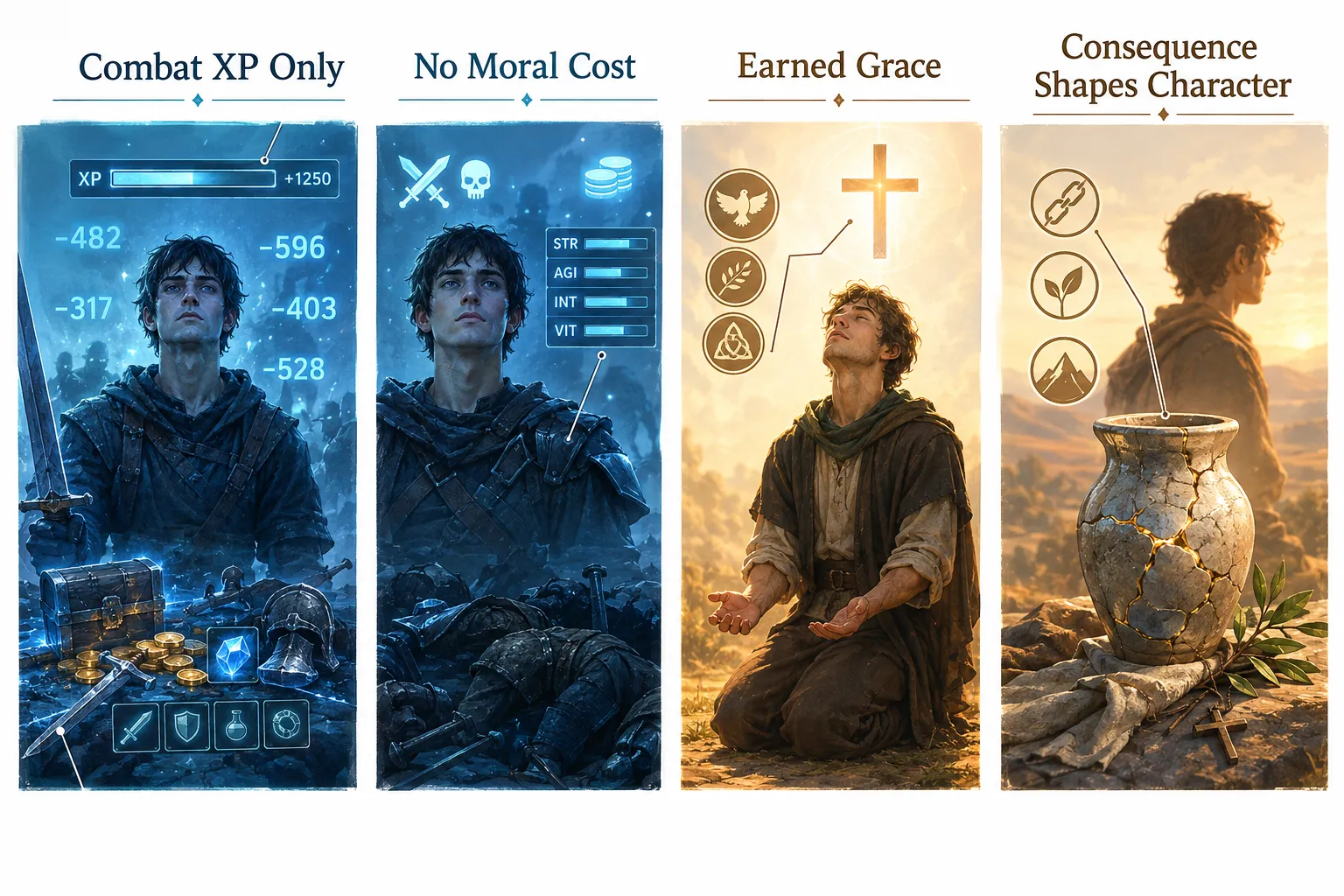
Faith-rooted LitRPG is a subgenre where the game-like progression system, stats, levels, skill trees, is designed to reflect spiritual or moral growth rather than purely mechanical power accumulation. In standard LitRPG, a character gets stronger by defeating enemies, completing quests, or optimizing builds. In faith-rooted LitRPG, those same structures carry theological weight: what a character chooses, what they refuse, and what it costs them shapes their progression as much as any combat log.
The difference is not cosmetic. Regular LitRPG can swap in a “Prayer” stat or rename a spell “Blessing” and remain entirely secular in its logic. Faith-rooted progression, by contrast, builds the game system around the reality that moral choices have consequences, that obedience, sacrifice, and repentance are load-bearing events in the character’s arc, not flavor text.
For more on how game mechanics can carry genuine spiritual weight, see Faith Based LitRPG: How Game Mechanics Can Deepen Spiritual Journeys in Virtual Worlds.
Choose faith-rooted LitRPG if:
- You want progression that feels earned rather than optimized
- The character’s inner life matters as much as their power level
- You’re writing or reading for an audience that wants faith handled honestly, not as a backdrop
Stick with standard LitRPG if:
- The appeal is pure power fantasy and system optimization
- Moral stakes would feel like an intrusion on the genre’s pleasures
What Makes Stat Grinding Feel Meaningless in LitRPG Stories
Stat grinding feels meaningless when it carries no moral or narrative consequence, when a character becomes stronger without becoming different. Readers are increasingly noticing this. Trend commentary in 2026 points to a growing fatigue with purely combat-driven strength gains, where the protagonist’s tenth level-up feels identical in emotional weight to the first.
The structural problem: if every fight yields XP and every XP point yields a stat bump, the system becomes arithmetic, not story. There’s no jeopardy in the ledger. The character can always grind back to safety.
“Progression without cost is just inflation.”
Faith-rooted LitRPG progression solves this by making the system respond to moral weight, not just effort. A character who gains a level by betraying someone should carry that in the record. A character who loses power by choosing mercy should feel that loss as real, and the reader should feel it too.
This is the same reason designing quest-based discipleship journeys in Christian LitRPG matters: quests that test character rather than just measuring combat output create stakes that resonate beyond the game screen.
How Leveling Up in Games Can Represent Spiritual Growth
Leveling up mirrors spiritual growth when the system tracks transformation, not just accumulation. The theological concept of sanctification, the slow, costly, often painful process of becoming more aligned with what one is called to be, maps onto LitRPG structure with surprising precision.
Both involve:
- Incremental progress that isn’t always visible in the moment
- Setbacks that reveal what was never truly solid
- A record of choices made under pressure
- Grace that arrives not as a cheat code but as something that had to be waited for
The Lightraiders curriculum [8], a live Christian RPG designed for youth discipleship, builds its entire progression system around spiritual training rather than combat power. Players advance by demonstrating faithfulness, not by accumulating kills. The Bible Era TTRPG Campaign Guide [6] goes further, treating Conviction as a spirituality stat that actively shapes what a character can and cannot do in play.
These are not metaphors bolted onto a secular frame. They are game systems built from the theological ground up, and they demonstrate that the structure works.
How to Write Character Progression That Feels Spiritual, Not Just Mechanical
Spiritual progression in fiction shows up through character choice and consequence, not through narration or scripture-dropping. The author’s job is to build a system where the right choices are genuinely costly and the wrong ones have real weight, then trust the reader to feel the difference.
Practical craft principles for faith-rooted LitRPG progression:
- Make the moral choice the mechanical event. Don’t let the character gain a level and then face a moral test. Let the moral test be the level gate.
- Let failure leave a mark. Spiritual setbacks should show up in the record, a stat that doesn’t recover cleanly, a skill that costs more to use after a betrayal.
- Earn the grace. When restoration comes, it should arrive after something real has been paid, not as a narrative shortcut. Cheap grace isn’t grace, it’s a reset button.
- Show doubt without resolving it too quickly. A character who never questions their faith under pressure isn’t being tested. A character who holds on anyway, at cost, is.
- Let the system reflect the covenant. If your world has a god or a divine order, the progression system should behave consistently with that theology, not just reward the protagonist for being the protagonist.
For a deeper look at how faith themes can be balanced across genres without becoming heavy-handed, see Faith in Fiction Across Genres: How Much Is Too Much?
Best Examples of LitRPG Books That Incorporate Faith and Spirituality
The most cited current example of explicitly Christian LitRPG is Canthany Rising, which builds its progression system around spiritual commitments rather than combat efficiency. Silas Bellhaven’s The Measured Debt series, beginning with The Cost of Being Chosen, approaches the genre from a different angle: Eamon Kersey’s record at Federated Record keeps clearing every collapse, until the position series starts asking why he’s always the one left standing. The numbers prove his strength. What they can’t prove is whether that strength was ever fully his.
Outside fiction, tabletop resources offer structural models:
- Lightraiders [8]: Christian RPG curriculum where advancement tracks spiritual faithfulness
- Sword of the Spirit: Bible RPG with campaign leveling integrated with scripture engagement [9]
- Bible Era TTRPG: Conviction as a playable spirituality stat [6]
- “Sorry, God” (2026): A devotional two-player roleplaying game where God functions as a co-player [1], perhaps the most theologically direct example of game mechanics built around a living faith relationship
For a broader reading list across faith-based fiction genres, the Best Christian Fiction Authors Across Cozy Mystery, Western, Fantasy, Thriller, and LitRPG guide is a useful starting point.
Can Faith-Based LitRPG Appeal to Non-Religious Readers
Yes, when the spiritual mechanics are embedded in story logic rather than announced as doctrine. Non-religious readers respond to consequence, cost, and earned transformation. Those are the same structural elements that make faith-rooted progression work for Christian readers. The theology doesn’t need to be labeled for the story logic to land.
The key distinction: walking with the reader, not talking at them. A character who faces a genuine moral crisis and chooses badly, and then carries that, is compelling regardless of the reader’s beliefs. A character who receives a divine blessing because the plot requires it is not.
Faith-based fiction that avoids moralizing tends to find secular readers naturally. The Faith Based Fiction for Secular Readers tag on this site collects relevant discussion on exactly that crossover.
What Religions Work Best for LitRPG Worldbuilding
Christianity maps onto LitRPG structure with particular precision because of its emphasis on covenant, record-keeping, debt, and grace, all of which have direct mechanical analogues. Concepts like sin as a stat penalty, repentance as a recovery mechanic, and sanctification as a long-form progression arc translate into game systems without distortion.
Other traditions offer different structural gifts:
- Judaism: Torah observance as a rule-set with consequence and covenant obligation
- Buddhism: Karma as an explicit progression/regression mechanic; detachment as a stat
- Islam: Submission and obedience as the condition for advancement; community accountability
The Bible RPG Free Rules [2] and the Biblical RPG play guides [9] demonstrate how specifically Christian theology, including prayer as a mechanic [5], can be formalized without losing its meaning. The Christian Gamers Guild’s treatment of prayer in play [5] is worth reading for anyone designing a faith-rooted system.
For worldbuilding that handles faith with depth rather than allegory, see Best Christian Epic Fantasy Series for Readers Who Want Deep Faith Themes Without Allegory.
Common Mistakes Authors Make with Spiritual Progression Systems
The most common failure is treating spiritual stats as passive bonuses rather than active moral commitments. A “Faith” stat that simply adds +5 to healing rolls is not spiritual progression, it’s a reskin. Spiritual mechanics need to respond to what the character actually does.

Mistakes to avoid:
- Resolving spiritual crises too cleanly. A dramatic conversion moment that resets all penalties is cheap grace. Real transformation leaves marks.
- Scripture-dropping as a substitute for consequence. Quoting a verse in the narration doesn’t make the progression spiritual. The character’s choice does.
- Making faith a power source, not a relationship. If prayer just refills a mana bar, the system is treating God as a vending machine. Faith under fire looks different, it costs something to hold on.
- Ignoring doubt. A character who never struggles with their faith is not being tested. Tested faith that holds is the story. Untested faith is a backdrop.
- Letting the protagonist’s faith exempt them from consequence. Mercy and justice both have to be present. A faith-rooted system where the righteous character always wins isn’t honest about how faith actually works.
How to Balance Game Mechanics with Meaningful Character Development
The balance point is this: mechanics should serve character, not replace it. When a stat number tells the reader everything they need to know about a character’s spiritual state, the author has handed the story to the spreadsheet.
A working framework:
| Mechanical Event | What It Should Also Be |
|---|---|
| Level gain | A moment of genuine transformation or cost |
| Skill acquisition | A choice that closes off another option |
| Stat penalty | A consequence the character must live with |
| Recovery mechanic | Earned restoration, not automatic reset |
| Quest completion | A moral test, not just a task list |
The LitRPG Power Systems tag collects articles on how to design systems that carry narrative weight. The principle across all of them: the system should make the story harder to tell, not easier. If the mechanics always provide a clear path forward, they’re not doing spiritual work.
Is Faith-Rooted LitRPG a Growing Genre
Yes, and it’s growing from a position of genuine scarcity. LitRPG output nearly tripled between 2023 and 2025, but the vast majority of that growth was secular progression fantasy. Faith-integrated progression remains structurally undersupplied relative to reader demand, which means authors entering this space in 2026 are writing into an opening, not a crowded shelf.
The signals are clear:
- Tabletop Christian RPG resources are multiplying: Lightraiders [8], the Bible Era TTRPG [6], the Biblical RPG Manual [7], and the devotional game Sorry, God [1] all released or expanded in 2025-2026
- Reader commentary consistently notes fatigue with combat-only progression
- The hybrid approach, “think less category, more experience”, is gaining traction among readers who want their faith represented honestly in genre fiction
For readers building a faith-filled reading list that includes LitRPG alongside mystery, western, and fantasy, Kindle Unlimited Christian Reads: How to Build a Clean Faith-Filled TBR is a practical guide.
FAQ
What is the simplest definition of faith-rooted LitRPG progression? It’s a LitRPG system where the character’s spiritual and moral choices drive their advancement, not just combat or grinding. The mechanics mirror sanctification: slow, costly, and shaped by what the character does when it’s hard.
Does faith-rooted LitRPG have to be explicitly Christian? No, but Christian theology maps onto LitRPG structure particularly well because of its emphasis on covenant, debt, grace, and record. Other faith traditions offer different but workable structural frameworks.
What’s the difference between earned grace and cheap grace in LitRPG? Earned grace arrives after the character has paid a real cost, a choice that hurt, a failure they couldn’t undo, a restoration that took time. Cheap grace is a narrative reset button that removes consequences without requiring transformation.
Can a secular LitRPG reader enjoy faith-rooted progression? Yes. When spiritual mechanics are embedded in story logic rather than announced as doctrine, non-religious readers respond to the consequence and cost. The theology doesn’t need to be labeled for the story to work.
What’s the biggest structural mistake in writing spiritual LitRPG? Treating faith as a power source rather than a relationship. If prayer just refills a resource bar, the system reduces God to a mechanic. Faith under pressure, held at cost, doubted and chosen again, is the story.
Are there real-world tabletop games that model faith-based progression well? Yes. Lightraiders [8] builds advancement around spiritual faithfulness. The Bible Era TTRPG [6] uses Conviction as a playable stat. Sorry, God [1] is a two-player devotional RPG where God is a co-player, perhaps the most direct example of faith as a living game mechanic.
How do I know if my spiritual progression system is working? Ask whether the character’s faith choices are the most consequential events in the story. If the combat log matters more than the moral record, the system isn’t doing spiritual work yet.
Is The Measured Debt series a good starting point for Christian LitRPG? Yes. The Cost of Being Chosen opens the series with a protagonist whose record looks clean, until the record itself becomes the problem. It’s a good model for earned progression where the numbers only tell part of the story.
Conclusion
Faith-rooted LitRPG progression, the conviction that leveling up should feel like spiritual growth, not just stat grinding, is not a niche preference. It’s a structural argument about what stories are for. When the game mechanics mirror sanctification, when grace costs something, when the character’s moral record shapes their power as much as their combat log, the genre stops being a power fantasy and starts being a story worth finishing.
The genre has room. The readers are there. And the theological architecture, covenant, debt, earned grace, faith under fire, maps onto LitRPG structure with more precision than most secular systems manage.
Actionable next steps:
- Read The Cost of Being Chosen for a working model of earned-progression Christian LitRPG
- Explore Faith Based LitRPG: How Game Mechanics Can Deepen Spiritual Journeys for deeper craft discussion
- Browse the Christian LitRPG tag for ongoing coverage of the genre
- If you’re building a progression system, test it against one question: does the character’s faith cost them something real? If the answer is yes, you’re writing in the right direction.
References
[1] Sorry God – https://babblegumsam.itch.io/sorry-god [2] Biblical RPG Free Rules 1.0 – https://www.scribd.com/document/773828301/Biblical-RPG-Free-Rules-1-0 [5] Faith in Play 68: Prayer – https://christian-gamers-guild.org/2023/07/04/faith-in-play-68-prayer/ [6] Bible Era TTRPG DMG Campaign Guide – https://www.scribd.com/document/879456125/Bible-Era-TTRPG-DMG-Campaign-Guide [7] The Bible Role Playing Game Manual – https://bible-students.org/2025/03/25/the-bible-role-playing-game-manual/ [8] Lightraiders – https://lightraiders.com/ [9] How to Play a Bible Based RPG – https://biblicalrpg.com/how-to-play-a-bible-based-rpg/