
{“cover”:”Landscape 1536×1024 editorial still life, no text anywhere: a warm-lit wooden reading table beside a rain-streaked window at dusk, two stacks of hardcover novels angled toward each other, the left stack in deep charcoal and blood-red jackets with cracked spines, the right stack in soft sage, cream and gold cloth bindings with a small ribbon bookmark and a worn hymnal beneath them. A single brass desk lamp casts a narrow pool of light across a folded church bulletin and a pair of reading glasses. Navy, warm amber, and muted sage palette, high contrast, shallow depth of field, magazine cover polish, purely visual.”,”content”:[“Landscape 1536×1024 labelled two-panel comparison guide, flat editorial vector style on clean off-white background, navy and warm amber palette with sage accents. Left panel titled with a short 2-word label and an illustrated open book whose pages show abstract shapes of a locked door, a shadowed hallway, a ticking clock, and a sealed envelope, with thin callout lines to four short labels. Right panel shows an illustrated open book with jagged red shapes, a shattered mirror and a grotesque silhouette, four short callout labels. Crisp thin linework, non-overlapping labels, 5% safe margins, no sentences.”,”content2″:””]}

Last updated: November 1, 2026
Quick answer
Readers looking for psychological thriller books with clean Christian alternatives usually don’t want less tension, they want tension built from secrets, unreliable memory, and moral pressure instead of gore, explicit content, or cruelty staged for shock. The practical method is to match the tension style you love (domestic secrets, missing evidence, identity puzzles, moral dilemmas) to a clean title that uses the same engine, then verify content with reader-generated warnings rather than trusting the word “clean” on a cover. Christian suspense had a strong 2026 showing, including four Mystery/Suspense/Thriller finalists at the Christy Awards [1].
Key takeaways
- Psychological suspense runs on uncertainty and instability; horror runs on visceral imagery. A book can be dark without being graphic.
- “Clean” has no single industry definition. It may mean no profanity, no sex, limited violence, no romance, or explicit faith content, rarely all five.
- Clean does not mean emotionally easy. Stalking, child endangerment, and spiritual manipulation can hit harder than a chase scene.
- Match by tension style, not by genre label. That’s how you find real substitutes instead of weaker imitations.
- Content warnings from readers beat publisher descriptions every time.
- Christian suspense in 2026 spans legal, aviation, domestic, gothic, and supernatural subgenres [1][2].
- A twist doesn’t have to disturb. Recognition can land harder than shock.
What’s the difference between psychological thrillers and horror books?
Psychological thrillers generate fear from not knowing: whose account is true, what’s inside the sealed file, whether the narrator can trust her own memory. Horror generates fear from seeing: injury, grotesque imagery, torture, sustained dread with no exit.
The mechanism matters because it tells you what can be removed without gutting the book. Psychological models describe suspense as rising from conflict, dissonance, and uncertainty, physiological arousal happens without a single graphic image. Remove the gore from horror and you often have nothing left. Remove it from a psychological thriller and the engine still runs.
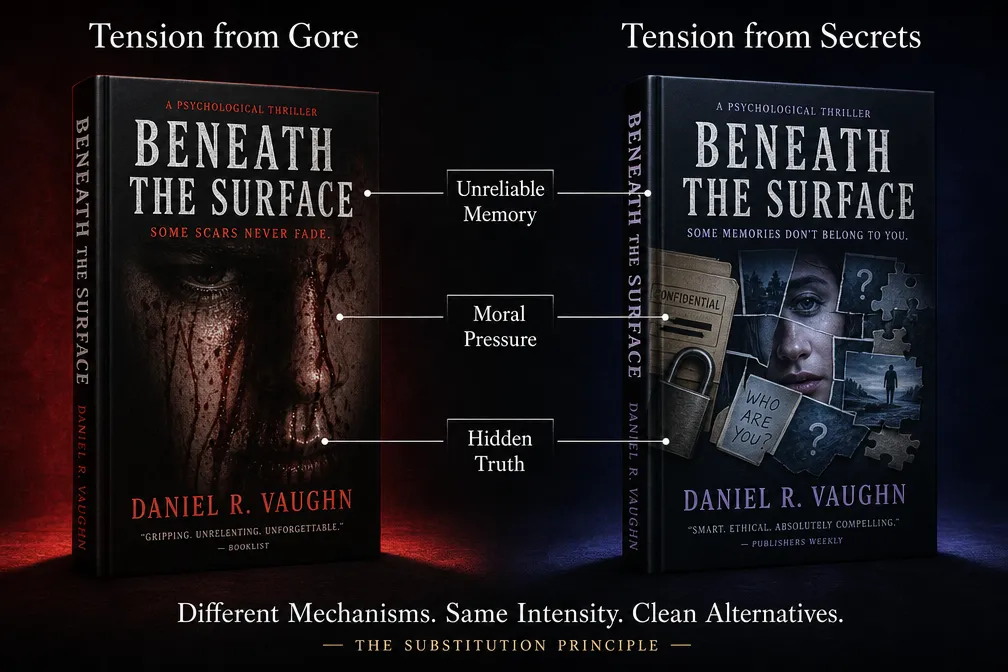
Decision rule: if the book’s hook is a question (“who altered the transcript?”), it’s suspense. If the hook is an image (“what’s in the basement”), expect horror conventions.
What makes a thriller suspenseful without graphic content?
Suspense comes from stakes a reader believes in and information the reader doesn’t fully have. Six engines do the heavy lifting:
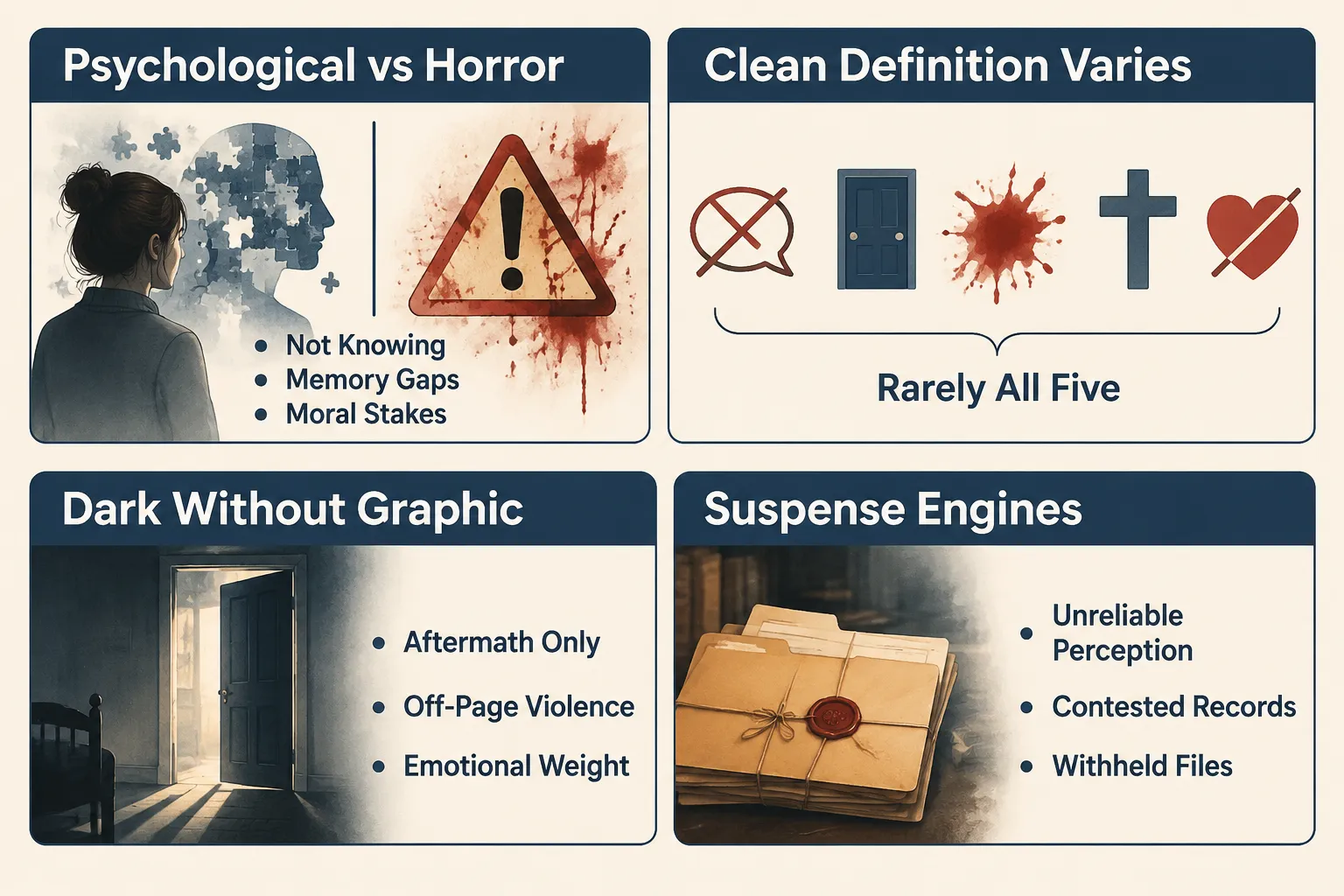
- Unreliable perception, the protagonist’s own account can’t be trusted.
- Contested records, a ledger, transcript, or prayer list that says something different from memory.
- Proximity, the threat is inside the household, church, or workplace, not out in the dark.
- Time pressure, a deadline that costs someone something real.
- Moral dilemma, telling the truth will hurt someone innocent.
- Betrayal, the helper is the harm.
None of those require a body count. For a deeper breakdown of how dread gets built responsibly, see this guide on creating dread without exploitation in Christian psychological suspense.
Clean suspense books vs dark thrillers: what’s the actual difference?
The difference is usually staging, not subject matter. Clean suspense will still put a murder, an abusive marriage, or a missing child at the center of the plot. It handles the worst moment off-page, or in aftermath, instead of rendering it in sensory detail.
| Element | Dark mainstream thriller | Clean suspense |
|---|---|---|
| Violence | On-page, detailed | Implied, aftermath, or off-page |
| Language | Frequent profanity | None or very mild |
| Sexual content | Explicit scenes common | Absent or closed-door |
| Villain | Often fascinating for its own sake | Motive matters more than method |
| Ending | May end in despair or ambiguity | Costly, earned resolution |
That last row is the real dividing line for most faith readers. Hope in the dark isn’t a softer ending, it’s a more expensive one.
Are there good thrillers without sex scenes or heavy profanity?
Yes, and the category grew noticeably through 2026. Retail suspense catalogs now carry a steady run of clean titles from Lynette Eason, Colleen Coble, Dani Pettrey, and Susan May Warren [2]. Christian fiction release roundups for October 2026 list new suspense alongside cozy mystery and historical [3].
Worth knowing: clean and Christian are not synonyms. Publishers Weekly has noted that Christian fiction is generally clean, while “clean fiction” is a broader shelf that may carry no biblical content at all. Kristine Delano’s The Lies We Trade (January 2026) is marketed as a clean high-stakes domestic and Wall Street thriller without being faith fiction [4].
Christian published suspense thriller book recommendations
The 2026 Christy Awards named 35 finalists across nine categories; the Mystery/Suspense/Thriller slate was The Accused by Cara Putman, Final Approach by Lynette Eason, Girl Lost by Kate Angelo, and Tempest at Annabel’s Lighthouse by Jaime Jo Wright [1]. Those four are a useful cross-section because each substitutes a different thing for graphic horror: legal stakes, mechanical danger, investigative dread, and gothic atmosphere.
Also circulating in late 2026: T.H. Meyer’s What the Shadows Know, which positions supernatural threat and spiritual warfare as an alternative to horror while staying free of graphic violence, and newer small-town suspense titles appearing in October 2026 listings [3][5].
For a curated starting list, there’s a full roundup of mind-bending Christian psychological thrillers without graphic content.
How to choose suspense without graphic horror by tension style
This is the substitution table most “clean thriller” lists skip. Find what you actually loved, then move sideways.
Domestic secrets, you liked the marriage that wasn’t what it looked like, the neighbor who knew too much. → Clean route: small-town or household suspense where the threat shares a hallway with the protagonist. Start with clean domestic suspense picks.
Missing evidence, you liked the file, the tape, the deleted message. → Clean route: suspense built on records. The Gathering Light series runs on this exact spine, who controls the record of someone’s truth. In When Hannah Sleeps, a woman who has transcribed a hundred other women’s worst nights finds her own testimony in someone else’s file.
Identity puzzles, you liked amnesia, doubles, the narrator who may be lying to herself. → Clean route: see memory loss, hidden identities, and moral reckoning, or the dual-timeline approach in two versions of the truth that still lead to hope.
Moral dilemmas, you liked the antihero, the slow slide, the justified wrong. → Clean route: stories where consequence actually lands. See Christian thriller alternatives to Breaking Bad.
Procedural intensity, you liked the case files and the interview room. → Clean route: Criminal Minds-style tension without graphic cases.
Psychological thriller authors similar to Colleen Hoover but cleaner
Readers who name Colleen Hoover usually want three things: fast emotional escalation, a relationship under strain, and a late reveal that reframes the whole book. The clean substitute keeps the escalation and reveal, drops the explicit content and the bleakest resolutions.
Look for closed-door domestic suspense and faith-adjacent emotional thrillers. In the Christian market, Dani Pettrey and Lynette Eason deliver pacing with romance that stays restrained [2]. If the romance itself is what you’re after, faith-driven tension without explicit scenes maps the territory.
Common mistake: assuming “Christian” means “no hard subject matter.” Several Christy finalists center on missing children and legal accusation [1].
How to check book content warnings before reading
Publisher copy tells you what the book is. Reader warnings tell you what it contains. Use both, in this order:
- Read the product description for subgenre signals: “gothic,” “supernatural,” “spiritual warfare,” “psychological.”
- Use Amazon’s Look Inside and read two random mid-book pages, not the first chapter. Openings are polished; chapter fourteen is honest.
- Scan Goodreads reviews filtered to 2 and 3 stars. Sensitive readers cluster there and name specifics [6][7][8].
- Search the title plus “content warning”, readers maintain informal lists.
- Check curated clean-read blogs that review by content, not just plot [9].
- Watch the series contract. Some series commit to it across the catalog, The Mercy Line, for example, is romance-absent throughout.
How do I know if a thriller book will be too intense for me?
Judge by theme, not by rating. Research associates horror enjoyment with sensation-seeking and openness to imaginative stimulation, meaning fear tolerance is personal, and a book with zero graphic content can still wreck you if it touches a live wire.
Ask three questions before you start:
- Is the threat aimed at a child? This is the most common distress trigger in otherwise clean suspense.
- Is the protagonist isolated or believed? Sustained disbelief (gaslighting, institutional dismissal) is heavier than physical danger for many readers.
- Does the book promise resolution? Check the final-page reviews. If readers say “I had to sit with it,” calibrate.
Edge case: supernatural clean suspense. No gore, but spiritual-warfare imagery can unsettle readers more than a procedural does [5].
Best page-turner thrillers with minimal violence
Minimal-violence page-turners rely on a ticking clock and a withheld document rather than a body count. Three reliable shapes:
- The contested record, someone’s account has been edited, and the original still exists.
- The institutional cover, a well-meaning organization protecting its own language.
- The returning name, someone everyone thought was gone files a claim.
Cozy mystery deserves a mention here. If you want puzzle satisfaction with gentle stakes, the Christian cozy mystery reading guide covers small-town clues and amateur sleuths. Current bestseller lists in Christian mystery and suspense are also a decent temperature check [10].
Can a psychological thriller work without shocking or disturbing twists?
Yes. Shock and recognition are different tools. A shock twist makes the reader gasp; a recognition twist makes the reader realize they already had every piece and chose not to assemble it.
Recognition-based endings tend to hold up better on reread, and they fit a faith framework naturally, the reveal isn’t that the world is worse than you thought, it’s that the truth was always available and somebody had to pay to speak it. That’s grace that costs something, not a clean exit.
Common mistakes when picking a thriller for sensitive readers
- Trusting the word “clean” alone. It’s undefined across the industry.
- Assuming a Christian publisher caps intensity. It caps content, not subject matter.
- Buying a series on book one’s tone. Series escalate.
- Reading only five-star reviews. Enthusiasts rarely flag triggers.
- Confusing “no romance” with “no tension.” Romance-absent books often raise moral stakes instead.
- Ignoring supernatural tags when the concern is fear, not gore.
FAQ
Is psychological suspense the same as horror? No. Suspense builds tension through uncertainty, secrets, and moral pressure. Horror relies on visceral imagery, gore, and sustained dread.
Does “clean” mean no murder? No. Clean suspense regularly includes murder, abuse, and child endangerment, handled off-page or in aftermath rather than in graphic detail.
Where can I find clean thriller recommendations by genre? Christian retail suspense catalogs, Christy Award finalist lists, and curated clean-read review blogs are the three most reliable sources [1][2][9].
Are there clean thrillers for readers who don’t want romance at all? Yes. Romance-absent suspense exists; check series-level content contracts rather than individual blurbs.
Which 2026 Christian suspense titles won recognition? The 2026 Christy Awards named The Accused, Final Approach, Girl Lost, and Tempest at Annabel’s Lighthouse as Mystery/Suspense/Thriller finalists [1].
Can a clean thriller still be genuinely scary? Yes. Proximity and disbelief frighten most readers more than violence does.
What’s the fastest way to vet a book? Read three mid-range Goodreads reviews and two random mid-book pages via Look Inside.
Are supernatural Christian thrillers safe for horror-averse readers? Not always. Spiritual-warfare content can be more unsettling than a procedural, even with no graphic violence [5].
Conclusion: build your own substitution list
Stop searching by genre label and start searching by the thing that kept you up: the sealed file, the narrator you couldn’t trust, the choice that cost somebody everything. Then do three things this week. One, name your tension style out loud. Two, pull two titles from the 2026 Christy suspense finalists and one clean domestic thriller, and vet all three with mid-range reviews. Three, pick one series with a stated content contract so the next five books come pre-qualified.
Fear is cheap to manufacture. Hope that survives the whole book costs something, and that’s the part worth reading for.
References
- Best Faith Fiction Reads From 2026 Christy Awards Finalists. womansworld.com.
- Suspense and Intrigue. christianbook.com.
- New Releases in Christian Fiction October 2026. janetsketchley.ca.
- The Lies We Trade. goodreads.com.
- Garden of Mercy Hill. amazon.com.
- Show. goodreads.com.
- Show. goodreads.com.
- Stolen Secrets. goodreads.com.
- Clean Reads. janetsketchley.ca.
- Christian Mystery & Suspense Bestsellers. us.amazon.com.