Last updated: October 22, 2026
Quick Answer
Christian psychological suspense builds fear from conscience, concealed truth, and moral consequence rather than gore or spectacle. The ethical line isn’t whether a novel contains crime, captivity, or terror, it’s whether those elements serve character, truth, and consequence instead of entertaining the reader with cruelty. Writers hold that line through withheld information, delayed disclosure, time pressure, and victim dignity, with hope that arrives after cost rather than instead of it. Done well, the dread is sharper than graphic horror, not softer.
Key Takeaways
- Dread lives in anticipation, not aftermath. What a reader fears is coming frightens more than what’s described on the page.
- The ethical test is narrative purpose. Does this scene reveal a person, or does it invite the reader to enjoy someone’s suffering?
- Victim dignity is non-negotiable. A character’s worst night is not set dressing.
- “Fade to black” is craft, not cowardice. Many Christian authors use it because real readers carry real histories.
- Faith raises stakes when it’s load-bearing, a character who believes in judgment has more to lose than one who doesn’t.
- Religious publishing is commercially strong, with the category posting the largest gain among major trade segments in recent reporting [1][2].
- Hope must cost something. Resolution that arrives free reads as a lie and kills the tension retroactively.
- Non-Christians read it comfortably when the faith is dramatized rather than explained.
What is Christian psychological suspense, and how does it differ from horror?
Christian psychological suspense is interior-threat fiction where the danger is epistemic, who controls the truth, whose memory can be trusted, what a record proves, and where faith functions as part of the conflict rather than decoration. Horror aims at revulsion and the uncanny; psychological suspense aims at sustained dread and moral uncertainty.
The practical differences:
| Horror | Christian psychological suspense | |
|---|---|---|
| Source of fear | Monstrosity, violation, the inexplicable | Conscience, guilt, concealed truth, paranoia |
| Reader position | Witness to harm | Participant in inference |
| Typical climax | Confrontation or survival | Reckoning and testimony |
| Moral frame | Often ambiguous by design | Mercy and justice held in tension |
A 2025 scoping review of literary terror catalogued the engines of fear writers actually use: unreliable narration, delayed disclosure, time pressure, guilt, paranoia, and moral dilemma. Only one item on that list requires blood. For a fuller breakdown, see how Christian authors build suspense without darkness in psychological thrillers.
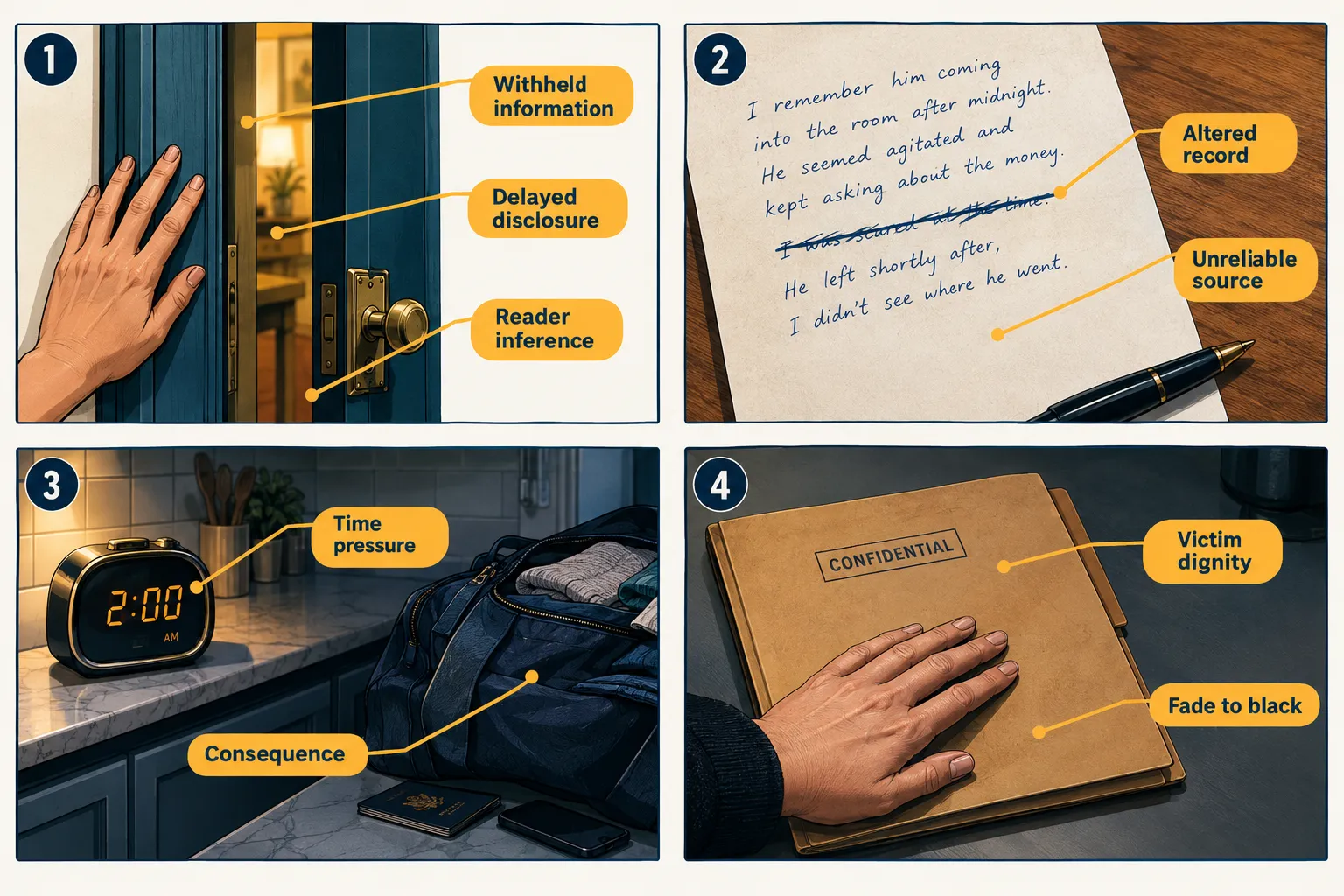
Decision rule: if removing the graphic element leaves the scene just as frightening, the graphic element was never doing the work.
How do you create dread in a story without exploiting readers?
You create dread by controlling what the reader knows and when. Exploitation happens when a scene’s purpose is sensation; dread happens when a scene’s purpose is dawning understanding.
Techniques that carry weight:
- Withhold one crucial fact the protagonist also lacks, and let both discover it together.
- Put a clock on it, a hearing date, a discharge, a Sunday service where someone will speak.
- Make the ordinary wrong. A hymnal margin, a recipe tin, a prayer list. Familiar objects turned sideways unsettle more than a dark basement.
- Use an unreliable record rather than an unreliable monster. Paper that lies is scarier than a man who shouts.
- Cut before the harm, resume after. The reader’s imagination fills the gap more effectively than prose can, and no one is being invited to enjoy it.
Common mistake: stacking atmosphere without jeopardy. Fog and creaking floors are mood. Dread requires something a specific person can lose.
What makes ethical fear different from manipulation in fiction?
Ethical fear serves understanding; manipulation serves the author’s effect at the reader’s expense. The difference shows up in whose interests the scene protects.
Three tests worth applying to any frightening scene:
- The purpose test. Does this reveal character, truth, or consequence, or does it exist to shock?
- The dignity test. Would the character depicted recognize themselves as a person here, or as material?
- The exit test. Does the reader leave the scene with something to carry, or only with residue?
Recent literary-theological commentary has drawn the same line: violence can legitimately reveal suffering and spiritual devastation, but must not become cruelty as entertainment. Fear sourced in conscience, memory, and hidden truth passes that test more reliably than bloodshed.
Christian suspense vs. secular thriller: what are the key differences?
The core difference is what the story treats as the final authority. Secular thrillers often end at survival or exposure; Christian suspense asks what a person owes the truth once they’re holding it, and whether mercy can be extended without excusing harm.
- Moral floor. Christian suspense assumes evil is real and nameable, not merely dysfunctional.
- Consequence. Grace shows up after cost, never as a shortcut past it.
- Content contract. No profanity, no graphic violence, no explicit content, carried by tone rather than announced as a disclaimer.
- Interiority. Prayer, doubt, and silence from God are dramatic events, not interludes.
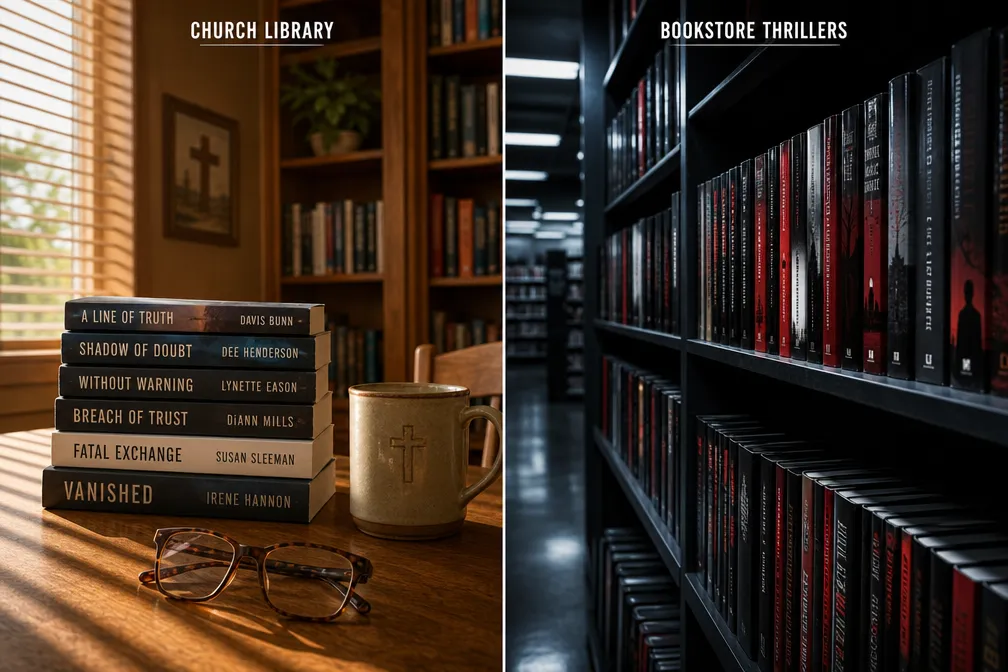
Readers coming from darker shelves may appreciate clean-read psychological thriller alternatives to Stephen King’s The Long Walk.
How do you write tension without graphic violence or trauma, and how much violence is too much?
Too much violence is any violence the plot could survive without. The working standard among Christian crime writers is to show investigators’ responses to a crime rather than linger over the body or the injury.
Practical boundaries:
- Report, don’t render. A coroner’s phrasing lands harder and cleaner than a camera.
- Trauma in consequence, not flashback. Show the locked door, the unslept nights, the flinch, not a replayed scene. More on this in Christian psychological thriller protagonists: trauma, memory, and faith recovery without graphic flashbacks.
- Fade to black deliberately. Authors use it partly because some readers carry histories they’re trying not to reopen. Danger survives the cut; sensory detail doesn’t need to.
- Never sexualize harm. No exceptions, no artistic justification.
Edge case: platform policy matters too. Google Play Books’ April 2026 update prohibits material that encourages self-harm, suicide, or eating disorders, with artistic exceptions preserved, meaning depiction is permitted, encouragement is not. Write the despair; never write the instruction.
Can non-Christians enjoy faith-based suspense, and is it appropriate for teens?
Yes to both, with conditions. Non-Christian readers engage readily when faith is dramatized through choice and consequence rather than explained in narration, the standard for any well-built belief system in fiction. Readers who rejected a sermon will still follow a character who prays and gets no answer.
For teen and young-adult readers, clean Christian suspense is often the most appropriate option in the broader thriller category: no explicit content, no gratuitous gore, and consequence treated seriously. Parents and librarians should still screen for:
- Content involving coercive religious authority or institutional abuse, which some titles handle directly
- Captivity, stalking, or child-endangerment threads
- Spiritual despair arcs that resolve slowly
Choose for a 14-year-old if the suspense is institutional or investigative. Wait until 16+ if the threat is domestic and intimate.
How do you balance spiritual themes with genuine suspense and dread?
Faith should raise the stakes, not relieve them. The balance holds when belief creates the dilemma instead of resolving it, a character whose conscience forbids the easy exit is in more trouble, not less.
- Let prayer go unanswered for most of the book.
- Make the most devout character the one with the hardest choice.
- Convert theology into pressure: if forgiveness is required, forgiving the antagonist becomes the terrifying act.
- Never resolve a faith question with a tidy conversion scene.
Further reading: how faith themes raise the stakes in Christian psychological thrillers and balancing spiritual themes with story across genres.
What theological principles should guide fear in Christian storytelling, and can you write suspense without a redemption arc?
Three principles do most of the work: evil is real, persons bear the image of God, and judgment belongs to God rather than the author. Fear becomes legitimate when it serves those claims and illegitimate when it entertains at a person’s expense.
You can absolutely write Christian suspense without a conversion or recovery arc. What you cannot do is write it without moral weight. A novel may end with a character unrepentant, a wound unhealed, or a question open, and still be rooted in faith, provided the story knows the difference between a cost and a cure. Hope in the dark can be as small as one person telling the truth at personal expense.
Common mistakes writers make with Christian psychological fiction
The most frequent failure is grace that arrives free. A resolution with no cost retroactively drains every page of tension before it.
- Sermon-dropping. A character quoting scripture to explain the theme instead of acting on it.
- The sanitized antagonist. Evil that’s merely rude isn’t frightening.
- Trauma as texture. Backstory suffering that never changes a decision.
- Late-arriving faith. Belief introduced in the final chapter as a solution.
- Throat-clearing openings. Dread starts in line one, not after three pages of weather.
- Disclaiming cleanliness. If the prose needs to announce its standards, the prose has already failed them.
Publishing tips for Christian psychological suspense and thriller
Position the book by reader experience rather than genre label stacking. Market signals in 2026 favor faith-integrated suspense: religious publishing has posted strong gains among trade categories, and devotional and fiction titles continue to anchor Christian reading trends [1][2][3]. October 2026 release lists show a visible cluster of Christian gothic and suspense titles, generally marketed with words like clean suspense, courage, and conviction rather than gore [4][5][6][7].
Practical moves:
- Lead cover copy with contradiction and jeopardy, not setting.
- Signal content standards through tone, and let categories and comparison titles do the filtering.
- Treat audio as primary, not secondary. Narration, silence, and pacing generate dread without description, and digital audio is outgrowing e-books across trade.
- Serialize where it fits. Short-form and serial Christian fiction is reshaping digital reading habits [8].
- Write a standalone-per-book series so new readers can enter anywhere.
- Adopt a written AI policy. The Authors Guild’s October 2026 recommendations urge author consent before manuscripts enter third-party AI systems, relevant to trust in a category built on sincerity.
Series worth studying for structure: The Gathering Light, where each book follows a new protagonist inside the same question, who controls the record of someone’s truth, beginning with When Hannah Sleeps.
Best Christian suspense authors and books to study
Start with contemporary authors working the clean-suspense line, then read for mechanism rather than plot.
- Jaime Jo Wright, Christian gothic mystery and suspense; The Resurrection of Evania James (Bethany House, October 2026) [4].
- Lynette Eason, procedural tension with faith intact; Deadly Charade with Kelly Underwood appeared on October 2026 Christian suspense lists [6].
- Flannery O’Connor and Graham Greene, for how grace arrives violently and at cost.
- Silas Bellhaven, The Gathering Light series, for institutional dread and testimony as the site of threat.
Reader-facing roundups: best Christian psychological thriller books for clean domestic suspense.
FAQ
Is Christian psychological suspense scary? Yes. Dread from conscience and concealed truth is often more persistent than shock, because it doesn’t resolve when the scene ends.
Does clean mean low stakes? No. Clean restricts depiction, not danger. Murder, captivity, and coercion all appear; the camera simply doesn’t linger.
What’s the difference between dread and horror? Dread anticipates harm; horror displays it. Dread is sustained, horror is punctual.
Can a Christian novel have an unredeemed villain? Yes. Judgment belongs to God, not the author, and an unrepentant antagonist can serve the story’s moral weight honestly.
How graphic is too graphic? Any detail the plot survives without is too graphic. Report rather than render.
Is this genre appropriate for teens? Usually, with screening for captivity, stalking, and domestic-threat content. Institutional and investigative plots suit younger readers best.
Do non-Christians read it? Regularly, when the faith is shown through action and cost rather than narration.
Does every book need a recovery arc? No. It needs consequence. Healing may be partial, delayed, or absent, so long as the story knows what it cost.
Conclusion
The ethics of fear come down to one question asked scene by scene: is this revealing a person, or using one? Writers who get this right earn a reader’s trust twice, once for the dread, once for refusing the cheap version of it.
Next steps for writers: audit your three most frightening scenes against the purpose, dignity, and exit tests. Cut any graphic detail the plot survives without. Move one revelation later than feels comfortable. Then check that your ending costs your protagonist something real.
Next steps for readers: start with a standalone-per-book series so you can leave if it isn’t for you, and notice whether the hope at the end was paid for.
The record always says something. What it means still depends on who’s willing to tell the truth about it.
References
- Christian Reading Trends 2026: Devotional Fiction Dominance Revealed. wboc.com.
- The Rise Of Christian Fiction: Market Trends, Regional Dynamics And Future Predictions For 2026. alibaba.com.
- 2026’s Ultimate Guide To Christian Fiction Trends, Top Authors And How To Profit. alibaba.com.
- Suspense. fuonlyknew.com.
- rosepointpublishing.com. rosepointpublishing.com.
- New Christian Fiction Releasing in October 2026. louallenwriter.wordpress.com.
- Suspense. fuonlyknew.com.
- Short Form Serial Christian Fiction Growth Reshapes Digital Reading. prsync.com.