Last updated: October 10, 2026
Quick Answer
Small-town Christian cozy mysteries with music and community events are clue-driven, low-gore mysteries set in close-knit towns where the choir loft, the harvest festival, and the fellowship-hall potluck supply both the suspects and the motive. Faith shows up in how characters behave under pressure, not in sermons. The subgenre is growing: Publishers Weekly reported in August 2026 that Christian publishers are adding mysteries with broad clean-read appeal, driven by demand for faith-centered puzzles in the Agatha Christie tradition [2].
Key Takeaways
- Definition: A cozy mystery with an amateur sleuth, a small-town setting, no graphic content, and faith treated as lived experience, often anchored to recurring events like choir practice, music festivals, bake sales, and benefit concerts.
- Why music works structurally: Rehearsals, worship services, and festivals force the same people into the same room on a schedule, which creates recurring suspects and overheard secrets [4].
- Market status: Christian mystery is rising, but cozy sales in Christian markets still trail the general market, partly because readers can find secular cozies easily [2].
- Cost: Most Christian cozy ebooks run roughly $0.99,$4.99, with many available at no extra cost through Kindle Unlimited.
- Reading order: Most series are standalone-per-book mysteries, but relationships and town history build, so book one first is the better experience.
- Age range: Generally fine for mature middle-grade readers up through adults, since murder happens offstage and language stays clean.
- Not for you if: You want graphic forensics, moral ambiguity without resolution, or steamy romance subplots.
- Where to look: Kindle Unlimited, Love Inspired Trade, church-library and cozy-mystery blog roundups, and author backlists.
What Are Christian Cozy Mysteries?
Christian cozy mysteries are gentle, puzzle-focused crime novels where an ordinary person, not a detective, solves a murder inside a small community, and where faith is part of the character’s actual decision-making rather than a label on the cover. Violence occurs off-page. Profanity and explicit content are absent. The emotional payoff is a community put back together, not a body count.
Three structural features define the form:
- An amateur sleuth with a legitimate reason to be nosy: church secretary, thrift-shop manager, choir director, caterer, pastor’s widow.
- A closed community where everyone knows everyone, so withheld information becomes dramatic currency.
- A moral frame where mercy and justice have to be held together, not traded against each other.
The distinguishing claim is harder than it sounds: grace in these books has to cost something. A confession that ruins a reputation. A truth that splits a congregation. For more on how that works on the page, see the Christian cozy mystery reading guide covering small-town clues and gentle justice.
A cozy mystery earns the word “cozy” from what happens after the crime, who shows up with a casserole, who keeps quiet, who finally tells the truth.
Why Do Cozy Mysteries With Community Events and Town Gatherings Work So Well?
Community events work because they’re a plot engine disguised as decoration. A bake sale needs volunteers, a cash box, a sign-up sheet, and a schedule, which means a suspect list, a motive, an alibi grid, and a timeline, all handed to the author at once.
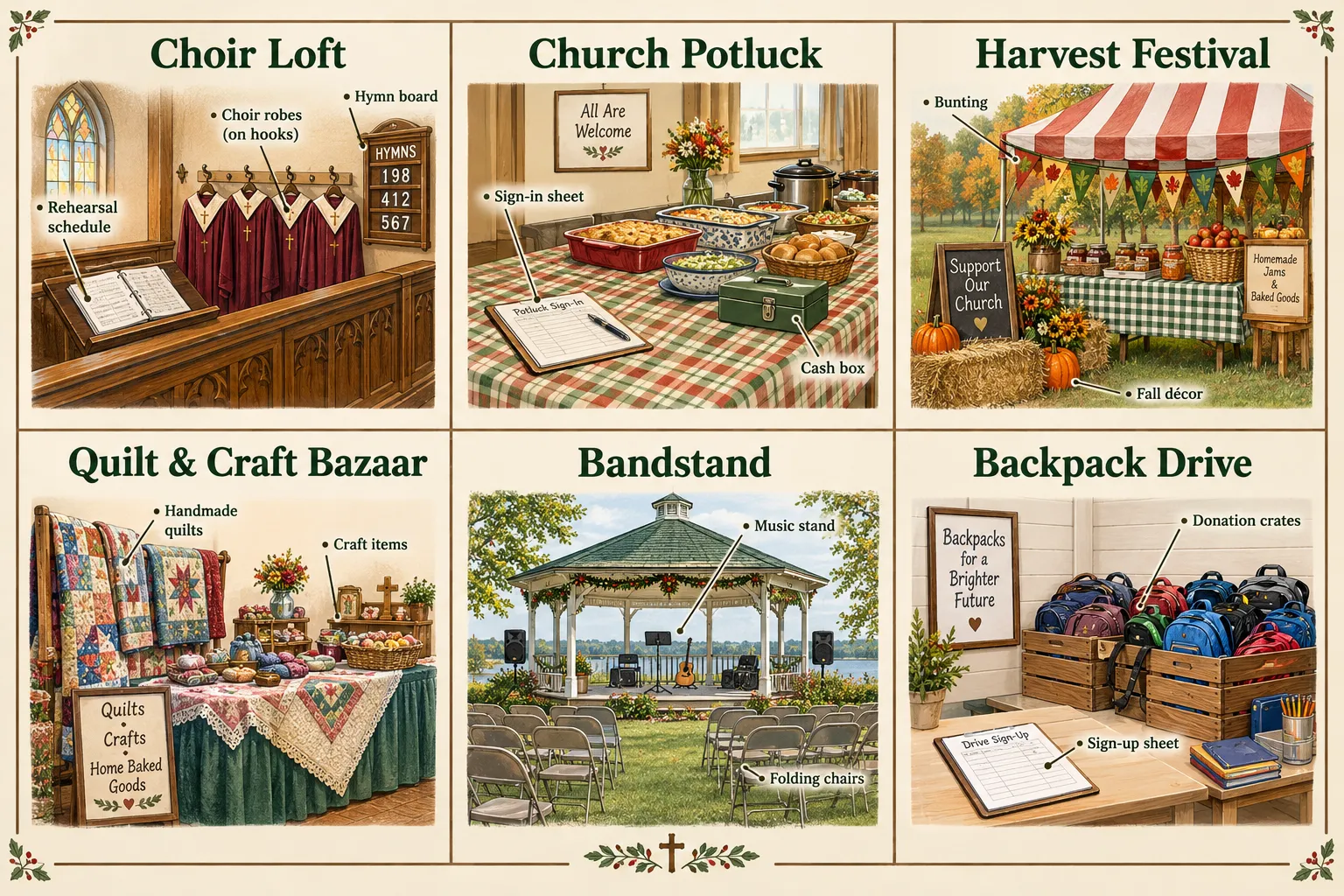
Reader interest in event-driven cozies is well established. ThriftBooks catalogs community-event mysteries built around bake sales, craft fairs, parades, and food festivals as a mature, ongoing reader category [6]. A 2026 faith-based cozy guide specifically names potlucks, bazaars, mission trips, and choir practice as natural generators of conflict and investigation [4].
Events that pull double duty as plot devices:
| Event | What it generates |
|---|---|
| Choir rehearsal | Weekly forced proximity, overheard arguments, missing members |
| Harvest or music festival | Outsiders in town, cash handling, scheduling gaps |
| Church bazaar or quilt fair | Donated objects with hidden histories |
| Benefit concert | Money, ego, and public reputation in one room |
| Potluck or funeral dinner | Everyone present, nobody watching the same door |
Common mistake: treating the festival as scenery. If the mystery would work identically at a grocery store, the event isn’t doing its job. In the Mercy House Mysteries, the object is the case, a quilt square, a recipe tin, a seed packet, a margin note in a hymnal.
Cozy Mysteries Featuring Music, Choirs, and Music Festivals
Music-centered cozies use the rehearsal calendar as their clock. Choirs, worship teams, bluegrass festivals, and benefit concerts give a writer a recurring cast, a public performance deadline, and a built-in hierarchy of rivalries, who got the solo, who controls the hymn selection, who handles the offering.
Analysis of the long-running Church Choir Mysteries series notes that the church functions as the social infrastructure of the whole series: it supplies the rhythm, the characters, the local rivalries, and the moral framework [11]. That’s the template later music-driven faith cozies still follow.
What a music setting gives the plot:
- A schedule readers can track (rehearsal Wednesday, performance Sunday).
- Physical artifacts that carry evidence: sheet music, hymnals, recordings, programs, instrument cases.
- Public and private spaces inches apart, the sanctuary and the choir room.
- Legitimate conflict without villainy: artistic disagreement is a real motive at low stakes.
A concrete example from Silas Bellhaven’s catalog: The Hymnal Margin Murder turns a penciled note in the margin of an old hymnal into the thread that pulls Juniper Gap’s best-kept secret loose. The Benediction Tape Murder does it with a recorded blessing holding the last words of a man who never finished his confession.
Edge case worth knowing: no major 2026 release has centered all four elements, Christian faith, small town, music, and community events, simultaneously. New-release listings show heavy cozy activity through September and October 2026, but the choir-and-festival niche remains thinly populated [9]. That’s a gap for readers to hunt in and for authors to fill.
Christian Cozy Mysteries vs. Regular Cozy Mysteries: What’s Actually Different?
The mystery mechanics are nearly identical. What changes is the moral logic of the ending and the content floor.
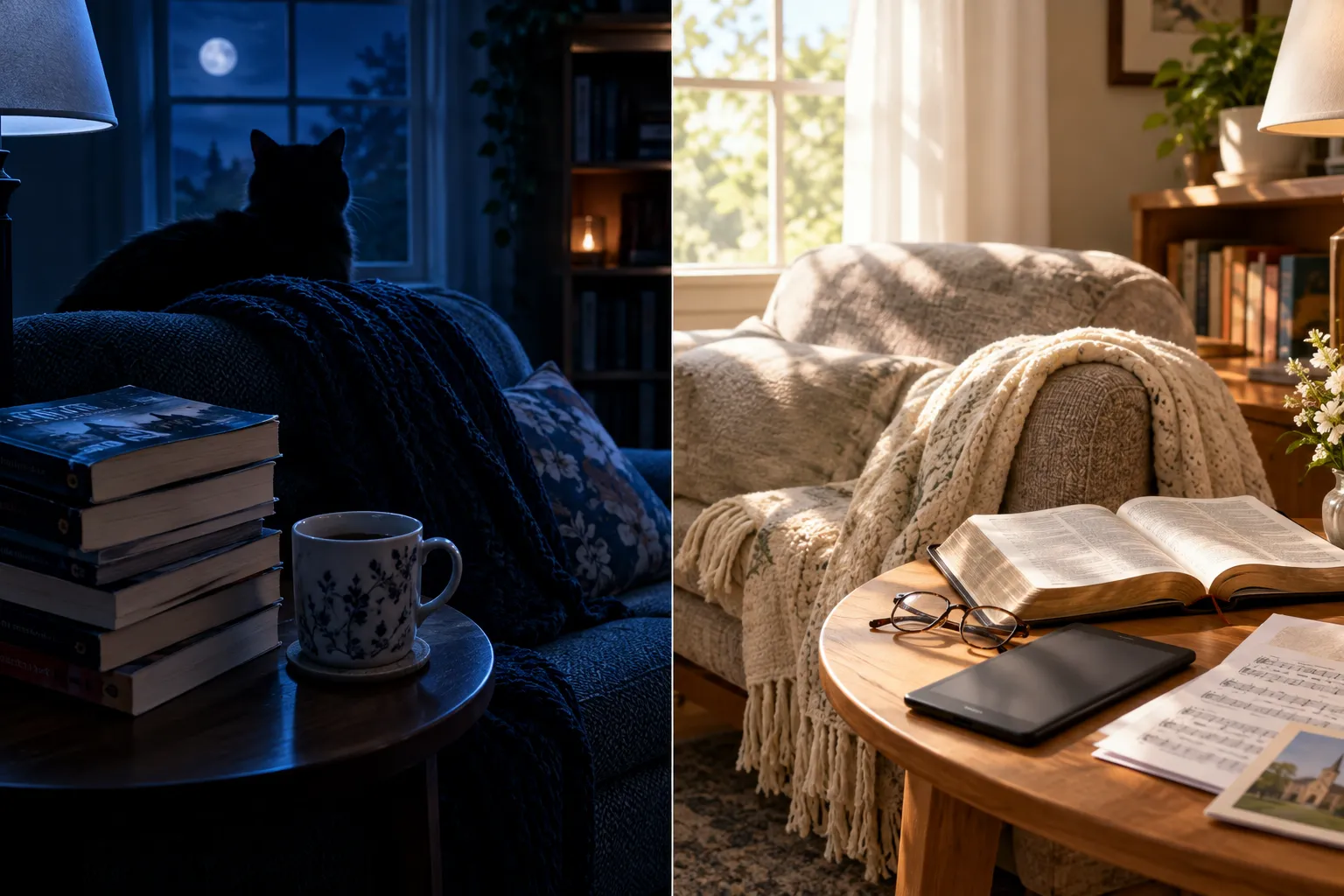
| Element | General-market cozy | Christian cozy |
|---|---|---|
| Sleuth | Baker, bookseller, innkeeper | Church volunteer, thrift-shop manager, choir member |
| Setting glue | Business, hobby club, holiday | Congregation, mission work, music ministry |
| Content | Usually clean, sometimes mild profanity or romance heat | No profanity, no explicit content, violence off-page |
| Resolution | Culprit caught, order restored | Culprit caught, plus a reckoning about confession and forgiveness |
| Faith | Absent or decorative | Load-bearing in character choices |
Publishers are currently testing clean crossover positioning rather than leaning only on explicitly religious branding, titles that work for Christian-fiction readers and general cozy readers who simply want wholesome content [2][7]. A small-town church-and-music mystery sits right in that overlap.
Choose a Christian cozy if you want the puzzle plus a question about what truth costs. Choose a general-market cozy if faith content is a distraction from the clues. For a deeper breakdown of reader expectations around content, see what “clean” really means to Christian fiction readers.
Which Small-Town Cozy Mystery Series With Faith Themes and Amateur Sleuths Should You Try?
Start with series where the sleuth’s job gives her real access to the community’s secrets, and where the series has enough books to be worth committing to.
The Mercy House Mysteries (Juniper Gap, Tennessee) is the clearest current example of the small-town-plus-church-events formula. Nora Bell Hartley runs donation intake at a church mercy house, which means every box she opens is a potential case file. Ten books, each anchored to a community event or artifact:
- A Donation to Die For, a mislabeled donation box, a ledger, and a deacon who died just before he could confess.
- The Christmas Room Clue, a shelter meant to hide shame becomes a Christmas murder scene.
- A Quilt for the Guilty, an old fair ledger stitched into a quilt square outlives the woman who hid it.
- The Seed Packet Murder, a church seed swap turns deadly.
- Full series page: The Mercy House Mysteries
Traditionally published options to watch: Love Inspired Trade has announced Dana Mentink’s Murders in the Marquee for September 2026 and Heather Day Gilbert’s All the Suspects on Campus for January 2027, both reflecting the imprint’s push into faith-centered mystery [2].
Decision rule: if you want faith integrated into the sleuthing rather than sitting beside it, look for series where the church is the workplace. If you want a lighter touch, look for general cozies with a small-town festival hook.
Related reading: Christian cozy mystery tropes, sleuth archetypes, and faith integration readers love and the small-town mystery setting archive.
Where to Find Christian Cozy Mystery Books (and What They Cost)
The fastest route is Kindle Unlimited, where most indie Christian cozy series live and where a subscription covers unlimited reading from enrolled titles. Standalone ebook prices typically fall between $0.99 and $4.99; traditionally published trade paperbacks run higher.
Where to search, in order of yield:
- Kindle Unlimited, browse the Christian mystery and cozy animal/culinary categories, then filter by series length.
- Author backlists, the Silas Bellhaven author page collects cozy, western, fantasy, and thriller series in one place.
- Love Inspired Trade, Harlequin’s faith imprint, which editor Shana Asaro says is responding to rising demand for Agatha-style faith mysteries [2].
- Cozy-mystery blogs and new-release trackers, useful for spotting festival- and music-themed titles early [9].
- Church and public library ebook catalogs, many carry Christian cozy series through Libby.
Cost tip: series book one is frequently discounted or free as a reader magnet. Start there, then judge read-through for yourself.
What If You Don’t Like Religious Themes in Mysteries?
Then look for how the faith is delivered, not whether it’s present. Preachy books announce their theme; well-built ones bury it in consequence. If a book’s faith content arrives as a character making a costly choice, most general cozy readers won’t find it intrusive.
Signals a faith cozy will read comfortably for you:
- Characters doubt out loud and don’t get tidy answers.
- Scripture appears in dialogue only when a real person would say it.
- No dramatic conversion scene resolves the plot.
- The culprit’s exposure costs the sleuth something socially.
Signals it won’t:
- Chapter-ending devotional summaries.
- A character who exists only to explain the theology.
- Grace handed out before anyone pays for anything.
One publishing perspective notes that faith themes integrate more naturally with justice, truth, and forgiveness than with pure puzzle mechanics, which is why Christian mystery grew out of romantic suspense rather than the drawing-room whodunit [2]. The practical takeaway: faith cozies that lean on justice tend to read least preachy.
Are Christian Cozy Mysteries Appropriate for All Ages, and Do You Read Them in Order?
Most are appropriate for roughly ages 12 and up: a murder occurs, but off-page, with no graphic description, no profanity, and no explicit content. Parents of younger readers should still preview, since themes can include abuse, theft, addiction, and grief handled honestly.
On reading order: each book resolves its own mystery, so you can technically start anywhere. But town history, recurring suspects, and the sleuth’s relationships accumulate. Industry discussion citing K-Lytics analyst Alex Newton has claimed well-built cozy series can hit 62-68% read-through from book one to book three, treat that as an industry claim rather than a verified benchmark [3]. Either way, the design intent is sequential.
Decision rule: start with book one if the series is under 15 books. For longer backlists, start with whichever event hook appeals most, a Christmas title, a festival title, a music title, then circle back.
FAQ
What makes a cozy mystery “Christian” rather than just clean? Faith affects the plot. Characters pray, fail, confess, and make choices with spiritual cost, and the resolution deals with forgiveness as well as guilt. Clean fiction only promises absent content; Christian cozy promises present conviction.
Do Christian cozy mysteries include romance? Sometimes, always without explicit content. Some series, including Silas Bellhaven’s western line, maintain a romance-absent content contract entirely.
Are there Christian cozy mysteries set at music festivals? Few so far. Church choir and hymnal-centered mysteries exist, but no major 2026 release has combined faith, small town, music, and community events as its full premise [9].
How long are these books? Most run 180-280 pages, roughly a four-to-six-hour read, which suits the one-sitting cozy habit.
Is the Christian cozy market actually growing? Yes, with caveats. Publishers Weekly reported expansion in August 2026, while consultant Cynthia Ruchti noted Christian cozy sales still trail the general market [2].
Can non-Christian readers enjoy them? Usually, if the faith content is woven into character behavior. Publishers are actively positioning these titles for crossover clean-read audiences [2][7].
Who’s the typical reader? Predominantly women 35-65, heavy Kindle Unlimited users, who want real stakes without graphic content [10].
What’s the best entry point into the Mercy House Mysteries? A Donation to Die For, book one, which establishes Juniper Gap, the mercy house, and the ledger that starts everything.
Conclusion: Your Next Steps
Small-town Christian cozy mysteries with music and community events sit in a real market gap, enough demand to be visible, not enough supply to be crowded. That’s good news for readers willing to look slightly past the bestseller rows.
Do this next:
- Pick one event hook that appeals to you, choir, festival, bazaar, potluck, and search it alongside “Christian cozy mystery.”
- Start with book one of a series at least five books deep, so there’s somewhere to go if you like it.
- Read the first chapter free before committing, and watch for how faith enters: through choice or through lecture.
- Check Kindle Unlimited before buying individually.
- Begin with A Donation to Die For if you want a small town, a church mercy house, and a donation box that should have held sweaters.
The best of these books don’t promise a world without wrongdoing. They promise neighbors who show up afterward, and a truth that someone is finally willing to pay for.
References
[1] ChristShare Highlights Clean Fiction as Cozy Mysteries Gain Interest – https://news.marketersmedia.com/christshare-highlights-clean-fiction-as-cozy-mysteries-gain-interest/89191539 [2] Mysteries on the Rise in Christian Fiction – https://www.publishersweekly.com/pw/by-topic/industry-news/religion/article/100974-mysteries-on-the-rise-in-christian-fiction.html [3] Zeitgeist: Mystery, Thriller, Suspense K-Lytics Report – https://www.authormedia.com/zeitgeist-mystery-thriller-suspense-k-lytics-report/ [4] Faith Based Cozy Mysteries – https://emilysreadingroom.com/subgenres/faith-based/ [6] Community Events Cozy Mysteries – https://www.thriftbooks.com/b/community-events/ [7] The Rise of the Cozy Mystery Explained: New Family-Friendly Crime Thrillers – http://prsync.com/wordsmith-world/the-rise-of-the-cozy-mystery-explained-new-family-friendly-crime-thrillers-4951759/ [9] 2026 New Releases – https://cozymysterycat.com/category/2026-new-releases/ [10] Top Selling Christian Novels – https://www.accio.com/business/top-selling-christian-novels [11] Church Choir Mysteries Books in Order – https://mostrecommendedbooks.com/series/church-choir-mysteries-books-in-order