Last updated: September 9, 2026
Quick Answer: Clean Christian westerns offer faith readers the full weight of frontier conflict, land disputes, moral compromise, violence, and injustice, without the graphic content that leaves secular westerns feeling hollow after the last page. The difference isn’t that Christian westerns soften the story. It’s that they give the hardship somewhere to land: in conscience, consequence, and the kind of grace that costs something to receive. For readers who want real stakes and a story that walks with them rather than talks at them, the Christian frontier western consistently delivers more long-term satisfaction than its secular counterpart.
Key Takeaways
- Clean Christian westerns handle justice, honor, and frontier hardship through the lens of conscience and faith, not by removing conflict, but by giving it moral weight.
- The difference from secular westerns is not less grit; it’s what the grit is for. Christian westerns use hardship to test and prove faith, not just to shock.
- Common themes include earned redemption, mercy and justice in tension, the cost of telling the truth, and faith under fire in isolated frontier settings.
- They are not only for deeply religious readers. Readers who simply want clean, morally grounded fiction with real stakes find the genre satisfying.
- Romance is optional, many Christian western series, including The Mercy Line, carry no romance at all, focusing entirely on conscience and frontier justice.
- Series depth matters. Christian western series tend to reward long-term readers because each book builds on the moral ledger of the last.
- Kindle Unlimited has made Christian westerns significantly more accessible, with multiple clean-read series available to borrow at no extra cost.
- The genre is actively growing in 2026, with new releases and sustained reader demand confirmed across religious publishing segments. [5][7]
What Is a Clean Christian Western Novel?
A clean Christian western is a frontier story set in the American West, typically the 19th century, where faith functions as a load-bearing element of the plot, not a decorative backdrop. “Clean” means no graphic violence, no explicit sexual content, and no profanity. “Christian” means the moral architecture of the story is shaped by biblical conviction: grace, justice, repentance, and the weight of conscience.
These are not sanitized stories. A clean Christian western can depict a man falsely accused, a widow cheated out of her land, or a lawman who must choose between a legal order and a righteous one. What it won’t do is wallow in brutality for its own sake or leave readers with the sense that cruelty is simply the nature of things.
The content contract, in plain terms: real stakes, real moral conflict, no graphic content, and faith handled as lived experience, not Sunday school lesson.
For a fuller breakdown of what “clean” actually means to readers and authors, see Clean Christian Fiction: What ‘Clean’ Really Means to Readers (And How Authors Can Deliver It).
How Are Christian Westerns Different from Regular Westerns?
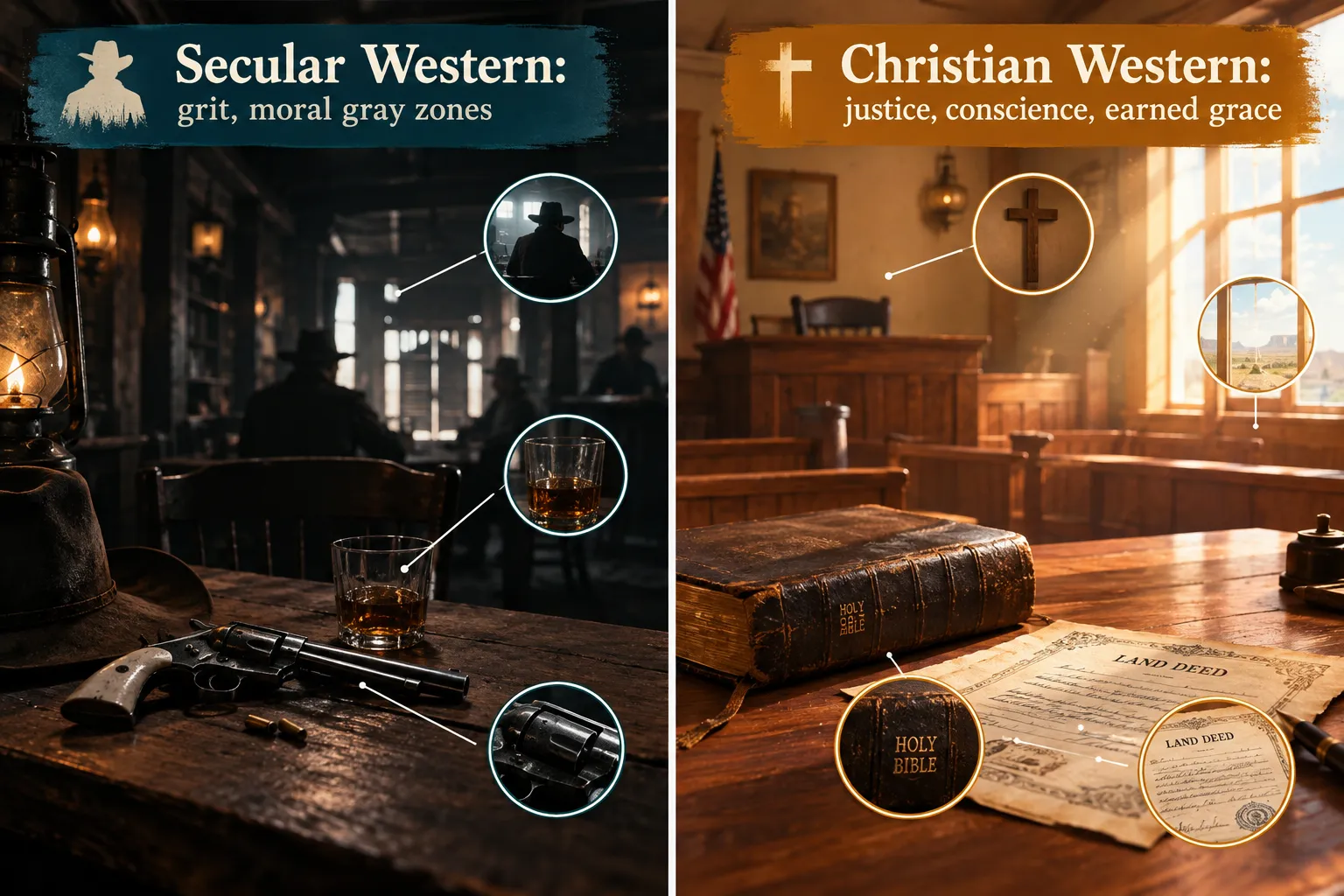
The most important difference is not content, it’s consequence. In a secular western, a man might do the right thing because he’s stubborn or proud or because the plot requires it. In a Christian western, a man does the right thing because he answers to something beyond the territory’s law, and the story takes that seriously.
Three structural differences that show up consistently:
- Moral weight on small decisions. Christian westerns treat the moment a character signs a false document, or stays silent when speaking would cost him, as the real dramatic hinge, not just the gunfight.
- Grace arrives after cost, not instead of it. Redemption in Christian frontier fiction is earned through consequence, not bypassed by a convenient conversion scene.
- The antagonist is often a system, not just a villain. Corrupt land courts, fraudulent warrants, labor-bond schemes, the injustice in Christian westerns tends to be structural, which gives the protagonist’s conscience something harder to fight than a single bad man.
Secular westerns, even well-written ones, often treat moral ambiguity as the point. Christian westerns treat it as the problem the story is trying to work through. That’s a fundamental difference in what the reader takes home.
For more on why the frontier setting resonates so specifically with faith readers, see Why Christian Readers Love Frontier Westerns: Genre Appeal, Faith Themes, and Clean-Read Expectations.
Do Christian Westerns Have Less Action and Adventure?
No. Clean Christian westerns carry the same physical stakes as secular ones, pursuits across open country, confrontations with corrupt officials, land disputes that turn violent, and characters who face genuine danger. The difference is that the action serves the moral question rather than replacing it.
A chase across railroad territory is more tense, not less, when the reader knows the man being pursued is carrying a truth that powerful people want buried. Danger lands harder when it has something to protect.
What Christian westerns typically keep:
- Physical conflict and frontier danger
- Morally complex antagonists
- High-stakes legal and land disputes
- Isolated settings where a character’s choices have no witnesses but God
What they trade away:
- Graphic depictions of violence for shock value
- Cynicism as a default worldview
- Endings that leave justice permanently out of reach
What Makes a Western Novel Secular vs. Christian?
The clearest test is this: does the story’s moral framework assume God is watching, or doesn’t it?
That’s not about whether a character prays or attends church. It’s about whether the story treats conscience as load-bearing. In a secular western, a character’s code of honor is self-authored, admirable, perhaps, but ultimately arbitrary. In a Christian western, the conscience answers to something that existed before the character did.
Secondary markers that distinguish the two:
| Feature | Secular Western | Christian Western |
|---|---|---|
| Source of the hero’s moral code | Personal honor / frontier custom | Conscience shaped by faith |
| Treatment of redemption | Rare, often cynical | Central, but costly |
| Violence | Often graphic, sometimes gratuitous | Present but purposeful |
| Resolution | Justice may or may not arrive | Mercy and justice held in tension |
| Worldview | Moral ambiguity as endpoint | Moral ambiguity as the problem to solve |
Common Themes in Faith-Based Frontier Stories
Faith-based frontier fiction returns to a recognizable set of questions, even across different series and authors. These aren’t formulas, they’re the natural intersection of the frontier setting and Christian conviction.
Recurring themes:
- Mercy and justice in tension. The law says one thing; conscience says another. Which does a man obey, and what does it cost him?
- The record and the truth. Ledgers, warrants, land deeds, and testimony, who controls the written record controls the story. Christian westerns treat the act of bearing true witness as genuinely heroic.
- Faith under fire in isolated places. The frontier strips away community, institution, and convenience. What a character believes when no one is watching is what the story tests.
- Earned grace. Redemption arrives, but only after the character has paid something real for it. Cheap grace doesn’t appear in well-written Christian frontier fiction.
- The ordinary Tuesday that turns. Not every crisis is a shootout. Sometimes the most important moment is a man deciding whether to sign his name to a lie.
These themes show up consistently in The Mercy Line series, where each book turns on a document, a record, or a legal claim, and what a man of conscience does when the paper says one thing and the truth says another.
Best Christian Western Books and Series for Beginners
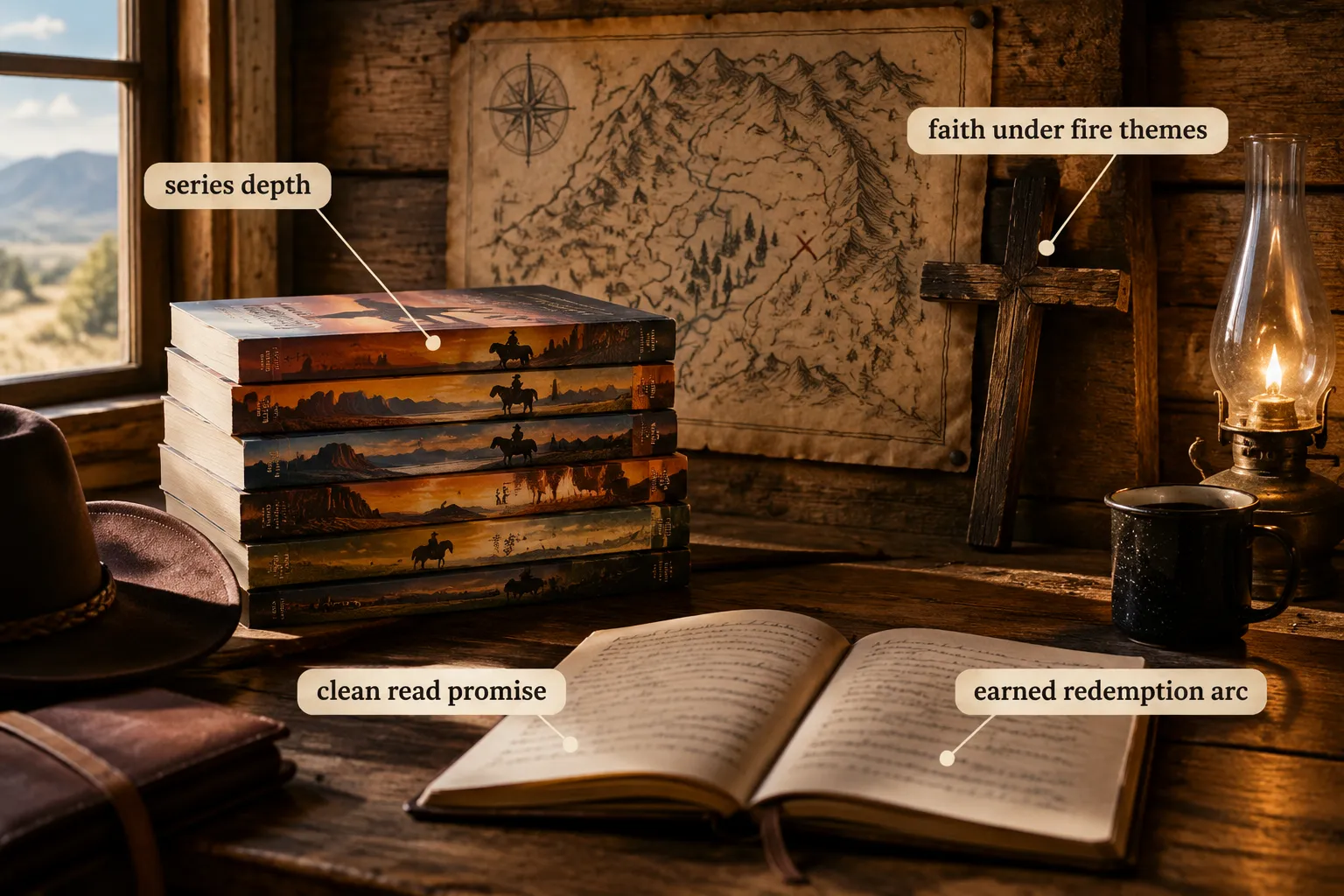
For readers new to the genre, the best entry points are series with strong first books that establish the world and moral stakes quickly, without requiring prior knowledge of the subgenre.
Recommended starting points in 2026:
- The Mercy Line by Silas Bellhaven, Start with The False Warrant. A territorial custody order that isn’t lawful, and a man who must decide what obedience is worth. Clean, conscience-driven, no romance. The series conscience line, “Where law runs out, a man finds what he answers to”, tells you everything about what you’re getting.
- Karen Baney’s Desert Manna Series, Christian historical western fiction with strong faith integration and frontier setting. [8]
- Heather Blanton’s work, Known for Christian western fiction with honest portrayals of frontier hardship alongside faith themes. [9]
- Tonya B. Ashley’s Faith and Dreams series, Christian western romance with clean content and faith-forward storytelling. [1]
- Mandi Blake’s Christian western romance, Active in the subgenre with a strong reader following and clean-read commitment. [4]
Choose your entry point based on what you want:
- No romance, pure conscience/justice → The Mercy Line
- Faith-integrated historical frontier → Karen Baney’s Desert Manna [8]
- Frontier hardship with honest faith → Heather Blanton [9]
- Christian western romance → Mandi Blake or Tonya B. Ashley [1][4]
For a broader reading list across clean Christian fiction genres, see Clean Christian Fiction TBR for 2026: Cross-Genre Kindle Unlimited Reads.
Why Do Christian Readers Prefer Clean Westerns Over Secular Ones for Long-Term Satisfaction?
Western Frontier Faith for Christian Readers: Why Clean Christian Westerns Beat Secular Grit for Long-Term Satisfaction comes down to one thing that secular westerns rarely deliver: a moral framework that holds.
Secular westerns can be brilliantly written. But they tend to resolve into one of two places, nihilism (the frontier is brutal and that’s all it is) or a personal code that the story never quite justifies. Neither of those lands well for a reader who believes the world is morally ordered.
Christian westerns give the hardship somewhere to go. The injustice isn’t just injustice, it’s a test of what the protagonist will do with the truth he’s holding. That gives readers something to carry out of the story.
The long-term satisfaction gap also comes from:
- Re-readability. Stories built on moral consequence reward re-reading because you see the choices differently the second time.
- Series investment. Christian western series build a moral ledger across books. Each installment deepens the stakes rather than resetting them.
- Emotional safety without emotional boredom. Clean content doesn’t mean low stakes. It means the tension comes from conscience and consequence, not from shock.
Industry reporting confirms that “clean reader” demand is a primary driver of Christian fiction’s continued growth, with religion publishing executives noting strong performance in fiction segments as recently as 2023-24. [5][7] Christianity Today’s analysis of the genre notes that Christian fiction has become more issue-driven and “messy”, but remains non-explicit, threading the needle between honest storytelling and clean content. [6]
Are Christian Westerns Only for Religious Readers?
No. Readers who simply want morally grounded fiction with real stakes, and no graphic content, find Christian westerns satisfying regardless of their personal faith background.
The faith in these stories is not a barrier. It’s a moral framework that makes the characters’ choices legible and the outcomes meaningful. A reader doesn’t need to share Caleb’s convictions in The False Warrant to understand why a man would refuse to enforce a warrant he knows is fraudulent, and to feel the weight of what that refusal costs him.
Who finds Christian westerns satisfying beyond core faith readers:
- Readers who grew up with Louis L’Amour and want the same moral clarity with less cynicism (see Books Like Louis L’Amour for Readers Who Want More)
- Readers who want clean content for personal or household reasons
- Readers who are tired of moral ambiguity as a genre default
- Readers who want frontier adventure without graphic violence
Do Christian Westerns Still Have Romance and Conflict?
On conflict: Yes, always. Conflict is the engine of every story in this genre, legal, moral, physical, and relational. Christian westerns don’t soften the conflict; they give it direction.
On romance: It depends on the series. Many Christian westerns include romance as a subplot or primary thread, and the subgenre has a strong Christian western romance tradition with active authors like Mandi Blake [4] and Tonya B. Ashley [1]. Others, like The Mercy Line, carry no romance at all by design, the conscience line and frontier justice are the entire story.
Choose based on your preference:
- Want romance woven in → Christian western romance series (Mandi Blake, Karen Baney [8])
- Want romance-absent frontier justice → The Mercy Line
- Want frontier adventure with faith themes and minimal romance → Heather Blanton [9]
For more on how faith-based fiction blends genres, see Blending Genres in Christian Fiction: Cozy Mystery + Romance, Western + Suspense, Fantasy + Thriller.
Where Can I Find Clean Western Fiction for Faith Readers?
The most accessible source in 2026 is Kindle Unlimited, where multiple clean Christian western series are available to borrow. Amazon’s Christian fiction categories and the “clean and wholesome” filters surface the subgenre reliably.
Practical places to find clean Christian westerns:
- Kindle Unlimited, Search “Christian western” or “clean western fiction” and filter by series. For strategy on building a full KU reading list, see Kindle Unlimited Christian Reads: How to Build a Clean, Faith-Filled TBR.
- Silas Bellhaven’s Mercy Line, Available on Amazon with the full series page at The Mercy Line.
- Christian fiction blogs and book tours, Sites like Reading Is My Superpower [1][8] and Faith Fiction and Fairy Tales [3] regularly feature new Christian western releases and author spotlights.
- Petticoats and Pistols, A blog community specifically dedicated to western romance, including Christian western romance authors. [4]
How Long Do Christian Western Books Usually Take to Read?
Most Christian western novels in the current market run between 55,000 and 90,000 words, placing them in the 4-8 hour reading range for an average reader. Series entries in The Mercy Line are designed for focused, single-sitting or two-session reads, long enough to develop moral weight, short enough to finish in an evening.
Rough reading time estimates:
- Short series entry (55-65k words): 3-5 hours
- Standard novel (70-85k words): 5-7 hours
- Longer standalone or series opener: 7-10 hours
For Kindle Unlimited subscribers, the low friction of borrowing means most readers move through a series quickly once they find a voice they trust.
Why Western Frontier Faith for Christian Readers Delivers What Secular Grit Cannot
The case for Western Frontier Faith for Christian Readers: Why Clean Christian Westerns Beat Secular Grit for Long-Term Satisfaction isn’t an argument against secular westerns. It’s an observation about what different readers need from a story.
Secular grit can be compelling in the moment. But a story that treats moral ambiguity as its final answer leaves a reader with nothing to hold onto after the last page. Christian frontier fiction, when it’s written honestly, not formulaically, gives the hardship a destination. The injustice matters because justice is real. The grace matters because it cost something. The faith matters because it’s tested, not assumed.
That’s the difference between a story that entertains and a story that stays with you.
Conclusion: Where to Start
If Western frontier faith for Christian readers is new territory, start with a single book from a series that matches what you’re looking for, romance or no romance, historical or contemporary-feeling frontier, action-forward or conscience-forward.
Actionable next steps:
- Try The False Warrant, the first book in The Mercy Line, if you want conscience-driven frontier justice with no romance and clean content throughout. Start here.
- Browse the full Mercy Line series at the series page to see the full arc of the Mercy Crossing world.
- Explore Christian western romance through authors like Mandi Blake [4] or Tonya B. Ashley [1] if you want faith and frontier with a romantic thread.
- Build a broader clean-read TBR across Christian western, mystery, and fantasy using the 2026 Clean Christian Fiction TBR guide.
- Follow faith fiction communities like Reading Is My Superpower [1][8] and Faith Fiction and Fairy Tales [3] for ongoing recommendations.
The frontier is wide. The stories rooted in faith are worth finding.
FAQ
What is the difference between a clean western and a Christian western? A clean western avoids graphic content but may have no faith element at all. A Christian western is clean and builds its moral framework on Christian conviction, conscience, grace, and the weight of answering to God rather than just a personal code.
Can I read Christian westerns if I’m not religious? Yes. Readers who want morally grounded fiction with real stakes and no graphic content find Christian westerns satisfying regardless of personal faith. The faith functions as a moral framework, not a requirement for the reader.
Are there Christian westerns without romance? Yes. The Mercy Line by Silas Bellhaven carries a romance-absent content contract across all nine books. The series focuses entirely on frontier justice, conscience, and earned grace.
Where is the best place to find Christian western books in 2026? Kindle Unlimited is the most accessible source, with multiple clean Christian western series available to borrow. Search “Christian western” on Amazon and filter by series for the best results.
Do Christian westerns have real conflict and danger? Yes. The conflict in Christian westerns, corrupt legal systems, fraudulent land claims, physical danger, moral compromise, is as real as in any secular western. The difference is that the conflict serves a moral question rather than existing for shock value.
How is faith shown in Christian westerns without being preachy? Through character choice and consequence, not narration or scripture-quoting. A man who refuses to sign a false warrant, a widow who tells the truth at cost to herself, faith shows up in what people do when it’s hard, not in what they say when it’s easy.
What is earned grace in Christian western fiction? Earned grace means redemption arrives after the character has paid something real, faced a consequence, made a costly choice, or carried a truth that hurt them to hold. It’s the opposite of a convenient conversion that resolves the plot without the character actually changing.
How long does it take to read a Christian western novel? Most run 55,000-85,000 words, which is roughly 4-7 hours of reading time. Series entries in The Mercy Line are designed for single-evening or two-session reads.
Are Christian westerns historically accurate? They vary. Some, like Karen Baney’s Desert Manna series [8], are grounded in specific historical periods and settings. Others prioritize moral and emotional authenticity over strict historical detail. Most sit somewhere between historical fiction and frontier adventure.
Is the Christian western genre growing? Yes. Religion publishing has reported strong fiction performance in 2023-24 [5][7], and clean-reader demand is identified as a key driver of that growth. [6] New Christian western releases continued through 2024-2025, and the subgenre remains actively publishing in 2026. [1][4]
What series should a complete beginner start with? The False Warrant (The Mercy Line, Book 1) for conscience-driven frontier justice with no romance. For Christian western romance, Mandi Blake [4] or Tonya B. Ashley [1] are well-reviewed entry points.
Do Christian westerns ever deal with dark themes? Yes. Corruption, injustice, grief, betrayal, and moral failure all appear in the genre. The distinction is that these themes are handled with purpose, they test and reveal character, rather than deployed for shock or left without resolution.
References
[1] Guest Post And A Giveaway Tonya B Ashley Of Faith And Dreams – https://readingismysuperpower.org/2024/04/16/guest-post-and-a-giveaway-tonya-b-ashley-of-faith-and-dreams/
[3] faithfictionandfairytales.wordpress – https://faithfictionandfairytales.wordpress.com/
[4] Meet Mandi Blake And Hear Her Amazing Journey – https://petticoatsandpistols.com/2024/04/meet-mandi-blake-and-hear-her-amazing-journey/
[5] 69747 Publishers Talk Trends And Titles With Pw Religion Editors – https://www.publishersweekly.com/pw/by-topic/industry-news/religion/article/69747-publishers-talk-trends-and-titles-with-pw-religion-editors.html
[6] Christian Fiction Finally Has Issues Messy Clean – https://www.christianitytoday.com/2023/12/christian-fiction-finally-has-issues-messy-clean/
[7] 95035 Religion Publishers See A Good Day – https://www.publishersweekly.com/pw/by-topic/industry-news/religion/article/95035-religion-publishers-see-a-good-day.html
[8] Guest Post And A Giveaway Karen Baney The Desert Manna Series – https://readingismysuperpower.org/2024/05/06/guest-post-and-a-giveaway-karen-baney-the-desert-manna-series/
[9] Heather Blanton – https://cknchristianpublishing.com/our-authors/heather-blanton/