
Last updated: September 26, 2026
Quick Answer
The 2026 psychological thriller trends Christian readers can use most are quiet dread (tension built through small wrongness instead of violence), memory gaps (uncertainty that raises real doubt without gore), and clean suspense (high emotional stakes with no profanity, explicit content, or graphic harm). Together, these three tools let Christian fiction deliver genuine unease and moral weight while staying rooted in hope, mercy, and earned grace rather than shock value.
Key Takeaways
- Quiet dread relies on wrongness in familiar places, not body count or action spectacle.
- Memory gaps work best when they create two or more believable explanations, not one convenient twist.
- Clean suspense removes graphic content but keeps real danger, real doubt, and real consequence.
- Christian readers can enjoy psychological thrillers when the darkness in the story is answered by something true, not ignored.
- The genre differs from mystery fiction because the central question is “what is real?” rather than “who did it?”
- Unreliable narrators fail when confusion replaces character; they succeed when the gap in memory reveals something about faith, guilt, or fear.
- Faith themes land best when shown through a choice under pressure, not a scripture quote dropped into dialogue.
- Traditional Christian suspense publishers are still acquiring series built on professional credibility and psychological pressure rather than only supernatural spiritual warfare [1] [9].
What Is Quiet Dread in Psychological Thrillers?
Quiet dread is tension created by a small, believable wrongness inside an ordinary setting, rather than by action, gore, or a body count. It works because the reader senses something is off before any character can prove it, and that gap between suspicion and confirmation is where the fear lives.
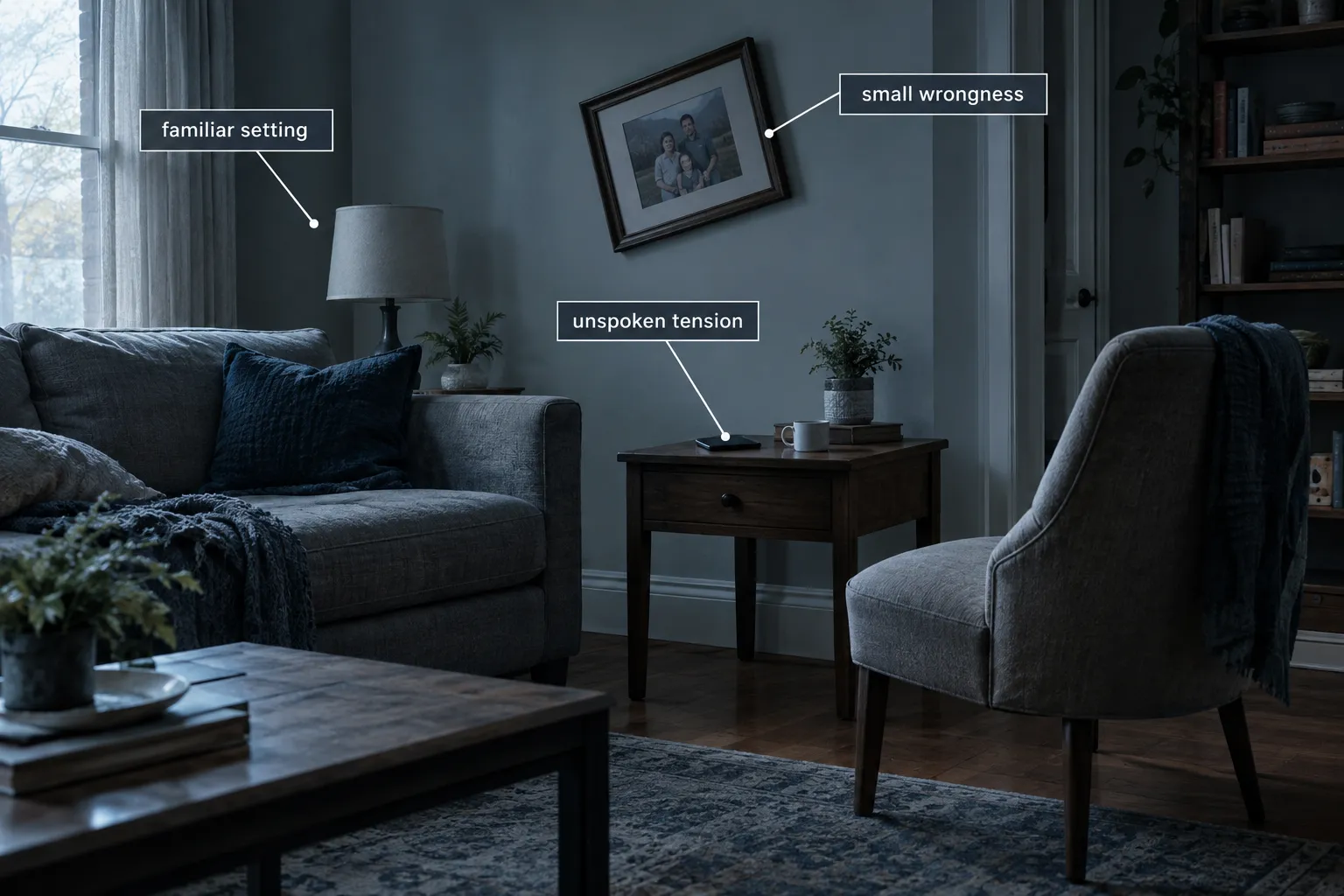
A church potluck where one casserole dish never gets claimed. A retreat counselor who repeats a client’s exact words back a little too precisely. A husband who remembers a phone call his wife insists never happened. None of these moments require violence. They require attention.
Genre analysis of slow-burn suspense describes this pattern as depending on waiting, contradiction, and a sense of inevitability rather than spectacle, a familiar place turning subtly wrong, or an ordinary conversation carrying threatening subtext underneath. That is the engine behind quiet dread, and it’s also the engine behind Christian psychological thriller plot structures that use trauma, memory, and grace without graphic content.
What Makes Quiet Dread Effective in Storytelling?
Quiet dread works best when the reader notices a detail before the protagonist does. That small lead, a locked drawer, a changed routine, a name spelled wrong on purpose, builds trust between reader and author even as it erodes trust between characters. Common mistake: piling on too many strange details at once, which turns dread into confusion instead of suspense. One clear wrongness, held for several chapters, does more work than five vague ones.
How Do Memory Gaps Work as a Plot Device in Suspense Novels?
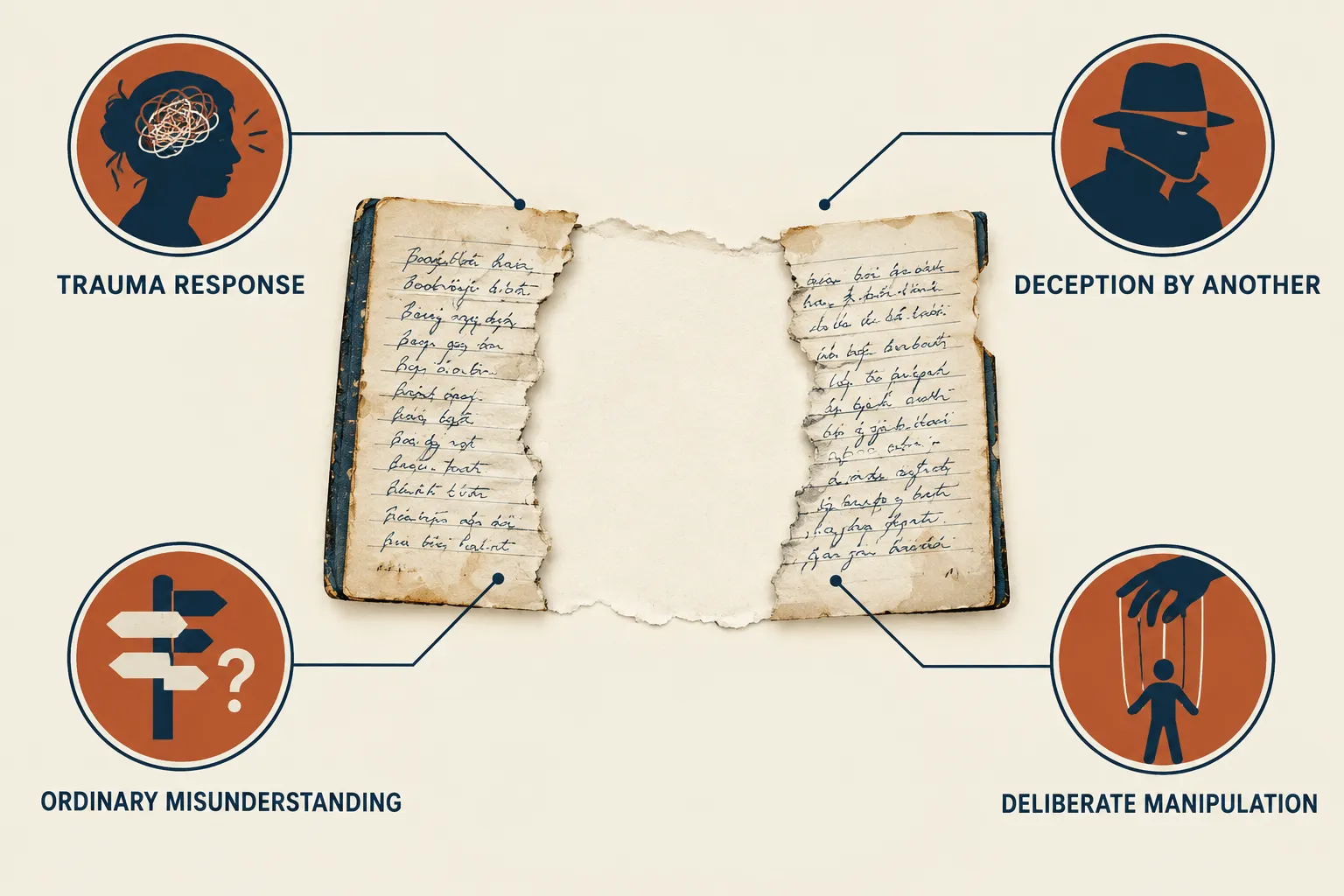
A memory gap works as a plot device when it opens at least two credible explanations at the same time, keeping both the protagonist and the reader honestly uncertain. If a missing memory only exists to set up a tidy reveal later, it reads as a trick rather than a lived experience.
The strongest gaps allow room for:
- Trauma-related dissociation, the mind protecting itself from a moment too painful to hold whole
- Deception by another person, someone rewriting what a character believes happened
- Ordinary misunderstanding, stress, exhaustion, or grief blurring a detail without any conspiracy at all
- Manipulation through repetition, a claim repeated so often it starts to feel true, an effect researchers call the illusory-truth effect
Clinical review of traumatic memory cautions against treating memory like a simple recording. Not every hard event produces amnesia, and not every recovered memory is accurate, which means a well-built gap should stay ambiguous longer than readers expect. Some recent research also separates missing facts from missing feeling: a character might remember exactly what happened but lose the memory of how frightened or how present they felt in the moment. That distinction gives Christian authors a gentler, more honest way to write trauma, through body language, avoidance, and unexplained unease rather than clinical exposition. This is the same craft ground covered in Christian psychological thrillers exploring doubt, redemption, and moral complexity.
Why Are Memory Gaps Popular in Modern Thrillers?
Memory gaps are popular because they let a story explore distrust and partial truth, two defining features of psychological thrillers, without needing graphic events to justify the tension. A reader stays engaged by trying to solve the character’s own mind, which is a quieter, more personal stake than solving a crime scene.
What Does Clean Suspense Mean for Christian Fiction?
Clean suspense means the story carries real danger, real fear, and real consequence, without profanity, graphic violence, or explicit content standing in for tension. The 2026 psychological thriller trends Christian readers can use most all point back to this same idea: suspense doesn’t require darkness on the page, it requires honesty about what darkness costs a person.
Clean does not mean safe or predictable. A clean suspense novel can still put a character’s reputation, marriage, faith, or freedom at genuine risk. What changes is the camera angle: the story lingers on decision and consequence rather than on the mechanics of harm. That’s the difference explored in how Christian authors build suspense without darkness in psychological thrillers and in non-violent suspense techniques that raise stakes without graphic content.
Decision rule: choose a clean suspense novel if you want to feel the weight of fear and doubt without needing to skip pages. Choose a traditional thriller if graphic detail doesn’t bother you and you’re reading purely for shock pacing.
Difference Between Psychological Thriller and Mystery Novels
A psychological thriller asks “what is real, and who can I trust?” while a mystery novel asks “who did it, and how do we prove it?” Mystery leans on clues and deduction; psychological thriller leans on perception, memory, and the slow erosion of certainty.
| Feature | Mystery Novel | Psychological Thriller |
|---|---|---|
| Core question | Who committed the act? | What is actually true? |
| Reader’s job | Assemble clues | Judge who to believe |
| Narrator | Usually reliable detective | Often unreliable or uncertain |
| Resolution | External answer (culprit named) | Internal answer (self understood) |
Both genres can coexist in Christian fiction, and the cozy mystery world at Mercy House shows the deduction side well, while a series like The Gathering Light leans into the psychological side, asking who controls the record of someone’s truth.
Can Christian Readers Enjoy Psychological Thrillers?
Yes, Christian readers can enjoy psychological thrillers, provided the story treats fear, doubt, and darkness as things to move through rather than things to dwell in for their own sake. The genre’s core conventions, mental turmoil, distrust, a closed-in atmosphere, and partial truth, are not incompatible with faith. They are, in fact, some of the oldest material in scripture itself: doubt, betrayal, grief, and the long wait for mercy.
What matters is where the story lands. A psychological thriller written from a Christian worldview doesn’t pretend the dread wasn’t real. It shows what a character does with fear once grace enters the room, and grace, in this genre, almost always shows up after cost, not instead of it. That’s the throughline in trending Christian responses to true crime obsession and in Stephen King alternatives written for faith-friendly readers.
Not for: readers who want thrillers to stay purely secular escapism with no moral weight attached. Best for: readers who want suspense that respects their intelligence and their conscience at the same time.
How to Build Tension Without Violence or Explicit Content
Tension without violence comes from delayed information, conflicting testimony, and characters who want different things badly enough to lie a little. A locked door works better than a broken one. A silence at dinner works better than a shout.
Practical techniques that build real stakes cleanly:
- Withhold context, not facts. Let readers see an event but not understand its meaning until later.
- Use professional or domestic authority as the threat. A retreat counselor, a church record-keeper, a family ledger, power over someone’s story is its own danger.
- Let dialogue carry subtext. A character can say “I’m fine” in three different ways across a book and mean three different things.
- Give the antagonist a reason that almost makes sense. Moral complexity, not cruelty for its own sake, is what modern suspense readers are actually asking for.
Common mistake: substituting a jump-scare structure for tension. Clean suspense earns its fear through pacing and character, not surprise alone. See more on this craft approach in how Christian authors build suspense without darkness and in Christian psychological thrillers that don’t rely on graphic violence.
Common Mistakes When Writing Unreliable Narrators
The most common mistake is making a narrator unreliable simply for shock value at the twist reveal, instead of grounding their unreliability in something psychologically or spiritually real. Readers forgive confusion when they can later see why it happened. They resent it when it feels like a trick played on them.
Other frequent errors:
- No internal logic. The narrator’s gaps should follow a pattern, trauma, fear, guilt, not appear and vanish for the writer’s convenience.
- Too much clarity too soon. If the reader solves the unreliability by chapter four, the tension collapses early.
- No emotional consequence. An unreliable narrator who never has to sit with what they got wrong misses the chance for earned grace.
- Confusing the reader instead of the character. The prose itself should stay clear even when the narrator’s perception doesn’t.
Edge case: a narrator who is unreliable because they are lying to protect someone else, not because they misremember. This version demands the reader question motive instead of memory, and it pairs well with faith themes about mercy versus justice.
Best Psychological Thrillers for Christian Readers in 2026: Quiet Dread, Memory Gaps, and Clean Suspense in Action
The best psychological thrillers for Christian readers in 2026 combine high-concept stakes, a missing person, a false record, a retreat gone wrong, with a resolution rooted in mercy rather than punishment alone. This year’s Christian fiction market shows continued appetite for professional-threat premises: a supposedly dead relative who calls again, a caregiver whose skill becomes suspicious, a psychiatrist who cannot lose his gift for reading minds [1] [9]. None of these need graphic content to work.
David C. Cook’s 40th-anniversary collector’s edition of Frank Peretti’s This Present Darkness, arriving November 3, 2026, is a useful marker for how far Christian suspense has traveled and how much staying power a well-built spiritual thriller can have across decades. The renewed interest confirms that Christian suspense readers have always wanted real danger paired with real conviction, this year’s trends simply update the delivery.
Inside that lane, The Gathering Light trilogy, When Hannah Sleeps, When the Voice Breaks, and When the Prayer List Opens, is built around exactly this tension: women who help record other people’s testimonies, until the system built to protect them turns their own words into evidence. Each book asks a new protagonist to face the same question from a different angle, with no ensemble drift to slow the story down.
How to Incorporate Faith Themes Into Suspense Novels
Faith themes work in suspense fiction when they show up as a choice under pressure, not as narration or a quoted verse. A character praying honestly in a moment of fear reads truer than a character explaining theology to another character.
- Let a character’s faith be tested by the plot, not stated as backstory.
- Show mercy costing something, a reputation, a relationship, a comfortable silence, before it’s given.
- Avoid resolving doubt with a single dramatic conversion scene; let belief return slowly, the way trust usually does.
- Trust the reader to recognize grace without being told what it means.
This restraint is the difference between preachy fiction and fiction that walks with a reader instead of talking at them, a distinction covered further in clean Christian fiction and what “clean” actually means to readers.
What Audiences Are Psychological Thrillers Best For?
Psychological thrillers are best for readers who want emotional and moral tension over physical action, and who enjoy questioning a narrator’s version of events as much as the plot itself. This includes readers who prefer character study to car chases, and readers who want a suspense novel that lingers after the last page rather than resolving cleanly and being forgotten.
Choose clean psychological suspense if: you want the unease of the genre without needing to brace for graphic content, and you want the story’s fear to be answered by hope rather than left unresolved in the dark.
Conclusion
Quiet dread, memory gaps, and clean suspense aren’t a trend that expires at the end of the year, they’re a description of how good Christian thrillers have always worked, updated for what 2026 readers are asking for. The fear stays real. The doubt stays honest. And the mercy, when it comes, has already cost someone something.
Next step: if this framework interests you as a reader, start with When Hannah Sleeps and follow the trilogy through to When the Prayer List Opens. If you’re writing in this space, study how the tension is built one withheld detail at a time, then let grace arrive only after the cost has been paid in full.
FAQ
Is quiet dread the same as slow-burn suspense? Yes, they describe the same technique, tension built through small wrongness and delayed information rather than action or shock.
Do memory gaps require a mental health diagnosis to be realistic? No. A memory gap can come from stress, grief, deception, or manipulation, not only clinical trauma, and mixing causes keeps the mystery honest.
What makes a thriller “Christian” beyond removing bad content? A Christian thriller shows faith tested through plot consequence, doubt, mercy, and repentance worked out through choice, not explained through narration.
Can a clean thriller still feel genuinely scary? Yes. Fear comes from stakes and pacing, not graphic detail, so a clean thriller can be as tense as any other.
Is psychological thriller the same genre as mystery? No. Mystery centers on solving an external crime; psychological thriller centers on questioning internal reality and who can be trusted.
Why do unreliable narrators work so well in this genre? They let the reader experience uncertainty directly instead of being told about it, which deepens suspense without violence.
Are memory-gap plots realistic? Partially. Research shows trauma can blur intensity and feeling more reliably than it erases plain facts, so a nuanced gap is more believable than total amnesia.
Who should avoid psychological thrillers? Readers who want fast plot resolution and low ambiguity may prefer straightforward mystery or cozy fiction instead.
References
[1] New Releases Sept 2026 – https://www.iolagoulton.com/new-releases-sept-2026/ [2] Best Christian Suspense Books Of 2026 – https://gracefulreads.com/best-christian-suspense-books-of-2026/ [3] What Readers Want Right Now The State – https://erinniumata.substack.com/p/what-readers-want-right-now-the-state [4] 2026 Release – https://www.iolagoulton.com/tag/2026-release/ [5] 2026 Thriller Market Report Best Selling Books 2026 Trends Top 5 Analysis – https://www.alibaba.com/product-insights/2026-thriller-market-report-best-selling-books-2026-trends-top-5-analysis.html [6] 2026 S Ultimate Book Market Breakdown From Thrillers To Self Help Alibaba S Hidden Gems – https://www.alibaba.com/product-insights/2026-s-ultimate-book-market-breakdown-from-thrillers-to-self-help-alibaba-s-hidden-gems.html [7] Best Selling Psychological Thrillers – https://www.accio.com/business/best-selling-psychological-thrillers [8] 2026 Psychological Thriller Market Report 1 2b Data Author Strategies – https://www.alibaba.com/product-insights/2026-psychological-thriller-market-report-1-2b-data-author-strategies.html [9] Christian Suspense And Mystery – https://stevensbooks.com/collections/christian-fiction/christian-suspense-and-mystery [10] The 2026 Psychological Thriller Boom Market Insights Trends And Strategic Forecasts – https://www.alibaba.com/product-insights/the-2026-psychological-thriller-boom-market-insights-trends-and-strategic-forecasts.html