
Last updated: September 28, 2026
Quick Answer
Christian fiction in 2026 is no longer confined to single-lane categories like inspirational romance or amateur-sleuth cozy mystery. Publishers and independent authors are blending faith with mystery, fantasy, romance, and thriller conventions in the same book, and that blending is opening new Kindle Unlimited discovery paths for readers who want clean, faith-rooted stories with real stakes. The shift is visible in traditional publishing (Harlequin’s Love Inspired Trade expanding into mystery) and in indie catalogs building series that cross genre lines under one trusted author brand [2].
Key Takeaways
- Genre blending is a 2026 publishing trend, not a niche experiment, traditional Christian imprints are actively expanding into mystery after years of leaning almost entirely on romance [2].
- Christian fiction differs from general fiction in how it treats consequence: faith shapes character choice and cost, not just setting or vocabulary.
- Clean fiction and Christian fiction overlap but are not identical, some clean-content books skip overt religious framing entirely.
- Mystery, fantasy, romance, and thriller each blend with faith differently, and knowing the blend helps readers pick the right shelf.
- Kindle Unlimited rewards series with genre crossover appeal because pages read compound across a catalog, not just one book [7].
- Suspense and mystery are considered a structural growth opportunity in Christian publishing because they carry themes of truth and consequence naturally [2].
- Non-religious readers are part of the audience for clean fiction, drawn by content standards rather than doctrine.
- The most common mistake in Christian fiction writing is resolving faith with a tidy conversion scene instead of letting it cost something.
What Is Christian Fiction and How Does It Differ From Regular Fiction?
Christian fiction is a story where faith functions as part of the plot’s cause and effect, not as decoration on top of a secular story. The difference from general fiction isn’t the presence of a church scene or a prayer; it’s that belief actually changes what a character is willing to risk, forgive, or refuse.

In practice, that means:
- A character’s faith gets tested by the plot, not explained by narration.
- Grace, when it arrives, comes after a cost has already been paid, not instead of it.
- The story can include real doubt, real failure, and real repentance without turning into a sermon.
Readers looking for this kind of storytelling often describe wanting fiction that feels like it’s “walking with them, not talking at them”, sitting inside the struggle rather than lecturing about it. That distinction is also why so many readers now search across genres instead of staying in one lane; they’re chasing a tone, not just a category.
Christian Fiction vs. Inspirational Fiction: What’s the Difference?
Inspirational fiction is a broader, softer label that can include Christian fiction but doesn’t require it. Christian fiction specifically centers a faith worldview as load-bearing to the plot, while inspirational fiction may only require an uplifting tone and clean content.
A useful way to separate the two:
| Feature | Christian Fiction | Inspirational Fiction | Clean Secular Fiction |
|---|---|---|---|
| Faith as plot driver | Yes, central | Sometimes, softer | Rarely or never |
| Content standard | No profanity/graphic content | No profanity/graphic content | No profanity/graphic content |
| Audience assumption | Reader expects faith themes | Reader expects gentle tone | Reader may not identify as religious |
| Typical marketing | Christian fiction category | General/uplifting fiction | Clean or wholesome fiction |
This is also why “clean fiction” and “Christian fiction” aren’t interchangeable. Some 2026 publishing initiatives are explicitly building clean fiction lines without requiring overt religious content, aiming at readers who want the content standard without the doctrine, a signal that the audience for clean stories is bigger than the audience that identifies specifically as Christian.
What Genres Blend Well With Christian Fiction in 2026?
Mystery, fantasy, romance, and thriller each blend with Christian fiction in a distinct way, and the blend determines what kind of reader the book will attract. Suspense-adjacent genres tend to pair most naturally with faith themes because both are built around truth, consequence, and moral weight [2].
Christian Mystery Novels: Clean Reads Worth Knowing
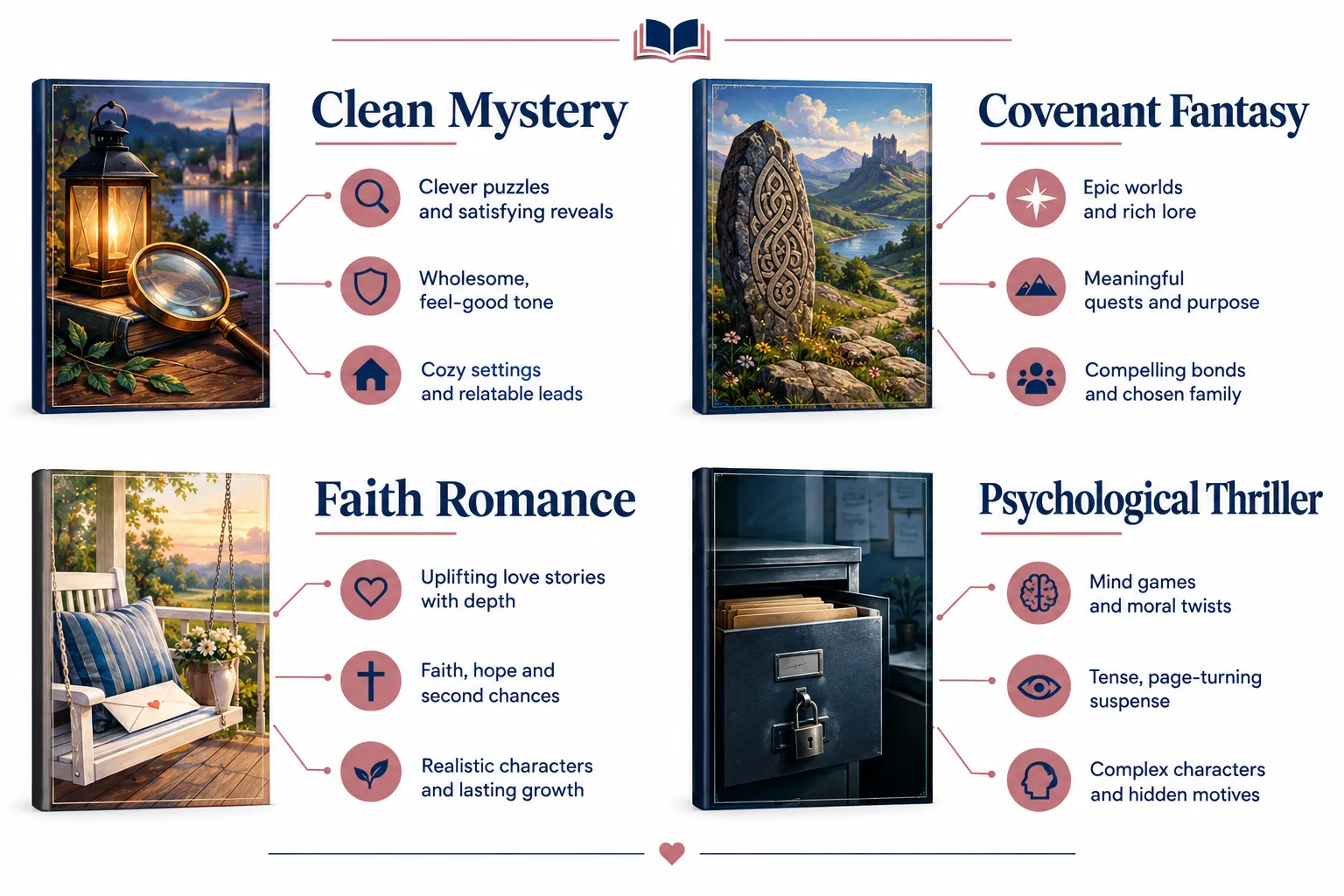
Christian mystery works best when a small community, a church, a shelter, a donation drive, hides a secret that ordinary procedure can’t fully explain. Cozy mystery is the most established form of this in Christian fiction, built around amateur sleuths in tight-knit towns rather than professional detectives. Readers who want that exact rhythm, a small town, a found object, a slow-burn reveal, tend to gravitate toward series like the Mercy House Mysteries tropes explored here, where church-social settings carry real secrets without graphic content.
Christian Fantasy Books for Adults
Christian fantasy blends well when the magic system or world-law mirrors a real spiritual question, covenant, mercy, memory, instead of borrowing generic quest tropes. Adult readers tend to want higher stakes and moral ambiguity than younger-skewing fantasy offers, which is why covenant-based worldbuilding (empires that try to audit mercy, or memory treated as evidence) resonates with readers who also enjoy Tolkien-influenced Christian fantasy.
Christian Romance Without Explicit Content
Romance blends into Christian fiction most cleanly through courtship tension and emotional stakes rather than physical description. Readers who loved time-slip or dual-timeline romantic structures in general fiction have a direct match in clean, faith-rooted historical romance built for Outlander fans, which keeps the tension emotional and historical rather than explicit.
Christian Thriller Recommendations
Thriller blends work when the danger is psychological or institutional rather than graphically violent, a record that’s been altered, a testimony that’s been rewritten, a system that protects the wrong person. That’s the exact spine behind clean Christian psychological thriller recommendations for Criminal Minds and Law & Order: SVU fans, where suspense comes from what a document proves, not from shock content.
Christian Fiction in 2026: Why Genre Blending Is Creating New KU Paths for Readers
Genre blending creates new Kindle Unlimited discovery paths because it lets a single author catalog capture readers from multiple search intents instead of just one. A reader who starts in cozy mystery and finishes a series can move into fantasy or thriller from the same trusted author without re-vetting content standards from scratch.
This matters mechanically on Kindle Unlimited because payouts come from a shared fund distributed based on pages read across the platform, and that fund total shifts month to month [7][3]. A catalog with cross-genre appeal keeps more readers subscribed and reading longer inside one author’s shelf, which compounds page-read totals across series instead of resetting the audience with every new book. That’s the practical reason Christian fiction in 2026 is leaning into genre blending as a KU strategy, not novelty, but retention. For a deeper look at how this shift changed the indie publishing landscape, see how Kindle Unlimited changed Christian fiction publishing.
Best Christian Fiction Books 2024, 2025, and 2026: Where the Market Is Heading
The clearest 2026 trend is traditional publishers formally expanding into mystery after decades of Christian fiction leaning almost entirely on romance and romantic suspense [2]. Editors have cited reader demand for Agatha Christie, style mysteries with faith woven in, and imprints are actively signing more mystery titles for 2026 and 2027 [2].
Literary agents are split on how fast this will scale. One perspective holds that clean general-market fiction’s growth has created favorable conditions for Christian mystery specifically, since suspense structurally accommodates themes of truth and moral consequence [2]. A more cautious view notes that Christian cozy mystery sales still trail general-market cozy mystery, and that readers already have abundant clean options outside Christian publishing [2]. Both views point to the same practical takeaway for readers: more cross-genre Christian mystery is coming, but it’s still an emerging category, not a saturated one, which is exactly the kind of gap indie KU catalogs have been filling. Readers ranking subgenres by how well they perform on Kindle Unlimited can see how mystery and thriller stack up in this breakdown of Christian fiction subgenres by reader engagement.
Kindle Unlimited Christian Fiction: Best Deals and How the Earnings Work
Kindle Unlimited is the most cost-effective way to read Christian fiction across genres because a single subscription unlocks entire series instead of pricing each book separately. For readers, the “best deal” isn’t a discount code, it’s finding an author whose backlist spans multiple genres so the subscription keeps paying off book after book.
- Choose KU if you read more than two or three books a month across genres, the subscription pays for itself fast.
- Choose single purchases if you read rarely or only want one specific title outside an author’s KU catalog.
- Common mistake: assuming every “clean” listing is faith-based. Some clean fiction imprints intentionally skip religious content, so check the book description, not just the content warning.
Readers hunting for lesser-known series can start with this list of Kindle Unlimited Christian reads and hidden-gem series beyond the bestseller lists.
Who Reads Christian Fiction Most?
The core Christian fiction audience skews toward women roughly 35 to 65 who are also active Kindle Unlimited subscribers, and many of them read across mystery, fantasy, romance, and thriller rather than staying in one genre. This is the audience genre blending is built for: readers who want faith represented honestly, real stakes, and no graphic content, regardless of which genre wrapper the story arrives in.
These readers tend to move between series based on trust in tone rather than strict genre loyalty, if an author handles faith honestly in one genre, they’ll often follow that author into a completely different one.
How to Write Christian Fiction That Appeals to Multiple Genres
Writing cross-genre Christian fiction works best when faith is embedded in the plot’s cost structure, not layered on top as narration. The genre elements, a locked door, a magic system, a slow-burn courtship, a psychological unraveling, should be the mechanism that forces the faith question, not a backdrop for it.
Common mistakes to avoid:
- Resolving faith with a tidy conversion scene. Grace that arrives without cost reads as unearned and forgettable.
- Explaining a theme directly through dialogue or narration. Trust the image and the choice instead of stating the moral.
- Preaching instead of showing consequence. A character’s belief should show up in what they do next, not in a paragraph of reflection.
- Ignoring genre craft standards. A Christian mystery still needs fair clues; a Christian fantasy still needs coherent world rules.
Writers building faith into speculative structures specifically can study how faith operates inside LitRPG and progression fantasy without turning leveling systems into a sermon delivery device.
Christian Fiction for Non-Religious Readers
Non-religious readers can enjoy Christian fiction because the content standard, no profanity, no graphic violence, no explicit content, appeals independently of belief. Many readers pick up clean fiction purely for the tone: lower anxiety, no shock value, and characters who face real consequences without gratuitous detail.
Readers who aren’t sure where to start often do better beginning with mystery or thriller entries, since the faith elements tend to surface through choice and consequence rather than direct theology, making the entry point feel like suspense fiction first, faith-rooted fiction second.
Frequently Asked Questions
Is Christian fiction the same as clean fiction? No. Clean fiction avoids profanity, sex, and graphic violence but doesn’t require a faith worldview. Christian fiction requires both the content standard and faith as a plot driver.
What’s the fastest-growing genre blend in Christian fiction right now? Mystery blended with suspense is the most actively expanding category in 2026, with traditional imprints signing new mystery titles after years of focusing mainly on romance [2].
Do I need to be religious to enjoy Christian fantasy or thriller? No. Many readers pick these up for the clean content standard and moral stakes, regardless of personal belief.
Why does Kindle Unlimited favor multi-genre author catalogs? Because KU payouts come from a shared fund split by pages read across the platform, so a catalog that holds readers across several genres tends to generate more consistent page-read totals over time [7][3].
What’s the biggest mistake new Christian fiction writers make? Resolving a character’s faith crisis too cleanly, grace without cost reads as unearned rather than moving.
Are Christian cozy mysteries as popular as general-market cozy mysteries? Not yet by most measures; agents note Christian cozy mystery sales still trail the general market, even as interest grows [2].
Conclusion
Christian fiction in 2026 rewards readers willing to cross genre lines instead of staying locked into one shelf. The clearest next step is simple: pick one trusted author across mystery, fantasy, romance, or thriller, follow their catalog through a subscription, and let the genre blend do what it’s built to do, carry faith through plot instead of narration, and let mercy show up only after something has actually been paid for.
References
[1] Top Selling Christian Novels – https://www.accio.com/business/top-selling-christian-novels [2] Mysteries on the Rise in Christian Fiction – https://www.publishersweekly.com/pw/by-topic/industry-news/religion/article/100974-mysteries-on-the-rise-in-christian-fiction.html [3] KDP Royalties Guide 2026: 35% vs. 70% Worked Examples – https://www.linkedin.com/posts/bestwriting_kdp-royalties-guide-2026-35-vs-70-worked-activity-7495132398670544896-FwCB [4] Top Selling Christian Fiction – https://www.accio.com/business/top-selling-christian-fiction [5] Faith Based Kindle Unlimited Books – https://heidimccahan.com/2026/01/24/faith-based-kindle-unlimited-books/ [6] Fiction Kindle Books – https://www.lemon8-app.com/experience/fiction-kindle-books?region=us [7] Kindle Unlimited Earnings – https://profitable.app/kdp/stats/kindle-unlimited-earnings [8] 2026’s Ultimate Guide to Christian Fiction Trends, Top Authors, and How to Profit – https://www.alibaba.com/product-insights/2026-s-ultimate-guide-to-christian-fiction-trends-top-authors-and-how-to-profit.html [9] Thomas – https://www.authormedia.com/author/thomas/ [10] 2026 Must-Read Books – https://www.designingtomorrow.net/2026-must-read-books/