Last updated: September 28, 2026
Quick Answer
Christian LitRPG with crafting and homesteading trades dungeon grinding for settlement building, resource stewardship, and skilled labor, using quiet, repeatable progression like planting, repairing, and trading to test a character’s faith instead of testing only combat skill. The stakes stay high because community survival, debt, and mercy toward neighbors carry lasting consequences, and grace in these stories is earned through the cost of stewardship, not handed out for free.
Key Takeaways
- Christian LitRPG with crafting and homesteading layers stat systems onto a Christian worldview, then routes growth through building and farming rather than only fighting.
- Quiet progression measures success in patched roofs, healthier soil, and cleared debt, not boss kills.
- LitRPG publishing volume grew sharply, from 917 releases in 2023 to 2,642 in 2025, a reported 188% increase, showing real appetite for progression fiction [1].
- The market is concentrated: the top ten titles captured roughly 30% of six-month reader consumption, and books two and later accounted for 76.3% of attention, rewarding authors who commit to a series [1].
- Reader attention is described as a “firehose,” with about 30.5% of readership following top or historic leaders, making a sharply legible premise essential for new titles [5].
- Meadowreach Homestead by G. A. Jensen launched in July 2026 as a LitRPG crafting slice-of-life audiobook, explicitly built around routine, found family, and gentle progression [6], with a planned seven-book series [7].
- High stakes in slow-burn Christian stories come from community survival and tested mercy, not monster tiers.
- Common mistakes include turning the stat system into a sermon delivery device or making faith irrelevant to the mechanics.
What Is Christian LitRPG With Crafting and Homesteading?
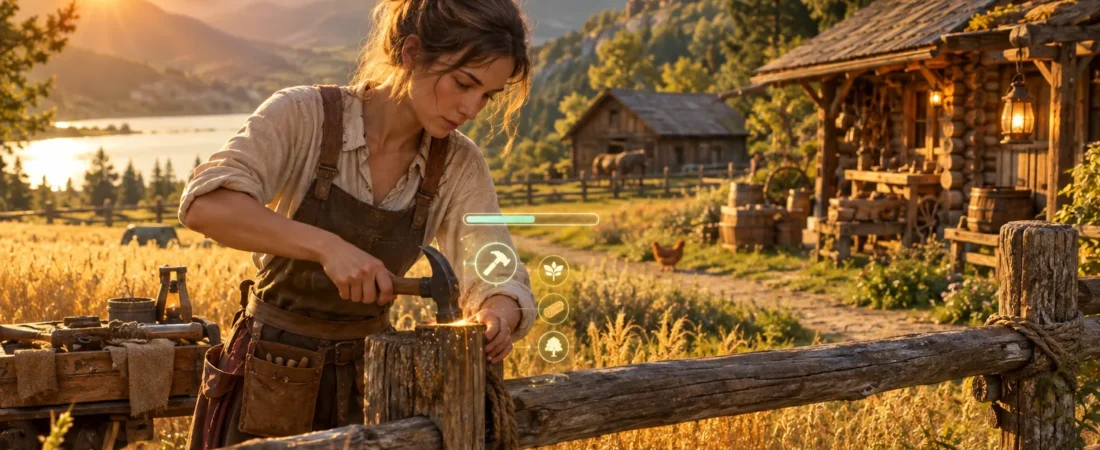
Christian LitRPG with crafting and homesteading is a subgenre of progression fantasy that layers game-like systems, levels, skills, quest logs, status windows, onto a Christian worldview, then channels the character’s growth through settlement-building, farming, and craft trades instead of routing it mainly through dungeon combat. The genre still shows its work: readers see the numbers, the notifications, the skill trees. What changes is what those numbers are attached to.
Regular epic fantasy rarely quantifies growth on the page, a character simply becomes stronger over chapters. LitRPG makes that growth visible and mechanical. A Christian version of the genre keeps that visible structure but ties experience gains, crafting yields, and settlement upgrades to choices that carry moral weight: whether to hoard seed grain, whether to shelter a stranger, whether to falsify a harvest report to protect a friend. For readers who want that structure without losing spiritual stakes, the connection between Christian LitRPG fiction and faith-based storytelling is worth exploring further, since the mechanics themselves become a language for conviction rather than a replacement for it.
Christian LitRPG vs. Secular LitRPG: What’s the Real Difference?
The mechanics, levels, loot, skill trees, look identical in Christian and secular LitRPG. The difference is what the system is for: secular LitRPG typically optimizes for personal power and status, while Christian LitRPG treats the same experience points and resources as things a character is accountable for.
| Element | Secular LitRPG | Christian LitRPG With Crafting and Homesteading |
|---|---|---|
| Primary win condition | Maximize personal power or rank | Sustain a household, farm, or settlement responsibly |
| Resource meaning | Loot, currency, status | Provision, stewardship, something owed to God or neighbor |
| Failure state | Death, stat loss, humiliation | Broken trust, unpaid debt, harm to the vulnerable |
| Growth trigger | Kills, dungeon clears | Repaired structures, honest trade, endurance through hardship |
| Grace mechanic | Rare; usually earned by grinding | Costly; tied to confession, restitution, or sacrifice |
Decision rule: choose Christian LitRPG with crafting and homesteading if the reward for reading progression fantasy should come with a conscience attached, not just a bigger number.
What Does Quiet Progression Mean in Christian LitRPG With Crafting and Homesteading?
Quiet progression means the character’s growth is measured in small, repeatable wins, a patched roof, a healthier field, a debt paid down one season at a time, rather than a single loud spectacle like a boss kill. Web fiction analysis describes the underlying engine as a recurring loop: goal, trial, learning, achievement, reward, new goal [3]. Crafting and farming supply that loop constantly without needing a fight scene every chapter.
This is what keeps quiet progression from feeling flat. Readers get a fresh, small goal often enough to stay engaged, but the story banks the emotional weight for slower, higher-stakes turns, a bad harvest, a betrayal in the trade ledger, a neighbor who needs more than the character can spare. The pacing works less like an action montage and more like a season changing: it feels calm until it doesn’t.
Common mistake: stacking too many small wins in a row without a cost attached to any of them. Quiet progression only stays gripping when at least some of those small goals fail or come at a price.
How Do Homesteading Mechanics Work in Christian Fantasy Novels?
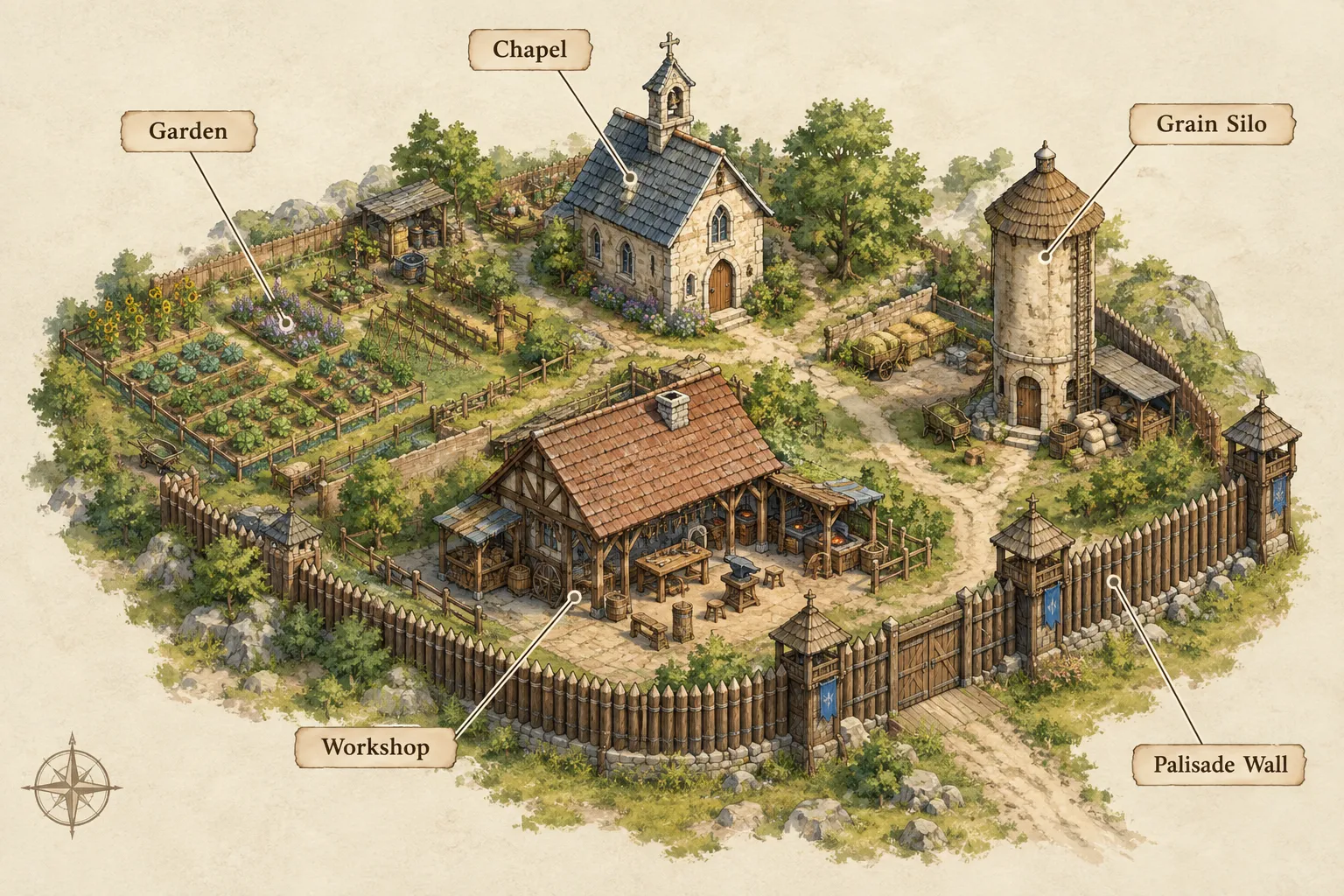
Homesteading mechanics in Christian fantasy typically translate real agrarian labor into trackable systems: land claims, seasonal cycles, crafting trees, hospitality mechanics, and defensive preparation, all wired to the same stat window a dungeon crawler would use for combat.
A workable homesteading system usually includes:
- Land and seasons, soil quality, weather risk, and planting windows that force real planning, not instant results.
- Crafting trees, trades like carpentry, preserving, or smithing that unlock in stages tied to practiced skill, not luck.
- Hospitality mechanics, a system that rewards (or costs) taking in strangers, feeding travelers, or extending credit to a struggling neighbor.
- Trade and debt tracking, ledgers that can be honest or falsified, creating a built-in temptation loop.
- Defensive preparation, walls, watch rotations, and stored supplies that matter only when threat finally arrives.
Crafting choices double as character development here: a character who chooses fair pricing over maximum profit, or who repairs a rival’s cart before their own barn, is revealing conviction through action, the exact approach described in character arcs in Christian LitRPG that level up faith and integrity alongside stats.
Can You Have High Stakes in a Slow-Burn Christian Story?
Yes. High stakes in a slow-burn Christian story come from what a community stands to lose, trust, provision, safety, mercy, not from raising the monster tier. A failed harvest that forces a choice between selling seed grain or feeding a starving family carries as much tension as a siege, because the character has to live with the choice afterward.
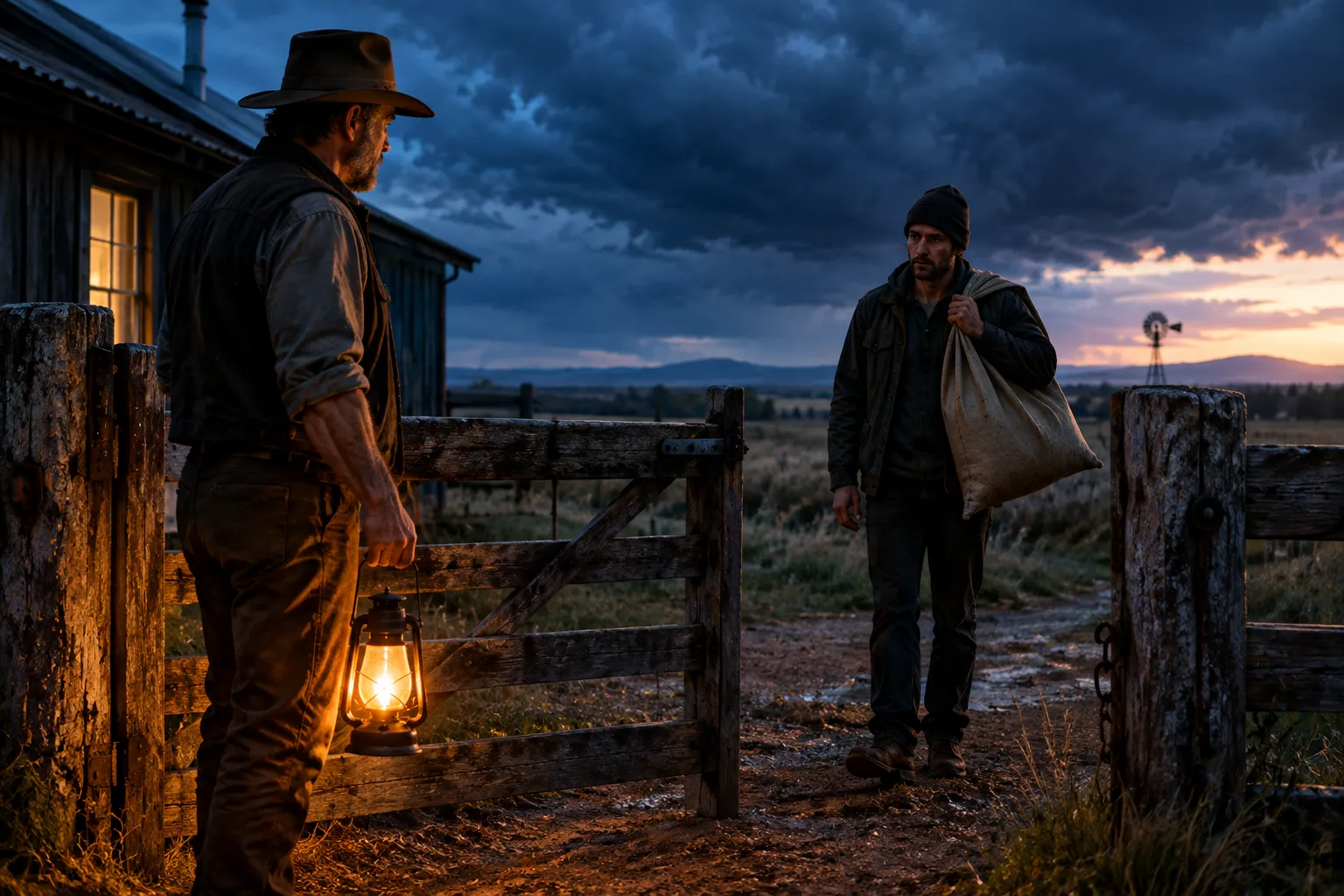
Faith-focused conflict often shows up as a direct clash between what the system rewards and what conscience demands: the quest log grants experience for the most efficient trade route, but taking it means passing a fugitive family in the cold. That gap between the mechanical reward and the moral cost is where the genre earns its tension without ever needing a monologue about it. The Measured Debt series works this exact pressure point in a different setting, corporate collapse instead of pastoral homestead, proving the mechanic-versus-conscience conflict travels across genres inside the same worldview. For more on how faith survives contact with plot rather than narrating over it, see how faith themes raise the stakes in Christian psychological thrillers, which uses a parallel structure in a different genre.
Edge case: a story with no external threat at all can still be high-stakes if the internal cost, reputation, a broken promise, a debt owed, is specific and consequential enough.
Best Christian LitRPG Books With Crafting and Homesteading Systems
The clearest current examples pair a game-system spine with agrarian or trade-based progression instead of combat-only leveling. Meadowreach Homestead by G. A. Jensen, released in July 2026, is built explicitly around crafting, exploration, gentle progression, and found family [6], with Audible listing it as the start of a planned seven-book series [7]. Homestead Crafter by S. D. McKittrick has likewise expanded into multiple audiobook installments, signaling reader demand for farming-and-building progression told across a longer arc.
For readers who want the same earned-progression ethic with a Christian moral spine but a different setting, The Measured Debt follows Eamon Kersey through collapsing corridors where a “position series” keeps proving his worth, right up until what he’s spent stops adding up. It shares the genre’s core promise: no cheap grace, no shortcut around cost. Readers building a shelf around this niche may also want the broader landscape covered in the 2026 Christian fantasy boom beyond Narnia retellings.
How Do Authors Balance Religious Themes With Game Mechanics?
Authors balance faith and mechanics by making the stat system a language for conviction, not a delivery vehicle for a sermon, faith shows up through choices the system measures, like tithing yield, offering hospitality, or reporting a harvest honestly, rather than through a character stopping the plot to explain doctrine.
Three mistakes show up often in weaker attempts:
- Preaching through narration. A character explaining what mercy means out loud, instead of choosing it under pressure, flattens the tension immediately.
- Faith with no mechanical cost. If belief never affects a stat, a resource, or a relationship in the game system, it reads as decoration rather than conviction.
- Grace with no price tag. A character receiving forgiveness or restored standing without losing anything first breaks the genre’s core promise of earned progression.
This is the same discipline covered in what makes a LitRPG series Christian without being preachy and in how game mechanics become spiritual discipline and discipleship, the system has to carry the theology, not narrate it.
Is Christian LitRPG Only for Religious Readers?
No. Readers who want cozy or low-grimdark progression fantasy with real community stakes can enjoy Christian LitRPG regardless of personal belief, since the crafting, trade, and settlement conflicts land on their own terms. The faith layer adds depth for readers who want it represented honestly, but it doesn’t gate entry for readers who came for the homestead-building alone.
Choose this genre if:
- A reader wants slower pacing with real consequences instead of constant combat.
- A reader is tired of grimdark tone and wants stakes without despair.
- A reader wants moral weight attached to the numbers on the page.
Skip it if:
- A reader wants fast, action-first pacing with minimal domestic detail.
- A reader wants ambiguous or absent moral framing rather than a defined worldview.
FAQ
What is Christian LitRPG with crafting and homesteading, in one sentence? It’s progression fantasy that uses game-style stats and leveling to track settlement-building and farming instead of only dungeon combat, with faith shaping what counts as a “win.”
How is quiet progression different from slow pacing? Quiet progression still delivers frequent small goals and rewards, it just measures them in repaired structures or improved yields instead of loud combat spectacle, keeping the loop engaging without raising volume [3].
Do these stories need magic systems to work? No. Many rely only on a status-window mechanic and a Christian moral framework, without requiring spellcasting or elaborate lore.
Is crafting-focused LitRPG a real trend or a niche? Both. LitRPG overall grew from 917 releases in 2023 to 2,642 in 2025 [1], and crafting-and-homesteading titles like Meadowreach Homestead are being packaged as multi-book series rather than one-off novelties [7].
Can a Christian LitRPG series avoid feeling preachy? Yes, by letting faith show up through consequence rather than dialogue, a character’s honesty in a trade ledger says more than a paragraph explaining honesty ever could.
What makes the stakes feel real without violence? Debt, hunger, broken trust, and the safety of dependents create consequences just as sharp as combat, especially when a single bad season can undo months of careful building.
Are these books good for readers coming from cozy fantasy? Yes, the settlement-building, found-family, and low-conflict-per-chapter structure overlaps heavily with cozy fantasy reading habits, just with an added moral spine.
Where should a new reader start? Start with a title that states its premise clearly in the blurb, crafting, homesteading, and a defined worldview, since discovery in this genre currently favors legible premises over broad “clean fantasy” branding [5].
Conclusion
Christian LitRPG with crafting and homesteading works because it refuses to confuse loud with important. A patched roof, a fair trade, a shared harvest, these carry weight because someone eventually has to answer for what they built and who they built it for. That’s the same earned-grace architecture running through every corner of faith-rooted fiction: hope in the dark, mercy and justice held together, redemption that costs something before it’s given.
For readers ready to go deeper, start with a title whose blurb names its systems plainly, follow a series past book one where the real payoff lives, and watch for stories that let the numbers on the page answer to something bigger than the numbers themselves. For more on how this genre handles conviction without sermonizing, see faith in fiction across genres and how much is too much.
References
[1] 2026 08 10 State Of Litrpg 2026 Discovery Crisis Market Analysis – https://litrpgcritic.com/blog/2026-08-10-state-of-litrpg-2026-discovery-crisis-market-analysis/ [3] Ne68461b55452 – https://note.com/nonkuri_yubiri/n/ne68461b55452?hl=en [5] For The Fans State Of Litrpg – https://www.litrpgtools.com/insights/for-the-fans-state-of-litrpg [6] B0h7ct4wlr – https://www.audible.com/pd/Meadowreach-Homestead-Audiobook/B0H7CT4WLR [7] B0h7h7q9sz – https://www.audible.com/series/Meadowreach-Homestead-A-LitRPG-Crafting-Slice-of-Life-Adventure-Audiobooks/B0H7H7Q9SZ