Last updated: October 18, 2026
Quick Answer
The best Christian psychological thriller books for readers who want clean domestic suspense keep the dread inside the house, a marriage, a church office, a family record, while leaving profanity, graphic violence, and explicit content off the page entirely. Strong current picks include Jaime Jo Wright’s The House on Foster Hill and The Resurrection of Evania James, Siri Mitchell’s State of Lies, Terri Blackstock’s If I Run, Colleen Coble’s Conspiracy, and Silas Bellhaven’s The Gathering Light series. The difference from mainstream domestic suspense isn’t lower stakes; it’s where the story believes justice and mercy come from.
Key Takeaways
- Clean doesn’t mean mild. Christian psychological thrillers can carry stalking, suspicious deaths, coercive control, and marital betrayal, they just handle the worst moments off-page.
- Faith shows up in the consequences, not in a sermon. The strongest titles let characters doubt, fail, and pay something real before grace arrives.
- Jaime Jo Wright is the closest current match for readers who want gothic, house-centered dread with a dual timeline.
- Siri Mitchell’s State of Lies is the best fit for readers who loved the “do I actually know my spouse?” engine of mainstream domestic thrillers, though its faith content is subtle.
- Terri Blackstock’s If I Run trades the quiet house for a fugitive chase and faster pacing.
- Vetting tip: read the free sample’s first chapter plus one chapter from the middle. Content slips show up at page 150, not page 5.
- Kindle Unlimited, ChristianBook, and curated Goodreads lists are the three most reliable discovery channels.
- Series like The Gathering Light (new protagonist each book, one spine question) suit readers who want psychological tension without romance subplots.
What Makes a Psychological Thriller Christian vs. Secular?
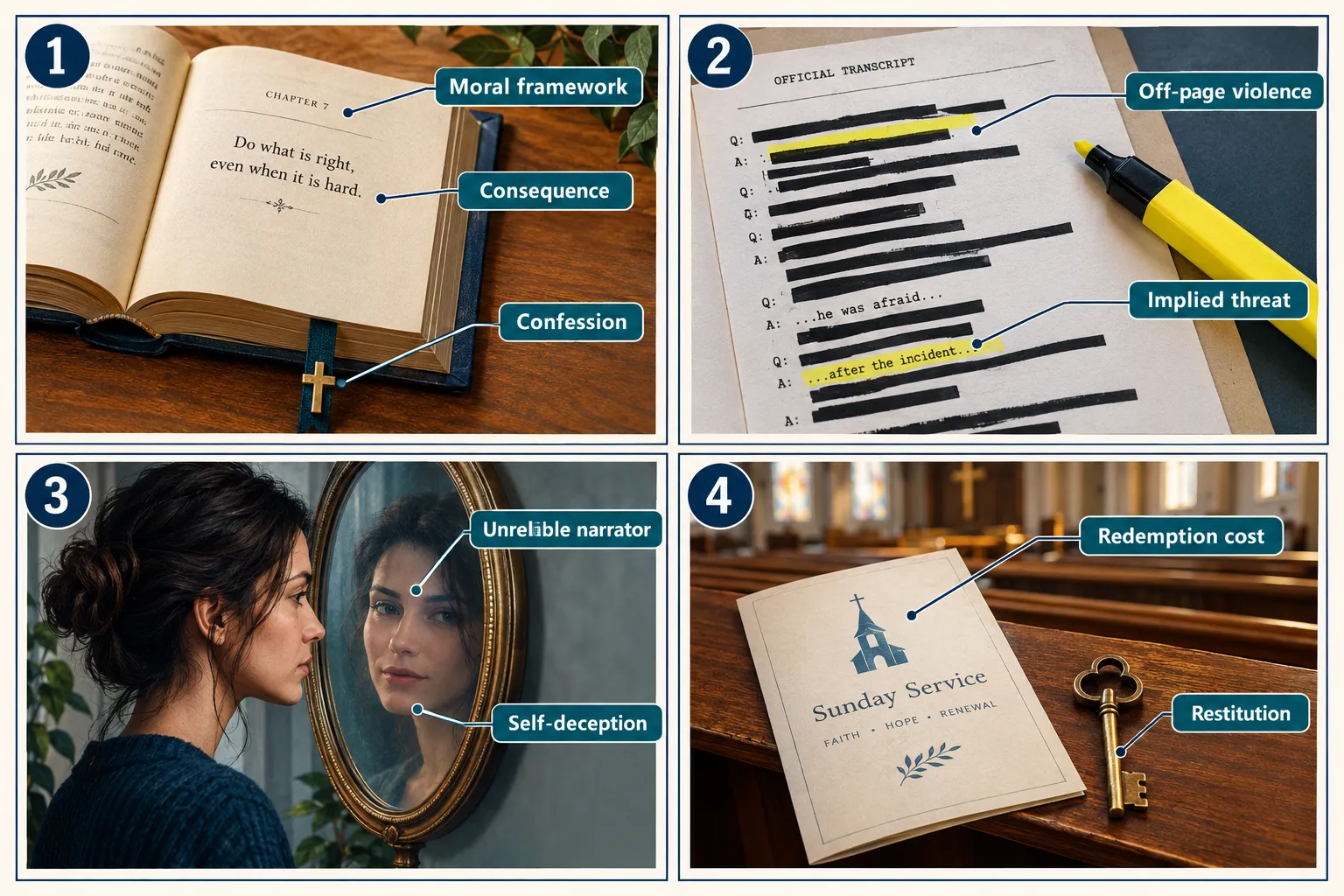
A Christian psychological thriller is distinguished by its moral framework, not by how often God gets mentioned. Both versions can use an unreliable narrator, a suspicious death, and a household built on lies. The secular version usually ends with survival or revenge. The Christian version ends with someone deciding what the truth costs and paying it.
Three structural differences show up reliably:
- Evil is named, not admired. Mainstream domestic suspense sometimes lets the manipulator be the most charming voice on the page. Faith-rooted suspense can write a chilling antagonist, but it refuses to make cruelty aspirational.
- Consequence is load-bearing. Confession, restitution, and forgiveness carry actual weight in the plot. A character who lies to protect a church, a family, or a reputation doesn’t walk away clean.
- Hope exists but isn’t free. The genre’s best work gives you hope in the dark, not a tidy conversion in chapter 30.
Decision rule: if you want the puzzle and the paranoia but you’re tired of nihilistic endings, you want Christian suspense. If you specifically want moral ambiguity left permanently unresolved, you don’t.
What’s the Difference Between Christian Suspense and Regular Thrillers?
Christian suspense keeps the tension and removes the on-page content most clean-read readers are avoiding: profanity, explicit sexual content, and graphic violence rendered in detail. Regular thrillers often rely on those elements for shock. Faith-based suspense relies on dread, discovery, and what a character stands to lose.
| Element | Mainstream domestic thriller | Christian domestic suspense |
|---|---|---|
| Profanity | Common, often heavy | Absent or extremely mild |
| Violence | Shown in detail | Implied, off-page, aftermath-focused |
| Sexual content | Frequently explicit | Closed-door or absent |
| Moral center | Often ambiguous | Present, though tested hard |
| Ending | Survival, twist, or bleak | Costly resolution with hope |
| Unreliable narrators | Standard | Standard, and used well |
The caveat worth knowing: “Christian” on a cover tells you about publisher category, not intensity. Some faith-market suspense is gentle. Some is genuinely unnerving.
Are Christian Thrillers Less Intense Than Mainstream Ones?
No, they’re less graphic, which is a different measurement. Intensity in psychological fiction comes from uncertainty and proximity, not gore. A woman finding her own name on a prayer list in someone else’s handwriting is more frightening than a described autopsy.
What faith-based thrillers typically do differently:
- Threats arrive through relationship: a husband, a counselor, a pastor, a sister-in-law.
- Violence happens between chapters; the book sits with the aftermath instead.
- The dread is institutional as often as physical, records, testimonies, and paperwork that can be edited to say something other than the truth.
Common mistake: assuming cozy pacing. Blackstock’s If I Run opens with a woman covered in a friend’s blood and running. That is not gentle. It is clean.
For more on this trade-off, see this breakdown of high-tension Christian thrillers in the True Detective mold.
Best Christian Domestic Suspense Books With No Profanity or Graphic Violence
These are the strongest current titles for readers who want relationship-driven tension with no profanity and nothing graphic on the page. All are available through major Christian retailers [9][10].
1. The House on Foster Hill, Jaime Jo Wright The best overall match. Present-day Kaine Prescott buys an abandoned Wisconsin house while fleeing a stalker; a century earlier, Ivy Thorpe investigates an unidentified woman’s death on the same property. Domestic vulnerability, a suspicious marital death, buried secrets, dual timeline. Reviewers describe the faith content as present but not heavy, suspense first.
2. State of Lies, Siri Mitchell Best contemporary domestic thriller in the category. Georgie Brennan, physicist and single mother, loses her husband to an apparent hit-and-run. A cryptic notebook, a missing computer, and activity beneath her own house make her question everyone close to her. Faith content is minimal and largely implicit, know that going in.
3. The Resurrection of Evania James, Jaime Jo Wright An October 2026 gothic release linking two women across time through a house connected to grave robbers. Eerie, historical, psychologically tense rather than procedural.
4. If I Run, Terri Blackstock Casey Cox is accused of murdering her friend and runs. Pursuit, shifting loyalties, and genuine questions about justice. Continues in If I’m Found and If I Live.
5. Conspiracy, Colleen Coble Book three in the Sanctuary series. Family secrets, sabotage, and present danger rooted in the past, strong for readers who want family relationships at the center of the threat.
6. The Gathering Light, Silas Bellhaven At Gathering Light Restoration Retreat, every testimony is preserved word for word, and that’s the problem. When Hannah Sleeps follows a transcriptionist who finds her own testimony in someone else’s file. When the Voice Breaks and When the Prayer List Opens each take a new protagonist and household. No romance subplot, no ensemble drift.
7. Out of Time, Irene Hannon An isolated Missouri estate, a century-old mystery, and escalating danger. Listed as a clean thriller; more romantic and historical than domestic.
8. The Bookshop of 99 Doors, Jaime Jo Wright Contained, atmospheric, closer to gothic domestic suspense than procedural fiction.
Christian Domestic Suspense Similar to Gone Girl
Start with State of Lies and The House on Foster Hill. Both run on the same core question Gone Girl made famous, how well do you actually know the person you married?, without the profanity, explicit content, or scorched-earth ending.
What transfers and what doesn’t:
- Transfers: unreliable perspective, marital dread, a secret life hiding in plain domestic sight, slow-burn revelation.
- Doesn’t transfer: celebratory cruelty, graphic sexual content, an ending where nobody gets to be good.
Readers who specifically love the twisty narrator should also see this guide to Christian psychological thrillers built on domestic suspense and unreliable narrators.
Christian Psychological Thrillers With Twist Endings and Redemption Themes
The best twist endings in this category hinge on a character’s moral position, not a plot gimmick. The reveal is usually that someone trustworthy edited the record, and the redemption comes from whoever decides to un-edit it, at cost.
Look for these structures:
- Dual timeline convergence. Wright’s novels withhold how the two eras connect until late.
- The document reversal. A ledger, transcript, notebook, or prayer list that proves the opposite of what everyone assumed.
- The complicit protagonist. The narrator helped build the system now being used against her. This produces redemption that costs something rather than easy victimhood.
Edge case: if you dislike open endings, check whether you’re starting a trilogy. If I Run does not fully resolve in book one.
Related: Christian psychological thrillers on doubt, redemption, and moral complexity.
How to Know if a Thriller Is Actually Clean Content
Don’t trust the cover category. Use a three-step check before you commit, it takes under five minutes.

- Read the free sample, then skip to the middle. Use “Look Inside” or the Kindle sample, then search the preview for common profanity. Content tends to slip around the midpoint, not the opening.
- Filter reviews for the word “clean.” Christian-market reviewers flag violations immediately and specifically. Four-star reviews are more honest than five-star ones.
- Check the series contract, not the single book. Some series maintain consistent boundaries across every entry; others drift as they expand.
Mistake to avoid: assuming “inspirational” means clean. It signals market placement, not content level. “Clean and wholesome” is a more reliable retailer tag.
Where to Find Christian Psychological Thrillers and Which Authors to Read
Three channels cover almost everything in print: Kindle Unlimited for subscription reading, ChristianBook’s suspense and new-release categories for curated faith-market titles [9][10], and Goodreads lists for reader-built discovery. Genre blogs tracking monthly Christian fiction releases are useful for pre-orders [5][7].
Authors worth building a list around:
| Author | Best for | Faith content level |
|---|---|---|
| Jaime Jo Wright | Gothic, house-as-threat, dual timeline | Moderate, woven in |
| Siri Mitchell | Contemporary marital uncertainty | Light, implicit |
| Terri Blackstock | Fugitive pacing, legal and justice themes | Moderate to strong |
| Colleen Coble | Family-centered danger, romance thread | Moderate |
| Lynette Eason | Fast romantic suspense, FBI plots | Moderate |
| Irene Hannon | Isolated settings, clean thriller pacing | Moderate |
| Silas Bellhaven | Record-and-testimony psychological thrillers, no romance | Lived, non-preachy |
Also useful: how to build Goodreads lists that surface clean Kindle Unlimited titles and this overview of which Christian fiction subgenres hold reader attention on Kindle Unlimited.
Best Christian Suspense Books for Women Readers Exploring Faith Struggles
For readers who want faith portrayed honestly rather than resolved neatly, prioritize books where the protagonist’s doubt is a plot engine instead of a character flaw she grows out of. Devotional and faith-centered fiction continues to draw strong reader interest heading into 2026 [4].
Choose by what you want tested:
- Doubt about God’s protection → The House on Foster Hill
- Doubt about a spouse → State of Lies
- Doubt about your own innocence → If I Run
- Doubt about church leadership and who controls your story → The Gathering Light
- Doubt about family loyalty → Conspiracy
The common thread in the best of these: the character prays and doesn’t get a clear answer, and has to act anyway. That’s faith under fire, and it reads truer than certainty. More on that in the role of prayer and discernment in Christian thriller plots.
FAQ
Are Christian psychological thrillers always romance-adjacent? No. Much of the faith market blends suspense with romance, but romance-absent options exist, including The Gathering Light series.
Do these books contain murder? Usually yes. Deaths occur and matter; the difference is that the violence is implied or shown through aftermath rather than depicted graphically.
What’s the best starting point for a first-time reader? The House on Foster Hill by Jaime Jo Wright. It balances atmosphere, domestic threat, and accessible faith content.
Is Christian suspense available on Kindle Unlimited? Many indie and mid-list Christian thrillers are enrolled in KU. Traditionally published titles from larger houses usually are not.
Can non-religious readers enjoy these books? Yes, especially titles like State of Lies where faith content is light and the suspense carries the book.
Do twist endings work in clean fiction? Yes. Twists in this category typically turn on a hidden document or a complicit narrator rather than graphic shock.
How long are most Christian domestic suspense novels? Commonly 320 to 400 pages in trade paperback, with indie titles often shorter.
What does “gothic suspense” mean in this genre? A story where the setting, usually an old house, functions as a source of psychological pressure, holding evidence, memory, and threat.
Conclusion
Clean domestic suspense works because the house is the smallest possible arena for the largest possible betrayal, and because a story that refuses to show you everything makes you imagine worse. The best Christian psychological thriller books for readers who want clean domestic suspense don’t soften the threat. They just decide that mercy and justice are the questions worth asking once the threat is exposed.
Next steps:
- Pick one title from the eight above that matches the doubt you most want tested.
- Run the three-step clean-content check on the sample before buying.
- Start When Hannah Sleeps if you want a record-driven thriller with no romance subplot, or The House on Foster Hill if you want gothic atmosphere.
- Build a Goodreads shelf as you go, and note which authors hold the boundary across a whole series rather than one book.
Somebody in every one of these stories is holding a record that proves something other than what it says. What they do next is the whole book.
References
[4] Christian Reading Trends 2026: Devotional Fiction Dominance Revealed – https://www.wboc.com/online_features/press_releases/christian-reading-trends-2026-devotional-fiction-dominance-revealed/article_ecf6b382-c5b5-589a-a286-f968c35e1f02.html [5] Best Christian Suspense Books Of 2026 – https://gracefulreads.com/best-christian-suspense-books-of-2026/ [7] New Christian Fiction Releasing In October 2026 – https://louallenwriter.wordpress.com/2026/10/01/new-christian-fiction-releasing-in-october-2026/ [9] New Release Fiction – https://www.christianbook.com/page/fiction/new-release-fiction?event=Fiction%7C1000184 [10] Suspense And Intrigue – https://www.christianbook.com/page/fiction/suspense-and-intrigue