Last updated: September 5, 2026
Quick Answer: Christian cozy mysteries and true crime both satisfy the human hunger for puzzles and justice, but they do it very differently. True crime centers real victims and often leans on graphic detail to generate tension. Christian cozy mysteries deliver the same satisfaction of a solved puzzle through community, character, and faith-rooted moral stakes, with no exploitation required. For readers who want suspense that leaves them feeling hopeful rather than disturbed, the faith-based cozy mystery is the more honest choice.
Key Takeaways
- Christian cozy mysteries are amateur-sleuth stories set in close-knit communities, where faith shapes how characters pursue truth and respond to wrongdoing.
- True crime draws on real cases and real victims; its tension often depends on graphic or disturbing content that can feel voyeuristic.
- Faith-based whodunits satisfy the same puzzle-solving instinct as true crime, without requiring exploitation of real suffering.
- The genre handles dark themes (deception, grief, betrayal) honestly, but frames them through mercy and justice rather than shock.
- Christian cozies differ from secular cozies in that faith is load-bearing, not decorative, it shapes character decisions, not just setting.
- Real suspense is possible without graphic violence; stakes built on relationships, reputation, and conscience can be just as gripping.
- The primary audience is women 35-65 who want clean, honest fiction that takes their faith seriously without preaching at them.
- Common tropes include small-town settings, amateur sleuths connected to church or ministry, found objects that hold secrets, and communities where everyone knows too much.
- The genre is growing in 2026, with major Christian publishers releasing new mystery and suspense titles throughout the year.
- Kindle Unlimited is a strong discovery platform for Christian cozy mystery series.
What Is a Christian Cozy Mystery?
A Christian cozy mystery is an amateur-sleuth story set in a small, close-knit community where faith is woven into how characters think, choose, and respond to wrongdoing. The sleuth is typically an ordinary person, not a detective, who stumbles into a crime and can’t look away. The mystery gets solved through observation, relationship, and conscience rather than forensics or force.
What makes it Christian is not a scripture verse dropped into chapter three. It’s the way a character weighs truth against loyalty, the way mercy shows up after cost, the way justice matters because people matter. The faith is load-bearing. Remove it, and the story changes shape.
In Silas Bellhaven’s Mercy House Mysteries, set in Juniper Gap, Tennessee, protagonist Nora Bell Hartley keeps finding bodies where she meant to find donations. The murders are real. The grief is real. But the investigation always circles back to questions the church community itself has to answer, about honesty, about who gets protected, and about what it costs to tell the truth once you’re holding it.
The Difference Between Cozy Mystery and True Crime
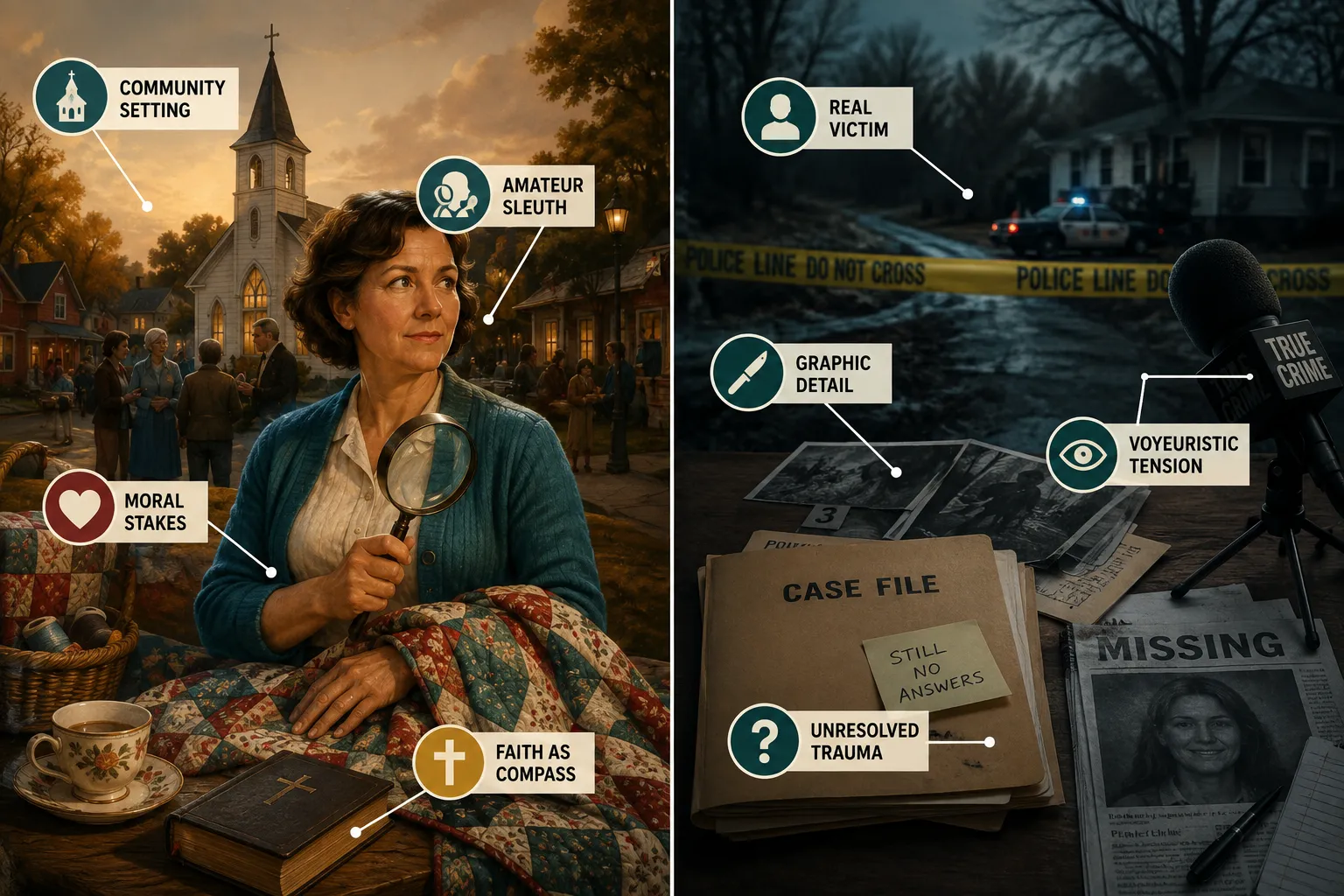
Cozy mystery is fictional; true crime is documentary. That single distinction changes almost everything about how each genre handles darkness, victims, and resolution.
| Christian Cozy Mystery | True Crime | |
|---|---|---|
| Victims | Fictional characters | Real people with real families |
| Tension source | Puzzle, relationship, conscience | Graphic detail, real danger |
| Resolution | Justice achieved within the story | Often unresolved or contested |
| Reader experience | Comfort, community, hope | Anxiety, outrage, sometimes voyeurism |
| Faith role | Shapes character and consequence | Absent or incidental |
True crime podcasts reached an estimated 19.1 million listeners in the U.S. [9], and the genre has dominated podcast charts for years [3]. But audience research also shows signs of listener fatigue and ethical concern [5], people are beginning to ask whether consuming real suffering as entertainment is something they want to keep doing.
That question is exactly where the Christian cozy mystery vs. true crime conversation becomes worth having.
Why Are Christian Mysteries Less Exploitative?
Christian cozy mysteries are less exploitative because their victims are fictional, their tension comes from moral stakes rather than graphic detail, and their resolution is built into the story’s structure. No real family is waiting to see how readers respond to their loved one’s death.
True crime’s ethical problem isn’t that it covers dark material, it’s that the darkness belongs to someone who didn’t choose to be entertainment. The victim’s worst day becomes a podcast episode, a docuseries, a Reddit thread. The genre can do genuine good (wrongful convictions have been overturned through listener attention), but the line between advocacy and voyeurism is thin and frequently crossed [6].
A faith-based whodunit sidesteps that entirely. The murder in A Donation to Die For, where a mislabeled donation box hides a ledger and a deacon who died just before he could confess, is not a real deacon. The grief in the story is crafted to be felt, not extracted from someone’s actual loss. That’s not avoidance of hard things. It’s the difference between honest fiction and exploitation.
“Walking with them, not talking at them”, that’s the standard. Stories that sit beside the reader in the dark, not ones that drag them through someone else’s worst night for entertainment.
How Do Faith-Based Mysteries Handle Dark Themes?
Faith-based mysteries handle dark themes honestly but frame them through mercy and justice rather than shock. Deception, grief, betrayal, and even violence appear, but the story’s moral architecture shapes how they land.
The key is what the author chooses to show versus what the story acknowledges exists. A character can be murdered without the reader needing to witness the act in graphic detail. A community can carry shame without the narrative lingering on it for effect. The darkness is real; the camera angle is chosen with care.
For a deeper look at how this works in suspense fiction specifically, how Christian authors build suspense without darkness in psychological thrillers covers the craft mechanics in detail.
What faith adds to dark themes:
- A moral framework that takes wrongdoing seriously without sensationalizing it
- Characters who must reckon with conscience, not just evidence
- The possibility of mercy, which doesn’t mean the villain escapes, but that the story doesn’t end with only punishment
- Earned grace: redemption that costs something, not cheap resolution
This is what separates a faith-based whodunit from both true crime and from sanitized fiction that pretends hard things don’t exist.
Can You Get Real Suspense From a Clean Mystery?
Yes, and the suspense in clean Christian fiction often runs deeper than shock-based tension because it’s built on relationships and conscience, not graphic content. When readers care about the characters, the stakes don’t need to be gruesome to feel real.
The question “who did it” is only half the engine in a well-written cozy. The other half is “what will this cost the community when the truth comes out?” In small-town settings where everyone is connected, the answer to that second question is almost always: more than anyone expected.
Non-violent suspense in Christian psychological thrillers explores this in depth, how stakes built on reputation, relationship, and moral choice can generate genuine dread without a single graphic scene.
Techniques that generate real suspense in clean fiction:
- A secret that, if revealed, would destroy a family or a friendship
- A character who knows the truth but has reasons to stay silent
- A sleuth who is personally connected to the suspect
- Time pressure tied to community events (a funeral, a church vote, a charity drive)
- Objects that carry history, a hymnal margin note, a recipe tin, a flood-relief box
Christian Cozy Mystery vs. Secular Cozy Mystery: What’s Different?
The difference between a Christian cozy and a secular cozy is not content restrictions, it’s whether faith is structural or decorative. A secular cozy might be set in a church and still treat faith as background color. A Christian cozy treats faith as the reason the sleuth cares about justice in the first place.
In a secular cozy, the protagonist might be charming, clever, and community-minded. In a Christian cozy, those same qualities are rooted in something: a belief that truth matters because people are made in the image of someone who is truth. That conviction shapes decisions under pressure in ways that pure personality doesn’t.
Clean Christian fiction vs. general clean reads breaks this distinction down clearly for readers trying to navigate Kindle Unlimited’s crowded mystery shelves.
Common Tropes in Faith-Based Whodunits
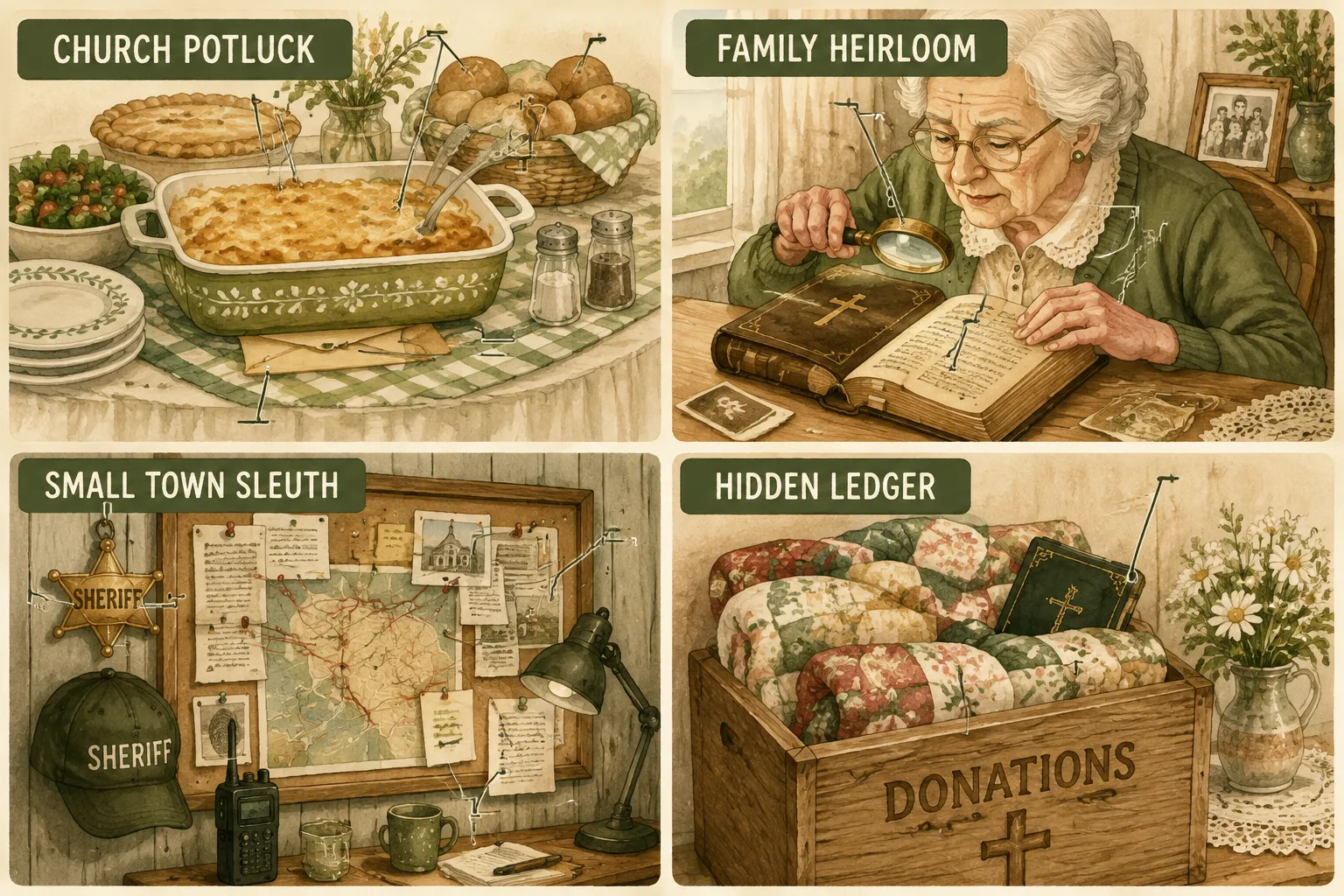
Christian cozy mysteries have a recognizable set of tropes that readers love precisely because they’re reliable, and the best authors find ways to make those tropes feel earned rather than formulaic.
For a full breakdown of how these tropes work in community settings, see Christian cozy mystery tropes in small communities.
Most common tropes:
- Amateur sleuth with community ties, a church volunteer, a thrift shop manager, a quilting circle member
- Small-town setting where history runs deep and secrets have nowhere to hide
- Found objects as clues, a family Bible, a donation box, a hymnal with margin notes, a recipe tin
- Ministry settings as crime scenes, charity drives, church socials, seed swaps, Christmas shelter programs
- Moral weight on the investigation, the sleuth isn’t just solving a puzzle; she’s deciding who deserves the truth
- Community reckoning, the resolution affects the whole town, not just the guilty party
- Faith under fire, characters whose belief gets tested by what they discover
The Mercy House Mysteries series hits nearly all of these in every book. The Hymnal Margin Murder (Book 9) uses a note scrawled in an old hymnal to surface Juniper Gap’s best-kept secret. A Quilt for the Guilty (Book 4) hides a fair ledger in a quilt square that outlives the woman who tried to bury it. The objects carry the history; the community carries the cost.
Do Christian Cozies Have Violence or Gore?
No. Christian cozy mysteries acknowledge that a murder has occurred but do not depict graphic violence, gore, or explicit content. The crime is real within the story; the camera stays on the aftermath and the investigation, not the act itself.
This is a deliberate craft choice, not a limitation. The tension in a cozy comes from the puzzle and the relationships, not from visceral detail. A body is found. The community is shaken. The sleuth starts asking questions that make people uncomfortable. That’s enough, and for many readers, it’s more than enough.
What you will find in Christian cozies:
- Death referenced and investigated, not depicted graphically
- Emotional weight on grief and consequence
- Moral complexity in the characters involved
- Justice that costs something to achieve
What you will not find:
- Graphic crime scenes or forensic detail
- Profanity
- Explicit content of any kind
- Shock for its own sake
Who Reads Christian Cozy Mysteries?
The core audience for Christian cozy mysteries is women between 35 and 65 who want fiction that takes their faith seriously without preaching at them. They are often Kindle Unlimited subscribers who read across multiple clean fiction genres and want stories with real stakes, not sanitized ones.
Religion print sales rose 12% in the first half of 2024 [7], and Christian fiction has seen a reported 14.7% yearly surge in market expansion [8], suggesting that demand for faith-rooted stories is not a niche trend. The cozy mystery category specifically has benefited from a broader cozy media expansion in 2026, Hallmark’s renewal of Mistletoe Murders for a third season and the announcement of a new Garage Sale Mystery film both signal that cozy-style crime fiction has a large, loyal audience that extends well beyond any single platform.
For readers navigating Kindle Unlimited specifically, Kindle Unlimited trends for Christian cozy mysteries in 2026 covers what the borrow data actually shows about reader preferences.
Best Christian Cozy Mystery Books and Series to Start With
The best entry point for Christian cozy mystery depends on whether you want a long-running series with a consistent sleuth or standalone-style books with fresh settings each time.
Start here if you want a series:
- Mercy House Mysteries by Silas Bellhaven, Begin with A Donation to Die For. Juniper Gap, Tennessee. Amateur sleuth Nora Bell Hartley. Ten books, all on Kindle Unlimited. Faith is structural, not decorative.
- The Erin Delaney Mysteries by Nancy Mehl, Fatal Finale (Bethany House, August 2026) continues this established Christian mystery series.
- Elizabeth Goddard’s suspense novels, When the Silence Breaks (Revell, August 2026) blends investigative tension with Christian themes.
- Lynette Eason’s thrillers, Twilight Tactics (Revell, August 2026) sits closer to thriller than cozy but maintains clean content and faith integration.
For readers who enjoy authors like Debbie Macomber (warm community settings, emotional depth, women’s relationships at the center), the Mercy House Mysteries series will feel familiar in tone while adding genuine mystery stakes.
For a broader reading list, the clean Christian fiction TBR for 2026 covers cross-genre Kindle Unlimited recommendations.
How Does Faith Integrate Into the Mystery Plot (Without Becoming a Sermon)?
Faith integrates into a mystery plot through character choice and consequence, not narration or scripture-dropping. The sleuth’s belief shapes what she notices, what she’s willing to risk, and what she does when she finds out the guilty party is someone she loves.
The test is simple: if you removed the faith element, would the story change? In a well-written Christian cozy, the answer is yes, because the protagonist’s willingness to pursue truth at personal cost, her instinct toward mercy even when justice demands accountability, her prayer in a quiet moment before a confrontation, these are not decorations. They’re the story.
Faith in fiction: how to weave believable spiritual journeys into plot without preaching covers the craft side of this in detail.
Signs that faith is structural, not decorative:
- The character’s faith is tested by what she discovers, not confirmed by it
- Moral dilemmas don’t have easy answers
- Grace shows up after cost, not instead of it
- The community’s faith is shown to be imperfect, people fail, cover things up, choose reputation over truth
- Resolution involves reckoning, not just revelation
Where to Find Christian Mystery Books Online
The easiest places to find Christian cozy mystery and faith-based suspense in 2026 are Amazon, Kindle Unlimited, and Christian-focused book communities.
- Amazon / Kindle Unlimited, Search “Christian cozy mystery” or browse the Mercy House Mysteries series page. KU subscribers can read the entire series at no additional cost.
- Silas Bellhaven’s author page, amazon.com/stores/Silas-Bellhaven/author/B0H42BDQBK covers cozy mystery, psychological thriller, frontier western, and fantasy under one faith-rooted catalog.
- Bethany House and Revell, Both major Christian publishers are releasing new mystery and suspense titles throughout 2026.
- Kindle Unlimited for Christian readers, A practical guide to finding clean reads in a crowded marketplace helps readers filter effectively.
- Book clubs and Christian fiction communities, Building Christian fiction communities covers where readers are gathering online.
FAQ
Q: Is Christian cozy mystery the same as inspirational mystery? A: They overlap but aren’t identical. “Inspirational” is a broader publishing category that includes romance and general fiction with faith themes. Christian cozy mystery is a specific genre combining amateur-sleuth mystery with small-town community settings and faith-rooted characters. All Christian cozies are inspirational; not all inspirational fiction is cozy mystery.
Q: Do Christian cozy mysteries always have a happy ending? A: The mystery is resolved and justice is served, but “happy” is the wrong word. The best ones end with something more honest: a community that has faced a hard truth and is still standing, grace that cost something to reach, and a protagonist who is changed by what she found. Comfort earned through honesty, not by avoiding it.
Q: Can men enjoy Christian cozy mysteries? A: Yes, though the primary audience is women. Readers who enjoy puzzle-driven plots, small-town settings, and moral complexity will find the genre satisfying regardless of gender. Readers who want faith-rooted fiction with more masculine leads might start with The Mercy Line, a Christian frontier western series.
Q: Are Christian cozy mysteries appropriate for teenagers? A: Generally yes. The content is clean, no graphic violence, no explicit content, no profanity. Themes of death, deception, and moral failure are present but handled with care. Individual parents should preview based on their teenager’s maturity.
Q: How is Christian cozy mystery different from a Christian thriller? A: Pacing and tone. Cozies are slower, warmer, community-focused, and the danger rarely threatens the sleuth’s life directly. Thrillers raise personal stakes, the protagonist is in danger, the tension is psychological, and the darkness runs deeper. Both can be clean and faith-rooted. For the thriller side, Christian psychological thrillers: doubt, redemption, and moral complexity is a good starting point.
Q: Why are so many Christian cozy mysteries set in small towns? A: Small towns create the conditions the genre needs: everyone knows everyone, secrets have nowhere to stay hidden, and the community itself becomes a character with its own history and loyalties. The church setting adds another layer, an institution built on truth that sometimes covers things up anyway. That tension is the engine.
Q: Is true crime losing popularity? A: There are signs of audience fatigue. Forbes noted in late 2025 that true crime podcasts may be losing some of their cultural dominance [5], though Triton Digital’s Q4 2025 ranker still showed strong overall podcast audience numbers [3]. The ethical conversation around true crime consumption has grown louder, which may be one reason readers are looking for mystery fiction that satisfies the same instincts without the moral cost.
Q: What’s the best first book in the Mercy House Mysteries series? A: Start with A Donation to Die For (Book 1). It introduces Nora Bell Hartley, establishes Juniper Gap, and sets up the series’ recurring question: what will you do with the truth once you’re holding it?
Conclusion: Suspense That Leaves the Light On
The Christian cozy mystery vs. true crime conversation comes down to a single question: what do you want to feel when you close the book?
True crime offers the adrenaline of real stakes and real puzzles, but it extracts that feeling from real suffering. For many readers, that trade has started to feel like too much to pay.
Faith-based whodunits offer something different: the same puzzle-solving satisfaction, the same hunger for justice, the same pleasure of a community revealed under pressure, but built from fiction, shaped by mercy, and resolved with the kind of hope that costs something to reach. Earned grace. Faith under fire. Redemption that doesn’t come cheap.
The genre is growing in 2026 for a reason. Readers who want suspense without exploitation, community without sentimentality, and faith handled honestly rather than preached, they’ve found it here.
Next steps:
- Start the Mercy House Mysteries with A Donation to Die For
- Browse the full Silas Bellhaven catalog for cozy mystery, thriller, western, and fantasy rooted in the same conviction
- Explore Christian cozy mystery tropes readers love to find your next series
- Check Kindle Unlimited for Christian readers for discovery tips
References
[3] Triton Digital S Q4 2025 U S Podcast Ranker Reveals Audience Spikes Beyond Top Shows And Genres – https://tritondigital.com/press-releases/February-26-2026/triton-digital-s-q4-2025-u-s-podcast-ranker-reveals-audience-spikes-beyond-top-shows-and-genres
[5] Are True Crime Podcasts Losing Popularity – https://www.forbes.com/sites/frankracioppi/2025/12/29/are-true-crime-podcasts-losing-popularity/
[6] True Crime Consumer Report – https://www.edisonresearch.com/solutions/true-crime-consumer-report/
[7] 95495 Religion Print Sales Up 12 In First Half Of 2024 – https://www.publishersweekly.com/pw/by-topic/industry-news/financial-reporting/article/95495-religion-print-sales-up-12-in-first-half-of-2024.html
[8] Christian Fiction 14 7 Yearly Surge Dramatic Market Expansion Data – https://www.firmenpresse.de/pressrelease734029/christian-fiction-14-7-yearly-surge-dramatic-market-expansion-data.html
[9] True Crime Podcast Listeners Reach 19 1 Million Reshaping Victim Advocacy And Case Resolution – https://ppc.land/true-crime-podcast-listeners-reach-19-1-million-reshaping-victim-advocacy-and-case-resolution/