
Last updated: September 6, 2026
Quick Answer: Christian cozy mysteries and true crime dramas like Dexter operate on completely different promises. The amateur sleuth in a Christian cozy mystery solves cases through community trust, moral clarity, and faith-rooted intuition, tools that trained detectives in gritty procedural dramas rarely use and often lack. That’s not a weakness in the fiction. It’s the whole point. When you understand what each format is actually doing, the question of “who solves cases better” stops being about credentials and starts being about what kind of truth the story is after.
Key Takeaways
- Christian cozy mysteries center on amateur sleuths who solve crimes through relational knowledge, community access, and faith-informed discernment, not forensic authority.
- True crime dramas like Dexter prioritize procedural spectacle and forensic detail, but often overstate how certain real-world analysis actually is [4].
- The amateur sleuth’s advantage in cozy fiction is social, not institutional, she knows who lied at the church potluck three years ago.
- Christian cozy mysteries differ from secular cozies primarily in how faith functions: it shapes character choices and moral stakes, not just setting.
- Mystery sales in Christian fiction are rising in 2026, particularly in small-town, amateur-sleuth formats, though they still trail the broader cozy market [9].
- The appeal of clean Christian fiction is not the absence of darkness, it’s that darkness is handled honestly, and hope is earned rather than assumed.
- Amateur sleuths make better fictional investigators in certain story types because their tools (empathy, community, conscience) are more interesting to read about than forensic databases.
- Readers who want faith represented honestly, not preached at them, are the core audience for this subgenre.
What Is a Christian Cozy Mystery Book?
A Christian cozy mystery is a puzzle-driven crime story set in a close-knit community, usually a small town, a church, or a faith-adjacent institution, where the protagonist is an ordinary person, not a law enforcement professional, and where faith shapes character choices without functioning as a sermon.
The genre sits at the intersection of classic whodunit structure and clean Christian fiction. No graphic violence, no explicit content, no profanity. But the absence of those elements isn’t the point, the presence of something else is. These stories offer moral stakes, community warmth, and a protagonist whose conscience is genuinely load-bearing in the plot.
In Silas Bellhaven’s Mercy House Mysteries, for example, Nora Bell Hartley keeps finding bodies where she expected to find donations. She’s not a detective. She’s a woman who knows Juniper Gap, Tennessee, its people, its silences, its long memories. That local knowledge is her investigative edge, and her faith is the lens through which she decides what to do once she’s holding the truth.
For a deeper look at how these stories are structured, see How to Write Christian Cozy Mystery: Plot Structure, Faith Integration, and Clean Content Guidelines.
How Is Cozy Mystery Different From True Crime?
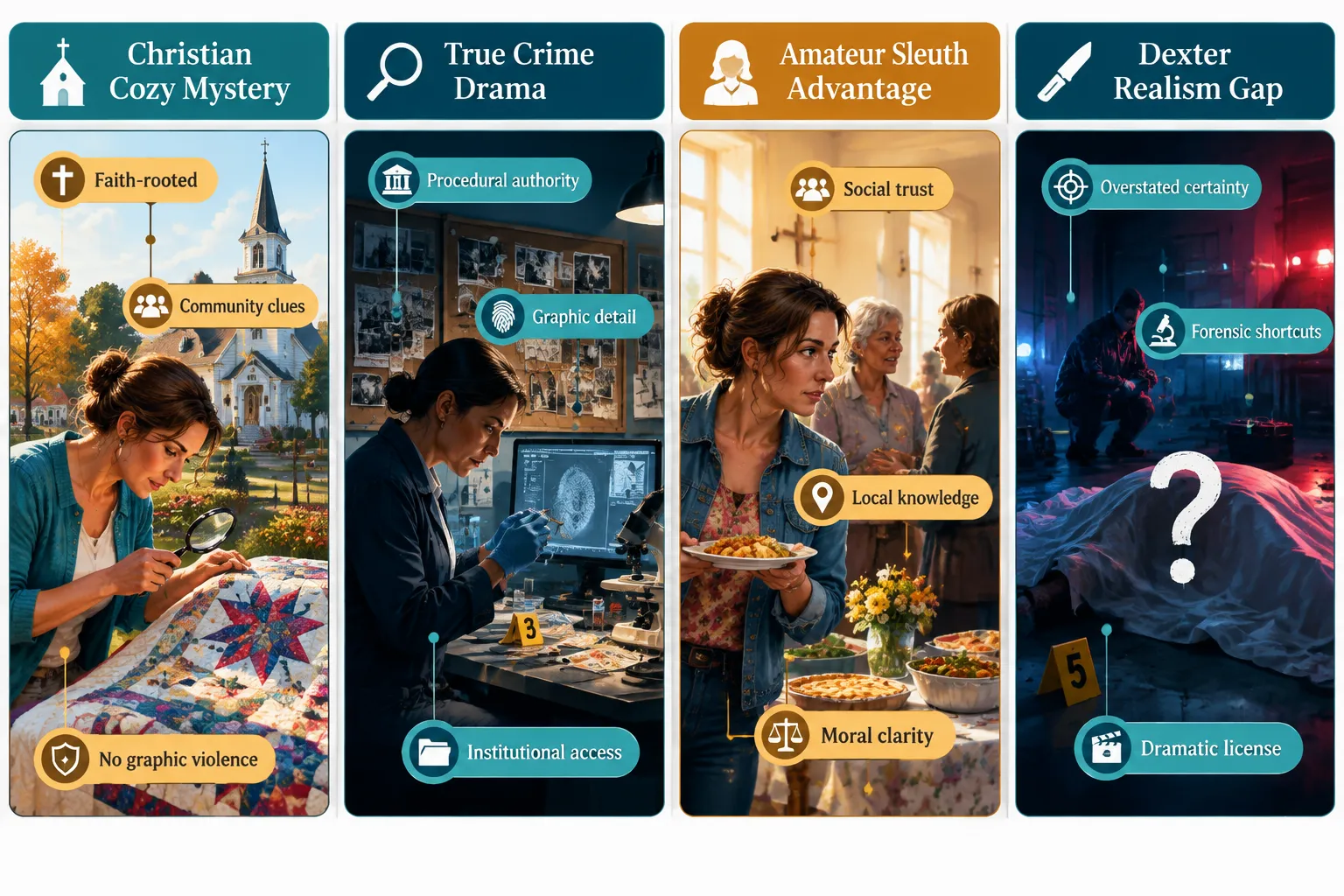
Cozy mystery and true crime are not competing answers to the same question, they’re different questions entirely. True crime (whether documentary, podcast, or drama like Dexter) asks: what actually happened, and how do we prove it? Cozy mystery asks: what does this death reveal about the people who lived alongside it?
Here’s how the two formats actually differ across key dimensions:
| Element | Christian Cozy Mystery | True Crime / Dexter-Style Drama |
|---|---|---|
| Investigator | Amateur, community member | Professional, law enforcement or forensic expert |
| Violence level | Off-page or minimal | Often graphic, central to tension |
| Primary tool | Relational knowledge, empathy, conscience | Forensic evidence, databases, authority |
| Faith role | Shapes character choices and moral stakes | Absent or used as character flaw |
| Resolution tone | Justice with mercy; community restored | Justice as closure; often ambiguous or dark |
| Reader experience | Comfort, puzzle satisfaction, hope | Tension, dread, procedural fascination |
The contrast matters for readers who want their faith represented honestly in fiction. True crime drama is built on institutional authority and forensic spectacle. Christian cozy mystery is built on the idea that the person who knows the town, who remembers what was said at the church potluck, who noticed the deacon’s hands shaking during the benediction, may be closer to the truth than the detective with the badge and the lab access.
Why Do Amateur Sleuths Solve Crimes in Cozy Mysteries?
The amateur sleuth solves crimes in cozy mysteries because her tools match the terrain. In a small town or close-knit community, the most valuable investigative asset isn’t a forensic database, it’s trust.
A professional detective arrives from outside. She shows a badge, asks formal questions, and leaves. The community closes around her like water around a stone. The amateur sleuth lives there. She knows who owes whom a favor, which family secret has been quietly kept for twenty years, and which smile doesn’t reach the eyes. That social intelligence isn’t a substitute for evidence, it’s how she finds the evidence worth looking for.
In Christian cozy mysteries specifically, faith adds another layer. The sleuth’s conscience is genuinely active. She’s not just solving a puzzle, she’s deciding what to do with the truth once she holds it. That’s a richer dramatic question than “can forensics confirm the timeline?” It’s the question every Mercy House mystery circles back to: what will you do with what you know?
For more on how community settings shape this dynamic, see Christian Cozy Mystery Tropes in Small Communities: How Church Life, Ministries, and Local Traditions Shape the Whodunit.
How Accurate Is Dexter Compared to Real Detective Work?
Dexter gets more right than most crime dramas, some bloodstain pattern concepts are handled with genuine care, but it still overstates how certain forensic analysis actually is in practice [4]. Real bloodstain pattern analysis, for instance, involves significant interpretive judgment and is far less definitive than the show presents [1].
The show’s larger distortion isn’t technical, it’s psychological. Dexter presents a protagonist whose forensic expertise makes him uniquely capable of seeing what others miss. That’s compelling television. But real investigations are collaborative, procedurally constrained, and often stalled by the very institutional structures the show treats as backdrop.
Common ways Dexter diverges from real detective work:
- Forensic conclusions are presented as near-certain when real analysis involves wide margins of error
- A single expert carries investigative weight that real departments distribute across teams
- Scene access and chain-of-custody protocols are compressed or ignored for narrative speed
- The emotional detachment of the protagonist is treated as an asset rather than a liability
The counterargument worth holding: trained detectives have tools amateurs genuinely lack, legal authority, database access, chain-of-custody control. Amateur sleuths make better fictional investigators in certain story types, but that’s a storytelling truth, not a real-world claim.
Can Amateur Detectives Actually Solve Crimes Better Than Professionals?
In fiction, yes, under specific conditions. In real life, no, and the distinction matters.
Real amateur investigators lack legal authority, access to forensic databases, and the ability to maintain chain-of-custody evidence. These aren’t minor gaps. They’re the structural foundation of any prosecution. An amateur who stumbles onto the truth can’t always do anything with it that holds up in court.
But in cozy mystery fiction, and in Christian cozy mystery vs. true crime comparisons specifically, the amateur’s advantage is narrative, not legal. The story is set in a world where:
- The community trusts the protagonist in ways it won’t trust law enforcement
- The killer underestimates her because she doesn’t carry a badge
- Her moral framework (faith, conscience, community loyalty) leads her to ask different questions than a procedural investigator would
That’s not a flaw in the genre. It’s the genre’s premise, and it’s an honest one. The best Christian cozy mysteries don’t pretend the amateur has institutional power. They show what happens when someone with relational power and a working conscience decides the truth matters enough to pursue it.
Christian Cozy Mystery vs. Secular Cozy Mystery: What’s the Difference?
The structural difference is small. The thematic difference is significant. Both feature amateur sleuths, small-town settings, off-page violence, and puzzle-driven plots. The distinction is what faith actually does in the story.
In secular cozy mysteries, a character might attend church the way she attends the farmers’ market, it’s part of the setting, not load-bearing. In Christian cozy mysteries, faith shapes how the protagonist interprets what she finds, what she risks, and what she does when the truth costs something. Mercy is a real category, not just a sentiment. Justice and grace are in tension, not automatically aligned.
The other practical difference: content contract. Christian cozy mysteries maintain clean content as a given, no profanity, no explicit material, no graphic violence. This isn’t a disclaimer; it’s a reading experience. The tone carries it before the reader finishes the first chapter.
For readers navigating this distinction more broadly, Clean Christian Fiction vs. General Clean Reads: What Sets Faith-Rooted Stories Apart on Kindle Unlimited is worth reading.
Why Are Cozy Mysteries Popular With Christian Readers?
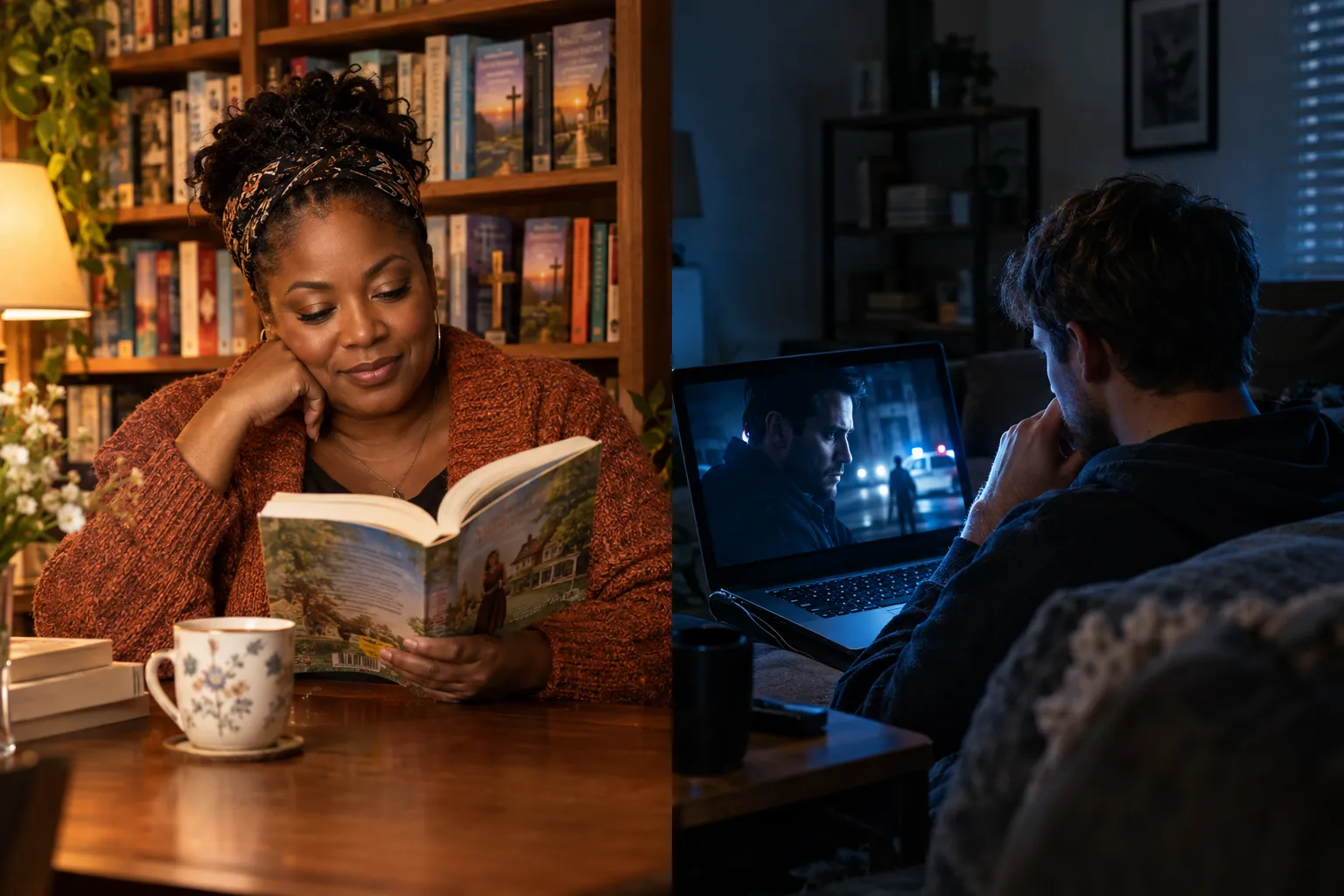
Christian readers are drawn to cozy mysteries because the format offers real stakes without the content that makes other crime fiction feel like a bad trade. The puzzle is genuinely engaging. The community is warm without being saccharine. And the resolution tends toward justice with mercy rather than justice as pure punishment.
The broader cozy fiction market is growing structurally, not just cyclically [6]. Within Christian publishing specifically, mystery sales are rising in 2026, particularly small-town, amateur-sleuth stories, though supply still trails reader demand [9]. That gap is part of why series like the Mercy House Mysteries find a ready audience: readers are looking for exactly this, and there isn’t yet an oversaturated shelf.
The deeper appeal is harder to quantify but easy to recognize: these stories treat faith as lived experience, not lesson. The protagonist doubts, serves, fails, and finds grace in the ordinary Tuesday that suddenly isn’t ordinary anymore. That’s not escapism. That’s recognition.
What Makes a Good Amateur Sleuth Character?
A good amateur sleuth has a reason to investigate that isn’t professional obligation, a community position that gives her access others don’t have, and a conscience that creates genuine dramatic tension when the truth turns out to be costly.
The strongest amateur sleuth characters share these traits:
- Rooted in place, she knows the town’s history, its grudges, its silences
- Trusted by the community, people tell her things they wouldn’t tell a detective
- Morally serious, she doesn’t solve the puzzle just to win; she cares what the answer means
- Underestimated, the killer doesn’t see her coming because she doesn’t look like a threat
- Faith under fire, in Christian cozy mysteries, her belief is tested by what she finds, not confirmed by it
The worst amateur sleuth characters are simply detectives without badges, they have all the investigative instincts of a professional but none of the institutional constraints. That’s a missed opportunity. The tension between what she can do and what she’s allowed to do, between what she knows and what she can prove, is where the best cozy mystery drama lives.
For more on the tropes that define this character type, see Christian Cozy Mystery Tropes Readers Love: Quirky Characters, Small Towns, and Spiritual Themes Explained.
How Do Cozy Mysteries Handle Violence Compared to True Crime?
Cozy mysteries keep violence off the page. The body is discovered; the manner of death is established; the investigation proceeds. What the reader never experiences is the act itself, no graphic description, no lingering on suffering, no shock-value imagery.
True crime drama, including Dexter, treats the violence as part of the story’s texture. The forensic detail, the crime scene reconstruction, the psychological profile of the killer, these aren’t incidental. They’re the genre’s primary sensory experience.
This isn’t a moral judgment about which approach is better. It’s a description of what each format is offering. For readers who want the puzzle without the graphic content, who want hope in the dark rather than darkness for its own sake, the cozy mystery format is the honest choice, not the sanitized one. The darkness is still there. The deacon still died. The secret still cost someone everything. The difference is that the story trusts the reader to feel the weight without being shown the wound.
Best Christian Cozy Mystery Series to Read in 2026
For readers new to the subgenre, here are strong starting points across different tones and settings:
For small-town, church-community mysteries with real stakes:
- The Mercy House Mysteries by Silas Bellhaven, 10 books set in Juniper Gap, Tennessee. Start with A Donation to Die For, where a mislabeled donation box holds a ledger and a deacon who died just before he could confess. The series runs through The Benediction Tape Murder and maintains its community warmth and moral weight across the full catalog.
For readers who want faith handled without preaching:
- Look for series where the protagonist’s faith shapes her choices, not her dialogue. The faith-under-fire test: does the character’s belief get tested by the plot, or does it just provide comfort? The best series do the former.
For Kindle Unlimited subscribers:
- The Christian cozy mystery subgenre is increasingly viable for digital-first readers. The religious digital content segment is growing at a significant rate through the mid-2030s [9], which means more indie and small-press titles are entering KU. The Mercy House Mysteries are available there.
For a broader survey of faith-based fiction across genres, Best Christian Fiction Books: Five Trilogies Worth Your Kindle Unlimited Subscription covers the wider Silas Bellhaven catalog.
Who Should Read Christian Cozy Mysteries?
Christian cozy mysteries are for readers who want a genuine puzzle, a community they can care about, and a story that treats faith as something lived rather than performed. The core audience is women 35-65 who read on Kindle Unlimited and want clean content with real stakes, but the genre isn’t limited to that demographic.
Read Christian cozy mysteries if:
- You want crime fiction without graphic violence or explicit content
- You’re tired of faith being either absent from fiction or handled as a lesson
- You find small-town settings emotionally specific rather than generic
- You want a protagonist whose conscience is part of the plot, not decoration
- You like series, the best Christian cozies build community across multiple books
This subgenre may not be for you if:
- You want forensic procedural detail as the primary tension
- You prefer morally ambiguous resolutions with no movement toward justice
- You’re looking for psychological horror or sustained dread
The Amateur Sleuth Fiction tag at the Silas Bellhaven blog is a useful starting point for readers exploring this space.
Conclusion: What the Comparison Actually Reveals
The question at the center of Christian cozy mystery vs. true crime, why amateur sleuths solve cases better than detectives in Dexter, isn’t really about competence. It’s about what kind of truth a story is built to find.
Dexter is built to find forensic truth: the physical record of what happened. The Mercy House Mysteries are built to find relational truth: what this death reveals about the people who lived alongside it, and what a person of conscience does once she knows.
Both are legitimate. But only one of them asks the question that actually keeps readers up at night: what will you do with the truth once you’re holding it?
Actionable next steps for readers:
- Start the Mercy House Mysteries with A Donation to Die For, it establishes Juniper Gap, Nora Bell Hartley, and the series’ moral stakes in a single tight story.
- Explore the broader subgenre through the Small Town Mystery and Clean Mystery Books tags for additional recommendations.
- If you want faith in fiction without preaching, read Faith in Fiction Across Genres: How Much Is Too Much?, it’s the clearest articulation of what “rooted in faith” actually means in practice.
The ordinary Tuesday can turn out to matter more than anyone expected. That’s not a genre promise. That’s a conviction.
Frequently Asked Questions
What is a Christian cozy mystery? A Christian cozy mystery is a puzzle-driven crime story set in a close-knit community where an amateur protagonist solves murders using relational knowledge and faith-informed discernment. Violence stays off the page, content is clean, and faith shapes character choices rather than functioning as a lesson.
How is Christian cozy mystery different from true crime? True crime focuses on forensic evidence and institutional investigation. Christian cozy mystery focuses on community trust, moral stakes, and relational knowledge. The amateur sleuth’s tools are social and spiritual, not procedural.
Is Dexter realistic? Partly. Dexter handles some forensic concepts more carefully than most crime dramas, but it overstates how certain bloodstain pattern analysis and scene reconstruction actually are in practice [4]. The show’s bigger distortion is psychological, it presents lone-expert investigation as more decisive than real collaborative, procedurally constrained detective work [1].
Can amateur sleuths actually solve crimes better than professionals? In real life, no, amateurs lack legal authority, database access, and chain-of-custody control. In cozy mystery fiction, the amateur’s social access and moral framework make her a more interesting investigator for the specific terrain these stories occupy.
What makes Christian cozy mystery different from secular cozy mystery? Both use amateur sleuths and small-town settings. The difference is what faith does in the story. In Christian cozy mysteries, faith is load-bearing, it shapes how the protagonist interprets evidence, what she risks, and what she does when the truth costs something.
Why do Christian readers prefer cozy mysteries over true crime? Cozy mysteries offer genuine puzzle satisfaction and real stakes without graphic content. For readers who want their faith represented honestly, not preached at them, the format delivers hope in the dark without avoiding the dark.
Where can I find Christian cozy mystery book recommendations? The Mercy House Mysteries by Silas Bellhaven is a strong starting point. The Christy Award Mystery tag and No Profanity Mystery Series tag at the Silas Bellhaven blog also surface relevant titles.
What is the best first book in the Mercy House Mysteries? A Donation to Die For, Book 1, establishes the setting, protagonist, and series’ moral stakes cleanly. It works as a standalone but rewards readers who continue through the series.
Are Christian cozy mysteries available on Kindle Unlimited? Yes. The Mercy House Mysteries and much of the Silas Bellhaven catalog are available on Kindle Unlimited. The Christian digital fiction market is growing steadily [9], making KU an increasingly strong home for this subgenre.
What is “earned grace” in Christian fiction? Earned grace means mercy arrives after cost, not instead of it. Characters doubt, fail, and reckon with consequences before grace shows up, which makes the grace feel real rather than formulaic. It’s the opposite of a tidy conversion moment.
How do cozy mysteries handle violence? The body is discovered; the death is established; the investigation proceeds. The act of violence itself stays off the page. This isn’t avoidance, it’s a deliberate choice that keeps the story’s focus on the puzzle and the community rather than the wound.
Who is the target audience for Christian cozy mysteries? Primarily women 35-65 who read on Kindle Unlimited and want clean, faith-rooted fiction with real stakes. But any reader who wants a genuine puzzle, a community worth caring about, and a protagonist whose conscience matters to the plot will find something here.
References
[1] How Realistic Is Dexter’s Analysis Of Crime Scenes – https://www.reddit.com/r/Dexter/comments/1i0vdni/how_realistic_is_dexters_analysis_of_crime_scenes/ [2] Mystery Cozy Paranormal – https://tropesmith.com/market/mystery-cozy-paranormal/ [4] Watch (Forensic Science Breakdown of Dexter) – https://www.youtube.com/watch?v=CjeEeBp96rE [6] Cozy Fiction Quiet Boom Publishing Trends – https://www.theculturalreview.com/trends/cozy-fiction-quiet-boom-publishing-trends [9] ChristShare Highlights Clean Fiction as Cozy Mysteries Gain Interest – https://news.marketersmedia.com/christshare-highlights-clean-fiction-as-cozy-mysteries-gain-interest/89191539