
Last updated: September 19, 2026
Quick Answer: Christian epic fantasy and The Great Gatsby occupy opposite ends of the moral spectrum, one world built on hollow longing, the other on covenant hope, but that contrast is exactly what makes Fitzgerald’s novel useful to faith-driven authors. By studying how The Great Gatsby constructs moral collapse through character and consequence rather than narration, Christian epic fantasy writers can learn to let their own faith-rooted themes carry the same weight without a single line of preaching.
Key Takeaways
- The Great Gatsby is a masterclass in showing moral decay through image, symbol, and consequence, not through authorial commentary.
- Christian epic fantasy differs from secular fantasy not by adding religious language, but by making faith structurally load-bearing in the world and the plot.
- The green light in Gatsby is a perfect foil for covenant hope: both are about longing, but one has no anchor and the other does.
- Faith-driven worldbuilding fails when religion is decoration; it succeeds when belief shapes the rules, the costs, and the mercy of the world.
- Allegory (Narnia) and faith-integrated fantasy (Tolkien) are two distinct approaches, neither is wrong, but they produce very different reading experiences.
- The biggest craft mistake in Christian fantasy is resolving moral tension too cleanly; Gatsby never does, and that’s why it still lands.
- Secular literature can absolutely improve Christian storytelling, not by replacing faith content, but by modeling how to trust the reader.
- The audience for Christian epic fantasy in 2026 is broader than ever, with religious press revenue up year-to-date and new imprints launching specifically for faith-adjacent speculative fiction.
What Is Christian Epic Fantasy and How Does It Differ from Secular Fantasy
Christian epic fantasy is secondary-world fiction in which faith is structurally load-bearing, not a character trait one hero happens to hold, but a force that shapes the world’s laws, its costs, and its mercy. The difference from secular fantasy is not the presence of a church or a prayer scene; it’s whether belief actually changes what happens in the plot.
In secular epic fantasy, a character might pray and nothing answers. In Christian epic fantasy, something does answer, and that answer usually costs something. The world is built on the assumption that the divine is real and active, which means every moral choice carries weight that secular worldbuilding doesn’t require.
For a deeper look at how this plays out in specific magic systems and world structures, see Best Christian Epic Fantasy Worlds on Kindle Unlimited: Faith-Integrated Magic Systems for Deep Worldbuilding Fans.
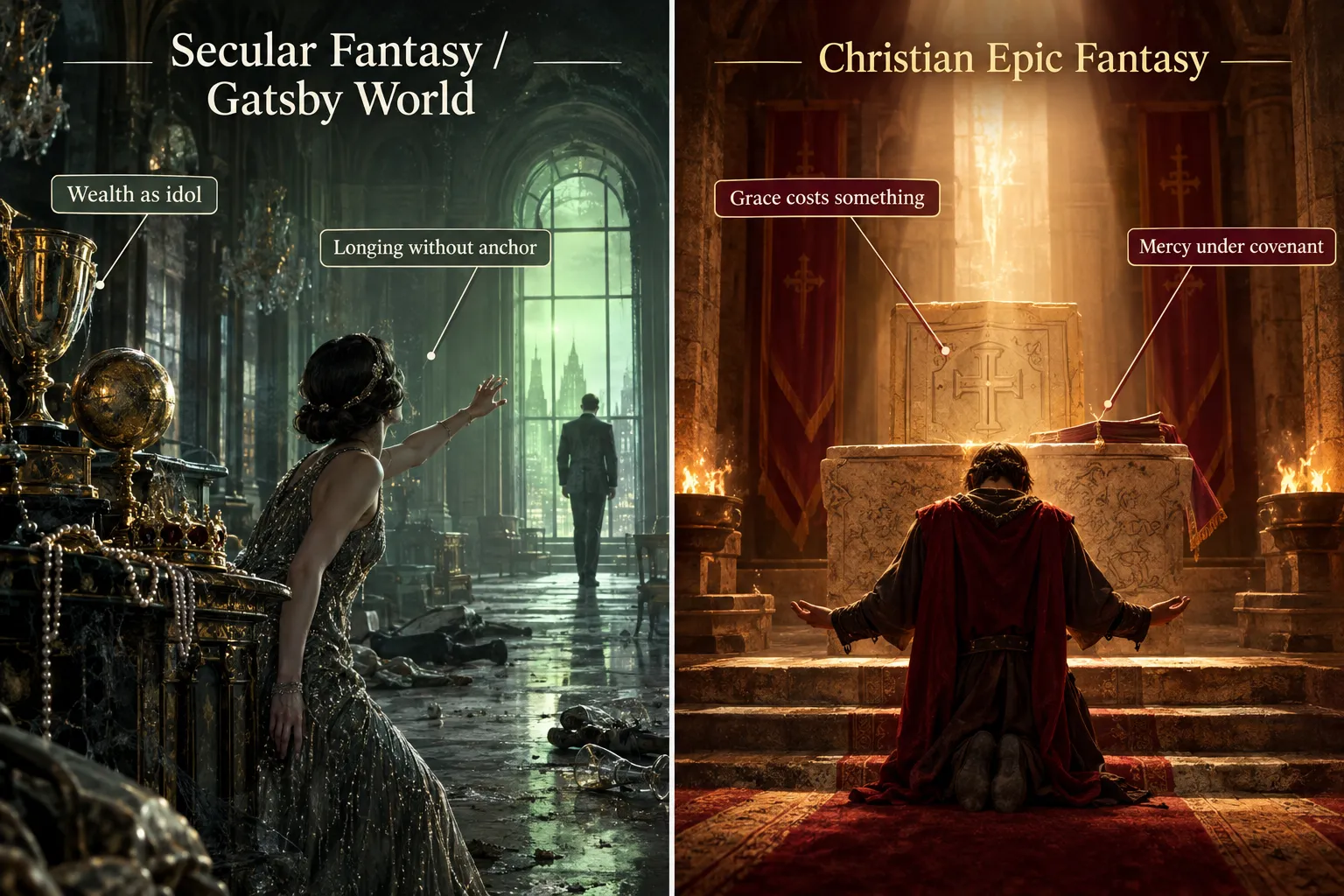
Choose Christian epic fantasy if: you want a world where the existence of God shapes the story’s logic, not just its mood.
What Are the Main Moral Themes in The Great Gatsby
The Great Gatsby organizes its entire narrative around moral collapse. Fitzgerald builds a world where wealth functions as a substitute for meaning, and the novel tracks what happens when people treat accumulation, status, and romantic obsession as ultimate goods [8].
The core moral themes are:
- Dishonesty, nearly every major character deceives someone, and the deceptions compound rather than resolve [9]
- Carelessness, Tom and Daisy’s famous “carelessness” is not laziness but a moral posture: they break things and retreat behind money [8]
- Avarice and false aspiration, Gatsby’s dream is not corrupt because it’s ambitious, but because it’s built on a lie about who he is and what Daisy represents [5]
- Death as judgment, Myrtle’s death and Gatsby’s murder function as consequences the novel refuses to soften [8]
- The absence of grace, no one in the novel extends mercy to anyone else; every relationship is transactional [9]
That last point is the most useful one for Christian epic fantasy writers. Fitzgerald’s world is morally serious precisely because grace is absent. A faith-driven world becomes morally serious when grace is present but costs something to receive.
How Can The Great Gatsby‘s Themes Apply to Christian Worldbuilding
The themes in The Great Gatsby apply to Christian worldbuilding as a foil, a structural opposite that clarifies what faith-driven fiction is actually doing. When a Christian epic fantasy world is built well, it answers every question Gatsby raises without ever referencing the novel directly.
Here’s how the translation works in practice:
| Gatsby’s World | Christian Epic Fantasy Equivalent |
|---|---|
| Green light: longing with no anchor | Covenant promise: longing with a real object |
| Wealth as identity | Calling as identity, and the cost of abandoning it |
| Carelessness as moral posture | Stewardship as moral posture, and what it demands |
| Death without redemption | Death that opens the question of grace |
| No one extends mercy | Mercy extended at personal cost, earned grace |
The key craft lesson: Fitzgerald never explains that his characters are morally empty. He shows it through what they want, what they do to get it, and what it costs everyone around them [5]. Christian epic fantasy should work the same way. A character who chooses covenant faithfulness over personal gain doesn’t need to deliver a speech about it. The choice and its consequence carry the weight.
What Makes a Fantasy World Faith-Driven Instead of Just Having Religious Elements
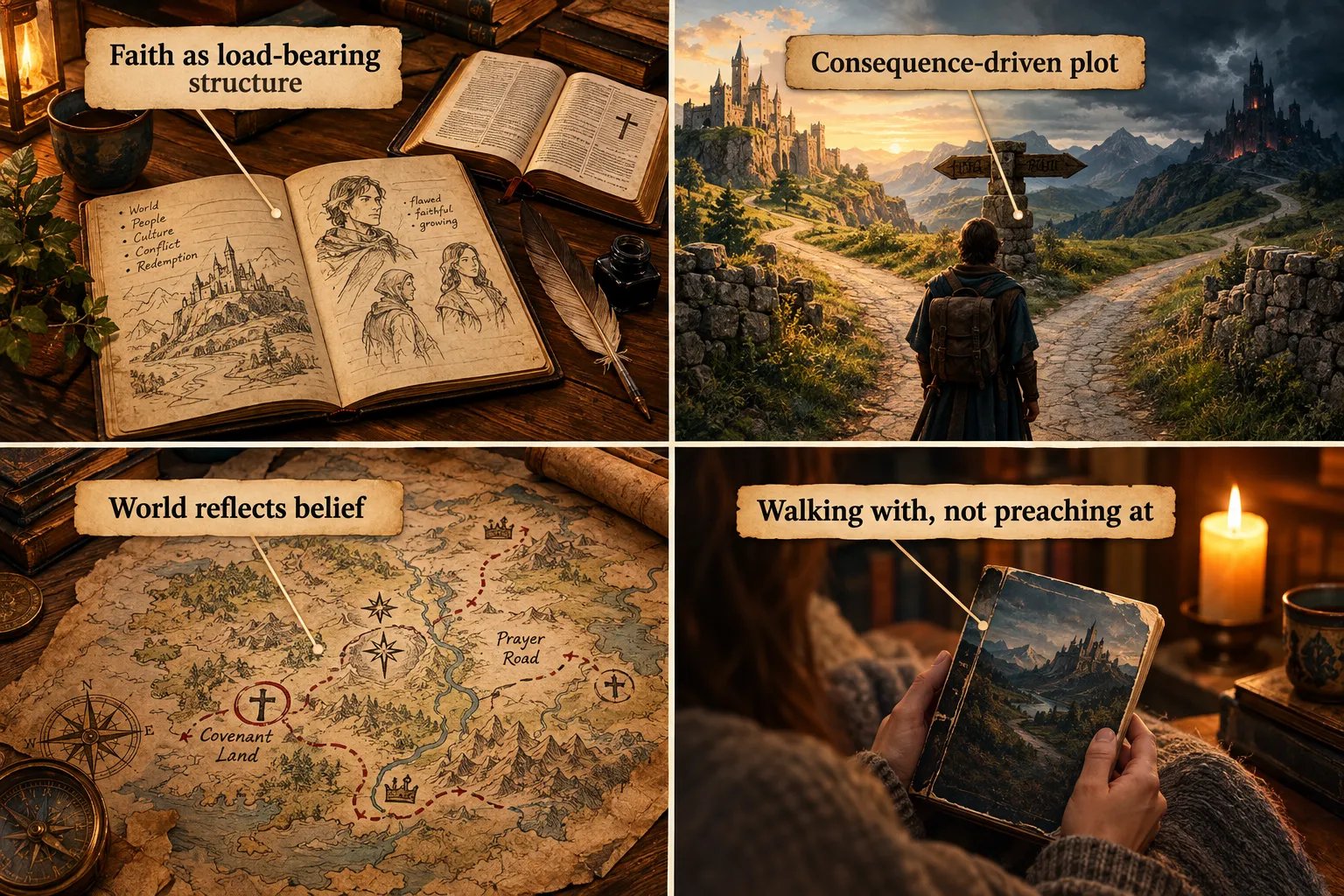
A faith-driven fantasy world is one where belief is structurally embedded in how the world works, not just in what characters say about it. Religious elements (temples, priests, prayer scenes) can exist in any secular fantasy. What makes a world faith-driven is that the theology is load-bearing.
Three tests for whether faith is actually load-bearing:
- Does disbelief have consequences in the world’s logic? If a character abandons covenant and nothing changes in how the world responds to them, faith is decoration.
- Does mercy cost the one who extends it? Cheap grace is not faith-driven worldbuilding, it’s wish fulfillment with religious vocabulary.
- Does the world’s history reflect a divine perspective on justice? A faith-driven world has a moral arc, even if characters can’t see it clearly from inside it.
The Sarel Chronicles approach this through the Great Map, a record of answered prayers that becomes a tool of institutional control. The faith is load-bearing because the question of who gets recorded and who gets left off the map drives every conflict in the story. That’s not a religious element added to a fantasy plot. That’s theology shaping the world’s power structure.
For more on how prayer, prophecy, and miracles function as worldbuilding tools, see Christian Epic Fantasy With Faith-Integrated Magic Systems: How Authors Use Prophecy, Prayer, and Miracles in Worldbuilding.
Best Examples of Christian Epic Fantasy Novels
The strongest examples of Christian epic fantasy in 2026 share one quality: faith is woven into the world’s structure, not announced in the dialogue.
Foundational examples:
- C.S. Lewis, The Chronicles of Narnia, allegorical, with Aslan as an explicit Christ figure; the faith is overt and the emotional power is real
- J.R.R. Tolkien, The Lord of the Rings, faith-integrated without allegory; providence, mercy, and eucatastrophe operate as the world’s deep grammar
- Stephen Lawhead, The Pendragon Cycle, Celtic Christianity woven into Arthurian myth, with redemption that costs the characters genuinely
Contemporary examples on Kindle Unlimited:
- The Sarel Chronicles (Silas Bellhaven), a map-scribe discovers that the institution recording divine favor has been deciding whose prayers count
- The Kethara Chronicles (Silas Bellhaven), covenant memory as physical object, in a world where an empire wants mercy quantified and controlled
The Realm Makers Conference in 2026 drew nearly 350 in-person attendees and 103 vendor booths, with Enclave Publishing, a speculative Christian press with over 100 titles, noting that the genre “reflects the creativity of God” because “there is no limit to the possibilities.” That’s not marketing language. That’s a theological argument for why Christian worldbuilding should be expansive rather than cautious.
See the 2026 Christian Fantasy Boom: How Epic Faith-Focused Series Are Breaking Out Beyond Narnia Retellings for a broader survey of what’s gaining traction right now.
How Do You Avoid Preachy Dialogue When Writing Faith-Based Fantasy
Preachy dialogue happens when a character says what the author wants the reader to believe, rather than what that character would actually say under pressure. The fix is the same in Christian epic fantasy as it is in any literary fiction: let the world do the teaching, not the characters.
Practical rules:
- Never let a character explain a theme. If a character says “true mercy means giving without expecting return,” the scene is over. If a character gives without expecting return and it costs them something visible, the reader understands mercy without being told.
- Put faith under fire. A character who believes easily and speaks about it smoothly is unconvincing. A character who believes through doubt, failure, and cost is the one readers trust.
- Use consequence as your preacher. In The Great Gatsby, Fitzgerald never tells us that Gatsby’s dream is hollow. The green light, the parties no one remembers, the funeral with no mourners, the world shows it [8]. Christian epic fantasy should trust the same technique.
This is the core of what it means to write fiction that walks with readers rather than talks at them. For a longer treatment of keeping pace while handling spiritual themes, see Balancing Action and Faith: How Christian Epic Fantasy Authors Keep the Pace While Exploring Spiritual Themes.
What’s the Difference Between Allegory and Faith-Integrated Fantasy Worldbuilding
Allegory maps fictional elements directly onto theological or spiritual realities, Aslan is Christ, the White Witch is evil, the Stone Table is the cross. Faith-integrated worldbuilding doesn’t map; it inhabits. The world operates according to a theological logic, but no character or object stands in for a specific doctrine.
Allegory: Best when the author wants the spiritual meaning to be unmistakable. Risk: readers who recognize the map stop exploring the territory.
Faith-integrated worldbuilding: Best when the author wants faith to feel lived rather than illustrated. Risk: the theological logic must be consistent enough that readers feel it without being told it.
Neither approach is wrong. Lewis chose allegory deliberately and it worked. Tolkien resisted allegory deliberately and that worked too. The craft question is which approach serves the story you’re actually trying to tell.
For more on this distinction, the Fantasy Allegory tag on this blog collects pieces that work through specific examples.
Can Secular Literature Like Gatsby Actually Improve Christian Storytelling
Yes, and the reason is specific. The Great Gatsby is a masterclass in trusting the reader. Fitzgerald never explains his moral vision. He constructs a world where the moral consequences are visible and lets readers draw their own conclusions [5][9].
Christian fiction has historically struggled with that trust. The impulse to make the spiritual meaning clear, to ensure no reader misses the point, produces exactly the preachiness that drives readers away. Studying how Fitzgerald handles moral weight without moralizing is directly applicable craft instruction.
What Gatsby teaches Christian epic fantasy writers:
- Symbols carry more weight than speeches (the green light, the eyes of Doctor T.J. Eckleburg)
- Consequences are more convincing than commentary
- Moral complexity in secondary characters makes the world feel real, not every character needs a clear moral valence
- Endings that don’t resolve cleanly are more honest than tidy ones
The eyes of Doctor T.J. Eckleburg, faded, watching, unable to intervene, are often read as a comment on the absence of God in Gatsby’s world [9]. A Christian epic fantasy writer can use that image in reverse: what does a world look like where those eyes are not faded, not absent, and not indifferent? That’s not borrowing from Gatsby. That’s using Gatsby as a foil to clarify what faith-driven worldbuilding is actually doing differently.
Common Mistakes Writers Make When Mixing Faith and Fantasy Genres
The most common mistakes in Christian epic fantasy fall into two categories: too much faith content delivered badly, or too little faith content delivered safely.
Too much, delivered badly:
- Characters who speak in theological abstractions under pressure
- Conversion moments that resolve moral tension instead of deepening it
- A world where God always intervenes before the cost becomes real
Too little, delivered safely:
- Faith as background detail, a church exists, characters mention prayer, but belief never changes a plot outcome
- Moral questions raised but not answered by the world’s logic
- “Clean” content that avoids darkness so thoroughly that grace has nothing to redeem
The middle path: faith under fire. Characters who believe and are tested, worlds where mercy is real but not free, grace that shows up after cost rather than instead of it. That’s earned grace, and it’s what separates fiction that readers trust from fiction that feels like a lesson.
See Faith in Fiction Across Genres: How Much Is Too Much for a genre-by-genre breakdown of where the balance actually sits.
How Much Religious Content Should a Christian Epic Fantasy Actually Include
There’s no fixed ratio, but there is a useful test: does the religious content serve the story, or does the story serve the religious content? When faith is load-bearing, the answer is always the former.
Practical guideline by story element:
- World structure: Faith should shape the world’s rules visibly, how power works, what mercy costs, what judgment looks like.
- Character motivation: At least one protagonist’s core conflict should be inseparable from their faith, not just their personality.
- Plot consequences: At least one major plot turn should hinge on a faith-driven choice and its real cost.
- Dialogue: Faith can appear in conversation, but never as the primary vehicle for theme delivery.
Editors at Realm Makers 2026 noted a strategic shift toward “faith-adjacent” content, stories that prompt conversations rather than deliver overt evangelism. That’s not a retreat from faith. It’s a more sophisticated understanding of how fiction actually works on readers.
Who Is the Audience for Christian Epic Fantasy
The core audience for Christian epic fantasy is readers who want their faith represented honestly in fiction, not preached at, not sanitized, but present and real. In 2026, that audience is measurably growing: religious press revenue reached $413.6 million year-to-date through June, up 1.6% from the prior year, and new faith-based imprints like Hachette’s Apiary launched specifically to reach readers seeking spiritual and emotional depth in fiction.
Primary reader profile:
- Women 35-65, Kindle Unlimited subscribers
- Already reading Christian mystery, thriller, or inspirational fiction
- Want real stakes, characters who doubt, fail, and find grace through cost
- Actively avoiding graphic content without wanting sanitized stories
Secondary audience:
- Tolkien and Lewis readers who want contemporary secondary-world fiction with the same theological seriousness
- Fantasy readers who are quietly Christian and tired of worlds where faith is absent or mocked
For a data-grounded look at how this audience behaves on Kindle Unlimited, see What Makes a Christian Fantasy Book Different from Regular Fantasy.
How Do You Write Moral Complexity in Faith-Driven Fantasy Like Gatsby Does With Wealth
The Great Gatsby achieves moral complexity by making Gatsby sympathetic and his dream understandable, even as the novel shows clearly that the dream is built on lies and will end in death [5]. The reader holds both truths at once. That’s the target for Christian epic fantasy: characters whose faith is real and whose failures are also real, without one canceling the other.
Craft techniques:
- Give your morally compromised characters genuinely good reasons for their choices
- Let the consequences of wrong choices fall on innocent people, that’s how Fitzgerald makes carelessness feel evil rather than just foolish
- Resist the urge to signal a character’s moral status through their speech patterns; let their choices carry it
- Allow your protagonist to be wrong about something important for most of the story
The Kethara Chronicles works this way: the empire’s auditors are not cartoonish villains. They believe they are containing mercy for good reasons. The horror is that their logic is internally consistent, and that’s what makes the covenant word Amara and Sela carry feel genuinely costly to speak.
Is Christian Epic Fantasy Still Marketable to Mainstream Readers
Christian epic fantasy is increasingly marketable beyond its core faith audience, particularly when the faith content is integrated rather than overt. The “faith-adjacent” framing emerging from publishers in 2026 reflects a real market reality: readers who don’t identify as Christian will engage with stories built on covenant, mercy, and earned grace, they just need those themes to arrive through story rather than through statement.
The comparison to Tolkien is instructive. The Lord of the Rings is deeply Catholic in its structure and assumptions, but most of its readers have no idea. They feel the weight of providence, the cost of mercy, the eucatastrophic turn, without ever being told what those things mean theologically. That’s the model. Faith-driven worldbuilding that trusts its own logic doesn’t need to announce itself.
FAQ
What is the main difference between Christian epic fantasy and regular epic fantasy? Christian epic fantasy treats faith as structurally load-bearing, it shapes the world’s rules, costs, and mercy. Regular epic fantasy may include religious elements, but belief doesn’t change how the world’s logic operates.
Why is The Great Gatsby useful for Christian fiction writers? Fitzgerald builds a morally serious world without moralizing. He trusts symbols and consequences to carry meaning rather than character speeches. That’s a direct craft lesson for faith-driven authors who want to avoid preachiness.
What does “earned grace” mean in Christian epic fantasy? Earned grace means mercy arrives after cost, the character has genuinely suffered the consequences of their choices before grace enters. It’s the opposite of cheap grace, where forgiveness resolves tension without the character paying anything real.
Can a Christian epic fantasy novel appeal to non-Christian readers? Yes, when the faith is integrated into the world’s logic rather than stated in the dialogue. Tolkien’s work is the clearest proof: deeply theological, widely read by secular audiences.
How do you avoid allegory becoming heavy-handed? By ensuring every element works on its own story terms first. If a character or object only makes sense as a symbol, the allegory is too thin. If it works as a character or object and also carries symbolic weight, it’s doing its job.
What’s the biggest craft mistake in Christian epic fantasy? Resolving moral tension too cleanly, especially through conversion moments that arrive without real cost. Fitzgerald never resolves Gatsby’s moral tension cleanly, and that’s why the novel still carries weight decades later.
How much faith content is too much in a Christian epic fantasy? When the story exists to deliver the faith content rather than the faith content existing to deepen the story, the balance has tipped. Faith should be load-bearing, not the load itself.
Is the Christian epic fantasy market growing in 2026? Yes. Religious press revenue is up year-to-date, new faith-based imprints are launching, and the Realm Makers Conference continues to grow, reflecting a widening editorial range from overt Christian fiction to faith-adjacent speculative stories.
What classic literature besides Gatsby is useful for Christian worldbuilding? Dostoevsky’s The Brothers Karamazov (faith under philosophical fire), Tolstoy’s Anna Karenina (consequence as moral architecture), and Flannery O’Connor’s short fiction (grace arriving violently, through cost) are all worth studying for the same reasons Gatsby is.
What’s the difference between “faith-adjacent” and “Christian” fiction? “Faith-adjacent” stories prompt spiritual conversations without overt evangelism, the faith operates beneath the surface. “Christian” fiction makes the faith explicit. Both are valid; the choice depends on the story and the intended audience.
Conclusion: The Green Light and the Covenant Stone
The Great Gatsby ends with Nick Carraway watching the green light across the water, that unreachable thing Gatsby spent his life reaching for, and observing that we are all boats against the current, borne back ceaselessly into the past [9]. It’s one of the most honest endings in American literature precisely because it offers no comfort. The longing is real. The object of the longing was never real. And there is nothing to anchor the reaching.
Christian epic fantasy answers that image not by arguing with it, but by building worlds where the longing has a real object, and where reaching for it costs something true. That’s not a theological rebuttal to Fitzgerald. It’s a different kind of honesty about the same human condition.
The craft lesson from this comparison between Christian epic fantasy vs. The Great Gatsby and classic literature’s moral themes is this: the faith-driven world earns its hope by taking the darkness seriously first. Cheap hope is as hollow as Gatsby’s parties. Hope in the dark, hope that has looked at the cost and chosen covenant anyway, is the thing that makes a secondary world feel true.
Actionable next steps for writers:
- Reread The Great Gatsby specifically for how Fitzgerald uses consequence rather than commentary to carry moral weight
- Audit your current worldbuilding: is faith load-bearing, or is it decoration?
- Identify one place in your manuscript where a character explains a theme, and cut the explanation, trusting the scene to carry it
- Study the Balancing Action and Faith framework for keeping spiritual themes from slowing plot momentum
- Browse the Redemption in Fantasy tag for examples of how other authors handle earned grace in secondary-world settings
References
[1] 827456 1183964 – http://dspace.unive.it/bitstream/handle/10579/6733/827456-1183964.pdf?sequence=2 [5] Mcadams Ethics – https://fitzgerald.narod.ru/critics-eng/mcadams-ethics.html [8] Moral Decay – https://www.revisiongenie.com/tools/quote-bank/the-great-gatsby/themes/moral-decay [9] Morality – https://www.enotes.com/topics/great-gatsby/themes/morality