Last updated: September 18, 2026
Quick Answer: Christian cozy mystery heroines in faith communities, pastors’ wives, church volunteers, and ministry leaders as sleuths, work so well because their spiritual roles give them natural access to secrets, a community’s trust, and a moral framework that shapes every decision they make. These women aren’t detectives by profession; they’re detectives by position. Their faith isn’t a backdrop, it’s the reason they can’t look away when something is wrong.
Key Takeaways
- Ministry roles create natural sleuths. Pastors’ wives, deaconesses, and church volunteers move through a community’s most private moments, grief, confession, financial need, which puts them exactly where secrets live.
- Faith shapes the investigation. A Christian heroine doesn’t just want to catch a killer; she wants to understand what went wrong and whether mercy is still possible. That tension is what separates faith-based cozy mystery from secular counterparts.
- The best heroines carry real spiritual weight. They doubt, they pray without easy answers, and they sometimes protect the wrong person for the right reason. Earned grace, not cheap resolution.
- Church settings are realistic mystery territory. Donation drives, potlucks, prayer lists, and committee meetings all generate the kind of low-level conflict, jealousy, old debts, hidden shame, that cozy mysteries run on.
- The genre is growing in 2026. New releases like When Daylight Is Gone feature four pastors’ wives hunting a predator in Appalachian wilderness, showing the archetype is actively expanding beyond small-town whodunits.
- Readers want faith represented honestly. The appeal isn’t comfort without cost, it’s comfort after cost. Stories that walk with the reader, not talk at them.
- Kindle Unlimited is the primary discovery channel for this subgenre, with clean Christian fiction showing strong borrow performance among women 35-65. [4][5]
- Avoiding preachiness is the craft challenge. Faith shows up in what the heroine does under pressure, not in what she quotes at other characters.
What Makes a Good Christian Cozy Mystery Heroine
A strong Christian cozy mystery heroine in a faith community is defined by three things: access, accountability, and a moral cost to staying silent.
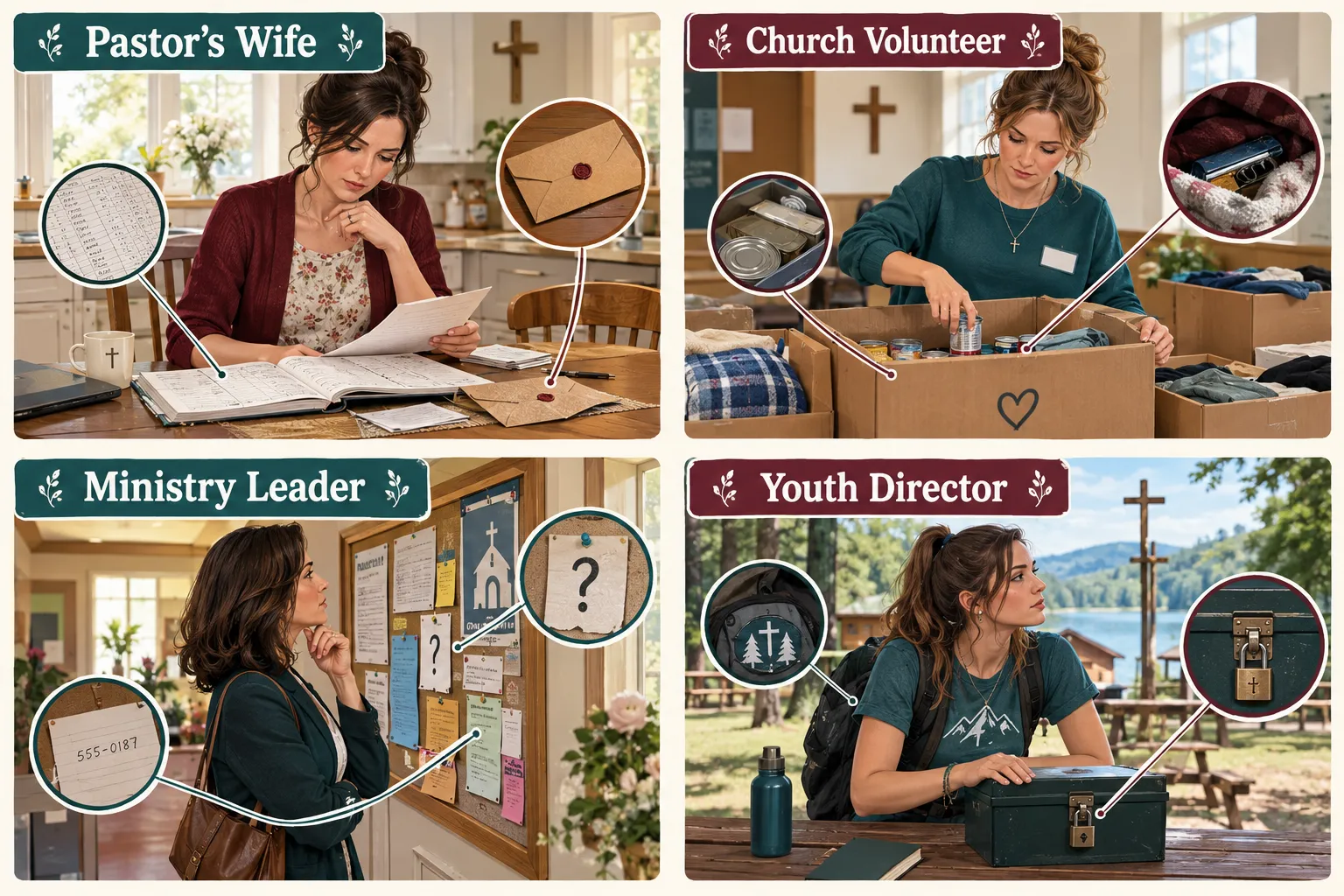
Access means she’s already inside the rooms where secrets are kept. The pastor’s wife who organizes the benevolence fund knows which families are drowning in debt. The church volunteer who runs the clothing drive has seen what people donate when they’re trying to get rid of evidence. The ministry leader who coordinates the prayer chain hears things people only say when they think God is the only one listening.
Accountability means she answers to something larger than her own curiosity. A secular sleuth can walk away. A woman rooted in her faith community cannot, because the people involved are her people, and justice is not optional when you believe mercy and justice belong together.
The moral cost is what separates a good heroine from a great one. She doesn’t just solve the crime. She has to decide what to do with what she finds. Sometimes the truth will hurt someone she loves. Sometimes the guilty party is sitting in the same pew she is. That’s where faith under fire becomes the actual story.
Choose this archetype if: you want a protagonist whose spiritual life creates plot complications, not just plot decoration.
How Faith Communities Work in Cozy Mysteries
Faith communities function as self-contained social ecosystems, and that’s exactly what a cozy mystery needs. Small, interconnected, full of history, and governed by unspoken rules about what gets said and what gets buried.
A church in a cozy mystery isn’t just a setting. It’s a pressure system. Consider what a single congregation holds:
- Financial records, who tithes, who borrows from the benevolence fund, who handles the books
- Relational history, decades of marriages, feuds, forgiven debts, and unforgivable ones
- Volunteer hierarchies, who leads the women’s ministry, who got passed over, who’s been doing the same job for thirty years without credit
- Pastoral authority, and the complicated dynamics of who has access to the pastor’s ear
These aren’t invented tensions. They’re the ordinary friction of any community that takes both love and accountability seriously. For a mystery writer, that friction is fuel.
The Mercy House Mysteries series, set in Juniper Gap, Tennessee, builds every book around exactly this kind of community infrastructure. In A Donation to Die For, a mislabeled donation box contains a ledger and a deacon who died before he could confess. The church setting isn’t incidental, it’s load-bearing. For a deeper look at how these community structures shape the genre, see Christian Cozy Mystery Tropes in Small Communities.
Can a Pastor’s Wife Solve Crimes Without Being Unrealistic
Yes, and in 2026, the archetype is more culturally resonant than ever.
The pastor’s wife sleuth works because her position is genuinely unusual. She holds informal authority without official power. She’s trusted by the congregation but not employed by it. She hears things in the parking lot after service that never make it into any official record.
Emilie Richards’ Ministry is Murder series established this archetype in Christian fiction decades ago, with Aggie investigating crimes inside her husband’s church community. The archetype has only grown since. A 2026 release, When Daylight Is Gone, features four pastors’ wives who turn amateur investigators while tracking a predator through the Appalachian wilderness, their faith and ministry roles explicitly driving the investigation, not decorating it.
The realism question comes down to motivation and access. A pastor’s wife who stumbles into a mystery because she was already in the room where it happened is believable. One who inserts herself into police investigations for no reason isn’t. The best versions of this character have no choice but to act, because the crime touches her community, her family, or her conscience in a way she cannot walk away from.
Common mistake to avoid: Making the pastor’s wife too passive (waiting for clues to come to her) or too aggressive (acting like a trained detective). The sweet spot is a woman who uses the tools she already has, relationships, institutional knowledge, and a deep sense of what’s wrong, to find what others miss.
Christian Cozy Mystery vs. Secular Cozy Mystery: Key Differences
Christian cozy mysteries and secular cozy mysteries share a structure, amateur sleuth, small community, low graphic violence, but they diverge in what the investigation means.
| Element | Christian Cozy Mystery | Secular Cozy Mystery |
|---|---|---|
| Moral framework | Faith-rooted; justice and mercy in tension | Personal ethics; justice as closure |
| Heroine’s motivation | Accountability to community and conscience | Curiosity, personal stakes, or professional role |
| Resolution tone | Earned grace, redemption costs something | Satisfying but not spiritually freighted |
| Content | Clean, no graphic violence, language, or explicit content | Varies widely by author |
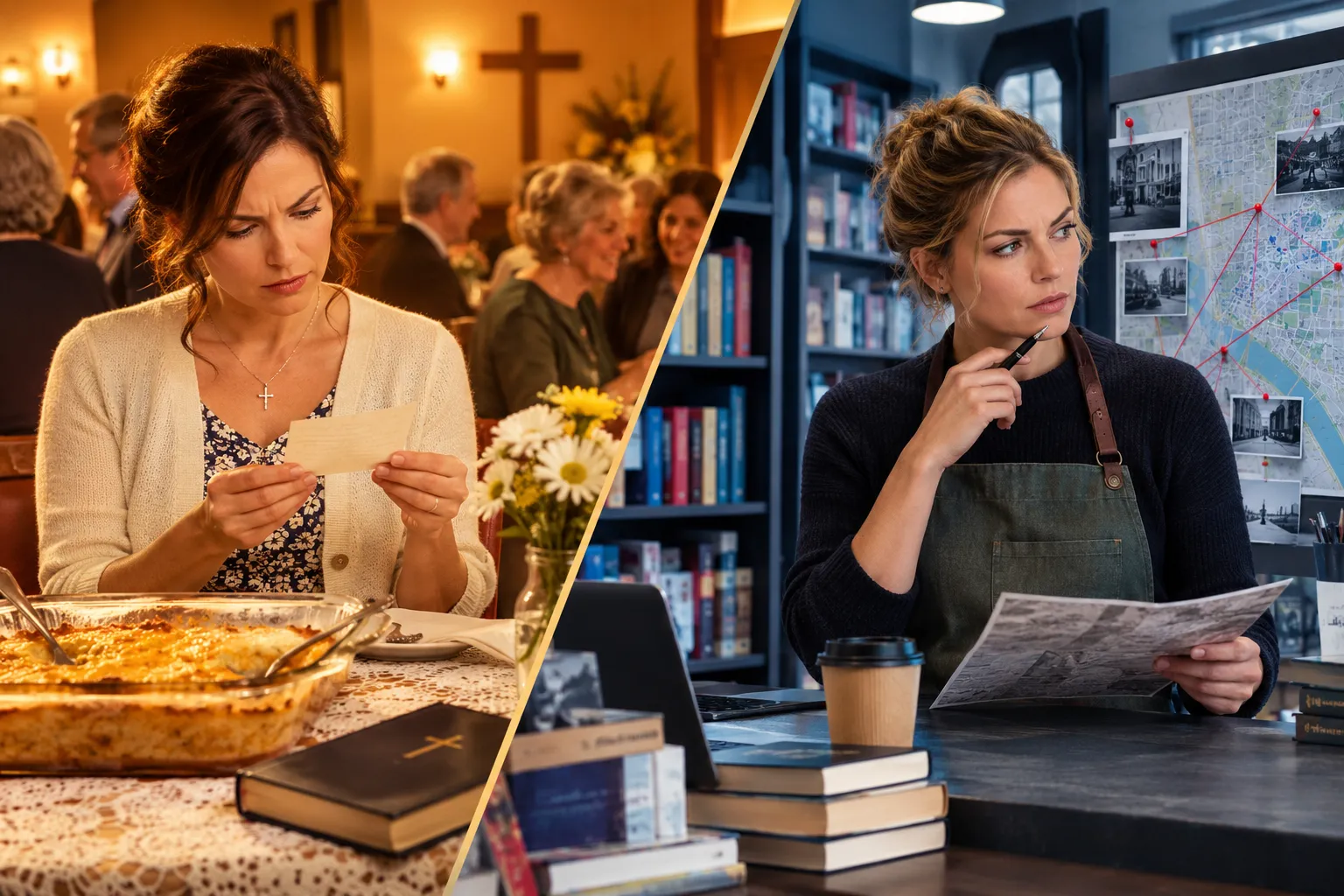
| Community role | Church, ministry, faith-based organization | Bookshop, bakery, small-town neighborhood |
The deepest difference is this: in a Christian cozy mystery, the heroine’s faith is tested by the investigation. She may discover that someone she respected is guilty. She may have to choose between protecting a friend and telling the truth. The resolution isn’t just “the killer is caught”, it’s “here is what justice costs, and here is what mercy looks like after it.” For more on this distinction, see Christian Cozy Mystery vs. True Crime: How Faith-Based Whodunits Satisfy Suspense Without Exploitation.
Common Tropes in Faith-Based Cozy Mysteries
Faith-based cozy mysteries have developed their own set of recurring tropes, and the best ones use those tropes as structural tools, not shortcuts.
The most reliable tropes include:
- The ministry object as evidence. A hymnal with margin notes, a prayer list with a suspicious name, a donation box hiding a ledger. Objects that carry spiritual significance become clues. (The Hymnal Margin Murder, A Donation to Die For)
- The trusted insider who isn’t. Someone the congregation trusts completely, a deacon, a longtime volunteer, a ministry leader, turns out to be hiding something. The heroine’s access to this person is exactly what makes the betrayal land.
- The secret that predates the crime. The murder didn’t start this week. It started with a decision made years ago, a debt, a shame, a cover-up, that finally ran out of room to hide.
- Faith tested by the investigation. The heroine’s prayer life, her relationship with her husband’s ministry, or her standing in the community is directly threatened by what she finds. She doesn’t come out of the book unchanged.
- Mercy and justice in direct conflict. The guilty party is someone who also did genuine good. Turning them in costs the community something real. This is where hope in the dark becomes more than a tagline.
For a full breakdown of how these tropes function across the genre, Christian Cozy Mystery Tropes Readers Actually Love is worth reading alongside this article.
How Do Authors Balance Faith and Mystery in Cozy Books
The craft answer is: faith shows up in what the character chooses, not in what she says about God.
A heroine who stops to deliver a three-paragraph reflection on forgiveness in the middle of a chase scene has broken the story. A heroine who, when she finally has the killer cornered, chooses to call for help rather than take matters into her own hands, and the reader understands that choice is rooted in something she believes about justice belonging to God, that’s faith under fire without a word of preaching.
Practical techniques authors use:
- Let the faith create the conflict, not resolve it. Her belief that every person is redeemable is exactly why she keeps second-guessing her suspect list.
- Use church objects and rituals as plot mechanics. The prayer chain, the benevolence fund, the annual quilt auction, these aren’t decoration; they’re the machinery the plot runs on.
- Show doubt as part of the faith. She prays and doesn’t get an answer. She asks for guidance and has to act anyway. That’s more honest, and more interesting, than a heroine whose faith always delivers clarity on cue.
- Earn the grace. If the book ends with forgiveness, that forgiveness should cost both the giver and the receiver something real. Redemption that costs something is the whole point.
See also: Faith in Fiction Without Preaching: How Christian Authors Keep Story First and Faith in Fiction Across Genres: How Much Is Too Much.
Ministry Leader Sleuth Characters: What Makes Them Work
Ministry leaders, youth directors, women’s ministry coordinators, deaconesses, outreach coordinators, make compelling sleuths for reasons slightly different from the pastor’s wife archetype.
Where the pastor’s wife has relational access, the ministry leader has institutional access. She runs the programs. She sees the budget. She knows who volunteered for what and who quietly stopped showing up. She’s also more likely to have direct conflict with other leaders, territory disputes, theological disagreements, personality clashes, which gives her both suspects and blind spots.
The best ministry leader sleuths carry a specific tension: they care deeply about the institution they serve, which means discovering wrongdoing inside it is personally devastating. The church isn’t just where she works. It’s where she belongs. When the crime touches the institution itself, she has to decide whether her loyalty is to the building or to the truth.
What readers respond to: A ministry leader who is competent, slightly underestimated, and whose spiritual life is genuinely complicated by what she finds. Not a saint. Not a skeptic. Someone in the middle, doing the work.
Where to Find Christian Cozy Mystery Series With Faith-Community Heroines
The best discovery channels in 2026 for Christian cozy mystery heroines in faith communities are:
- Kindle Unlimited, the primary platform for this subgenre, with strong borrow performance among women 35-65 [4][5]
- Goodreads lists, search “minister’s wife sleuth,” “church cozy mystery,” or “Christian amateur detective” for curated reader lists
- Amazon series pages, browsing by series rather than individual titles helps identify authors with consistent faith integration
Series worth starting with:
- The Mercy House Mysteries by Silas Bellhaven, Nora Bell Hartley, a church thrift store volunteer in Juniper Gap, Tennessee. Ten books, all available on Kindle Unlimited. Browse the series.
- Ministry is Murder by Emilie Richards, Aggie, a pastor’s wife, investigates crimes inside her husband’s congregation. A foundational series in the archetype.
- When Daylight Is Gone (2026), four pastors’ wives as amateur investigators in an Appalachian thriller setting.
For a broader reading list across Christian fiction subgenres, Best Christian Fiction Authors Across Cozy Mystery, Western, Fantasy, Thriller, and LitRPG covers the full landscape.
Do Cozy Mysteries With Pastors’ Wives Need to Be Preachy
No, and the best ones actively resist it. Preachiness is a craft failure, not a faith requirement.
A pastor’s wife who quotes scripture at suspects, delivers mini-sermons to grieving characters, or resolves every moral question with a tidy verse has stopped being a character and started being a mouthpiece. Readers, especially the Christian readers who make up the core audience for this subgenre, recognize the difference immediately, and they don’t like it any more than secular readers do.
The alternative isn’t to strip out the faith. It’s to let the faith live in the character’s behavior, her hesitations, her relationships, and the cost she pays for doing the right thing. That’s what “walking with them, not talking at them” means in practice.
The test: If you removed all the explicit faith language from a scene, would the character’s faith still be visible in what she does? If yes, the faith is load-bearing. If no, it was decoration, and decoration is what produces preachiness.
For a full treatment of this craft question, How to Write Christian Cozy Mystery: Plot Structure, Faith Integration, and Clean Content Guidelines goes deeper.
What Readers Like About Christian Cozy Mysteries
Christian cozy mystery readers, primarily women 35-65, heavy Kindle Unlimited users, are looking for something specific that neither secular cozies nor overtly devotional fiction delivers on its own. [4][5]
They want:
- Real stakes without graphic content. The danger is genuine, but the book doesn’t require them to read through graphic violence or explicit scenes to get there.
- A heroine whose faith is honest. Not perfect. Not performative. Someone who prays and waits and sometimes gets it wrong.
- Community as comfort. The small-town church setting is part of the appeal, familiar rhythms, recognizable relationships, a world where people still bring casseroles and mean it.
- Hope that costs something. Not cheap resolution. Not a tidy conversion moment at the end. But genuine hope, the kind that shows up after the hard thing, not instead of it.
The cultural moment in 2026 is also worth noting. Netflix’s true-crime coverage of real-world pastoral abuse cases has put pastor’s wives and church power dynamics into mainstream conversation. Readers are primed to think about women in ministry as both vulnerable and capable of agency. Clean Christian fiction that takes that tension seriously, rather than sanitizing it, is meeting a real need.
FAQ
What is a Christian cozy mystery heroine? A Christian cozy mystery heroine is an amateur female sleuth whose investigation is shaped by her faith and her role in a faith community, a pastor’s wife, church volunteer, or ministry leader who finds herself in the middle of a crime she can’t ignore.
Are pastor’s wife cozy mysteries a real subgenre? Yes. The archetype has been active since at least Emilie Richards’ Ministry is Murder series, and new releases in 2026, including When Daylight Is Gone, confirm it’s a current, growing niche rather than a historical curiosity.
Do Christian cozy mysteries have to avoid all conflict? No. The best ones deal honestly with betrayal, grief, financial desperation, and moral failure inside the church. The difference is that graphic violence, explicit content, and profanity are absent, not that difficulty is absent.
Why do church settings work so well for cozy mysteries? Churches hold financial records, relational history, volunteer hierarchies, and pastoral authority, all of which generate the kind of low-level conflict and buried secrets that cozy mysteries run on.
What makes a Christian cozy mystery feel preachy? When the heroine’s faith is expressed through dialogue and scripture quotation rather than through her choices and their consequences. Faith that shows up as behavior is compelling; faith that shows up as lecture is not.
Is Kindle Unlimited a good place to find Christian cozy mysteries? Yes. Kindle Unlimited is the primary discovery and reading channel for this subgenre, with strong borrow performance among the core demographic of women 35-65. [4][5]
Can a church volunteer realistically solve a murder? In fiction, yes, because the volunteer’s access to the community’s inner workings, combined with a strong moral motivation, gives her both the means and the reason to investigate. The key is that her access must be earned by her role, not invented for plot convenience.
What’s the difference between a Christian cozy mystery and a Christian thriller? Tone and pacing. Cozy mysteries are warm, community-focused, and low on graphic content. Christian thrillers carry higher tension, more psychological weight, and often darker settings, though both can handle faith honestly.
Are there Christian cozy mystery series available on Kindle Unlimited? Yes. The Mercy House Mysteries by Silas Bellhaven is a ten-book series available on Kindle Unlimited, featuring church volunteer Nora Bell Hartley in Juniper Gap, Tennessee.
What’s the best first book to try in this subgenre? A Donation to Die For is a strong entry point, it establishes the church setting, the heroine’s role, and the faith-mystery balance without requiring any prior series knowledge.
Conclusion
Christian cozy mystery heroines in faith communities, pastors’ wives, church volunteers, and ministry leaders as sleuths, work because their spiritual roles aren’t separate from their investigations. They’re the investigation. The access, the motivation, the moral cost of staying silent, all of it flows from who these women are inside their communities.
The genre is growing in 2026, and the best of it isn’t soft or safe. It’s honest about what churches hold: old debts, buried shame, genuine love, and the complicated people who carry all three at once. The heroines who navigate that territory well are the ones whose faith is rooted deep enough to survive what they find.
Next steps for readers:
- Start with A Donation to Die For to see the church-community sleuth archetype in action
- Browse the full Mercy House Mysteries series for ten books of Juniper Gap, Tennessee
- Explore Christian Cozy Mystery Tropes Readers Actually Love for a broader view of the genre’s conventions
- Check Kindle Unlimited Trends for Christian Cozy Mysteries for what’s performing in the market right now
Hope in the dark is only worth something if the dark was real. These heroines know that. So do the readers who keep coming back for them.
References
[4] Publishers Remain Faithful to Fiction – https://www.publishersweekly.com/pw/by-topic/industry-news/religion/article/91841-publishers-remain-faithful-to-fiction.html
[5] Mysteries on the Rise in Christian Fiction – https://www.publishersweekly.com/pw/by-topic/industry-news/religion/article/100974-mysteries-on-the-rise-in-christian-fiction.html