
Last updated: September 23, 2026
Quick Answer: Christian psychological thrillers inspired by true crime interest draw on the same human curiosity, understanding dangerous minds, anticipating threats, processing fear, that drives mainstream true crime consumption. The difference is where the moral center sits. Faith-based suspense keeps the victim’s dignity intact, places conscience and consequence at the heart of the plot, and treats redemption as something that costs the characters something real. It satisfies the same appetite without making shock value the product.
Key Takeaways
- True crime interest is driven by curiosity, threat recognition, and emotion regulation, not just fascination with violence, according to research by psychologist Corinna Perchtold-Stefan and colleagues (cited in The Economic Times, September 2026).
- Christian psychological thrillers can meet that curiosity without centering the offender or exploiting the victim’s suffering.
- Faith-based suspense differs from secular crime fiction primarily in its moral architecture: conscience, accountability, and the possibility of genuine change are load-bearing story elements, not decorative add-ons.
- The genre avoids graphic violence not by avoiding darkness, but by refusing to make darkness the point.
- Frank Peretti’s This Present Darkness, with over 15 million copies sold, demonstrates that spiritually framed conflict can generate massive commercial traction without imitating the most graphic conventions of mainstream crime fiction.
- Fictional crime inspired by general realities, rather than direct dramatization of named victims, allows authors to explore fear, guilt, and justice without claiming ownership over a specific family’s tragedy.
- Clean Christian fiction in this space is not sanitized fiction. The stakes are real. The cost is real. The grace, when it arrives, is earned.
- Series like Silas Bellhaven’s The Gathering Light show how psychological tension can be built entirely from institutional manipulation, erased testimony, and the slow unraveling of a character’s sense of reality, no graphic content required.
What Are Christian Psychological Thrillers Inspired by True Crime Interest?
Christian psychological thrillers inspired by true crime interest are faith-rooted suspense novels that engage the same questions driving true crime’s cultural popularity, who did this, why, and what does it reveal about human nature, while grounding the narrative in a Christian moral framework. They are not retellings of real cases. They are fictional stories shaped by the same fears and curiosities that make true crime compelling, redirected through a lens of conscience, mercy, and justice.
These books typically feature:
- Psychological manipulation as the primary threat (gaslighting, institutional control, false testimony)
- Protagonists under pressure whose faith is tested, not displayed
- Crimes that carry moral weight without graphic depiction
- Resolution that involves accountability, not just revelation
The genre sits at the intersection of clean Christian fiction and psychological suspense, a space that has grown steadily as readers look for alternatives to content that leaves them unsettled in ways they didn’t choose.
How Do Faith-Based Thrillers Differ From Secular True Crime Shows?
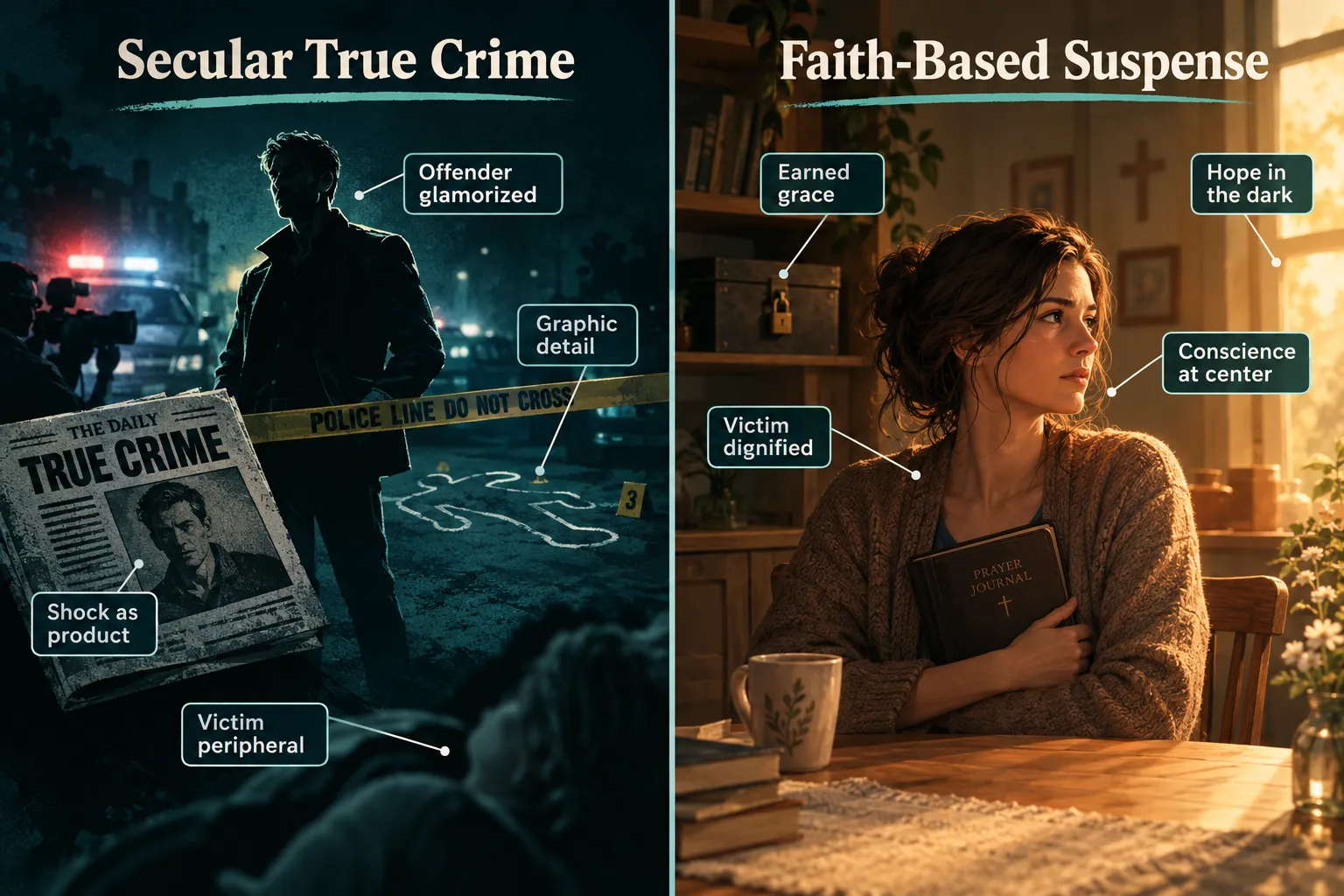
The core difference is not content rating, it’s moral architecture. Secular true crime, whether podcast, documentary, or dramatized series, frequently centers the offender. A 2026 study by researchers affiliated with Maastricht University found that participants consistently noticed this imbalance: offenders were glamorized or given narrative prominence, while victims remained peripheral. Participants also raised concerns about sensationalism, misinformation, and creators profiting from real harm.
Faith-based suspense inverts that structure. The victim’s dignity is protected. The offender’s psychology may be explored, but it is never celebrated. And the moral question, what will you do with the truth once you’re holding it?, belongs to the protagonist, not the perpetrator.
Key structural differences:
| Element | Secular True Crime | Faith-Based Suspense |
|---|---|---|
| Moral center | Offender’s psychology | Protagonist’s conscience |
| Victim’s role | Often peripheral | Dignified, story-shaping |
| Resolution | Revelation or arrest | Accountability + possibility of change |
| Darkness | Often the product | Present but not the point |
| Faith | Absent or incidental | Load-bearing story element |
This is why readers who feel vaguely used after a true crime binge often find faith-based suspense genuinely satisfying. The tension is real, but so is the hope in the dark.
Why Do Christian Suspense Stories Avoid Graphic Violence and Exploitation?
Christian suspense avoids graphic violence and exploitation because the genre’s ethical foundation holds that darkness should serve the story’s larger moral purpose, not become the product being sold. This isn’t squeamishness. It’s a deliberate creative and theological position.
Pastor and lawyer Randy Singer, speaking in a CrimeReads roundtable with other Christian suspense authors, described the balance this way: violence may be narratively necessary, but it should never become what the reader is actually buying. The moment graphic content becomes the draw, the story has stopped being about justice, conscience, or mercy, and started being about sensation.
For readers who want to understand this approach more deeply, how faith themes raise the stakes in Christian psychological thrillers breaks down exactly how spiritual stakes replace shock value without reducing tension.
The practical result: fear in Christian suspense comes from psychological and moral jeopardy, not from graphic depiction. A character who doesn’t know whether she can trust her own memory is terrifying. A prayer list with the protagonist’s name on it, written in the hand of someone who was supposed to be safe, creates genuine dread, without a single violent scene.
Can You Recommend Christian Thrillers for True Crime Fans?
True crime fans who want fiction that satisfies the same curiosity, dangerous minds, hidden motives, the gap between what people say and what they’ve done, will find strong options in the current Christian suspense market [1].
Recommended starting points:
- Silas Bellhaven’s The Gathering Light series, When Hannah Sleeps, When the Voice Breaks, and When the Prayer List Opens each follow a different woman inside a faith-based retreat where testimony is controlled, records are manipulated, and the protagonist’s own sense of reality becomes the crime scene. The spine question across all three books: who controls the record of someone’s truth? Browse the series on Amazon.
- Frank Peretti’s This Present Darkness, A 40th-anniversary collector’s edition is scheduled for November 3, 2026. The novel has sold more than 15 million copies and remained in the Christian Booksellers Association’s top ten for more than 150 consecutive weeks. Its premise, a small town, a conspiracy, prayer as active resistance, is as close to a spiritual thriller as the genre gets.
- Colleen Coble, Cara Putman, Carrie Stuart Parks, All three have built careers on Christian suspense that addresses murder, domestic violence, and abuse without gratuitous content. Coble’s position, shared in the same CrimeReads roundtable, is that a strong Christian suspense novel starts with a compelling story and organic characters, not characters built to deliver a message.
For readers who want a broader map of the genre, clean Christian psychological thriller books as alternatives to graphic psych thrillers offers a detailed reading guide.
What Makes a Psychological Thriller Ethical From a Christian Perspective?

A psychological thriller is ethical from a Christian perspective when it treats every person in the story, victim, perpetrator, bystander, as someone whose life carries moral weight. That sounds simple. It changes everything about how a story is built.
Ethical markers in faith-based psychological suspense:
- The victim is not a prop. Their suffering drives the story’s moral stakes, not its shock factor.
- The perpetrator is not glamorized. Their psychology may be explored, but the narrative does not invite admiration.
- The protagonist’s faith is tested, not performed. Doubt, failure, and cost are all present. Grace shows up after the cost, not instead of it.
- The resolution involves accountability. Mercy and justice are not opposites in this framework, they are held in tension, and that tension is the story.
- The reader is not left worse off. This is the practical test: does the story leave the reader with something, clarity, courage, a harder-won hope, or just a residue of dread?
The non-violent suspense in Christian psychological thrillers guide explores the specific craft techniques authors use to raise stakes without graphic content.
Do Christian Psychological Thrillers Still Have Real Suspense Without Graphic Content?
Yes, and the mechanism is worth understanding, because it’s counterintuitive to readers who assume tension requires graphic content. Psychological suspense draws its power from uncertainty, not imagery. The question “can I trust what I remember?” is more frightening than most crime scenes, because it puts the threat inside the protagonist’s own mind.
Christian psychological thriller plot structures using trauma, memory, and grace details how authors build this kind of tension across a full novel structure.
In The Gathering Light series, the suspense comes from:
- Institutional gaslighting, a retreat that uses therapeutic language to control what women are allowed to say about their own experiences
- Erased testimony, a protagonist who discovers her own words appearing in someone else’s file
- Slow revelation, the reader and character learning together that the system meant to help is the threat
None of that requires a graphic scene. All of it creates genuine dread. This is faith under fire, not the absence of danger, but the presence of something worth protecting when danger arrives.
How Do Faith-Based Thrillers Handle Redemption and Justice Differently?
Faith-based thrillers treat redemption as something that costs the characters something real, not a clean exit, not a dramatic conversion moment, but a slow and often painful reckoning with what was done and what it demands. Justice and mercy are held together, not traded off.
In secular crime fiction, resolution typically means the offender is caught. In faith-based suspense, resolution means the moral ledger has been honestly faced. That distinction shapes everything: who gets a voice, whose suffering is counted, whether the ending feels earned or merely convenient.
This is what the Silas Bellhaven catalog means by earned grace. Grace is not cheap. It is not delivered as a sermon. It shows up after the cost has been paid, and sometimes the cost is still being paid when the last page turns.
Can Christians Enjoy True Crime Content Responsibly?
Christians can engage with true crime content thoughtfully, but the ethical questions are real and worth taking seriously. Research published in September 2026 by psychologist Corinna Perchtold-Stefan and colleagues found that true crime interest is driven by multiple motivations: curiosity about dangerous minds, defensive vigilance, emotion regulation, excitement, and learning to anticipate threats. These are not inherently harmful motivations.
The problems arise when content:
- Centers the offender’s perspective at the expense of the victim’s dignity
- Profits from a real family’s suffering without their consent or participation
- Sensationalizes details in ways that retraumatize survivors
- Leaves the viewer with glamorized violence and no moral framework
A practical filter: Ask whether the content treats the victim as a person or as a plot device. If the victim’s name is primarily a hook and their suffering is primarily atmosphere, the content has crossed into exploitation, regardless of its production quality.
Faith-based suspense fiction offers a way to satisfy the same curiosity, understanding dangerous minds, processing fear, exploring the gap between appearance and reality, without those ethical costs.
Why Are Some True Crime Stories Problematic, and How Do Christian Versions Fix That?
The core problem in exploitative true crime is ownership: creators claiming narrative authority over a real person’s worst experience, often without consent, accuracy, or accountability. The 2026 Maastricht University study identified this pattern clearly, offenders glamorized, victims peripheral, creators profiting from real harm.
Christian fiction’s answer is not to pretend crime doesn’t exist. It’s to use fictional crime, inspired by general human realities rather than specific named cases, so that the story can explore fear, guilt, evil, and justice without claiming ownership over a specific family’s tragedy.
Fiction still carries ethical responsibilities. But a fictional protagonist whose testimony is being erased by an institution that was supposed to protect her can speak to the experience of real survivors without exploiting any one of them. That’s the difference between fiction that witnesses to hard things and content that monetizes them.
What Should I Know Before Reading Christian Psychological Thrillers?
For readers new to the genre, a few honest expectations:
- The darkness is real. These are not cozy mysteries with a spiritual veneer. Psychological manipulation, institutional abuse, and moral failure are present and treated seriously.
- The faith is not decorative. Characters pray, doubt, fail, and return to belief, sometimes in that order, sometimes not. Faith is tested and proven through the plot, not announced in the narration.
- The content is clean. No graphic violence, no explicit content, no profanity. This is a deliberate craft choice, not a limitation.
- The tension is psychological, not physical. If you’re looking for action sequences, this may not be your genre. If you’re looking for the slow unraveling of a character’s sense of reality, you’re in the right place.
- Grace costs something. Don’t expect a tidy resolution. Expect an honest one.
For readers who want to understand how trauma and memory function in these stories without graphic flashbacks, Christian psychological thriller protagonists: trauma, memory, and faith recovery is a strong next read.
Where Can I Find Christian Psychological Thrillers That Aren’t Preachy?
The best place to start is with authors who treat faith as lived experience rather than lesson. Colleen Coble’s position, that a strong Christian suspense novel begins with a compelling story and organic characters, is the right filter. If a book’s characters feel like they exist to deliver a message, it’s not the right book. If they feel like people whose faith is part of how they see the world, not a speech they’re waiting to give, that’s the genre working as it should.
Practical recommendations:
- Silas Bellhaven’s The Gathering Light, When Hannah Sleeps, When the Voice Breaks, and When the Prayer List Opens are available on Kindle Unlimited. Faith shows up in the characters’ choices and their costs, never in the narration.
- Colleen Coble, Her Rock Harbor and Hope Beach series are widely available and consistently deliver psychological tension without preaching.
- Cara Putman and Carrie Stuart Parks, Both write legally and forensically researched suspense with faith woven into character rather than announced as theme.
The clean Christian fiction TBR for 2026 offers a broader cross-genre reading list for Kindle Unlimited subscribers.
FAQ
Q: Do Christian psychological thrillers have to be set in a church or religious community? A: No. Many are set in ordinary domestic or professional environments. The faith is in the characters, not the setting, though some, like The Gathering Light series, do use a faith-based institution as the source of threat, which creates its own particular kind of tension.
Q: Are these books only for Christian readers? A: No. Readers who want psychological suspense without graphic content, and who appreciate stories where moral questions carry real weight, often find the genre satisfying regardless of their own faith background.
Q: What’s the difference between Christian suspense and Christian cozy mystery? A: Cozy mysteries are lighter in tone, community-centered, and typically resolve with warmth. Christian psychological thrillers are darker in atmosphere, more interior in focus, and deal with threats that are harder to contain. Both are clean; the emotional register is very different.
Q: Can a Christian thriller address abuse or trauma honestly? A: Yes, and the best ones do. The commitment is to honest portrayal without graphic exploitation. Trauma is present, real, and taken seriously. The difference is that it serves the character’s moral and spiritual arc, not the reader’s appetite for disturbing detail.
Q: Is The Gathering Light series connected to the Mercy House Mysteries? A: They share an author and a worldview, but not characters or settings. The Gathering Light introduces a new protagonist and household in each book. The Mercy House Mysteries follow Nora Bell Hartley in Juniper Gap, Tennessee, across a cozy mystery series.
Q: Why do some Christian thrillers feel preachy? A: Usually because the author has used a character as a mouthpiece rather than letting faith emerge through choice and consequence. When a character stops the plot to explain what the reader should believe, the story has stopped working. The best faith-based suspense trusts the reader to draw their own conclusions from what the characters do under pressure.
Q: Are Christian psychological thrillers available on Kindle Unlimited? A: Many are, including Silas Bellhaven’s The Gathering Light series. KU availability has expanded significantly for the genre in 2026 [1].
Q: Do these books have romantic subplots? A: Some do, some don’t. Silas Bellhaven’s The Gathering Light series maintains a romance-absent content contract. Other Christian suspense series, particularly those by Colleen Coble, include romantic threads alongside the suspense.
Conclusion
Christian psychological thrillers inspired by true crime interest answer a real and legitimate human need: to understand how people deceive, how institutions fail, how evil hides in plain sight, and what it costs someone to tell the truth once they’re holding it. That last question is the one faith-based suspense is built to carry.
The genre rejects exploitation not by avoiding hard things, but by refusing to make hard things the product. Victims are people, not atmosphere. Perpetrators are not glamorized. Grace, when it arrives, has been earned through cost and consequence, not handed out as a reward for enduring the plot.
Next steps for readers:
- Start with When Hannah Sleeps if you want psychological suspense built around institutional manipulation and erased testimony.
- Browse The Gathering Light series page for the full three-book arc.
- Read how faith themes raise the stakes in Christian psychological thrillers to understand the craft mechanics behind the genre.
- Explore the Silas Bellhaven author page for the full catalog across mystery, thriller, western, and fantasy, all rooted in the same conviction that God is real, stories matter, and the two have always belonged together.
References
[1] Best Christian Suspense Books Of 2026 – https://gracefulreads.com/best-christian-suspense-books-of-2026/
[7] Audiobooks Christian Mystery Suspense – https://www.audible.com/topic/audiobooks-christian-mystery-suspense
[10] Recommend Christian Mystery Books Female Leads – https://www.goodnovel.com/qa/recommend-christian-mystery-books-female-leads