
Last updated: October 23, 2026
Quick Answer
Christian spy thriller alternatives offer clean espionage reads with faith, sacrifice, and romantic tension by keeping the tradecraft (double identities, coded transmissions, betrayal inside the network) while removing graphic violence, profanity, and explicit content. The current wave includes Roseanna M. White’s The Spy Keeper of Marseille (Tyndale, July 7, 2026), Natalie Walters’s Spies, Lies & Alibis (Thomas Nelson, May 19, 2026), Lynette Eason and Kelly Underwood’s Deadly Charade (Revell, October 2026), and Colleen Coble and Rick Acker’s She Will End This (November 10, 2026). The trade-off is real: less shock, more consequence.
Key Takeaways
- The tradecraft stays. What goes is the on-page gore, the language, and the bedroom scenes, not the danger.
- Best starting point for most readers: The Spy Keeper of Marseille, a 368-page WWII Resistance novel built on ordinary people who were never trained as spies.
- Romance in these books runs on restraint, proximity, and trust, not consummation. Tension comes from what’s withheld.
- Faith works best here as pressure, not sermon, the choice a character makes when obedience could get someone killed.
- Secular spy fiction usually wins on scale and cynicism. Christian espionage wins on moral weight and what betrayal actually costs a soul.
- Strong female leads are common, not rare: Resistance network chiefs, FBI agents, analysts.
- Non-religious readers generally do fine with the subgenre as long as the faith is lived rather than lectured.
- Kindle Unlimited and faith-fiction review sites are the fastest discovery routes for new series [1][2].
What makes a Christian spy thriller different from regular espionage books
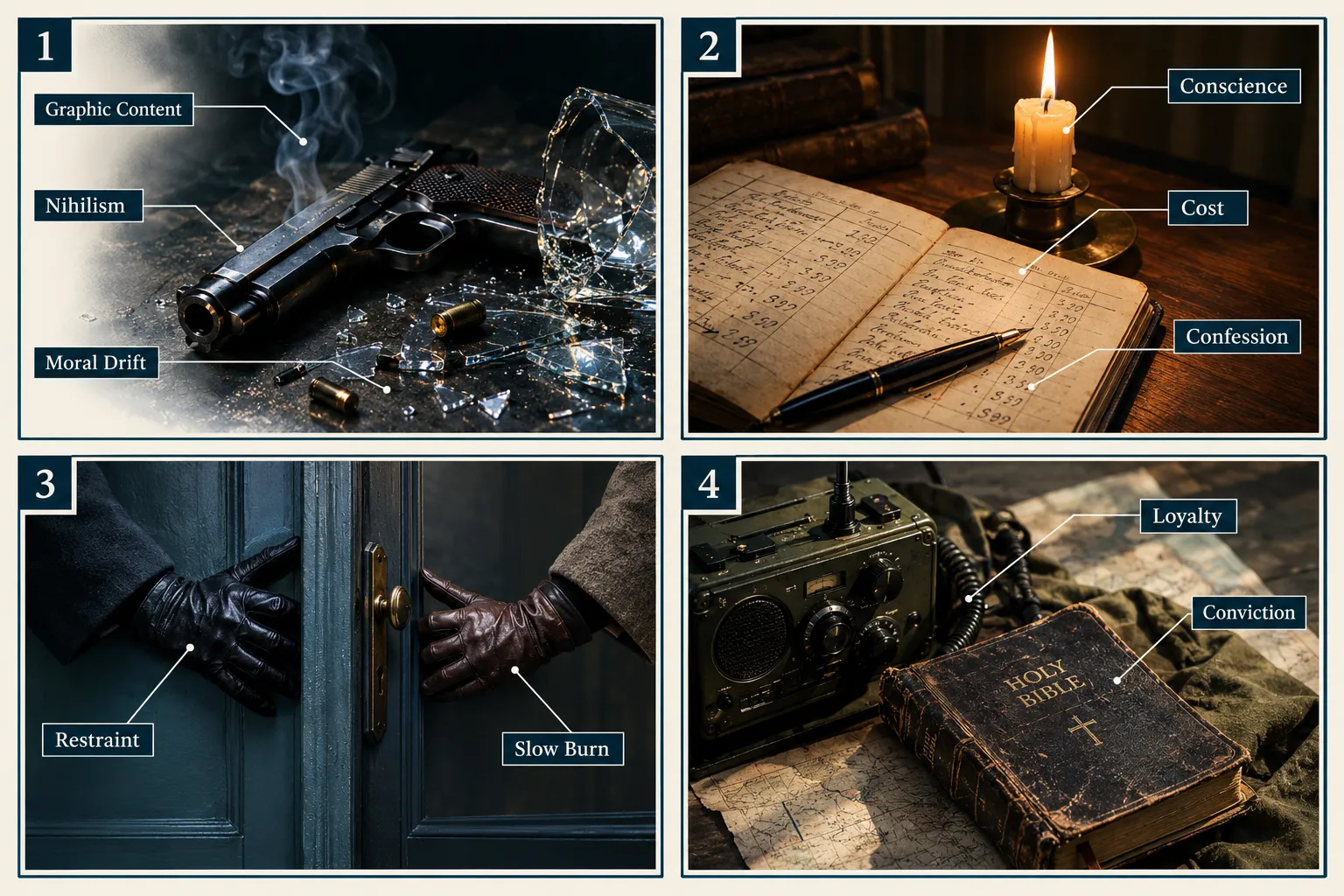
The difference isn’t the plot mechanics, it’s the moral accounting. A mainstream spy novel often treats deception as a professional skill with no spiritual price tag. A Christian spy thriller charges the character for it.
Practical differences you’ll notice by chapter three:
- Violence happens off-page or in aftermath. You see the consequence, not the wound.
- The agent has a conscience that costs something. Lying to protect a network still wounds the person doing the lying.
- Loyalty conflicts get religious weight. Who do you answer to when the handler, the state, and God all want different things?
- No nihilistic ending. Hope in the dark is the contract, but it has to be paid for.
The genre’s real question isn’t “will the mission succeed?” It’s “who will still be worth trusting when it does?”
Decision rule: if you want moral ambiguity with no resolution, stay secular. If you want ambiguity that gets answered at a cost, come here.
Best Christian spy thriller series to start with
Start with The Spy Keeper of Marseille if you want historical depth, or Spies, Lies & Alibis if you want pace and humor. Both deliver espionage structure without graphic content.
| Title | Author | Publisher / Date | Setting | Romance level |
|---|---|---|---|---|
| The Spy Keeper of Marseille | Roseanna M. White | Tyndale, July 7, 2026 | WWII France | Slow-burn, central |
| Spies, Lies & Alibis | Natalie Walters | Thomas Nelson, May 19, 2026 | Contemporary | Second-chance, light humor |
| Deadly Charade | Eason & Underwood | Revell, October 2026 | FBI / art smuggling | Forced proximity, clean |
| She Will End This | Coble & Acker | November 10, 2026 | Contemporary espionage | Romantic thriller |
| Wrong Girl, Wrong Day | Terry Toler | October 2026 | International | Family-centered, minimal |
The Spy Keeper of Marseille follows Zelie Bellerose, a widowed mother who joins the French Resistance and rises to lead a major intelligence network, alongside Marcel Laurent, a pianist turned operative. It’s inspired by Marie-Madeleine Fourcade, who actually led the Alliance network. Coded radio traffic, double identities, betrayal from inside, all of it is there.
Deadly Charade puts FBI agents Kira Miller and Bryce Lambert undercover as newlyweds inside an art-smuggling ring. Retail listings disagree on the exact date (October 6, 27, and 28 all appear), so treat it as an October 2026 release [3].
Clean espionage thrillers with faith themes, and Christian spy novels with romance that aren’t preachy
The least preachy books share one trait: faith shows up in what a character does under pressure, never in a speech. Look for novels where no one explains the theme out loud.
Signals a book won’t preach at you:
- The believing character also doubts, and the doubt isn’t resolved in one prayer.
- Nobody converts in the last twenty pages as a plot bow.
- Scripture appears, if at all, as something a character remembers at a bad moment, not as a lesson inserted for the reader.
- The antagonist has a coherent reason for what they’re doing.
Tyndale’s own framing of The Spy Keeper of Marseille leans on ordinary people taking extraordinary risks, not trained superagents. That’s the register that keeps a faith thriller honest. For more on this balance, see redefining clean Christian fiction beyond heavy-handed messages.
Common mistake: assuming “clean” means “low stakes.” The content is clean. The consequences usually aren’t.
Christian spy thrillers vs secular spy books: which is better?
Neither is better across the board, they optimize for different things. Secular espionage usually wins on geopolitical scale, moral ambiguity, and technical tradecraft density. Christian espionage wins on emotional stakes, sacrifice that lands, and endings that mean something.
Choose secular if you want:
- Dense procedural tradecraft and institutional cynicism
- Protagonists who never resolve their compromises
- Larger body counts and harder prose
Choose Christian alternatives if you want:
- Danger without graphic content
- Romantic tension that’s built on restraint
- A protagonist whose conscience is a plot engine, not a weakness
Edge case: readers coming off le Carré sometimes find Christian espionage too interior and too fast-resolving. The fix is to start historical, WWII Resistance fiction carries more operational texture than contemporary romantic suspense.
Do Christian espionage novels have as much action and tension?
Often yes, but the tension is engineered differently. Instead of escalating violence, these books escalate exposure: the risk of being found out, of a radio transmission running thirty seconds too long, of a cover identity cracking at a dinner table.
Where the pressure comes from:
- Proximity danger, undercover partners who can’t break character in front of hostiles
- Network betrayal, somebody inside is reporting, and the reader knows before the hero does
- Moral traps, save the asset or protect the network, pick one
- Time under observation, long scenes where nothing explodes and everything could
This is the same craft logic behind non-violent suspense in Christian psychological thrillers: remove the gore and you’re forced to build dread out of character.

Christian spy thriller authors recommendations and where to find the series
Five names cover most of the current field: Roseanna M. White (historical espionage), Natalie Walters (contemporary romantic suspense), Lynette Eason (FBI/undercover, often co-written), Colleen Coble (romantic thriller, now with Rick Acker), and Terry Toler (international spy thriller).
Where to find them:
- Kindle Unlimited, the strongest route for indie and mid-list series; see why clean Christian fiction dominates Kindle Unlimited
- Amazon’s inspirational fiction “coming soon” feed for pre-orders [3]
- Faith-fiction review blogs like The Well Read Fish, which reviewed Spies, Lies & Alibis as fast-paced romantic suspense blending espionage, second-chance romance, and faith [1][2]
- Publisher catalogs, Tyndale, Revell, Thomas Nelson
- Monthly roundups of new Christian fiction releases
Market tracking suggests inspirational fiction demand has stayed strong through 2026, with suspense and romance among the most active categories [4][5][6].
What does clean romance mean in Christian thrillers?
Clean romance means no explicit sexual content, no profanity, and emotional intimacy carried by restraint rather than physical escalation. Attraction is real and often intense, it just doesn’t go to the bedroom on the page.
What it typically includes:
- Slow-burn attraction over many chapters
- Forced proximity (fake marriages, shared cover identities, safehouses)
- Longing, withheld confession, a single significant touch
- Courtship that has to survive the mission
What it excludes: explicit scenes, crude language, and romance treated as a reward rather than a commitment. Deadly Charade‘s undercover-newlywed setup is the archetype, two agents with every reason to stay professional and no way to avoid each other. See also Christian suspense romance and balancing tension with faith.
Christian spy thrillers for readers who don’t want heavy faith messaging
If you want light faith content, pick contemporary romantic suspense over inspirational historical fiction. Books marketed as “romantic thriller” or “romantic suspense” generally carry a lighter spiritual load than those marketed as “inspirational historical.”
Lightest-to-heaviest, as a rough guide:
- Romantic thriller with espionage (She Will End This), faith present, rarely foregrounded
- FBI/undercover romantic suspense (Deadly Charade), light, situational
- Contemporary spy romance (Spies, Lies & Alibis), moderate, woven with humor
- WWII Resistance historical (The Spy Keeper of Marseille), faith as survival framework
- Mission-driven spy thriller (Wrong Girl, Wrong Day), forgiveness as the explicit theme
Check the sample chapters. If the first ten pages explain a spiritual point to you directly, the rest probably will too.
Best Christian espionage books with strong female characters
Zelie Bellerose in The Spy Keeper of Marseille is the standout: a widowed mother who ends up running a major spy network, drawn from the real Marie-Madeleine Fourcade of the Alliance network. Kira Miller in Deadly Charade is the contemporary counterpart, an FBI agent working a smuggling ring from the inside.
What makes these leads work:
- Competence is established through action, not told to the reader
- Motherhood and command exist in the same character without one canceling the other
- Their faith is tested operationally, not decoratively
Readers who want this register in other genres should look at Christian western romance with a female marshal.
Christian spy thrillers about sacrifice and redemption, and whether non-religious readers will enjoy them
Yes, non-religious readers generally enjoy these books when the faith is lived rather than argued. The subgenre’s core appeal, somebody pays a real price for other people, isn’t denominational.
Sacrifice-and-redemption titles worth starting with:
- The Spy Keeper of Marseille, untrained civilians risking everything, redemption through service
- Wrong Girl, Wrong Day, forgiveness and a mother-daughter bond under international threat
- She Will End This, family secrets and espionage, billed directly as a romantic thriller
Edge case: readers who dislike any religious content at all will still bounce off the historical titles, where prayer functions as plot infrastructure. Contemporary romantic suspense is the safer entry.
Grace that costs something reads as drama to any audience. Grace handed over free reads as propaganda to everyone.
Christian espionage books published 2023-2026: what the release cycle shows
The 2026 cycle shows Christian publishers treating espionage as a flexible frame rather than a fixed shelf. Within six months you get WWII Resistance fiction, undercover FBI art-smuggling, contemporary family espionage, and an international spy thriller about forgiveness.
Confirmed 2026 dates:
- Spies, Lies & Alibis, Thomas Nelson, May 19, 2026
- The Spy Keeper of Marseille, Tyndale, July 7, 2026 (368 pages, paperback)
- Deadly Charade, Revell, October 2026
- Wrong Girl, Wrong Day, October 2026
- She Will End This, November 10, 2026 ($18.99 trade paperback list; retailer pricing varies and changes)
That breadth matches the broader genre-blending shift across Christian fiction in 2026. Earlier 2023-2024 releases are harder to catalog cleanly, so the most reliable method is browsing publisher backlists by author rather than by subgenre label [7][8][9][10].
FAQ
Are Christian spy thrillers actually suspenseful? Yes. Tension is built from exposure risk, betrayal inside the network, and moral traps rather than escalating gore.
Which Christian spy thriller should a first-time reader pick? The Spy Keeper of Marseille (Tyndale, July 2026) for historical espionage, or Spies, Lies & Alibis (Thomas Nelson, May 2026) for faster contemporary pacing.
Do these books contain profanity or explicit scenes? No. The clean-content contract excludes profanity, graphic violence, and explicit sexual content across the major Christian publishers in this space.
Is there real romance, or is it just implied? Real romance, built on slow burn, forced proximity, and restraint. Deadly Charade‘s undercover-newlywed plot is a clear example.
Are there Christian spy novels with female leads in command? Yes. Zelie Bellerose leads a Resistance intelligence network in The Spy Keeper of Marseille, inspired by Marie-Madeleine Fourcade of the real Alliance network.
Can I find these on Kindle Unlimited? Some traditionally published titles aren’t in KU, but indie Christian suspense is heavily represented there.
How do Christian spy thrillers compare to secular ones on tradecraft? Secular espionage generally carries denser procedural detail; Christian alternatives trade some of that for interior moral stakes.
What if I want espionage-style tension but in another genre? Try clean psychological suspense, see clean Christian psychological thrillers with hopeful endings.
Do the endings always resolve happily? Hopefully, not easily. The genre convention is hope earned through cost, not a tidy escape.
Conclusion
The honest summary of Christian spy thriller alternatives: clean espionage reads with faith, sacrifice, and romantic tension keep almost everything that makes spy fiction work and remove the parts that make it unreadable for clean-content readers. What’s left is a conscience under operational pressure, which is arguably the oldest engine in the genre anyway.
Next steps:
- Start with The Spy Keeper of Marseille if you want depth, Spies, Lies & Alibis if you want speed.
- Pre-order She Will End This (November 10, 2026) for contemporary espionage.
- Read sample chapters first to calibrate how much faith content you want.
- Follow faith-fiction review sites and publisher catalogs rather than genre labels [1][2].
- Branch into adjacent clean suspense with how faith themes raise the stakes in Christian psychological thrillers.
Somewhere in Marseille, a woman who was never trained for any of this is counting seconds on a radio transmission. That’s the whole appeal, and no amount of gore would improve it.
References
- Suspense. thewellreadfish.com.
- thewellreadfish.com. thewellreadfish.com.
- Religious Inspirational Fiction Coming Soon Literature. amazon.com.
- Best Selling Christian Fiction. accio.com.
- 2026’s Ultimate Guide To Christian Fiction Trends, Top Authors And How To Profit. alibaba.com.
- Best Selling Christian Fiction Books 2026 Verified Trends Market Insights. alibaba.com.
- Top Selling Christian Fiction. accio.com.
- Top Selling Christian Novels. accio.com.
- The Rise of Christian Fiction Market Trends Regional Dynamics and Future Predictions for 2026. alibaba.com.
- Top 10 Best Selling Christian Fiction Books in 2026 Market Insights Trends. alibaba.com.