
{“cover”:”Landscape editorial composition (1536×1024) split down the center: left side shows a collapsed gray stone dungeon corridor lit by cold blue floating status-window light, rubble and a lone armored figure; right side shows a warm sunlit fantasy village square with a small crowd of diverse robed and cloaked characters sharing bread at a long wooden table, an open leather book bridging the two halves in the foreground. Warm amber tones on the right, cool desaturated tones on the left, high-contrast magazine composition, no text anywhere on the image.”,”content”:[“Labelled four-panel comparison infographic on a clean parchment-cream background: panel one shows a solitary armored figure fighting a shadow monster labeled ‘Solo Combat’, panel two shows a small found-family group repairing a village well labeled ‘Shared Stewardship’, panel three shows a glowing translucent stat-window over an open hand labeled ‘System Mechanics’, panel four shows a worn leather journal with a small cross etched on its cover labeled ‘Faith As Consequence’. Thin navy callout lines connect each label to its scene, teal-and-cream editorial palette, no other text.”,”Split-screen editorial photograph, warm natural lighting: left half shows a cozy timber-and-stone inn interior with a healer character bandaging a farmer’s hand beside a hearth and hanging herbs, right half shows the same characters years later standing on a castle rampart at dawn overlooking a marching army with banners, connected by a single stone bridge crossing the frame’s center. Soft amber light on the left transitioning to cool dawn light on the right, cinematic depth of field, no text or labels rendered.”}

Last updated: September 26, 2026
Quick Answer
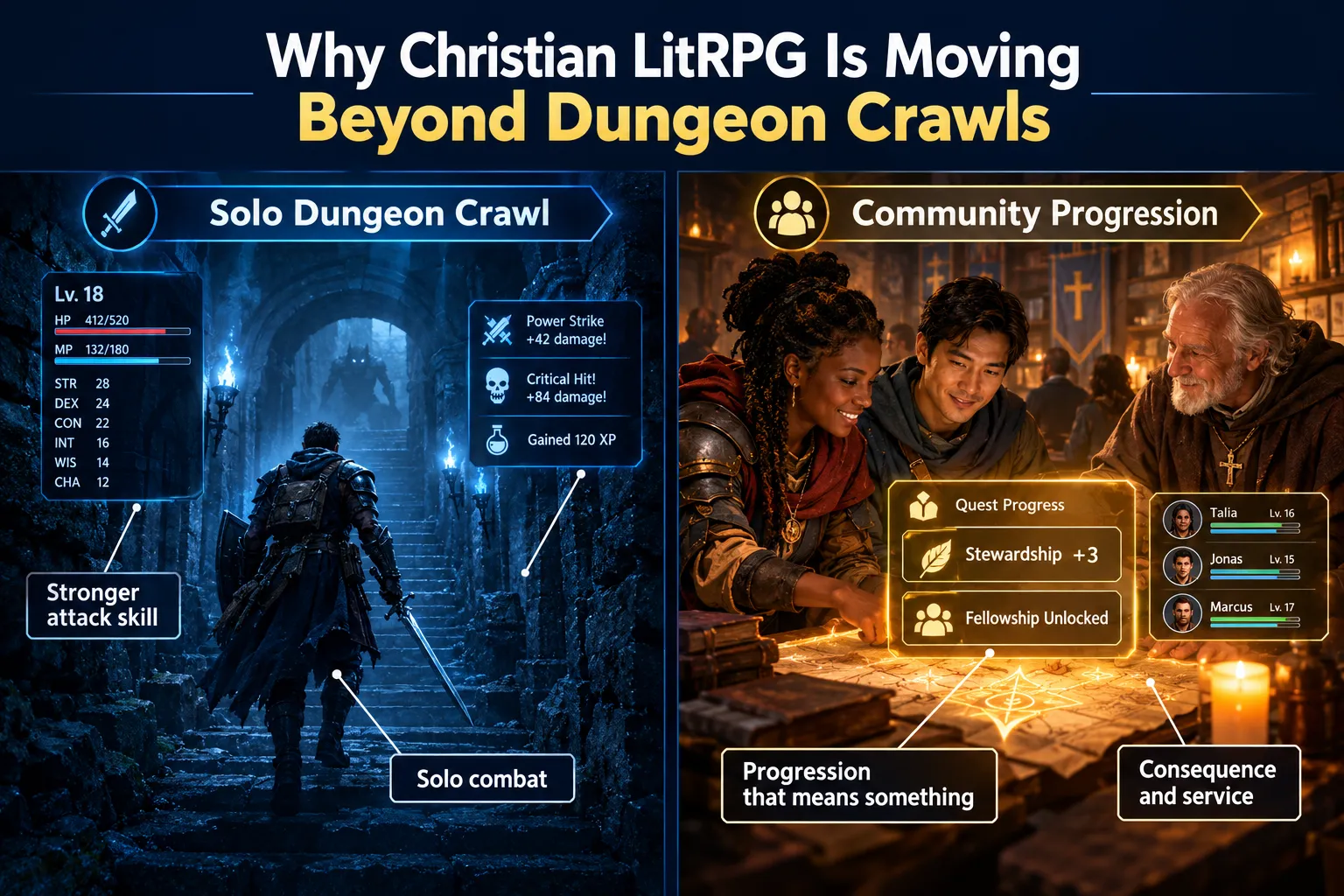
Christian LitRPG is shifting away from solo dungeon-crawl combat toward stories built on fellowship, stewardship, and consequence, because readers and authors both want progression that means something beyond a stronger attack skill. Why Christian LitRPG is moving beyond dungeon crawls: community, progression, and the 2026 cozy-to-epic shift comes down to three forces, a crowded release market that rewards series with real relationships, a genre-wide blending of LitRPG with progression fantasy, and a growing appetite for cozy-fantasy comfort sitting right next to full epic stakes.
Key Takeaways
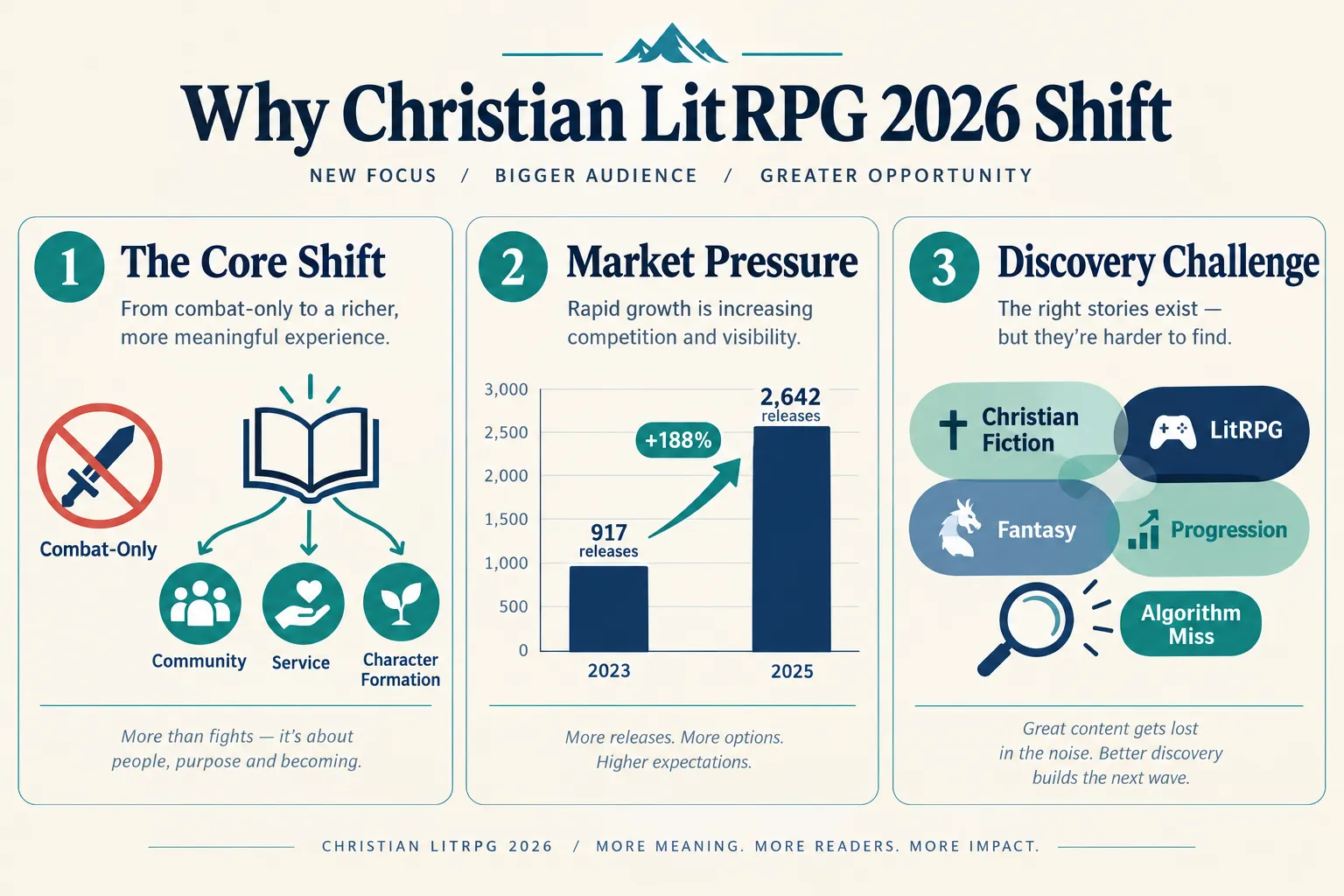
- The core shift: Christian LitRPG is moving from hard-stat dungeon crawls toward stories where community, service, and character formation carry as much weight as combat.
- Market pressure is real: tracked LitRPG releases rose from 917 in 2023 to 2,642 in 2025, a 188% jump, which makes discovery harder for new readers and pushes authors toward stronger relationships and series bonds [3].
- Progression fantasy is the wider umbrella: LitRPG needs an explicit game layer (stats, levels, quests), while progression fantasy can show growth through mastery, leadership, and spiritual maturity without a visible system window [7].
- Cozy fantasy is trending alongside epic fantasy, not replacing it, both are rising as readers want emotional refuge and high stakes in the same year [8].
- September 2026 release calendars show farming, village, inn, chef, and healer LitRPG sitting next to conventional dungeon and apocalypse titles, proof the genre is widening, not narrowing [5].
- Faith progression in Christian LitRPG usually tracks character integrity, not just XP totals, grace that costs something rather than a stat boost that fixes everything.
- Beginners should start with a shorter series that pairs a clear system with a small, well-drawn community rather than a sprawling multi-book power-fantasy epic.
What Is Christian LitRPG and How Is It Different From Regular LitRPG?
Christian LitRPG keeps the genre’s core mechanics, levels, stats, quests, system notifications, but ties every gain to a moral or spiritual cost instead of a pure power curve. Secular LitRPG can build a whole plot around a character becoming unbeatable; Christian LitRPG tends to ask what that character owes once the power actually arrives.
The difference shows up in small design choices:
- Stakes: a secular dungeon crawler often treats death as a reset button; Christian LitRPG frequently keeps death, loss, and failure permanent enough to matter.
- Cheat codes: overpowered protagonists and instant-win mechanics get scaled back in favor of skills that still require judgment.
- The system itself: instead of a neutral game engine, the “system” in Christian LitRPG often behaves like a moral ledger, it records what a character did, not just what they killed.
- The goal: leveling up is a means to protect, serve, or repair something, not an end in itself.
For a closer look at how this plays out on the page, Christian LitRPG: gamification meets grace, a genre deep dive breaks down specific mechanics authors use to keep the system honest rather than decorative.
Why Christian LitRPG Is Moving Beyond Dungeon Crawls: Community, Progression, and the 2026 Cozy-to-Epic Shift Explained
Why Christian LitRPG is moving beyond dungeon crawls: community, progression, and the 2026 cozy-to-epic shift is happening because a single-hero, single-corridor structure runs out of room fast, there’s only so much a lone character clearing rubble can say about a person’s character. Authors are widening the frame to include households, work crews, congregations, and towns because that’s where faith actually gets tested.
Market data backs this up. LitRPG Critic’s 2026 analysis shows the genre’s top ten eligible works captured 30.0% of tracked consumption in a recent six-month window, while 76.3% of tracked consumption went to Book 2 or later in a series [3]. That’s a discovery bottleneck, and the fix isn’t more solo dungeon content, it’s stronger series bonds readers actually want to return to. A hero readers care about across nine books usually has a support cast, not just a corridor full of enemies.
There’s also a genre-blending effect. Progression fantasy doesn’t require a visible system at all, growth can come from mentorship, cultivation, or leadership instead of stat sheets [7]. Christian LitRPG sitting closer to that broader category has more room to dramatize discipleship and stewardship without every problem resolving through a new attack skill.
Best Christian LitRPG Books That Focus on Community Instead of Combat
The strongest community-centered Christian LitRPG titles use the system to reveal character under pressure, with a small cast readers grow attached to across multiple books rather than a rotating cast of dungeon fodder.
Look for these markers when choosing a series built on relationships instead of body counts:
- A fixed cast that stays together book to book, so consequences carry forward instead of resetting.
- Work that matters outside combat, repairing a well, running a market stall, keeping a record honest, shown with the same detail as a fight scene.
- A system that tracks integrity, not just kills, so cheating or shortcuts show up as a cost later in the series.
The Measured Debt series is a working example of this design. At Federated Record, Eamon Kersey’s strength keeps clearing every collapse in The Cost of Being Chosen, until the position series itself starts asking why he’s always the one left standing, and the story turns from combat competence toward what his reputation has actually cost the people around him across The Remembered Route and The Borrowed Yield. Readers looking for character arcs built this way can also check character arcs in Christian LitRPG: leveling up faith and integrity alongside stats and skills for a breakdown of how integrity tracking works as a story mechanic.
How Does Faith Progression Work in Christian LitRPG Stories?
Faith progression works like a second stat sheet that never shows numbers, it tracks whether a character’s choices match what they claim to believe, and it usually costs something before it pays out. A stat boost can arrive instantly; faith progression in these stories tends to arrive after a character has already paid a price for it.
Common patterns include:
- Delayed reward: a character does the right thing with no system bonus attached, and the payoff comes chapters later, if at all.
- Reversal of power logic: the strongest character in the room is sometimes the one who chooses to serve rather than dominate.
- Repentance as a mechanic: mistakes aren’t wiped by a respawn, they get carried, named, and worked through.
This is the same design logic covered in faith in LitRPG and progression fantasy: how Christian game-world narratives turn leveling up into spiritual growth, and it’s also the throughline behind progression fantasy for Christian readers who want earned grace, not cheap grace, grace that shows up after cost, never instead of it.
What Does Cozy LitRPG Mean, and Why Is It Trending in 2026?
Cozy LitRPG means low-violence, low-threat game-world stories built around comfort, craft, and small daily wins, farming a plot of land, running an inn, healing patients, instead of survival horror or combat escalation. It’s trending in 2026 because publishers see it as selling an emotional state, not just a set of tropes: readers want to feel safe inside a book the same way they’d want to feel safe inside a room [8].
September 2026 release calendars show this clearly, with titles like farming, village, chef, inn, and healer LitRPG releasing alongside standard dungeon and apocalypse books rather than replacing them [5]. For Christian LitRPG specifically, cozy elements let authors slow down and show hospitality, patience, and quiet service as real progression, not filler between fights. Christian cozy LitRPG for readers who want quests, crafting, and community without harem tropes covers what to look for if this subgenre is the entry point.
Are Christian LitRPG Books Appropriate for Young Adults?
Many Christian LitRPG titles work well for teen and young adult readers because the genre’s clean-content standards already strip out graphic violence, profanity, and explicit content that mainstream LitRPG sometimes includes. That said, “Christian LitRPG” isn’t automatically “young adult”, some titles carry heavier themes around loss, betrayal, or moral failure that suit adult readers better.
Choose a title for a younger reader if:
- The system mechanics stay clear and uncomplicated rather than stacking dense stat math.
- The moral stakes are visible without needing graphic depiction to land.
- The cast is small enough for a teen reader to track without a series bible.
Skip it for a younger reader if:
- The book is marketed explicitly as adult progression fantasy with heavy psychological or violent content.
- The publisher description flags mature themes around trauma or grief without softening.
How Do You Balance Epic Fantasy With Christian Values in LitRPG’s 2026 Cozy-to-Epic Shift?
Balancing epic scale with Christian values means letting the system serve the theme instead of the other way around, big battles and world-ending stakes stay in the story, but the resolution comes from character choice, not from acquiring a bigger sword. That’s the real engine behind the cozy-to-epic shift: cozy scenes establish what’s worth protecting, and epic scenes test whether the character will actually protect it.
Practical ways authors hold both together:
- Anchor scale in relationship, so a kingdom-level threat still gets measured by what it does to one household or one town.
- Let mercy have a cost, so choosing to spare an enemy or forgive a betrayal changes the plot’s difficulty, not just its mood.
- Keep the system honest, so power gained through shortcuts produces a visible consequence later in the story rather than disappearing quietly.
For readers who want the epic side of this without losing the moral weight, the 2026 Christian fantasy boom: how epic faith-focused series are breaking out beyond Narnia retellings covers where full-scale Christian epic fantasy is headed this year.
Which Christian LitRPG Series Should You Start With in 2026?
Start with a series that’s three to four books long, has one consistent protagonist, and shows its system mechanics clearly in the first chapter, that combination gives new readers a manageable entry point without a huge back catalog to catch up on. Longer, established series dominate consumption right now, which makes a tighter trilogy a better first read, not a worse one [3].
A quick decision guide:
| If you want… | Start with… |
|---|---|
| A workplace-style system with real consequence | The Measured Debt (three-book trilogy) |
| Cozy pacing before anything epic | A farming, inn, or village-focused title from a 2026 cozy LitRPG release list |
| Full epic stakes with a clear moral spine | A Christian epic fantasy series with an explicit system layer |
Goodreads lists for Christian LitRPG: how to build a faith-focused game-world TBR without accidentally grabbing harem series is a useful next stop for building out a longer list once the first series is finished.
How Is the Christian LitRPG Community Different From Mainstream Fantasy Communities?
The Christian LitRPG community leans harder on direct reader-author relationships, newsletters, Discord groups, and curated recommendation lists, because the genre crosses so many shelf categories that algorithm-based discovery often misses it entirely. A single title can qualify as Christian fiction, clean fiction, young adult fiction, game fiction, or progression fantasy depending on how it’s tagged, so word-of-mouth and community curation carry more weight than they do in mainstream fantasy [7].
This mirrors what’s happened in Christian speculative fiction more broadly, where community infrastructure, conferences, online bookstores, awards, has been credited with helping niche categories find their readers instead of waiting on retail algorithms. That same pattern shows up in how Christian LitRPG readers find new series now: through recommendation threads and small trusted lists rather than broad category browsing.
Common Mistakes New Christian LitRPG Readers Make (and What Happens When It Gets Too Preachy)
The most common mistake new readers make is judging the whole genre by one dungeon-crawl-heavy book, when the category now spans cozy, epic, and progression-fantasy hybrids with very different pacing [2]. A second mistake is picking a series purely by system complexity, without checking whether the cast and stakes are strong enough to carry multiple books.
Watch for these edge cases:
- Too much system, not enough story: stat screens that never affect a decision are decoration, not progression.
- Too much sermon, not enough plot: when a character’s faith gets explained in narration instead of shown through a hard choice, the story stops moving and starts lecturing.
- Skipping book one: series-concentration data shows most consumption goes to later books, but starting mid-series in this genre almost always means missing the system’s internal logic.
When Christian LitRPG gets too preachy, the fix isn’t removing faith, it’s removing the narrator’s explanation of faith and trusting the plot to carry it instead. What makes a LitRPG series Christian without being preachy and faith in fiction across genres: how much is too much both dig into where that line sits in practice.
FAQ
Is Christian LitRPG the same as clean fantasy? Not exactly. Christian LitRPG always includes clean content, but clean fantasy doesn’t require game mechanics like levels, stats, or system notifications the way LitRPG does.
Do I need to understand RPG stats to enjoy Christian LitRPG? No. Most Christian LitRPG titles explain stats and levels within the story itself, so no outside gaming knowledge is required.
What’s the difference between LitRPG and progression fantasy? LitRPG requires an explicit game-like system (levels, stats, quests); progression fantasy can show growth without any visible system at all [7].
Why are so many 2026 releases labeled cozy LitRPG? Publishers and authors see cozy fantasy as selling emotional safety, and that demand is rising alongside epic fantasy, not instead of it [8].
Is dungeon-crawl Christian LitRPG disappearing? No. Dungeon and apocalypse titles still release regularly; they’re now sitting alongside farming, village, and inn-focused titles rather than dominating release calendars alone [5].
Can Christian LitRPG work for readers who don’t normally read fantasy? Yes, especially cozy or community-focused entries, since the stakes often center on relationships and daily life rather than complex world lore.
How long should a first Christian LitRPG series be? Three to four books is a manageable starting length that still lets a series build real character consequence without requiring a large time investment.
Conclusion
Why Christian LitRPG is moving beyond dungeon crawls: community, progression, and the 2026 cozy-to-epic shift comes down to a simple design truth, a corridor full of monsters can only say so much about a person, but a household, a crew, or a congregation can say almost anything. The genre is widening because readers want stakes big enough to matter and relationships close enough to feel earned grace when it finally shows up.
Next step: pick one shorter series with a clear system and a small, consistent cast, start there, watch how the story handles cost and consequence, and build outward from that single trusted read.
References
[1] Trends Of Litrpg – https://www.accio.com/business/trends-of-litrpg [2] Litrpg Novels 2026 Vs Litrpg Books In 2016 What A Decade Changed – https://litrpgreads.com/blog/litrpg/litrpg-novels-2026-vs-litrpg-books-in-2016-what-a-decade-changed [3] 2026 08 10 State Of Litrpg 2026 Discovery Crisis Market Analysis – https://litrpgcritic.com/blog/2026-08-10-state-of-litrpg-2026-discovery-crisis-market-analysis/ [4] K Lytics Alex Newton On Where Indie Genre Money Moves In Late 2026 – https://indieauthorweekly.com/k-lytics-alex-newton-on-where-indie-genre-money-moves-in-late-2026/ [5] September 2026 Litrpg Release Calendar – https://www.reddit.com/r/litrpg/comments/1w4e2al/september_2026_litrpg_release_calendar/ [6] Best Selling Litrpg Of 2026 – https://www.accio.com/business/best-selling-litrpg-of-2026 [7] Litrpg A Genre Spotlight – https://ninc.com/litrpg-a-genre-spotlight/ [8] Zeitgeist Cozy Fantasy And Litrpg Surge As Hottest Niches In 2026 – https://www.authormedia.com/zeitgeist-cozy-fantasy-and-litrpg-surge-as-hottest-niches-in-2026/ [9] Best Selling Lit Rpg – https://www.accio.com/business/best-selling-lit-rpg [10] News – https://md-books.com/news