Last updated: September 17, 2026
Quick Answer: The best small-town Christian mysteries on Kindle Unlimited combine clean whodunit plots with genuine community life and faith that shapes character choices rather than interrupting them. Series like Silas Bellhaven’s Mercy House Mysteries, Hope Callaghan’s cozy lines, and K.C. Hart’s Skeeterville series are actively maintained in KU as of 2026, offering readers multiple entry points into small-town, faith-laced mystery without graphic content or heavy-handed preaching [2][5].
Key Takeaways
- Christian cozy mysteries differ from standard cozies by treating faith as load-bearing, it shapes what characters do when no one is watching, not just what they say in church.
- Kindle Unlimited hosts multiple active Christian cozy series in 2026, though individual book enrollment can change; checking KU status before borrowing is always wise [5].
- Small-town settings do real narrative work, the church social, the donation drive, the quilt circle aren’t decoration; they’re where secrets live and where community accountability plays out.
- Gentle spiritual themes means faith surfaces through consequence and choice, not through characters delivering mini-sermons to each other.
- No religious background is required to enjoy these books; the best ones are written for anyone who wants clean stakes and honest characters.
- Series outperform standalones on KU for this subgenre, the community deepens book by book, and readers stay for the relationships as much as the mystery.
- The target reader is primarily women 35-65 who want real stakes without graphic content, and who are tired of faith being either absent or preachy in their fiction.
- Common tropes include amateur sleuths, church-adjacent crimes, heirloom objects with secrets, and small-town gossip networks that both help and hinder the investigation.
- Alternatives to KU exist, including direct purchase, library apps, and author newsletters, but KU remains the most cost-effective way to sample multiple series.
What Makes a Christian Cozy Mystery Different From Regular Cozy Mysteries
A Christian cozy mystery carries the same structural DNA as any cozy, amateur sleuth, low-graphic violence, tight community setting, puzzle-driven plot, but faith functions as an active ingredient rather than a background detail. In a standard cozy, a character might attend church the way they attend yoga: it’s characterization texture. In a Christian cozy, what a character believes about mercy, truth, and accountability actually determines what they do when the evidence points somewhere inconvenient.
The practical difference shows up in three places:
- Moral stakes, not just plot stakes. The sleuth isn’t only trying to catch a killer; she’s wrestling with whether to expose someone whose guilt will destroy a family she loves. That’s a faith question, not just a mystery question.
- Community as conscience. The church, the quilting circle, the donation drive, these aren’t cozy set dressing. They’re the social structures that make secrets both possible and costly. For more on how this works in Southern settings, see Small-Town Secrets and Church Dynamics: Why Southern Christian Cozy Mysteries Feel So Real.
- Grace that costs something. The best Christian cozies don’t resolve with a tidy conversion or a prayer that fixes everything. Redemption shows up after the hard choice, not instead of it.
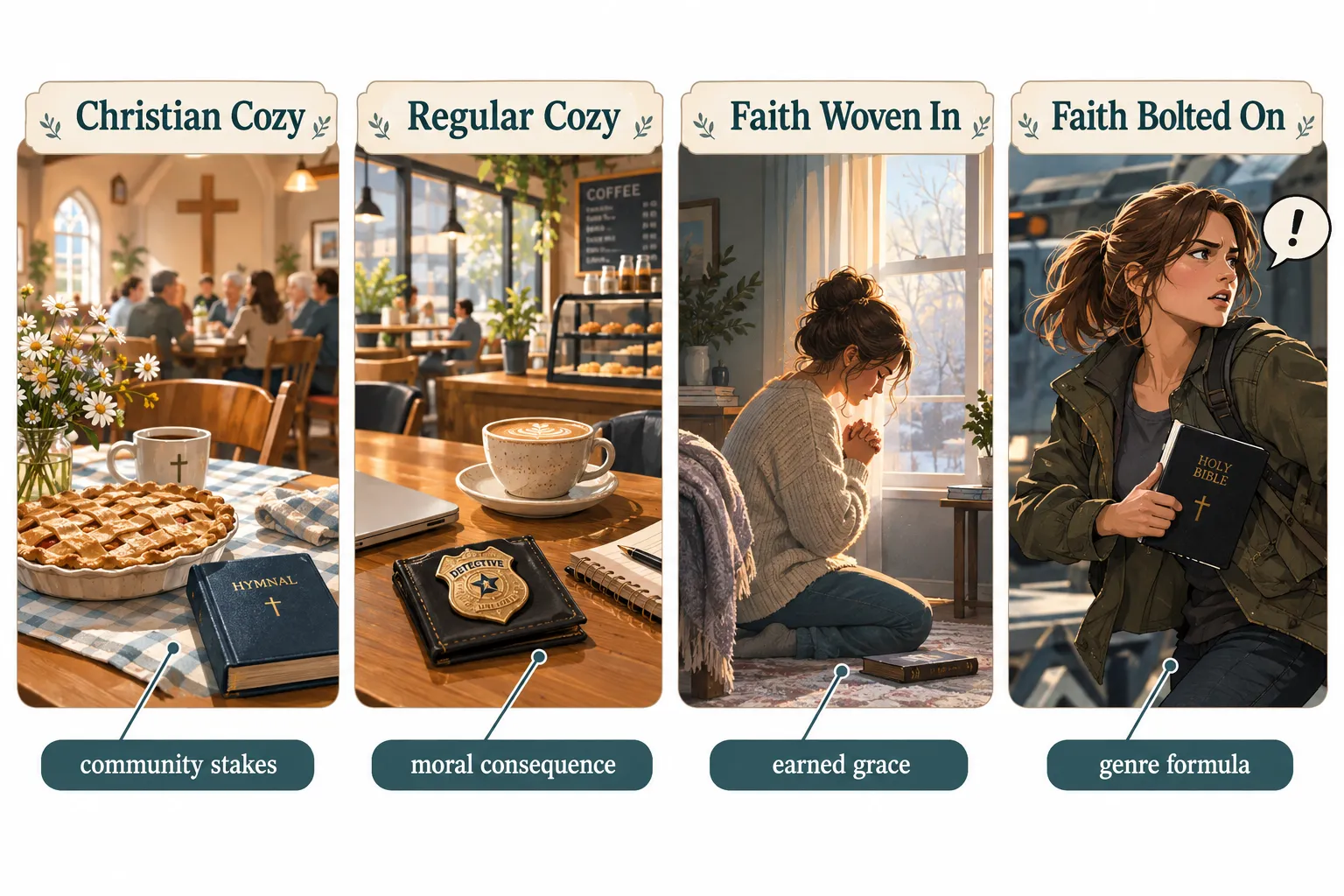
“Walking with them, not talking at them”, that’s the line that separates a Christian cozy that works from one that preaches. The faith has to be lived, not announced.
For a deeper look at how these tropes function across the subgenre, Christian Cozy Mystery Tropes Readers Love: Quirky Characters, Small Towns, and Spiritual Themes Explained is worth the read.
Best Christian Mystery Books on Kindle Unlimited in 2026
Several strong series are actively available on KU as of 2026, though enrollment can shift, always confirm KU status on the Amazon listing before borrowing [5].
Silas Bellhaven, The Mercy House Mysteries
Set in Juniper Gap, Tennessee, this ten-book series follows Nora Bell Hartley, who keeps finding bodies where she expected to find donations. The series is built around the Mercy House thrift ministry, which means every crime is tangled up in the community’s generosity, its secrets, and its long memory.
Each title in the series uses a faith-adjacent object as both a plot device and a thematic anchor:
| Book | Object at the Center | What It Holds |
|---|---|---|
| A Donation to Die For | A mislabeled donation box | A ledger and a deacon’s unfinished confession |
| The Family Bible Secret | A family Bible | A record about to name the wrong family |
| A Quilt for the Guilty | A quilt square | An old fair ledger stitched into the fabric |
| The Hymnal Margin Murder | An old hymnal | A note pointing to Juniper Gap’s best-kept secret |
| The Benediction Tape Murder | A recorded blessing | A man’s last words before he could confess |
The full series page is at The Mercy House Mysteries on Amazon. For readers new to the series, A Donation to Die For is the right starting point.
Hope Callaghan
Hope Callaghan maintains several clean, faith-laced cozy lines, including the Garden Girls Mystery series and the Divine Cozy Mystery series, explicitly marketed as available free with Kindle Unlimited [11]. Her books lean into community life, humor, and light spiritual themes, making them a natural companion read to the Mercy House Mysteries.
K.C. Hart, Skeeterville Cozy Mystery Series
K.C. Hart launched A Spring Day Murder (Skeeterville Cozy Mystery Series, Book 1) in April 2025, available in KU, continuing the small-town, church-centered approach of her earlier Katy Cross series [1]. The Skeeterville books are a good option for readers who want a newer series with a fresh small-town setting.
For a broader look at how Christian fiction performs across KU categories, see Christian Fiction Subgenres Ranked by Reader Engagement: What Works Best on Kindle Unlimited.
Small-Town Cozy Mysteries With Faith Themes: What to Look For
Small-town setting and faith themes reinforce each other in ways that don’t work in urban mysteries. In a small town, everyone knows everyone, which means secrets have weight, accountability is personal, and forgiveness has to be chosen face-to-face rather than at a comfortable distance.
What makes a small-town Christian cozy feel real:
- The setting has a specific texture, a particular church, a named diner, a quilting circle with actual members who have history with each other.
- The community has memory. Old wrongs don’t disappear; they get passed down, stitched into quilts, written in the margins of hymnals.
- Faith shows up in ordinary decisions: whether to tell the sheriff what you saw, whether to protect someone who doesn’t deserve protection, whether mercy and justice can occupy the same moment.
The cozy mystery market continues to generate new small-town series at a steady pace, tracking sites like Cozy Mysteries Unlimited document multiple new launches each year [10], and Christian authors consistently adapt this template with spiritual stakes layered in.
How Much Does Kindle Unlimited Cost Per Month
As of 2026, Kindle Unlimited costs $11.99 per month in the United States (Amazon pricing; confirm current rate on Amazon’s KU page, as pricing can vary by region and promotional period). The subscription gives access to over four million titles, including a significant catalog of Christian fiction, cozy mysteries, and faith-based series.
Is KU worth it for Christian cozy readers?
- Yes, if you read two or more books per month in the genre, a single KU book typically retails for $3.99,$6.99, so the subscription pays for itself quickly with series reading.
- Reconsider if you read slowly or prefer to own your library permanently; buying individual titles may make more financial sense.
- Practical note: KU enrollment for individual books can change. Author Heidi McCahan’s curated faith-based KU list from January 2026 explicitly warns that KU status can shift over time [5]. Always check the Amazon listing before borrowing.
Christian Cozy Mystery Series vs. Standalone Books
For this subgenre, series almost always outperform standalones, for readers and for authors. The reason is structural: the community is the point. A standalone can introduce a small town and a cast of neighbors, but it takes multiple books for those relationships to develop the kind of weight that makes a mystery feel genuinely consequential.
Choose a series if:
- You want to watch a community deepen over time.
- You care about recurring characters growing, failing, and finding grace across multiple books.
- You’re a KU subscriber, series are the most economical use of the subscription.
A standalone might work better if:
- You want to sample the subgenre without committing to a series.
- You prefer a self-contained story with a clean resolution.
The Mercy House Mysteries are designed for series investment, each book stands alone as a mystery, but the community of Juniper Gap accumulates meaning book by book. Readers who start with A Donation to Die For and continue through The Benediction Tape Murder are reading a ten-book portrait of a town that keeps its secrets badly.
Cozy Mysteries With Strong Community Themes: Why Community Is the Real Engine
The mystery plot is the vehicle; the community is the destination. In the best small-town Christian cozies, the crime matters because of what it reveals about the people around it, who knew, who protected whom, who stayed silent and why.
This is where Christian cozy mysteries carry something that secular cozies sometimes miss: a theological understanding of community as a place where people are genuinely accountable to each other. Not just socially awkward if they’re caught, but morally responsible in a way that has weight beyond reputation.
Community elements that drive the best Christian cozies:
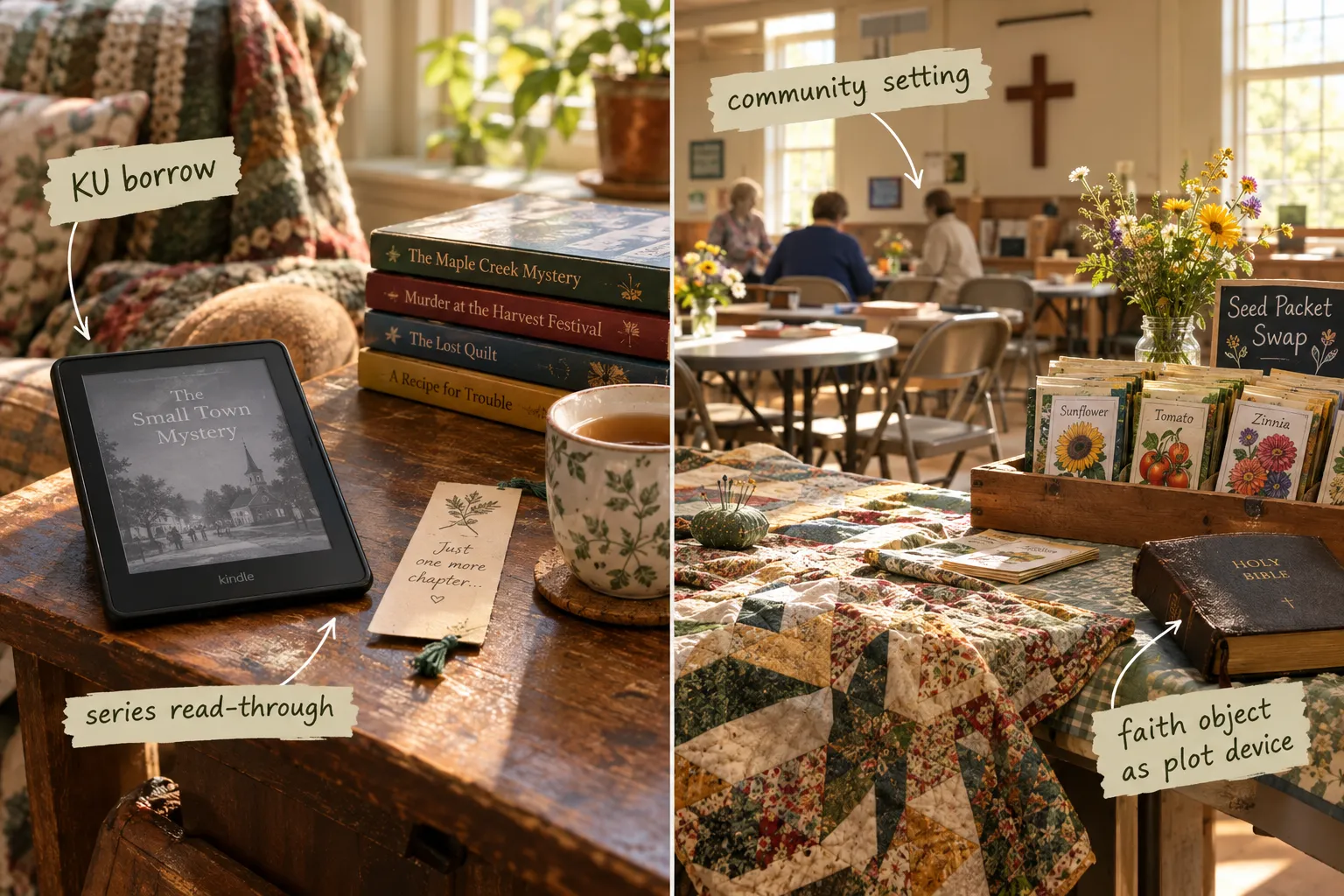
- Church events as crime scenes, donation drives, seed swaps, Christmas shelters, quilt fairs. The ministry setting means the crime is always a betrayal of something people trusted.
- Gossip networks as investigative tools, the same social web that spreads rumors also surfaces truth, if the sleuth knows how to listen.
- Generational memory, old wrongs that were never fully resolved, family Bibles with records someone tried to hide, hymnals with notes in the margins.
For more on how community dynamics function in Southern Christian fiction specifically, Small-Town Secrets and Church Dynamics: Why Southern Christian Cozy Mysteries Feel So Real goes deeper on the mechanics.
What Age Group Reads Christian Cozy Mysteries
The core readership for Christian cozy mysteries is women ages 35-65, with the strongest concentration in the 45-60 range. These are readers who grew up with faith as a lived reality, not a cultural accessory, they want fiction that reflects that, not fiction that either ignores it or turns it into a lesson.
That said, the subgenre has genuine crossover appeal:
- Younger readers (25-35) who want clean fiction without graphic content are a growing segment, particularly on KU where sampling is low-risk.
- Readers new to Christian fiction often enter through cozy mystery because the genre’s warmth and community focus feel accessible even if the faith themes are unfamiliar.
- Men read in this space too, though less frequently, the community-focused, relationship-driven structure tends to skew toward female readership.
The Reddit community for cozy mysteries has active threads specifically requesting Christian KU recommendations [7], which suggests the demand is real and reader-driven, not just publisher-led.
Gentle Spiritual Themes in Mystery Books Explained
“Gentle spiritual themes” doesn’t mean shallow faith or decorative religion. It means faith that surfaces through the story rather than over it, through what a character chooses when the choice is hard, not through what they announce in dialogue.
What gentle spiritual themes look like in practice:
- A character decides to tell the truth even when lying would protect someone she loves. The faith isn’t named; the cost is.
- A mystery resolves not just with the killer identified, but with a community forced to reckon with what it ignored for years. Mercy and justice arrive together, at a price.
- Prayer appears as a private, honest act, not a plot device that delivers answers, but a moment where a character admits she doesn’t know what to do next.
What gentle spiritual themes are NOT:
- Characters who quote scripture at each other in natural conversation.
- A villain whose evil is explained by their lack of faith.
- A conversion scene that resolves the emotional climax.
For a broader discussion of how much faith is too much across genres, Faith In Fiction Across Genres: How Much Is Too Much is a useful reference.
How to Find Christian Cozy Mysteries on Kindle Unlimited
Finding genuinely faith-rooted cozies on KU takes a little more than a keyword search, because “Christian” as a category label covers everything from lightly inspirational to explicitly evangelical.
Practical steps:
- Search Amazon for “Christian cozy mystery” and filter by Kindle Unlimited [2]. Sort by review count or average rating to surface established series.
- Check author sites directly. Authors like Hope Callaghan and K.C. Hart explicitly list which titles are KU-enrolled [1][11]. This is more reliable than Amazon’s filter, which can lag.
- Use reader-curated lists. Heidi McCahan’s January 2026 faith-based KU list [5] and Reddit’s r/CozyMystery community [7] both surface titles that readers have actually verified as KU-available.
- Start with Series Book 1. If a series has ten books and Book 1 is in KU, the rest usually are too, but confirm before committing.
- Follow authors on newsletter or social. KU enrollment changes, and authors typically announce when titles enter or exit the program.
For a data-informed look at what’s trending in this space, Kindle Unlimited Trends for Christian Cozy Mysteries: What 2026 Borrow Data Reveals About Reader Preferences covers current patterns.
Alternatives to Kindle Unlimited for Christian Books
KU is the most cost-effective subscription for volume readers, but it’s not the only option.
| Option | Best For | Notes |
|---|---|---|
| Direct Amazon purchase | Readers who want to own titles permanently | Often $3.99,$6.99 per book |
| Hoopla / Libby (library apps) | Readers with a library card | Selection varies; Christian cozy coverage is growing |
| Author newsletters | Finding deals and free first-in-series | Many Christian authors offer Book 1 free to subscribers |
| Goodreads lists | Discovery before committing | Useful for finding series with verified faith themes |
Choose KU if you read two or more books per month and want to sample broadly across series before committing. Choose direct purchase if you read slowly, re-read favorites, or want to support specific authors directly. For tips on using Goodreads to surface clean KU options, see Goodreads for Christian Fiction Fans: How to Build Lists That Surface Clean Kindle Unlimited Gems.
Common Tropes in Small-Town Christian Mysteries
These tropes appear across the subgenre because they work, they create the conditions where faith under fire becomes visible without being announced.
The most reliable tropes:
- Heirloom objects with secrets, family Bibles, recipe tins, quilts, hymnals. Objects that carry memory and make secrets physical.
- Ministry events as crime scenes, donation drives, seed swaps, Christmas shelters, quilt fairs. The betrayal of a charitable act raises the moral stakes immediately.
- The amateur sleuth with community access, a thrift shop volunteer, a church secretary, a quilting circle regular. Someone who belongs to the community and therefore sees what outsiders miss.
- The secret that predates the crime, the murder is usually the surface; the real story is something the town has been carrying for years.
- Accountability without vengeance, resolution that involves truth-telling and consequence, but not cruelty. Mercy and justice in the same room.
For a fuller breakdown of how these tropes function and why readers return to them, Christian Cozy Mystery Tropes: Sleuthing, Secrets, and Small-Town Faith Communities Explained for New Readers covers the mechanics in depth.
Do I Need a Religious Background to Enjoy Christian Cozy Mysteries, And Are They Preachy?
No religious background is required. The best Christian cozies are written for readers who want honest characters and clean stakes, the faith is part of the texture, not a prerequisite for entry.
On the preachiness question: this is the real filter. Some Christian cozies do lean heavily on scripture-quoting, conversion moments, and characters who exist mainly to model correct theology. Those books have their audience. But the stronger end of the subgenre, including the Mercy House Mysteries, treats faith the way good literary fiction treats any worldview: as something characters live inside, doubt, and work through, not something they perform for the reader.
A useful test before committing to a series: read the first chapter sample. If the faith feels like it’s walking alongside the story, it probably is. If it feels like it’s stopping the story to make a point, that’s the book’s actual register, and it won’t change in chapter six.
For readers who want faith represented honestly without being preached at, Faith-Rooted Character Development in Christian Fiction: Authentic Spiritual Arcs Without Sermonizing addresses exactly this tension.
Conclusion: Where to Start With the Best Small-Town Christian Mysteries on Kindle Unlimited
The best small-town Christian mysteries on Kindle Unlimited share a common conviction: that a small town is not a backdrop but a moral ecosystem, and that faith shows up most clearly in the ordinary Tuesday that suddenly isn’t ordinary anymore.
Actionable next steps:
- Start with A Donation to Die For (Amazon link), it’s Book 1 of the Mercy House Mysteries and the cleanest entry point into Juniper Gap, Tennessee. A mislabeled donation box, a deacon who died before he could confess, and a community that thought it knew its own secrets.
- Check the full Mercy House series page (here) to see which titles are currently KU-enrolled.
- Browse Hope Callaghan’s KU-listed series for additional volume, her Garden Girls and Divine Cozy lines are actively maintained in KU as of 2026 [11].
- Use Heidi McCahan’s curated faith-based KU list [5] as a living reference, she updates it and notes when enrollment changes.
- If you want to go deeper on the genre, Clean Christian Fiction That Isn’t Just Romance: Mysteries, Westerns, Fantasy, Thrillers, and LitRPG for KU Readers maps the full landscape of faith-rooted fiction available on the platform.
The community is waiting in Juniper Gap. The donation box is already mislabeled. Someone in the church knew more than they said, and the ordinary Tuesday is about to matter more than anyone expected.
FAQ
What is the best Christian cozy mystery series to start with on Kindle Unlimited? The Mercy House Mysteries by Silas Bellhaven, starting with A Donation to Die For, is one of the strongest entry points. It’s set in Juniper Gap, Tennessee, uses ministry events as crime scenes, and treats faith as something characters live rather than announce.
Are Christian cozy mysteries actually clean? Yes. The subgenre’s content contract typically means no graphic violence, no profanity, and no explicit content. The tone itself carries this, it doesn’t need to be stated as a disclaimer.
How many Christian cozy mystery series are on Kindle Unlimited in 2026? Multiple active series are enrolled as of 2026, including titles from Silas Bellhaven, Hope Callaghan, and K.C. Hart [1][5][11]. Individual book enrollment can change, so always confirm KU status on the Amazon listing.
Do Christian cozy mysteries require you to be Christian to enjoy them? No. The best ones are written for anyone who wants honest characters, clean stakes, and a community that feels real. Faith is part of the texture, not a barrier to entry.
What’s the difference between inspirational mystery and Christian cozy mystery? “Inspirational” is a broader, softer label, it often means faith is present but light. “Christian cozy mystery” typically signals a more explicit faith framework, though the quality of how that faith is handled varies widely by author.
Are there Christian cozy mysteries set outside the American South? Yes, though the Southern small-town setting is the most common template. Some series use Midwestern towns, Pacific Northwest communities, or even historical settings. The community structure matters more than the geography.
How long are most Christian cozy mystery series on KU? Series range from three to fifteen or more books. The Mercy House Mysteries runs ten books. Longer series tend to have stronger community development and deeper reader loyalty.
Can I find Christian cozy mysteries on library apps like Libby or Hoopla? Some titles are available through library apps, but coverage is inconsistent. KU remains the most reliable subscription platform for this subgenre as of 2026.
What makes a Christian cozy mystery “gentle” in its spiritual themes? Gentle means faith surfaces through character choice and consequence, not through dialogue that stops the story to deliver a theological point. Prayer is private and honest. Grace arrives after cost, not instead of it.
Is the Mercy House Mysteries series romance-free? Yes. The series focuses on community, mystery, and faith, there is no central romance arc. This is part of the series’ content contract.
References
[1] kchartauthor – https://www.kchartauthor.com/ [2] Christian Cozy Mysteries – https://www.amazon.com/christian-cozy-mysteries/s?k=christian+cozy+mysteries [4] Cozy Mysteries In Kindle Unlimited – https://mariankrick.com/cozy-mysteries-in-kindle-unlimited/ [5] Faith Based Kindle Unlimited Books – https://heidimccahan.com/2026/01/24/faith-based-kindle-unlimited-books/ [7] Christian Kindle Unlimited Recommendations – https://www.reddit.com/r/CozyMystery/comments/15jyto1/christian_kindle_unlimited_recommendations/ [10] cozy-mysteries-unlimited – https://cozy-mysteries-unlimited.com/