
Last updated: September 27, 2026
Quick Answer
A Christian cozy mystery with a bookshop sleuth works because the setting solves two problems at once: it gives an amateur detective a believable reason to know everyone in town, and it hands the author a built-in clue system made of inscriptions, marginalia, and catalog records instead of forensics. Literary clues create better faith-and-community whodunits because they can be planted fairly, solved by careful readers, and tied naturally to themes of truth-telling and repair, without a single sermon.
Key Takeaways
- Bookshops give sleuths legitimate access. A shop owner talks to collectors, historians, and neighbors as part of the job, not by coincidence.
- Literary clues are fair-play clues. Inscriptions, bookmarks, and catalog slips can be shown to the reader in plain sight, satisfying classic mystery-puzzle expectations.
- Faith shows up through action, not exposition. Hospitality, honest confession, and restitution carry the spiritual weight instead of church-service scenes.
- Christian mystery is a growing publishing category. Industry reporting describes rising interest in faith-centered mysteries built on traditional puzzle conventions.
- The bookshop-mystery model is proven and repeatable, appearing across both Christian and general-market cozy lines.
- Community, not plot mechanics, is the genre’s real engine, a solved crime matters less than a restored neighborhood.
- The subgenre suits readers 35-65 who want clean stakes, real consequences, and a gentle pace.
- A bookshop sleuth mystery can exist without religious themes, but faith adds a distinct moral throughline that pure secular cozies skip.
What Is a Christian Cozy Mystery With a Bookshop Sleuth?
A Christian cozy mystery with a bookshop sleuth is a clean, low-violence whodunit where an amateur detective who owns or works in a bookshop solves a local crime, and where faith operates as lived conviction rather than lecture. The mystery follows traditional cozy rules, no graphic violence, no explicit content, a closed community of suspects, while the bookshop setting supplies both motive material and clue material.
This differs from a “regular” cozy mystery mainly in what grounds the stakes. A secular cozy resolves when the culprit is named. A Christian cozy resolves when the truth is told and something gets repaired, a reputation, a friendship, a debt, a broken trust. The crime-solving is real, but it is not the last word. That’s consistent with how Silas Bellhaven’s Mercy House Mysteries handle Juniper Gap, Tennessee: a donation box, a quilt square, a hymnal margin, ordinary objects that hold a town’s unfinished business.
Why Do Bookshop Sleuths Work Well in Faith-Based Mysteries?
Bookshop sleuths work in faith-based mysteries because their occupation naturally explains why they know everyone, hear everything, and get pulled into disputes without straining plausibility. A librarian, deacon, or shop owner has a reason to be trusted with secrets; a random busybody usually doesn’t.
Three specific advantages show up again and again in Christian cozy mystery with a bookshop sleuth structures:
- Built-in trust. Customers already share personal stories at the counter, grief, family history, old grudges over a family Bible or an estate sale box.
- Cross-generational access. A bookshop draws children’s story hour, a genealogy club, and estate liquidators under one roof, which widens the suspect pool honestly.
- A pace that fits gentle suspense. Investigating between shelving carts and closing time keeps tension warm instead of frantic, which matches the brand’s preference for hope in the dark over shock value.
Guideposts’ Secrets of Mary’s Bookshop line follows this exact logic: Mary Fisher returns to Cape Cod, opens a mystery bookshop in Ivy Bay, and gets drawn into the town’s secrets because her business puts her in the middle of the community, not on its edge.
Decision rule: if a story needs the sleuth to plausibly know six or seven suspects personally within the first chapter, a bookshop (or another public-facing small business) solves that problem faster than almost any other setting.
How Do Literary Clues Create Better Faith-and-Community Whodunits?
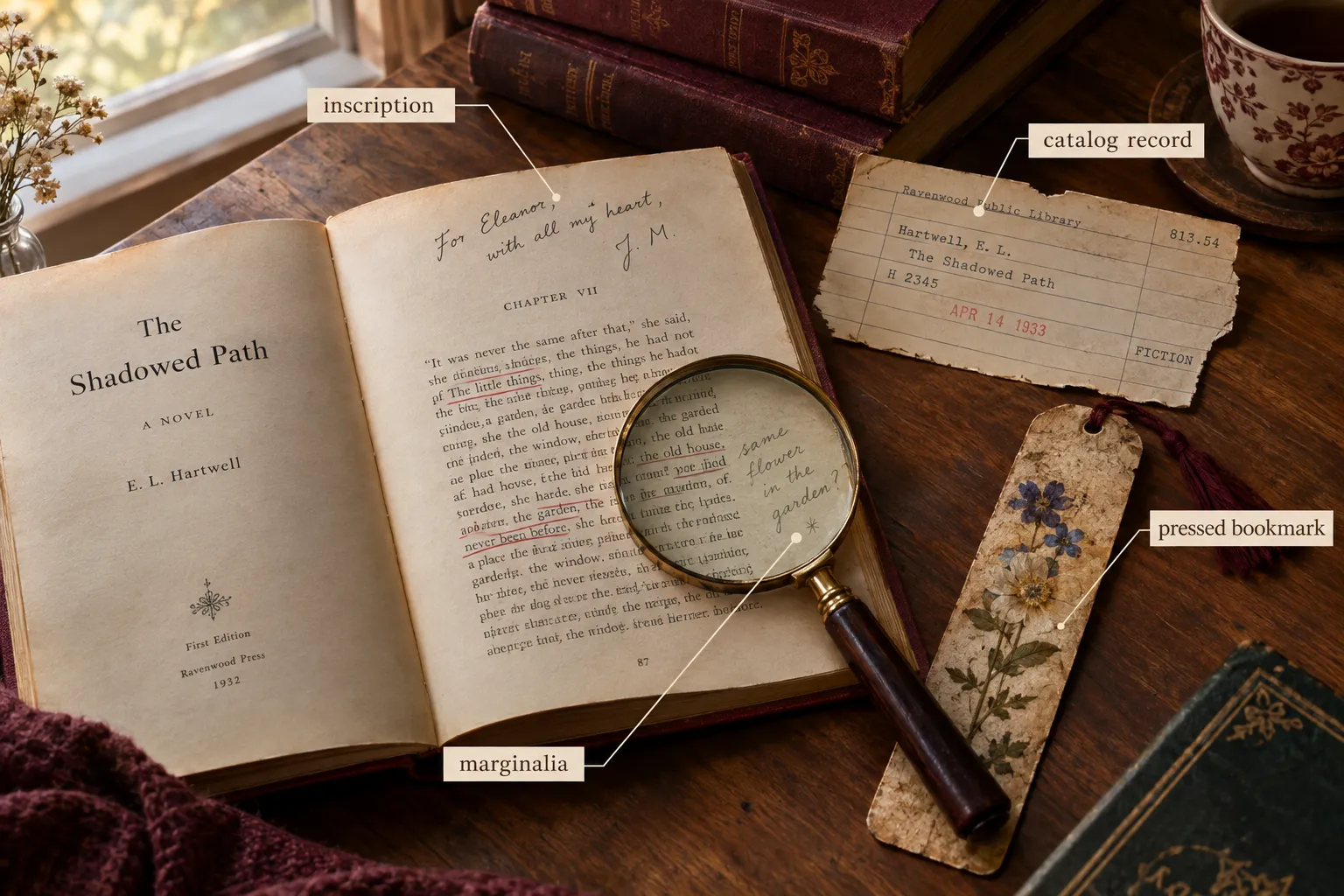
Literary clues create better faith-and-community whodunits because they can be shown to the reader honestly, without hiding behind lab results or unexplained detective intuition. A margin note, a mismatched catalog entry, or a forged inscription is either there on the page or it isn’t, that fairness is what “fair-play” mystery readers actually want.
Common literary clue types and what they reveal:
| Clue type | What it can hide | Why readers can solve it fairly |
|---|---|---|
| Handwritten inscription | A relationship the town forgot | The wording is visible on the page |
| Marginalia | A confession left in the margins | The reader sees exactly what the sleuth sees |
| Library or catalog record | A borrowing pattern nobody questioned | Dates and names are concrete, checkable facts |
| First-edition history | A theft or forged provenance | Ownership records either match or don’t |
| Missing page or bookmark | Something someone wanted forgotten | The gap itself is the evidence |
Authors use these devices the way a locksmith uses a key blank: the object is ordinary, but its shape carries the whole plot. Because the clue is literary rather than technical, faith and character motive can attach to it directly, a stolen inscription is really a stolen apology; a missing page is really a hidden shame someone never confessed. That’s the difference between a puzzle and a story that means something. For a broader look at how small-town institutions shape these puzzles, see how church life, ministries, and local traditions shape the whodunit.
Common mistake: making the literary clue too obscure to solve without expert knowledge. A fair-play clue should require attention, not a rare-book degree.
What Makes a Good Cozy Mystery Protagonist in a Bookshop?
A good bookshop-sleuth protagonist has a defensible reason to investigate, a flaw the mystery will test, and relationships that predate the crime. Readers stay loyal to a sleuth who feels like a neighbor, not a genius detective on vacation.
Traits that hold up across the genre:
- Rooted history in the town, she didn’t just move there; people already have opinions about her.
- A skill that maps to detection, cataloging, appraising, or organizing translates naturally into noticing what’s out of place.
- A personal stake beyond curiosity, a friend accused, a shop’s reputation on the line, a debt owed.
- Doubt she has to work through, not certainty she arrives with. Faith under fire reads more honestly than faith already settled.
Nora Bell Hartley in Mercy House Mysteries fits this pattern: she keeps finding bodies where she meant to find donations, and every case tests something she believes, not just something she suspects. For more on how faith communities produce this kind of amateur detective, see pastors’ wives, church volunteers, and ministry leaders as sleuths.
Christian Cozy Mysteries vs. Secular Cozy Mysteries: What’s the Difference?
The core difference is what the resolution costs and repairs. Secular cozies typically end when guilt is assigned; Christian cozies end when guilt is assigned and the community deals honestly with what it cost to get there.
| Element | Secular cozy mystery | Christian cozy mystery |
|---|---|---|
| Violence/language | Varies, sometimes edgier | Consistently clean |
| Faith presence | Usually absent or incidental | Present as lived conviction, not lecture |
| Resolution | Culprit named | Culprit named, plus confession, restitution, or reconciliation |
| Protagonist motive | Curiosity or profession | Often community obligation or personal conviction |
| Tone | Light, sometimes cynical | Warm, hopeful, honest about hard things |
Can a bookshop sleuth mystery exist without religious themes? Yes, plenty do, and they work fine as pure puzzle-and-charm cozies. General-market bookshop mysteries scheduled for September 2026, including the Driftwood Harbor Bookshop Mysteries and Boone’s Book Nook Bookstore Mysteries, prove the setting carries a story on its own [3]. What faith adds isn’t a requirement, it’s a second question running alongside “who did it”: what does the town owe the person left holding the truth?
Best Christian Cozy Mystery Books and Series With Bookshop Settings
The best current entry points combine a strong sense of place with a sleuth whose job explains her investigation. Readers new to the subgenre should start with a series that has an established backlist so the town and cast have room to deepen.

- Guideposts’ Secrets of Mary’s Bookshop, Mary Fisher’s mystery bookshop in Ivy Bay, Cape Cod, anchors a coastal community whodunit line.
- Love Inspired’s Christie Club Mystery series, building on classic-puzzle conventions, with a new installment reportedly planned for early 2027.
- Mercy House Mysteries, set in Juniper Gap, Tennessee; not bookshop-specific, but built on the same principle of an object (a donation box, a hymnal, a quilt) carrying both clue and conscience. Browse the full Mercy House Mysteries series or start with A Donation to Die For.
Cozy-mystery release trackers for late 2026 continue to list bookshop and library settings as a recurring category across Christian and general-market titles alike, suggesting the setting’s appeal is durable rather than trend-driven [2] [7] [8]. For a wider look at how these community settings extend past church walls, see Kindle Unlimited Christian cozy mysteries beyond church life, libraries, bookshops, and hobby clubs.
How Important Is Community in Christian Cozy Mysteries?
Community is not decoration in a Christian cozy mystery, it’s the actual stakes. The crime threatens a relationship network the reader has come to care about, and the resolution has to account for what the whole town lost, not just who gets arrested.
The American Library Association’s genre framework defines cozy mysteries around amateur sleuths, socially intimate settings, and a light tone, a bookshop qualifies on all three because it functions as both workplace and social crossroads. Mercy and justice have to coexist in that space: the guilty party still faces consequence, but the community also has to decide how to live with the person once the truth is out. That tension, not the clue itself, is usually what makes a Christian cozy memorable. For more on how small towns generate that pressure, see quirky characters, small towns, and spiritual themes explained.
Are Christian Cozy Mysteries Appropriate for All Ages? Who Reads Them and Why?
Christian cozy mysteries are generally appropriate for teen and adult readers because the genre maintains a clean-content contract: no graphic violence, no profanity, no explicit content. Most publishers still market them to adult readers rather than children, since the emotional material, grief, betrayal, guilt, runs deeper than a children’s mystery would carry.
The core audience is women roughly 35-65, often Kindle Unlimited subscribers, who want real stakes without graphic content. Industry reporting on rising Christian-mystery demand points to readers who already love the traditional puzzle format, think Agatha Christie conventions, but want faith represented honestly instead of ignored or lectured [5]. That’s a specific ask: not devotional fiction, and not a scrubbed copy of secular cozies, but something with its own moral center.
Edge case: a mystery involving a death is rarely ideal for young children regardless of how clean the language is; parents should treat these as adult or older-teen reading, similar to how they’d treat any whodunit involving a body.
Common Mistakes to Avoid When Writing a Faith-Based Cozy Mystery
The most common mistake is turning a scene into a sermon instead of letting a choice carry the theme. If a character has to explain what she just learned about grace, the scene has already failed.
Other frequent missteps:
- Making faith a subplot instead of a lens. Faith should shape how characters interpret events, not sit beside the plot as a separate thread.
- Skipping the cost of grace. Redemption that costs something reads as earned; redemption handed out for free reads as cheap.
- Over-explaining the literary clue. If the sleuth walks the reader through the deduction line by line, the puzzle loses its fairness and its fun.
- Ignoring the wider suspect pool a bookshop naturally offers, collectors, estate handlers, visiting authors, and defaulting to the same three neighbors every book.
- Resolving the mystery without resolving the relationship damage. A named culprit without a repaired community leaves the “cozy” half of the genre undone.
For a broader craft discussion on this balance, see balancing spiritual themes with story in Christian mystery, western, fantasy, and LitRPG and faith-rooted character development without sermonizing.
Where to Find Christian Cozy Mystery Book Recommendations and Reviews
Readers can find current Christian cozy mystery recommendations through monthly release trackers, Christian-fiction bestseller roundups, and genre blogs that specialize in cozy mystery coverage. Because the category is still building its shelf space compared to general-market cozies, cross-checking a few sources gives a fuller picture than any single list.
- Genre-specific release trackers covering upcoming cozy titles by month [2] [7] [8]
- General mystery-coming-attractions roundups that flag Christian and faith-adjacent titles alongside secular ones [3]
- Christian fiction bestseller aggregators for a sense of what’s currently selling [5]
- Author series pages and backlists, which let a reader sample tone before committing to a full series
Readers comparing subgenres before choosing where to start might also want Christian cozy mystery vs. private investigator thrillers or a look at why amateur sleuths solve cases better than detectives in Dexter-style true crime.
FAQ
Is a Christian cozy mystery the same as a “clean” cozy mystery? Not quite. A clean cozy simply avoids graphic content. A Christian cozy mystery also embeds faith as a working part of how characters make decisions, not just an absence of objectionable material.
Do bookshop mysteries need a real rare-book plot to work? No. A basic inscription, a mismatched catalog card, or an overdue library slip can carry a whole mystery without requiring appraisal-level book expertise from the reader.
Can a Christian cozy mystery have a real villain, not just a misunderstanding? Yes. Mercy and justice both matter in this genre, the wrongdoer still faces real consequence. The genre avoids graphic violence, not moral seriousness.
Are these books preachy? The strongest ones aren’t. Faith should show up through what a character does under pressure, hospitality offered, a truth told at cost, rather than through direct narration or scripture-dropping.
What’s the typical setting besides a bookshop? Diners, quilting circles, church socials, and small nonprofits show up often, since all four give a sleuth a plausible reason to know the whole town.
Why are bookshop mysteries trending across both Christian and general markets right now? Release calendars for late 2026 show continued bookshop and library settings across multiple mystery lines, Christian and secular alike, suggesting the setting’s appeal isn’t tied to one publisher’s trend cycle [3] [4] [10].
Who is the typical reader of this subgenre? Mostly women aged 35-65, frequently Kindle Unlimited subscribers, who want gentle suspense, clean content, and characters whose faith gets tested rather than assumed.
Does the sleuth have to be a shop owner specifically? No, a librarian, a book club organizer, or an estate-sale appraiser can serve the same structural function, as long as the job explains the access to people and objects.
Conclusion
A Christian cozy mystery with a bookshop sleuth earns its warmth the same way any good story earns grace: through cost, not shortcut. The bookshop gives the plot fair, visible clues, an inscription, a missing page, a catalog slip anyone can check, and the faith runs underneath through hospitality, honest confession, and the hard work of repairing a community after the truth comes out. That’s a better whodunit than one built on forensics alone, because the reader isn’t just solving a puzzle. They’re watching a town decide what mercy costs.
Readers looking for that exact blend can start with Silas Bellhaven’s Mercy House Mysteries, set in Juniper Gap, Tennessee, where Nora Bell Hartley keeps finding bodies where she meant to find donations, and secrets the church socials never sing about.
References
[2] Coming Soon Cozy Mystery New Releases For September 2026 – https://www.bookfrolic.com/coming-soon/coming-soon-cozy-mystery-new-releases-for-september-2026/ [3] Mystery Current Coming Attractions September 2026 – https://kingsriverlife.com/09/05/mystery-current-coming-attractions-september-2026/ [4] New Releases Sept 2026 – https://www.iolagoulton.com/new-releases-sept-2026/ [5] Top Selling Christian Novels – https://www.accio.com/business/top-selling-christian-novels [7] 2026 New Releases – https://cozymysterycat.com/category/2026-new-releases/ [8] Coming Soon – https://www.cozycrimereads.com/coming-soon [10] September 2026 Releases – https://viewsshewrites.com/september-2026-releases/